
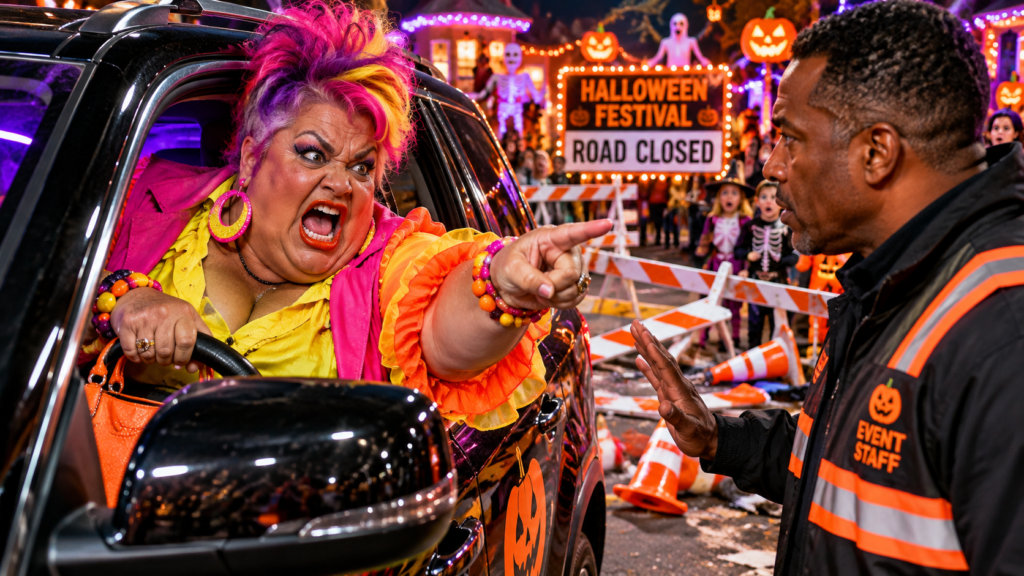
Chapter 7: The Street Belonged to Everyone
When the final families left, Daniel and Elaine remained near the entrance.
The street was quiet again.
Pumpkins still glowed along the sidewalks.
The temporary barriers were waiting to be removed.
Karen approached them.
She had one last box of supplies under her arm.
“Daniel.”
He turned.
“I wanted to tell you something.”
She looked at the empty road.
“Last year, I thought everybody was trying to push me out.”
Daniel waited.
“I thought if I backed down, people would think I had no rights.”
Elaine listened silently.
Karen continued.
“But I was confusing having a right with getting my way.”
The words came slowly.
They sounded uncomfortable.
Which was probably why they mattered.
Daniel nodded.
“You weren’t wrong to care about getting home.”
Karen looked at him.
“I was wrong about how I handled it.”
That was enough.
There was no dramatic apology.
No crowd gathered around them.
No speech.
Just three neighbors standing on a quiet street after a long night.
The following spring, the association approved a permanent event-access policy based partly on the problems exposed by the Halloween incident.
Residents received advance notices.
Closure maps were posted.
Emergency access routes were clearly marked.
And anyone with a concern had a designated way to raise it before an event began.
Karen even volunteered for the committee that reviewed the notices.
She still complained about the font size.
Nobody was surprised.
But she showed up.
That mattered.
For Daniel, the most important change was not the new signs or the new barriers.
It was what happened inside the homes afterward.
Neighbors began talking to one another again instead of arguing through neighborhood posts.
Elaine started hosting Sunday coffee for residents who wanted to stop by.
Families who had once avoided community events returned.
And Karen’s house, once surrounded by tension, became just another home on Oak Ridge Drive.
The following October, children once again walked down the street carrying glowing pumpkins.
The barricades went up.
The signs went up.
The music started.
Karen stood beside Daniel at the entrance.
A resident approached, looking confused about the detour.
Before Daniel could answer, Karen pointed toward the sign.
“Park over there,” she said. “The festival owns the street tonight.”
Daniel raised an eyebrow.
Karen corrected herself.
“Not owns.”
She smiled.
“Shares.”
Then she turned back toward the crowd.
For years, Karen had believed that respect meant having people move aside when she demanded it.
That Halloween taught her something different.
Sometimes respect meant understanding where your rights ended.
Sometimes fairness meant accepting an inconvenience you did not choose.
And sometimes a neighborhood became stronger not because everyone agreed, but because people learned how to disagree without treating one another like enemies.
The street was closed again that night.
But nobody was shut out.
And for the first time, Karen understood the difference.








