
CHAPTER 5: THE PROJECTION OF TRUTH
The wooden gavel struck the laminate table with a dry, hollow snap that echoed through the Oakridge Estates Community Hall.
“Order,” Evelyn Vance declared, her voice amplified through a portable PA system that hummed with a low, sixty-cycle buzz. She stood behind the head folding table, flanked by Vice-President Dan and two stone-faced committee members. A rigid, high-collared black blazer obscured her neck, but the skin around her eyes was tight, grayed by three days of feverish preparation. “This emergency special assembly of the Oakridge Estates Homeowners Association is now in session.”
Fifty metal folding chairs clattered against the linoleum floor as residents settled into their rows. The air inside the windowless hall was thick with the scent of stale drip coffee, floor wax, and unspoken resentment.
Evelyn didn’t waste time on opening formalities. She tapped her microphone twice, a sharp burst of static wincing through the speakers. “We are here tonight to address a critical breach of neighborhood safety, professional decorum, and lot compliance. On Tuesday afternoon, Lot 42 operated an unauthorized, industrial-grade electrical apparatus on a lot approach—a clear hazard to pedestrians, children, and visiting officers of this board.”
A quiet murmur rippled through the middle rows, but Evelyn pressed forward, her right hand slapping a thick stack of printed notices onto the table.
“Under Section 9, Clause C of our covenants,” she continued, her chin tilting upward, “the Board has evaluated a mandatory fine of twenty-five hundred dollars against the homeowner, alongside an immediate order to cease all unapproved motorized exterior equipment. Furthermore, if compliance is not secured within seventy-two hours, the Board will file for injunctive property foreclosure.”
Vice-President Dan shifted uncomfortably in his metal chair, his eyes dropping to the folder in front of him. He opened his mouth toward his goose-neck microphone. “Evelyn, before we take a board vote on the emergency assessment, we need to allow the lot owner his five minutes of public response.”
“The facts are documented in the police report I filed, Dan,” Evelyn hissed, her hand covering her microphone only partially, her voice leaking through the speakers. “The board’s authority is absolute on lot approaches.”
From the aisle near the back wall, Mark Lawson stood up.
He didn’t carry a clipboard. He wore a dark steel-gray work shirt, sleeves rolled neatly to his forearms, a heavy black laptop bag slung over his right shoulder. He walked down the center aisle with a slow, deliberate stride, the rubber soles of his boots silent against the linoleum.
He set a small portable digital projector onto the vacant table in front of the board dais, plugged the power strip into the floor outlet, and pointed the glass lens toward the ten-foot white screen hanging from the rear wall.
“Members of the board,” Mark said. His voice was unamplified, but it carried to every corner of the room with the flat, immovable weight of iron. “Ms. Vance has spent seventy-two hours framing an incident to justify a twenty-five hundred dollar penalty and a foreclosure threat. Before you cast a vote that binds this community to a legal liability, you need to see what actually occurred.”
Evelyn slammed her palm onto the table. “This is an administrative hearing, not a film exhibition! Mr. Lawson, you are out of order!”
“Sit down, Evelyn,” Dan said sharply, leaning into his microphone. “Let him play it.”
Mark tapped a single key on his laptop keyboard. The projector fan hummed to life, throwing a bright, cold rectangle of white light across the hanging screen.
The room went dead silent.
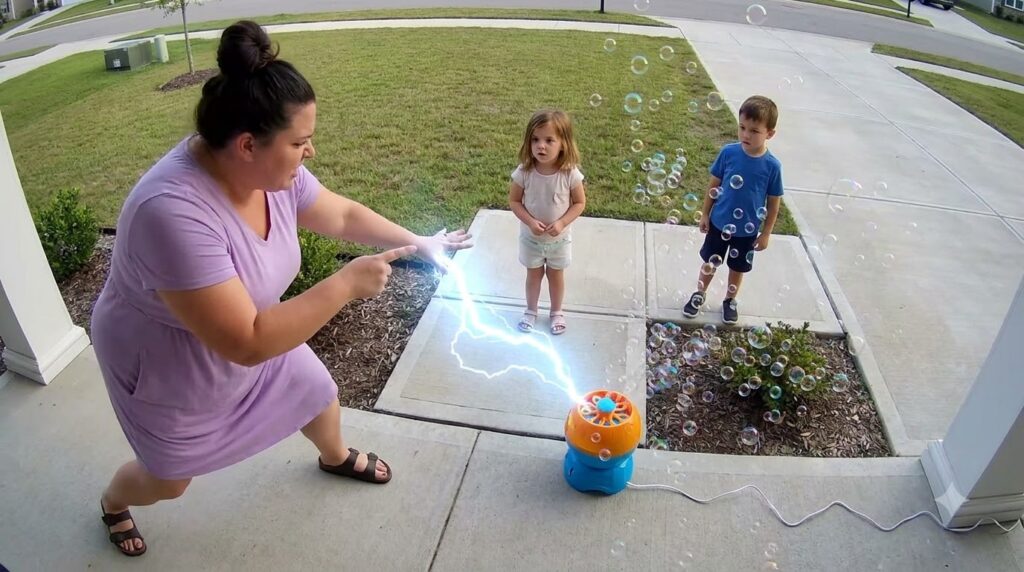
In raw 4K resolution, the doorbell camera footage filled the wall. The perspective was crisp, wide, and indisputable. The fifty assembled homeowners watched seven-year-old Lily and nine-year-old Toby sitting quietly on their walkway, surrounded by floating soap bubbles.
Then came the intrusion.
The room gasped as Evelyn Vance marched into the frame—not inspecting, not knocking on a door, but charging across the lawn like a sergeant storming a trench. Her face was contorted on the ten-foot screen, her mouth wide as her voice boomed through the hall speakers: “Turn that thing off, it’s spraying bubbles everywhere!”
The crowd leaned forward as one. They watched her lunge forward, her heavy hands reaching out to snatch the device from two frozen children. They saw the bright, blue static arc flash from the housing. They saw Evelyn’s eyes roll back in shock as her legs buckled, sending her flying backward onto the grass in a chaotic, sprawling heap, her lavender dress riding up her knees as she hit the turf.
A single snort of laughter broke from the third row.
Within three seconds, the entire hall erupted. Fifty homeowners—people who had spent years receiving fifty-dollar citations for unwashed trash cans, overgrown grass, and unapproved porch lights—erupted into a wall of roaring, uncontrollable laughter.
“Look at her go!” someone yelled from the back.
“She got taken out by a bubble machine!” another voice shouted over the din.
Evelyn stood up so fast her folding chair screeched against the floor, her face burning a violent, mottled purple. “Order! Silence! I demand order!”
Mark didn’t laugh. He kept his eyes fixed on Dan. “As you can see, Ms. Vance entered my property without notice, verbally intimidated my children, and attempted to seize my property before shocking herself on an active electric motor. Furthermore, Deputy Miller has attached this video to the county sheriff’s CAD log.”
Dan shook his head in disbelief, wiping a tear of laughter from his eye before clearing his throat into the microphone. “Evelyn… this is unbelievable. You told this board you were assaulted by an ungrounded trap.”
“He altered the outlet!” Evelyn screamed, her fingers digging into the laminate table until her knuckles turned white. “The clause gives me the right! Section 9, Clause C—”
“Section 9, Clause C is legally void,” Mark interrupted, pulling a single sheet of paper from his leather folder and laying it directly in front of Dan.
Evelyn froze.
“That is a certified copy of a municipal easement deed filed with the county clerk in 1998,” Mark explained, his voice ringing cold and clear across the hushed hall. “The first eight feet of every lot approach on Maple Creek Lane—including the walkway where Ms. Vance stepped—is designated as a public municipal service easement. The HOA board never had the legal jurisdiction to regulate, inspect, or enforce covenants on that ground. Her retroactive clause isn’t just an overreach—it’s a civil violation of county authority.”
The room went dead quiet again, but this time it wasn’t laughter. It was the heavy, suffocating silence of an absolute defeat.
Dan looked at the county deed, then looked up at Evelyn, his expression hardening into cold disgust. He reached for his microphone.
“I motion to immediately dismiss all fines and citations against Lot 42,” Dan said into the PA system.
“Seconded!” three voices from the audience shouted simultaneously.
“All in favor?” Dan called out.
Every hand in the hall shot into the air.
“The motion carries four to zero,” Dan declared. He turned his eyes directly toward Evelyn, who stood paralyzed behind her chair. “And I motion to immediately suspend Evelyn Vance from the presidency pending a formal recall vote at next month’s meeting.”
Before the second could even be called, the entire room erupted into applause.
Evelyn grabbed her clipboard and her folder, her hands shaking violently. She didn’t look at the board. She didn’t look at the neighbors who were standing and cheering. She pushed past the end of the table and fled out the side emergency exit, the heavy steel door slamming shut behind her into the cold night air.
Mark leaned down, unplugged his projector, and packed his laptop into his bag. He had won the room. He had cleared the fines. He had dismantled her authority in front of the entire cul-de-sac.
Yet, as he pulled the blue-inked county deed attachment back into his folder, his eyes caught the tiny stamp at the bottom corner: EXEMPTION-MUNI-04: SUBJECT TO UNRECORDED UTILITY ACCESS REVOCATION.
He stopped. The municipal easement proved Evelyn had no right to enforce HOA rules on his walkway. But the county stamp meant the city possessed an unrecorded right-of-way that bypassed both the HOA and the homeowner—a clause that had sat dormant in county archives for thirty years, waiting for someone with real municipal authority to pull the wire.
Mark closed his bag, his thumb tracing the leather strap. The fight in the community hall was over, but the land beneath his boots held a history that paper alone couldn’t close.








