CHAPTER 2: THE RESTRAINT OF SILENCE
“You’re going to pay for every square inch of this.”
Evelyn Vance’s voice hit the concrete walkway before she fully stood, a strained, rasping threat cut short by a dry cough. Her hands were caked with damp dark soil from the lawn edge where she’d pushed herself up. The lavender fabric of her dress was ruined, a jagged black smudge clinging to her right knee like grease from an ungreased axle.
Mark Lawson didn’t take a step backward. He stood on the edge of the porch shadow, his posture grounded, his right thumb still hooked loosely over the lip of his work-pants pocket. Behind him, the front screen door clicked shut with a soft magnetic thud—Lily and Toby were safely inside, their small faces barely visible behind the tinted glass.
“You’re out of your mind, Evelyn,” Mark said. His voice was level, dropped into a low register that barely carried past the front hedge. “You stepped onto my private property without an invitation and put your hands on my children’s toy.”
“This isn’t private property!” Evelyn snapped, her heavy chest heaving under the discolored collar of her dress. She gestured wildly toward the concrete path with the aluminum clipboard she’d snatched back from the grass. The metal frame was bent at the corner, scraped raw. “This is Oakridge Estates. Every exterior fixture, every temporary installation, every walkway line falls under architectural oversight. Read the covenants!”
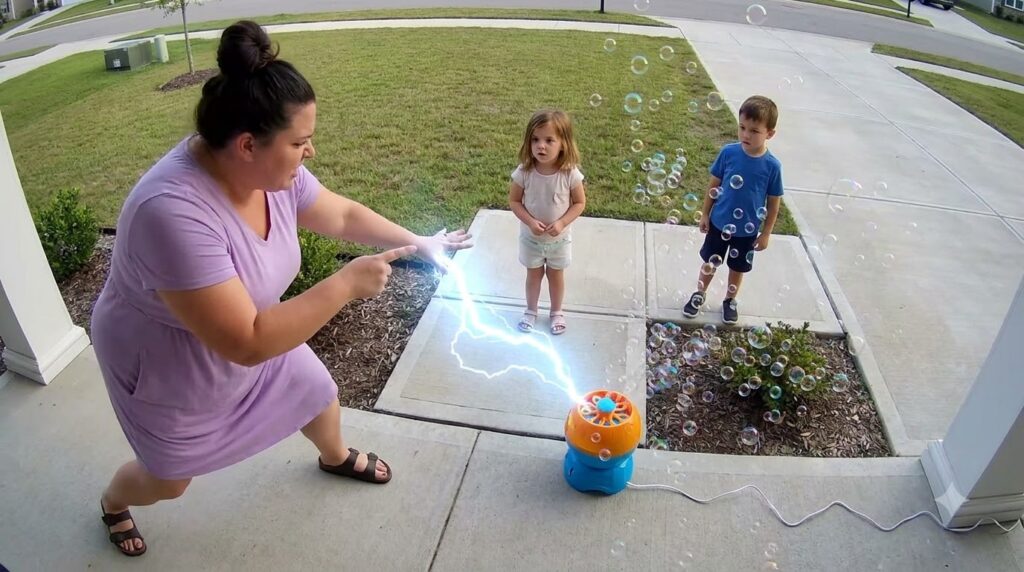
She took two steps toward him, her dark sandals squeaking against the dry concrete, but her eyes kept darting back toward the blue-and-orange cylinder resting on the grass. It continued its soft, rhythmic whir, throwing a thin lattice of soap bubbles into the humid air between them. She kept a full six feet of distance from the machine, her knuckles white around her clipboard.
“I’m issuing an emergency assessment,” she hissed, her eyes narrowing until the skin around her temples bunched into sharp folds. “Illegal industrial equipment on a primary residential lot. Unapproved electrical draw. Hazardous obstruction. That’s five hundred dollars baseline, plus five hundred a day until that hazard is removed from this street.”
Mark didn’t argue. He didn’t raise his voice to match her rising pitch. He knew the math of anger; he’d seen it in motor pools and maintenance bays from Fort Bragg to Al Asad. When an officer or an inspector knew they’d lost the tactical ground, they didn’t retreat—they built a fortress out of paper.
“You’re going to jail for this, Mark,” she continued, her voice dropping into a vicious, shaking whisper. “I’m calling the county sheriff. You rigged a booby trap. You intentionally set an ungrounded device where a board member could be harmed while executing official duties.”
“Call them,” Mark said simply.
Evelyn blinked, her lips pressing into a thin, pale line. “What did you say?”
“Call the deputies,” Mark repeated. He reached into his left pocket and pulled out his phone. The cold glass of the screen reflected the harsh midday light. He didn’t unlock it in front of her. He didn’t point it at her face like a weapon. He simply held it flat in the palm of his hand, steady as an iron block. “Tell them exactly what you just told me. Tell them you walked past the property line, stood over two kids under the age of ten, shouted at them, and tried to snatch their property before you lost your footing.”
Evelyn’s chin jerked upward. “I was abating a nuisance! Section 4, Paragraph B!”
“Section 4 doesn’t give you the right to trespass, Evelyn.” Mark turned his head slightly, his gaze drifting upward toward the dark, circular dome mounted precisely four inches above the porch light fixture. The tiny red LED inside flickered once every three seconds—a steady, silent pulse. “And every word you’ve spoken since your sandals hit my concrete is sitting on a secure cloud server right now.”
Evelyn’s eyes tracked his line of sight. For a fraction of a second, her tirade faltered. Her shoulders stiffened, her gaze locking onto the black glass dome. The color drained from her flushed cheeks, leaving her face a sallow, mottled gray.
“You can’t record people on private lot approaches without written consent,” she muttered, though the conviction had bled out of her voice, replaced by a cold, calculating panic.
“It’s my front door,” Mark said calmly. “It records everything that touches my air.”
Evelyn adjusted her grip on her bent clipboard, using it like a shield across her chest. She backed toward the driveway, her heels digging into the turf before she found the flat asphalt. “We’ll see what the board says about your ‘air’ at the emergency hearing, Mark. We’ll see how brave you are when the legal notices arrive in your mailbox tomorrow morning.”
She turned and marched down the center of the cul-de-sac, her lavender dress trailing a faint scent of scorched cotton and ozone.
Mark stayed on the porch step until her front door slammed shut across the street. Only then did he drop his gaze to the outdoor outlet beside his knee. He reached down, flipping the spring-loaded plastic cover open. Behind the GFI reset button, tucked into the narrow seam where the stainless steel plate met the brick facade, something caught the light—a tiny, brass key, no larger than a padlock key, tucked deliberately into the gap as if someone had tried to wedge it out of sight hours before the children had ever plugged the machine in.
Mark reached out, his calloused fingertips brushing the cold brass, but paused before pulling it free. The game wasn’t over; it was just shifting boards. He unlocked his phone, tapped the security application, and began exporting the raw four-minute video file to three separate drive locations.