
CHAPTER 4: THE MEASURE OF PROOF
The heavy black-and-white SUV came to a stop along the curb, its tires crunching over a thin ridge of dried wash-off gravel. The driver’s side door opened with a dull mechanical latch, and Deputy Miller stepped out into the glare of the ten o’clock sun. His hand rested lightly over his utility belt, his eyes taking in the front walkway, the quiet house, and Mark Lawson sitting unmoving on his porch bench.
Evelyn Vance’s front door opened across the cul-de-sac before Miller’s boots even cleared the asphalt. She didn’t wait on her porch. She marched down her driveway, holding a fresh yellow notepad in one hand and her bent aluminum clipboard in the other. Her lavender dress had been exchanged for a dark navy pantsuit, but her posture remained locked in rigid, forward aggression.
“Deputy,” Evelyn called out, her voice cutting through the quiet hum of an overhead power line. “I’m glad you’re here. As President of the Association, I need to make sure the formal criminal report includes the full hazard assessment.”
Miller didn’t turn around right away. He adjusted his campaign hat, his gaze lingering on the orange-and-blue bubble machine sitting silent beside Mark’s porch step. He took three unhurried strides up the driveway, halting right at the edge of the concrete walkway.
“Morning, Mark,” Miller said, his tone neutral, built on years of mediating suburban boundary spats. “Ms. Vance filed an official complaint regarding an ungrounded apparatus and intentional assault.”
“Deputy,” Mark said, standing up from the bench. He held a black leather folder in his left hand, his thumb resting over the brass clasp. “I appreciate you coming out. Everything you need is right here, including the video.”
Evelyn stepped onto the edge of Mark’s lawn, her dark leather flats sinking half an inch into the damp turf. “Don’t let him distract you with manufactured footage, Deputy. He altered his exterior outlet to conduct a current into the walkway apron! It knocked me onto the ground! Section 9 of our bylaws explicitly prohibits—”
“Ms. Vance,” Miller interrupted, turning his head just enough to catch her in his peripheral vision. “Please remain on the sidewalk while I speak with the homeowner.”
“This is an active Association investigation!” she insisted, her voice rising an octave. “I have full authority under Section 9, Clause C to inspect any lot approach in Oakridge Estates!”
Mark opened the folder. He didn’t offer a dramatic speech. He pulled out the top document—a crisp, white eleven-by-seventeen printout bearing the official blue seal of the North Carolina Board of Examiners for Engineers and Surveyors.
“Deputy,” Mark said softly, his voice cutting under Evelyn’s sharp cadence. “This is the certified land survey for Lot 42, logged with the county recorder three years ago. If you look at the boundary line running from the eastern curb pin to the garage wall, you’ll notice something interesting.”
Miller stepped closer, taking the heavy paper. His thumb traced the thin dotted line marking the property threshold.
“My front walkway sits entirely inside my private property line,” Mark continued. “Ms. Vance was six feet past the boundary when she reached for the device. But more importantly, look at the second page.”
Mark pulled out a laminated card—a state master electrician’s compliance tag, stamped and dated four weeks prior. “The exterior GFI receptacle was installed by a licensed contractor and passed county building inspection. It’s fully grounded to code. The static discharge Ms. Vance experienced was caused by her dragging her synthetic sandals across two hundred feet of dry turf before touching a running electric motor.”
“That’s a lie!” Evelyn shouted, taking two aggressive steps forward onto the concrete walkway. “He’s manipulating technical terms to cover up a booby trap! He saw me coming across the street and turned the voltage up!”
Miller looked up from the survey. “Ms. Vance, you cannot ‘turn up’ the voltage on a standard 110-volt outdoor wall outlet. And if you step onto this private walkway again while I am conducting this interview, I will issue a citation for interference.”
Evelyn’s mouth snapped shut. Her face went red, the veins along her neck standing out against her high collar.
“Now, Mark,” Miller said, handing back the survey. “Let’s see that camera footage.”
Mark unlocked his tablet, tapping the screen once to pull up the high-definition playback. He held the screen flat in his hands so both Miller and Evelyn could see the glass display clearly.
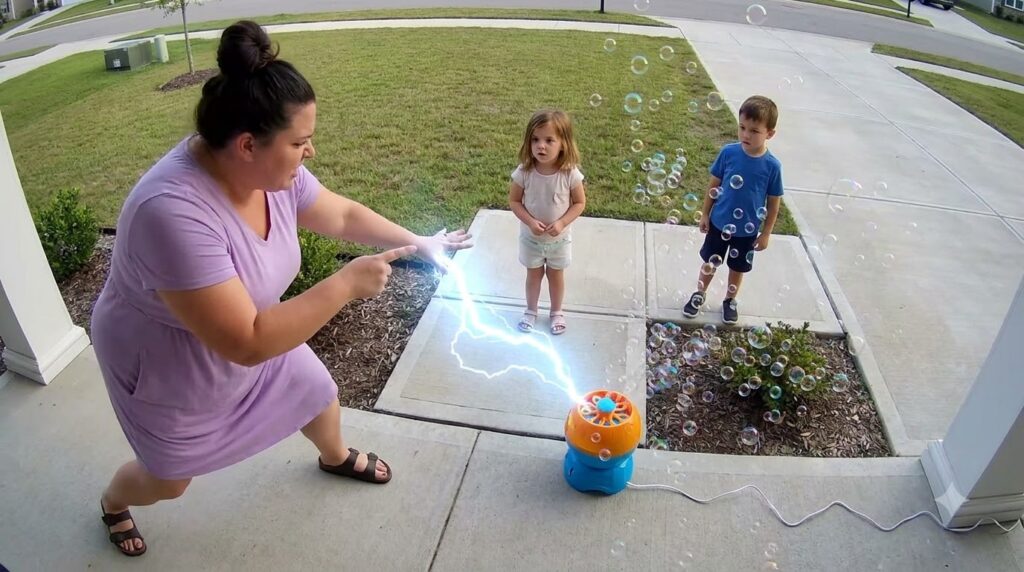
The 4K lens captured every detail in ruthless, unedited clarity. The screen showed the two children playing quietly. Then Evelyn came into frame—not walking calmly as an inspector, but charging across the lawn, her face contorted in anger. The audio played crisp and loud through the tablet’s front speakers: “Turn that thing off, it’s spraying bubbles everywhere!”
The screen captured her lunging forward, her hands reaching out to snatch the device, the sharp crackle of static, and her violent, uncoordinated tumble backward onto the lawn turf. Then came her shaken, furious scream from the grass: “What did that thing do, move it now—unplug it before it hits me again!”
Miller stared at the glass screen for five seconds after the video ended. A long, silent breath escaped his nose.
Across the walkway, Evelyn looked at the screen as if it were a mirror showing a stranger. Her hands trembled around her clipboard.
“Ms. Vance,” Miller said, his voice dropping into an icy, official tone. “What I see here is an unprovoked trespass, verbal intimidation of two young minors, and an attempted destruction of private property. Mr. Lawson did not trap his walkway. You attempted to seize a toy from two children and lost your balance.”
“I… I was enforcing the rule,” Evelyn stammered, her composure splintering. “The board clause gives me the right—”
“Your board clause does not override state trespass law,” Miller said firmly. He pulled his notepad from his chest pocket. “Mr. Lawson, do you wish to file a formal trespass report against Ms. Vance today?”
Mark looked past Miller, his eyes fixing on the lawn edge near the curb where the surveyor’s flags had once stood. He knew that if he filed the report now, Evelyn would retreat into a legal defensive shell, hiding behind HOA insurance indemnification before the public board meeting on Thursday. A simple trespass warning would let her claim she was a martyr for neighborhood standards.
He wanted her entire structure exposed on the record—not in a police log, but in front of the fifty homeowners she had terrorized for six years.
“Not today, Deputy,” Mark said slowly, his voice laced with cold calculation. “I’ll reserve my right to file if she sets foot on my lot again. But I want this video clip attached to the official CAD incident log so it’s a matter of public record.”
Miller nodded once. “Done. Ms. Vance, I suggest you return to your property and leave Mr. Lawson and his family alone.”
Evelyn didn’t speak. She turned on her heel, her dark suit jacket snapping behind her as she hurried back across the street. But as she reached her porch, she paused, pulling her phone from her pocket and dialing a number with rapid, violent stabs of her finger.
Mark watched her door close. He looked down at the tablet screen, then turned his eyes to the edge of his lawn. Beside the concrete walkway, half-buried under two inches of decorative river rock near the sidewalk edge, a glint of weathered metal caught the midday light—a solid brass survey cap driven into the dirt years ago, stamped with six faded letters: MUNI-EASE.
Mark’s brow furrowed slightly as he stared at the stamp. The HOA bylaws claimed authority over all residential front yards, but that brass cap meant something else entirely. The board’s entire legal foundation wasn’t just overreaching—it was built over land they didn’t even have the right to regulate.
He tapped his tablet screen, locking the display as Miller drove away, ready for Thursday night.








