
The Glass Eye on Maple Creek Lane: A Legacy of Boundaries and Silence

CHAPTER 1: THE ACCELERATION OF SOAP

The hum of the electric pump was a low, steady frequency against the midday heat.

Mark Lawson stood three paces inside the open frame of his garage, the air thick with the smell of warm lawnmower oil and dry pine studs. Through the rectangular cutout of the doorway, the front yard stretched out in a square of crisp bermuda grass, bisected by the pale gray ribbon of the concrete walkway. Seven-year-old Lily was crouching near the edge of the porch step, her fingers tracing the moisture pattern of a floating sphere before it popped against the stone. Beside her, Toby sat on his heels, watching the orange-and-blue cylinder rest on the edge of the path.

The machine was simple: a plastic housing, an internal impeller, and a standard white extension cord running back to the weather-sealed GFI receptacle on the exterior wall.

Then the shadow broke the light on the driveway.

It came fast—a heavy, deliberate stride that didn’t pause at the property line. Evelyn Vance did not check the grass for soft soil. Her dark sandals struck the concrete with a flat, rhythmic slap. Her lavender knee-length dress shifted with the momentum of her frame, her dark hair pulled back into a bun so tight it seemed to pin the skin of her forehead flat. In her left hand, a rigid aluminum clipboard caught the glare of the sun.

“Turn that thing off!”

Her voice did not rise from her chest; it cracked across the lawn like a dry branch snapping underfoot. Lily flinched, her small shoulders drawing inward toward her neck. Toby stayed on his heels, his hands locking onto his knees as his eyes widened.

Evelyn was already three feet onto the private walkway, her body looming over the two children. Her face was flushed, the skin around her jaw white with tension. “It’s spraying bubbles everywhere! Look at this drift—it’s hitting the sidewalk!”

She didn’t look up at the front door. She didn’t look toward the open garage where Mark had just set down a socket wrench.

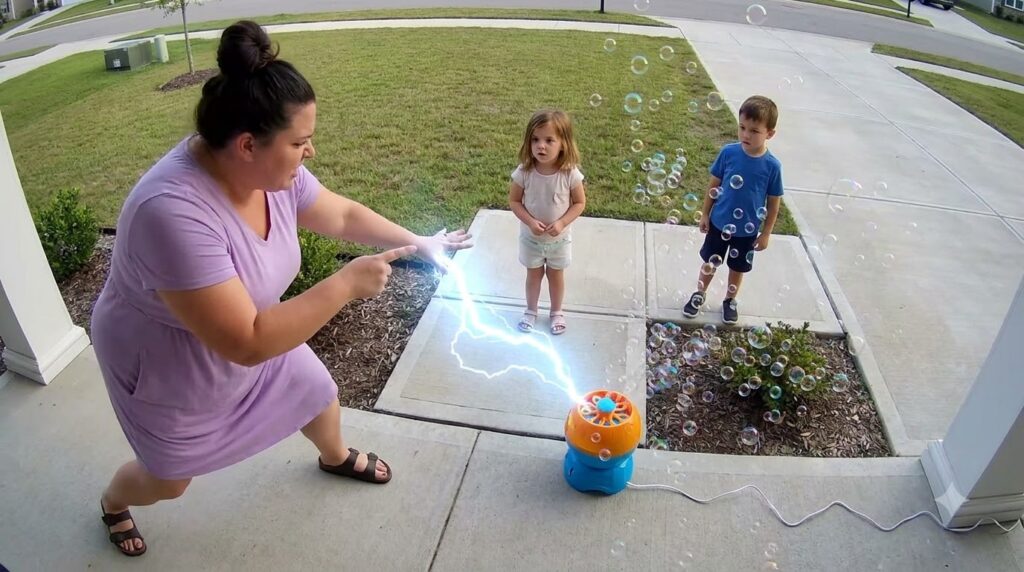
Instead, Evelyn lunged forward. Her heavy frame bent at the waist, her right arm shooting downward toward the blue casing of the machine. Her fingers spread, intent on grabbing the top rim to yank the motor clear of its cord.

She didn’t see the fine mist resting over the synthetic housing, nor the static buildup running along the ungrounded metal bracket of the internal fan.

The moment her palm pressed against the casing, a thin, blue crackle snapped through the air—a sharp, audible arc that sounded like a dry twig breaking under a heavy boot.

Evelyn’s body went rigid. A short, strangled gasp caught in her throat. The sudden involuntary spasm of her muscles threw her balance backward, her dark sandals skittering across the smooth concrete edge. She hit the turf hard, her hip and shoulder absorbing the impact against the damp bermuda grass.

The aluminum clipboard flew from her grip, clattering against the walkway before settling in the lawn.

Silence rushed back into the space, broken only by the continuous, indifferent whir of the blue pump. Bubbles continued to rise into the warm air, drifting slowly over the lavender fabric of her dress, where a dark, scorched smudge clung to the hem near her right knee.

Lily didn’t move. Toby didn’t breathe.

Evelyn pushed herself up onto her elbows, her face white where it wasn’t blotched with red. Her dark bun was slightly crooked, a few stray hairs clinging to her sweat-sheened forehead. She scrambled back two feet on her hands and knees before forcing her legs under her, her breathing ragged and shallow.

She didn’t touch the machine again. Her right arm stayed drawn against her side, her index finger trembling as she thrust it toward the children from five feet away.

“What did that thing do?” her voice rasped, trembling with a sudden, wild volatility. “Move it now—unplug it before it hits me again!”

Above the front door, four feet higher than Evelyn’s head, a small red LED glowed inside a black glass dome, silently recording the angle of her fall.


CHAPTER 2: THE RESTRAINT OF SILENCE

“You’re going to pay for every square inch of this.”

Evelyn Vance’s voice hit the concrete walkway before she fully stood, a strained, rasping threat cut short by a dry cough. Her hands were caked with damp dark soil from the lawn edge where she’d pushed herself up. The lavender fabric of her dress was ruined, a jagged black smudge clinging to her right knee like grease from an ungreased axle.

Mark Lawson didn’t take a step backward. He stood on the edge of the porch shadow, his posture grounded, his right thumb still hooked loosely over the lip of his work-pants pocket. Behind him, the front screen door clicked shut with a soft magnetic thud—Lily and Toby were safely inside, their small faces barely visible behind the tinted glass.

“You’re out of your mind, Evelyn,” Mark said. His voice was level, dropped into a low register that barely carried past the front hedge. “You stepped onto my private property without an invitation and put your hands on my children’s toy.”

“This isn’t private property!” Evelyn snapped, her heavy chest heaving under the discolored collar of her dress. She gestured wildly toward the concrete path with the aluminum clipboard she’d snatched back from the grass. The metal frame was bent at the corner, scraped raw. “This is Oakridge Estates. Every exterior fixture, every temporary installation, every walkway line falls under architectural oversight. Read the covenants!”

She took two steps toward him, her dark sandals squeaking against the dry concrete, but her eyes kept darting back toward the blue-and-orange cylinder resting on the grass. It continued its soft, rhythmic whir, throwing a thin lattice of soap bubbles into the humid air between them. She kept a full six feet of distance from the machine, her knuckles white around her clipboard.

“I’m issuing an emergency assessment,” she hissed, her eyes narrowing until the skin around her temples bunched into sharp folds. “Illegal industrial equipment on a primary residential lot. Unapproved electrical draw. Hazardous obstruction. That’s five hundred dollars baseline, plus five hundred a day until that hazard is removed from this street.”

Mark didn’t argue. He didn’t raise his voice to match her rising pitch. He knew the math of anger; he’d seen it in motor pools and maintenance bays from Fort Bragg to Al Asad. When an officer or an inspector knew they’d lost the tactical ground, they didn’t retreat—they built a fortress out of paper.

“You’re going to jail for this, Mark,” she continued, her voice dropping into a vicious, shaking whisper. “I’m calling the county sheriff. You rigged a booby trap. You intentionally set an ungrounded device where a board member could be harmed while executing official duties.”

“Call them,” Mark said simply.

Evelyn blinked, her lips pressing into a thin, pale line. “What did you say?”

“Call the deputies,” Mark repeated. He reached into his left pocket and pulled out his phone. The cold glass of the screen reflected the harsh midday light. He didn’t unlock it in front of her. He didn’t point it at her face like a weapon. He simply held it flat in the palm of his hand, steady as an iron block. “Tell them exactly what you just told me. Tell them you walked past the property line, stood over two kids under the age of ten, shouted at them, and tried to snatch their property before you lost your footing.”

Evelyn’s chin jerked upward. “I was abating a nuisance! Section 4, Paragraph B!”

“Section 4 doesn’t give you the right to trespass, Evelyn.” Mark turned his head slightly, his gaze drifting upward toward the dark, circular dome mounted precisely four inches above the porch light fixture. The tiny red LED inside flickered once every three seconds—a steady, silent pulse. “And every word you’ve spoken since your sandals hit my concrete is sitting on a secure cloud server right now.”

Evelyn’s eyes tracked his line of sight. For a fraction of a second, her tirade faltered. Her shoulders stiffened, her gaze locking onto the black glass dome. The color drained from her flushed cheeks, leaving her face a sallow, mottled gray.

“You can’t record people on private lot approaches without written consent,” she muttered, though the conviction had bled out of her voice, replaced by a cold, calculating panic.

“It’s my front door,” Mark said calmly. “It records everything that touches my air.”

Evelyn adjusted her grip on her bent clipboard, using it like a shield across her chest. She backed toward the driveway, her heels digging into the turf before she found the flat asphalt. “We’ll see what the board says about your ‘air’ at the emergency hearing, Mark. We’ll see how brave you are when the legal notices arrive in your mailbox tomorrow morning.”

She turned and marched down the center of the cul-de-sac, her lavender dress trailing a faint scent of scorched cotton and ozone.

Mark stayed on the porch step until her front door slammed shut across the street. Only then did he drop his gaze to the outdoor outlet beside his knee. He reached down, flipping the spring-loaded plastic cover open. Behind the GFI reset button, tucked into the narrow seam where the stainless steel plate met the brick facade, something caught the light—a tiny, brass key, no larger than a padlock key, tucked deliberately into the gap as if someone had tried to wedge it out of sight hours before the children had ever plugged the machine in.

Mark reached out, his calloused fingertips brushing the cold brass, but paused before pulling it free. The game wasn’t over; it was just shifting boards. He unlocked his phone, tapped the security application, and began exporting the raw four-minute video file to three separate drive locations.

CHAPTER 3: THE STRATEGY OF PAPER

The metal mailbox door dropped with a sharp, hollow clang that echoed straight down the quiet pavement of Maple Creek Lane.

Mark Lawson didn’t take the mail back into the kitchen. He stood at the edge of his driveway, the morning sun casting a long, angular shadow across the asphalt. In his calloused palm rested a heavy manila envelope, eight by eleven inches, sealed with a metal clasp and stamped in red ink across the front: OFFICIAL NOTICE – IMMEDIATE COMPLIANCE REQUIRED.

The air was still cool, carrying the sharp scent of cut fescue and damp soil, but the day was already heating up. Across the street, the blinds in Evelyn Vance’s front window twitched once, a dark silhouette breaking the horizontal lines before vanishing back into the parlor shadow.

Mark slid his thumb under the flap, tearing the heavy paper. Inside lay a five-page document printed on stiff, twenty-pound bond paper.

He skipped the legal boilerplate on page one, his eyes dropping directly to the bolded itemized breakdown on page two.

Notice of Violation – Lot 42.

  1. Unauthorized operation of industrial-grade electrical apparatus within residential zone: $500.00.
  2. Unsafe modification of exterior GFI circuit resulting in bodily harm to an officer of the Association: $1,000.00.
  3. Refusal to abate an active public nuisance upon direct verbal notice: $1,000.00.

Total Assessment Due Within 72 Hours: $2,500.00.

Mark turned to the third page. Beneath the summary of fines sat a full-page excerpt from the Oakridge Estates Bylaws, Section 9, Clause C. The ink was fresh, laser-printed within the last twelve hours, but the text cited a ruling from six years prior: The Board of Directors retains the absolute right of immediate entry onto any lot approach, walkway, or porch structure for the purpose of safety verification and abatement without prior written notice.

At the bottom of the page sat a digitized signature block: Evelyn Vance, President, alongside a faded co-signature from a former board vice-president who had moved to South Carolina four years ago.

Mark stared at the signature line. The date on the attached board resolution reading “Approved March 14, 2020” had been typed in a slightly different font face than the body paragraph above it. A retroactive clause, stapled into the current enforcement binder to create a paper trail for her trespass.

He flipped to the final page. It was a formal notification of an Emergency Special Hearing scheduled for Thursday evening at the community hall, accompanied by a copy of an incident narrative Evelyn had submitted to the county sheriff’s department at seven o’clock that morning. In her written statement, she claimed Mark had “installed a modified electrical apparatus with exposed wiring designed to shock visitors crossing the property threshold.”

She wasn’t just trying to collect two grand. She was building a criminal case to force a court-ordered injunction against his lot.

Mark folded the document carefully, aligning the edges with precision before sliding it back into the manila pocket. He didn’t feel his heart rate spike. In the motor pool, when a diagnostic code came back red, you didn’t curse the engine; you pulled the schematic and checked the ground wires.

He walked back up his driveway, his boots crunching on the gravel along the edge. Instead of going inside, he turned toward his workbench in the rear of the garage.

He pulled out a heavy accordion folder marked LOT 42 – DEEDS & SURVEYS. From the back pocket, he extracted a certified county land survey completed three years ago when he purchased the property, complete with the gold embossed seal of the state surveying board. Beside it, he laid out the electrical inspection report from last month’s outlet upgrade, signed and stamped by a master electrician licensed in the state of North Carolina.

Mark sat down on his wooden stool, pulled his phone from his pocket, and dialed the non-emergency line for the County Sheriff’s Department.

“Sheriff’s Office, Dispatcher Hayes.”

“Good morning,” Mark said, his voice flat and clear. “My name is Mark Lawson, Lot 42 on Maple Creek Lane. I’m calling to follow up on an incident report filed this morning by a neighbor, Evelyn Vance. I have certified survey documentation, licensed trade inspections, and unedited 4K security footage ready for the responding deputy.”

There was a brief pause on the line, the soft tapping of keys filling the silence. “Mr. Lawson? Deputy Miller is assigned to that call. He’s scheduled for a neighborhood drive-through around ten-thirty.”

“Tell him I’ll be sitting on my porch,” Mark said. “I’ll have a fresh pot of coffee ready, and the monitor set up on the table.”

He hung up, placed the phone beside his property survey, and reached for his tape measure. There was work to do before the patrol car turned onto the street.

CHAPTER 4: THE MEASURE OF PROOF

The heavy black-and-white SUV came to a stop along the curb, its tires crunching over a thin ridge of dried wash-off gravel. The driver’s side door opened with a dull mechanical latch, and Deputy Miller stepped out into the glare of the ten o’clock sun. His hand rested lightly over his utility belt, his eyes taking in the front walkway, the quiet house, and Mark Lawson sitting unmoving on his porch bench.

Evelyn Vance’s front door opened across the cul-de-sac before Miller’s boots even cleared the asphalt. She didn’t wait on her porch. She marched down her driveway, holding a fresh yellow notepad in one hand and her bent aluminum clipboard in the other. Her lavender dress had been exchanged for a dark navy pantsuit, but her posture remained locked in rigid, forward aggression.

“Deputy,” Evelyn called out, her voice cutting through the quiet hum of an overhead power line. “I’m glad you’re here. As President of the Association, I need to make sure the formal criminal report includes the full hazard assessment.”

Miller didn’t turn around right away. He adjusted his campaign hat, his gaze lingering on the orange-and-blue bubble machine sitting silent beside Mark’s porch step. He took three unhurried strides up the driveway, halting right at the edge of the concrete walkway.

“Morning, Mark,” Miller said, his tone neutral, built on years of mediating suburban boundary spats. “Ms. Vance filed an official complaint regarding an ungrounded apparatus and intentional assault.”

“Deputy,” Mark said, standing up from the bench. He held a black leather folder in his left hand, his thumb resting over the brass clasp. “I appreciate you coming out. Everything you need is right here, including the video.”

Evelyn stepped onto the edge of Mark’s lawn, her dark leather flats sinking half an inch into the damp turf. “Don’t let him distract you with manufactured footage, Deputy. He altered his exterior outlet to conduct a current into the walkway apron! It knocked me onto the ground! Section 9 of our bylaws explicitly prohibits—”

“Ms. Vance,” Miller interrupted, turning his head just enough to catch her in his peripheral vision. “Please remain on the sidewalk while I speak with the homeowner.”

“This is an active Association investigation!” she insisted, her voice rising an octave. “I have full authority under Section 9, Clause C to inspect any lot approach in Oakridge Estates!”

Mark opened the folder. He didn’t offer a dramatic speech. He pulled out the top document—a crisp, white eleven-by-seventeen printout bearing the official blue seal of the North Carolina Board of Examiners for Engineers and Surveyors.

“Deputy,” Mark said softly, his voice cutting under Evelyn’s sharp cadence. “This is the certified land survey for Lot 42, logged with the county recorder three years ago. If you look at the boundary line running from the eastern curb pin to the garage wall, you’ll notice something interesting.”

Miller stepped closer, taking the heavy paper. His thumb traced the thin dotted line marking the property threshold.

“My front walkway sits entirely inside my private property line,” Mark continued. “Ms. Vance was six feet past the boundary when she reached for the device. But more importantly, look at the second page.”

Mark pulled out a laminated card—a state master electrician’s compliance tag, stamped and dated four weeks prior. “The exterior GFI receptacle was installed by a licensed contractor and passed county building inspection. It’s fully grounded to code. The static discharge Ms. Vance experienced was caused by her dragging her synthetic sandals across two hundred feet of dry turf before touching a running electric motor.”

“That’s a lie!” Evelyn shouted, taking two aggressive steps forward onto the concrete walkway. “He’s manipulating technical terms to cover up a booby trap! He saw me coming across the street and turned the voltage up!”

Miller looked up from the survey. “Ms. Vance, you cannot ‘turn up’ the voltage on a standard 110-volt outdoor wall outlet. And if you step onto this private walkway again while I am conducting this interview, I will issue a citation for interference.”

Evelyn’s mouth snapped shut. Her face went red, the veins along her neck standing out against her high collar.

“Now, Mark,” Miller said, handing back the survey. “Let’s see that camera footage.”

Mark unlocked his tablet, tapping the screen once to pull up the high-definition playback. He held the screen flat in his hands so both Miller and Evelyn could see the glass display clearly.

The 4K lens captured every detail in ruthless, unedited clarity. The screen showed the two children playing quietly. Then Evelyn came into frame—not walking calmly as an inspector, but charging across the lawn, her face contorted in anger. The audio played crisp and loud through the tablet’s front speakers: “Turn that thing off, it’s spraying bubbles everywhere!”

The screen captured her lunging forward, her hands reaching out to snatch the device, the sharp crackle of static, and her violent, uncoordinated tumble backward onto the lawn turf. Then came her shaken, furious scream from the grass: “What did that thing do, move it now—unplug it before it hits me again!”

Miller stared at the glass screen for five seconds after the video ended. A long, silent breath escaped his nose.

Across the walkway, Evelyn looked at the screen as if it were a mirror showing a stranger. Her hands trembled around her clipboard.

“Ms. Vance,” Miller said, his voice dropping into an icy, official tone. “What I see here is an unprovoked trespass, verbal intimidation of two young minors, and an attempted destruction of private property. Mr. Lawson did not trap his walkway. You attempted to seize a toy from two children and lost your balance.”

“I… I was enforcing the rule,” Evelyn stammered, her composure splintering. “The board clause gives me the right—”

“Your board clause does not override state trespass law,” Miller said firmly. He pulled his notepad from his chest pocket. “Mr. Lawson, do you wish to file a formal trespass report against Ms. Vance today?”

Mark looked past Miller, his eyes fixing on the lawn edge near the curb where the surveyor’s flags had once stood. He knew that if he filed the report now, Evelyn would retreat into a legal defensive shell, hiding behind HOA insurance indemnification before the public board meeting on Thursday. A simple trespass warning would let her claim she was a martyr for neighborhood standards.

He wanted her entire structure exposed on the record—not in a police log, but in front of the fifty homeowners she had terrorized for six years.

“Not today, Deputy,” Mark said slowly, his voice laced with cold calculation. “I’ll reserve my right to file if she sets foot on my lot again. But I want this video clip attached to the official CAD incident log so it’s a matter of public record.”

Miller nodded once. “Done. Ms. Vance, I suggest you return to your property and leave Mr. Lawson and his family alone.”

Evelyn didn’t speak. She turned on her heel, her dark suit jacket snapping behind her as she hurried back across the street. But as she reached her porch, she paused, pulling her phone from her pocket and dialing a number with rapid, violent stabs of her finger.

Mark watched her door close. He looked down at the tablet screen, then turned his eyes to the edge of his lawn. Beside the concrete walkway, half-buried under two inches of decorative river rock near the sidewalk edge, a glint of weathered metal caught the midday light—a solid brass survey cap driven into the dirt years ago, stamped with six faded letters: MUNI-EASE.

Mark’s brow furrowed slightly as he stared at the stamp. The HOA bylaws claimed authority over all residential front yards, but that brass cap meant something else entirely. The board’s entire legal foundation wasn’t just overreaching—it was built over land they didn’t even have the right to regulate.

He tapped his tablet screen, locking the display as Miller drove away, ready for Thursday night.

CHAPTER 5: THE PROJECTION OF TRUTH

The wooden gavel struck the laminate table with a dry, hollow snap that echoed through the Oakridge Estates Community Hall.

“Order,” Evelyn Vance declared, her voice amplified through a portable PA system that hummed with a low, sixty-cycle buzz. She stood behind the head folding table, flanked by Vice-President Dan and two stone-faced committee members. A rigid, high-collared black blazer obscured her neck, but the skin around her eyes was tight, grayed by three days of feverish preparation. “This emergency special assembly of the Oakridge Estates Homeowners Association is now in session.”

Fifty metal folding chairs clattered against the linoleum floor as residents settled into their rows. The air inside the windowless hall was thick with the scent of stale drip coffee, floor wax, and unspoken resentment.

Evelyn didn’t waste time on opening formalities. She tapped her microphone twice, a sharp burst of static wincing through the speakers. “We are here tonight to address a critical breach of neighborhood safety, professional decorum, and lot compliance. On Tuesday afternoon, Lot 42 operated an unauthorized, industrial-grade electrical apparatus on a lot approach—a clear hazard to pedestrians, children, and visiting officers of this board.”

A quiet murmur rippled through the middle rows, but Evelyn pressed forward, her right hand slapping a thick stack of printed notices onto the table.

“Under Section 9, Clause C of our covenants,” she continued, her chin tilting upward, “the Board has evaluated a mandatory fine of twenty-five hundred dollars against the homeowner, alongside an immediate order to cease all unapproved motorized exterior equipment. Furthermore, if compliance is not secured within seventy-two hours, the Board will file for injunctive property foreclosure.”

Vice-President Dan shifted uncomfortably in his metal chair, his eyes dropping to the folder in front of him. He opened his mouth toward his goose-neck microphone. “Evelyn, before we take a board vote on the emergency assessment, we need to allow the lot owner his five minutes of public response.”

“The facts are documented in the police report I filed, Dan,” Evelyn hissed, her hand covering her microphone only partially, her voice leaking through the speakers. “The board’s authority is absolute on lot approaches.”

From the aisle near the back wall, Mark Lawson stood up.

He didn’t carry a clipboard. He wore a dark steel-gray work shirt, sleeves rolled neatly to his forearms, a heavy black laptop bag slung over his right shoulder. He walked down the center aisle with a slow, deliberate stride, the rubber soles of his boots silent against the linoleum.

He set a small portable digital projector onto the vacant table in front of the board dais, plugged the power strip into the floor outlet, and pointed the glass lens toward the ten-foot white screen hanging from the rear wall.

“Members of the board,” Mark said. His voice was unamplified, but it carried to every corner of the room with the flat, immovable weight of iron. “Ms. Vance has spent seventy-two hours framing an incident to justify a twenty-five hundred dollar penalty and a foreclosure threat. Before you cast a vote that binds this community to a legal liability, you need to see what actually occurred.”

Evelyn slammed her palm onto the table. “This is an administrative hearing, not a film exhibition! Mr. Lawson, you are out of order!”

“Sit down, Evelyn,” Dan said sharply, leaning into his microphone. “Let him play it.”

Mark tapped a single key on his laptop keyboard. The projector fan hummed to life, throwing a bright, cold rectangle of white light across the hanging screen.

The room went dead silent.

In raw 4K resolution, the doorbell camera footage filled the wall. The perspective was crisp, wide, and indisputable. The fifty assembled homeowners watched seven-year-old Lily and nine-year-old Toby sitting quietly on their walkway, surrounded by floating soap bubbles.

Then came the intrusion.

The room gasped as Evelyn Vance marched into the frame—not inspecting, not knocking on a door, but charging across the lawn like a sergeant storming a trench. Her face was contorted on the ten-foot screen, her mouth wide as her voice boomed through the hall speakers: “Turn that thing off, it’s spraying bubbles everywhere!”

The crowd leaned forward as one. They watched her lunge forward, her heavy hands reaching out to snatch the device from two frozen children. They saw the bright, blue static arc flash from the housing. They saw Evelyn’s eyes roll back in shock as her legs buckled, sending her flying backward onto the grass in a chaotic, sprawling heap, her lavender dress riding up her knees as she hit the turf.

A single snort of laughter broke from the third row.

Within three seconds, the entire hall erupted. Fifty homeowners—people who had spent years receiving fifty-dollar citations for unwashed trash cans, overgrown grass, and unapproved porch lights—erupted into a wall of roaring, uncontrollable laughter.

“Look at her go!” someone yelled from the back.

“She got taken out by a bubble machine!” another voice shouted over the din.

Evelyn stood up so fast her folding chair screeched against the floor, her face burning a violent, mottled purple. “Order! Silence! I demand order!”

Mark didn’t laugh. He kept his eyes fixed on Dan. “As you can see, Ms. Vance entered my property without notice, verbally intimidated my children, and attempted to seize my property before shocking herself on an active electric motor. Furthermore, Deputy Miller has attached this video to the county sheriff’s CAD log.”

Dan shook his head in disbelief, wiping a tear of laughter from his eye before clearing his throat into the microphone. “Evelyn… this is unbelievable. You told this board you were assaulted by an ungrounded trap.”

“He altered the outlet!” Evelyn screamed, her fingers digging into the laminate table until her knuckles turned white. “The clause gives me the right! Section 9, Clause C—”

“Section 9, Clause C is legally void,” Mark interrupted, pulling a single sheet of paper from his leather folder and laying it directly in front of Dan.

Evelyn froze.

“That is a certified copy of a municipal easement deed filed with the county clerk in 1998,” Mark explained, his voice ringing cold and clear across the hushed hall. “The first eight feet of every lot approach on Maple Creek Lane—including the walkway where Ms. Vance stepped—is designated as a public municipal service easement. The HOA board never had the legal jurisdiction to regulate, inspect, or enforce covenants on that ground. Her retroactive clause isn’t just an overreach—it’s a civil violation of county authority.”

The room went dead quiet again, but this time it wasn’t laughter. It was the heavy, suffocating silence of an absolute defeat.

Dan looked at the county deed, then looked up at Evelyn, his expression hardening into cold disgust. He reached for his microphone.

“I motion to immediately dismiss all fines and citations against Lot 42,” Dan said into the PA system.

“Seconded!” three voices from the audience shouted simultaneously.

“All in favor?” Dan called out.

Every hand in the hall shot into the air.

“The motion carries four to zero,” Dan declared. He turned his eyes directly toward Evelyn, who stood paralyzed behind her chair. “And I motion to immediately suspend Evelyn Vance from the presidency pending a formal recall vote at next month’s meeting.”

Before the second could even be called, the entire room erupted into applause.

Evelyn grabbed her clipboard and her folder, her hands shaking violently. She didn’t look at the board. She didn’t look at the neighbors who were standing and cheering. She pushed past the end of the table and fled out the side emergency exit, the heavy steel door slamming shut behind her into the cold night air.

Mark leaned down, unplugged his projector, and packed his laptop into his bag. He had won the room. He had cleared the fines. He had dismantled her authority in front of the entire cul-de-sac.

Yet, as he pulled the blue-inked county deed attachment back into his folder, his eyes caught the tiny stamp at the bottom corner: EXEMPTION-MUNI-04: SUBJECT TO UNRECORDED UTILITY ACCESS REVOCATION.

He stopped. The municipal easement proved Evelyn had no right to enforce HOA rules on his walkway. But the county stamp meant the city possessed an unrecorded right-of-way that bypassed both the HOA and the homeowner—a clause that had sat dormant in county archives for thirty years, waiting for someone with real municipal authority to pull the wire.

Mark closed his bag, his thumb tracing the leather strap. The fight in the community hall was over, but the land beneath his boots held a history that paper alone couldn’t close.

CHAPTER 6: THE SILENCE OF THE BORDER

The warm Saturday air smelled of freshly cut bermuda grass and drying concrete.

Mark Lawson sat on the top step of his front porch, a cold glass mug resting in the palm of his hand. Across the lawn, the soft, rhythmic whir of the orange-and-blue bubble machine hummed like a faithful engine. A steady column of translucent spheres rose into the afternoon light, drifting lazily over the concrete walkway before dissolving into the green turf.

Lily stood near the edge of the path, her small hand reaching up to pop a low-floating bubble, her laughter ringing out across the cul-de-sac. Beside her, Toby sat crisscross on the grass, carefully adjusting the plastic fan cover with a toy screwdriver, completely unbothered by the motor’s low hum.

The street was quiet. Across the asphalt, the front windows of Lot 18 were dark. The heavy navy curtains behind Evelyn Vance’s parlor glass had remained drawn since Friday morning, when Dan and two county officers had delivered the certified notice of emergency board suspension and the formal county trespass warning to her front door. The white clipboard that had governed Maple Creek Lane for six years was gone from her porch rail. In its place sat a single unopened stack of local newspapers gathering dust on her doorstep.

Mark’s gaze shifted down toward his boots. Near the edge of the lawn, right where the concrete walkway met the public sidewalk, a small circle of river rock had been neatly cleared away. Exposed to the sun sat the brass survey cap he’d uncovered earlier that week—the solid metal marker stamped MUNI-EASE.

He had studied the deed attachment again late last night. The unrecorded municipal easement wasn’t a trap; it was an old legal boundary line drawn thirty years ago when the county laid the water mains beneath Maple Creek. It meant that the land beneath the walkway had never belonged to the HOA’s private jurisdiction. Evelyn’s entire apparatus of fines, notices, and inspections had been an illusion—a castle built on land she never had the authority to touch.

A soft crunch of tires on asphalt broke the quiet of the street.

Mark looked up. A silver sedan pulled into the driveway across the road—Dan, wearing a plain polo shirt instead of a suit, carrying a folder of interim board documents. He stepped out of his car, caught Mark’s eye across the pavement, and offered a short, respectful nod before walking up Evelyn’s porch steps to drop off the formal recall election ballot materials.

Mark raised his mug in a silent acknowledgment, but didn’t speak. He didn’t need to. The quiet held its own weight now.

Beside his elbow, mounted four inches above the porch light, the black glass dome of the doorbell camera caught the bright afternoon sun. The tiny red LED flickered once every three seconds—a steady, unyielding guardian that had recorded the precise moment an overbearing myth had collapsed under the weight of its own arrogance.

Lily ran up the concrete steps, her shoes squeaking softly on the stone, her hands covered in soapy residue.

“Dad,” she said, looking up with bright, clear eyes. “Can we leave the machine on until dinner?”

Mark looked at his daughter, then at the bright blue sky above the quiet suburban rooftops, and finally at the steady stream of soap bubbles floating freely across the lawn edge.

“Leave it running, kiddo,” Mark said softly, his voice grounded with absolute certainty. “It’s our air.”

Similar Posts

Leave a Reply

Your email address will not be published. Required fields are marked *






