Chapter 2: The Promise Behind the Blue Ribbon
Walter Bennett had not entered Bailey in the Brookfield Community Dog Show because he wanted recognition.
He entered because his late wife, Helen, had asked him to.
Helen had loved dogs almost as much as she loved the quiet routines of their marriage.
For forty-eight years, the Bennetts had lived in the same two-story house on Maple Street. They had raised three children, planted roses beside the front porch, and taken evening walks through a neighborhood where most people still waved when a car passed.
Bailey had joined their family seven years earlier.
He was a clumsy golden retriever puppy with oversized paws and a habit of carrying shoes into the backyard.
Helen had laughed every time he stole Walter’s slippers.
When she became ill, Bailey changed.
He stopped running wildly through the house. He learned to walk slowly beside her. On difficult afternoons, he rested his head against her knee while she sat in the living room.
Walter often believed the dog understood things that people struggled to say.
During Helen’s final spring, she had watched a recording of the Brookfield dog show on television.
She remembered attending the event years earlier, when their children were young.
Walter had jokingly suggested entering Bailey.
Helen smiled.
“Promise me you’ll do it someday.”
Walter agreed without giving the request much thought.
Three months later, Helen was gone.
After the funeral, the house became painfully quiet.
Walter stopped attending church breakfasts. He let the garden grow wild. Some mornings, he remained in bed long after sunrise because he could not think of a reason to get up.
Bailey gave him one.
Every morning at seven, the dog stood beside the bed with his leash.
At first, Walter walked him only to the corner.
Then around the block.
Eventually, they returned to the park where Walter and Helen had spent so many afternoons.
His granddaughter Sophie noticed the change.
At sixteen, Sophie had inherited her grandmother’s determination and her grandfather’s gentle nature.
She suggested training Bailey for the community dog show.
Walter laughed.
“I’m too old to start competing.”
Sophie disagreed.
Over the following months, she visited every Wednesday and Saturday.
Together, they practiced simple commands in the backyard.
Sit.
Stay.
Come.
Walk beside me.
Bailey was not always cooperative.
Sometimes he chased squirrels. Sometimes he forgot everything when another dog appeared.
Walter occasionally became frustrated.
Sophie never let him quit.
She reminded him that the goal was not perfection.
The goal was showing up.
By the morning of the competition, Walter had polished his old brown shoes, pressed his favorite plaid shirt, and placed Helen’s photograph inside his jacket pocket.
Sophie had tied a small blue ribbon around Bailey’s leash.
They arrived early.
Emily Carter greeted them at the registration table.
She had worked with Bailey several times and knew how much the event meant to Walter.
When she watched Bailey complete his final obedience exercise, she felt a quiet sense of pride.
The golden retriever remained beside Walter even when another dog barked nearby.
He followed every command.
And when Walter finished, Bailey looked up at him with the same trusting expression Helen had loved.
The judges awarded Bailey the highest score in the adult companion-dog division.
Walter did not know he had won until Daniel began announcing the results.
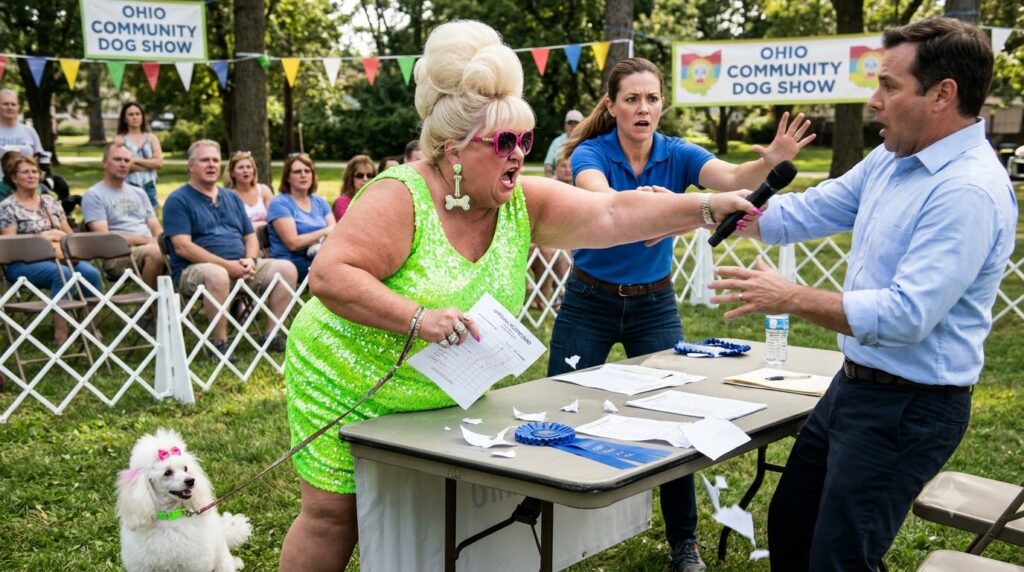
That was when Patricia interrupted.
Now, standing beside the ring while torn scorecard pieces lay scattered on the grass, Walter felt the joy draining out of the afternoon.
Sophie gripped his arm.
“Grandpa, you earned that.”
Walter nodded, but he did not answer.
He had spent most of his life avoiding confrontation.
He did not know how to respond to someone willing to humiliate strangers over a ribbon.
Across the ring, Patricia continued arguing with Margaret.
Then she said something that made Walter look up.
She claimed the competition had been fixed before it began.
And she insisted she could prove it.