Chapter 10: The Ribbon That Finally Meant Something
The following spring, Brookfield held a small community celebration at the recreation center.
It was not the annual dog show.
That event would return in the summer.
Instead, the town organized a gathering to thank volunteers and recognize residents who had contributed to community activities.
Margaret invited Walter, Sophie, Emily, Daniel, Thomas, and several longtime volunteers.
Bailey was invited too.
Walter arrived wearing the same brown shoes he had worn on the day of the competition.
His granddaughter walked beside him.
Bailey trotted happily at the end of his leash.
The golden retriever had grown a little grayer around his muzzle.
He still carried himself with quiet confidence.
Inside the recreation center, a display table featured photographs from previous community events.
One photograph showed Walter and Bailey standing beside the blue first-place ribbon.
Sophie had taken the picture after the committee confirmed the official results.
Walter had initially been reluctant to display the award.
But Sophie persuaded him to place it beside Helen’s photograph on the living room mantel.
Every morning, he saw both.
The ribbon reminded him of the promise he had kept.
Helen’s photograph reminded him why the promise mattered.
During the celebration, Margaret announced that the dog show committee had created a new recognition.
It would not be awarded for obedience, appearance, or technical performance.
It would honor the relationship between a person and an animal, particularly when that bond helped someone through a difficult period.
The committee called it the Helen Bennett Companion Award.
Walter was stunned.
Margaret explained that the award had been proposed by volunteers who had learned about Helen’s role in Bailey’s training journey.
The Bennett family had approved the use of her name.
Future recipients would be selected through a separate nomination process, with clear criteria and independent review.
Walter looked toward Sophie.
She smiled through tears.
He accepted the inaugural commemorative plaque with trembling hands.
For a moment, he could not speak.
Then he thanked the committee.
He said Helen would have been embarrassed by the attention.
She would also have been delighted.
The room filled with warm laughter.
Near the back stood Patricia.
She had come at Margaret’s invitation as a resident, not as a competitor or organizer.
She wore a simple burgundy sweater and black trousers.
Princess sat quietly beside her.
Patricia watched Walter accept the award.
Six months earlier, she would have interpreted the recognition as another insult to herself.
Now she understood that someone else’s happiness did not diminish her own worth.
After the ceremony, Patricia approached Walter.
She congratulated him.
Then she asked whether Bailey was still enjoying his walks.
Walter smiled.
Every morning, he said.
Rain or shine.
Patricia glanced down at Princess.
She explained that they had been attending training classes.
The little poodle sat patiently at her feet.
Walter noticed.
He complimented Princess’s progress.
Patricia looked genuinely pleased.
For a few minutes, they talked about dogs.
Nothing more.
No arguments about scores.
No accusations.
No discussion of who deserved recognition.
Just two older neighbors sharing stories about animals they loved.
Before leaving, Patricia paused beside the photograph display.
She looked at the picture of Walter holding Bailey’s ribbon.
Then she noticed another photograph.
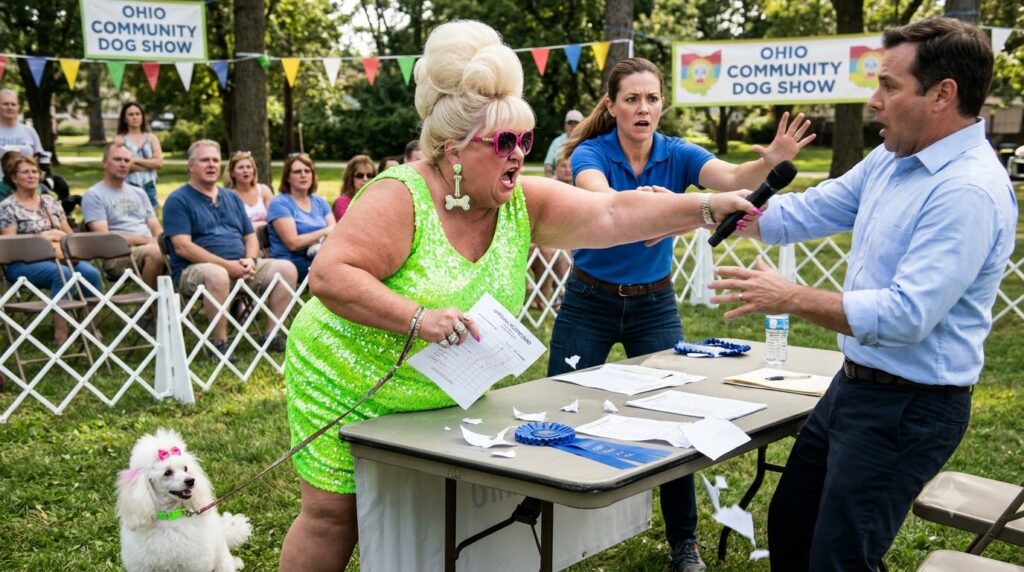
It showed the audience at the previous year’s dog show, taken before the confrontation.
Families were smiling.
Children sat on the grass.
Dogs rested beside folding chairs.
In the background, Patricia stood beside Princess, looking toward the judges’ table.
She remembered how angry she had already been.
How convinced she was that anything less than first place would be an insult.
She studied the photograph for several seconds.
Then she walked away.
Outside, the afternoon sun had broken through the clouds.
Sophie was helping Walter into his car.
Bailey waited patiently beside the open door.
Patricia crossed the parking lot with Princess.
As she passed Walter, he raised his hand in farewell.
She waved back.
It was a small exchange.
But it was real.
That summer, the Brookfield Community Dog Show returned with stronger procedures, clearer rules, and a renewed commitment to fairness.
Walter attended with Bailey, though he chose not to compete again.
Instead, he and Sophie volunteered to welcome first-time participants.
Emily continued helping families train their dogs.
Daniel returned as event host.
Margaret remained director, grateful that the tradition had survived its most difficult year.
Patricia honored her suspension.
She did not enter Princess.
She attended as a spectator for part of the afternoon, kept her distance from the judging area, and applauded when a nervous young boy completed his first successful obedience routine with a rescue dog.
No one pretended the previous year had never happened.
The damaged scorecard, the confrontation, and the attempted score changes remained part of the event’s history.
But they no longer defined it.
Near the end of the afternoon, Walter sat beneath a shade tree while Bailey rested at his feet.
Sophie joined him with two paper cups of lemonade.
Across the field, families were gathering around the competition ring.
The blue first-place ribbon fluttered in the breeze.
Walter watched a little girl kneel beside her dog and whisper encouragement before their turn.
He smiled.
He thought of Helen.
He thought of all the mornings when getting out of bed had seemed impossible.
He thought of Sophie refusing to let him give up.
And he thought of how close he had come to surrendering his victory simply because someone else demanded it.
The ribbon had never been the most important thing.
What mattered was that he had earned it fairly, kept his promise, and found the courage to accept something good without apologizing for it.
Bailey lifted his head and rested his chin on Walter’s knee.
Walter scratched behind his ears.
For nearly fifty years, Helen had reminded him that kindness and strength belonged together.
He finally understood something else she had tried to teach him.
Being gracious did not mean allowing someone to take what was rightfully yours.
And standing up for yourself did not require becoming cruel.
Across the ring, another dog finished its routine.
The crowd applauded.
Walter joined them.
This time, the applause belonged to everyone.
Because the true measure of a community was never who claimed the biggest prize. It was whether ordinary people could trust that their effort, dignity, and joy would be respected—even when someone else refused to lose.