Chapter 8: The Lake Belonged to Everyone
By early spring, the county had completed a broader review of the Lake Briar shoreline proposal.
The original marina expansion concept was withdrawn.
Gordon Whitcomb and several other boat owners worked with county staff to develop a smaller alternative that would improve existing private docking facilities without relocating the public fishing pier.
The revised concept still required the usual reviews and approvals.
But it no longer depended on removing public access.
That change mattered.
It showed that the community did not have to choose between supporting local boating and preserving a place where ordinary residents could fish, walk, and enjoy the water.
Rebecca Collins also recommended several improvements to the public pier.
The county approved repairs to damaged planks, clearer signage, and an accessible approach from the parking area.
A small maintenance project improved drainage near the entrance, where standing water had made the boards slippery.
The work was modest.
No ribbon-cutting ceremony was planned.
No politician needed to stand in front of a camera.
The pier simply became safer and easier to use.
Rosa returned to her morning walks.
Harold resumed fishing twice a week.
Families came with children carrying buckets, nets, and inexpensive fishing rods.
Some arrived in pickup trucks.
Others walked from nearby neighborhoods.
A few came by boat.
Nobody was asked to prove that they belonged.
Patricia was rarely seen at the public pier after the association meeting.
Her husband continued participating in marina discussions, though he became noticeably more careful about distinguishing private association interests from public authority.
Patricia eventually sent Walter a short written apology through her attorney.
It acknowledged that she had interfered with his belongings and had no right to remove his chair from the pier.
The apology was not warm.
It did not contain a dramatic confession.
But it was specific.
Walter appreciated that.
He did not become Patricia’s friend.
He did not pretend the incident had never happened.
He simply accepted the apology for what it was and moved forward.
One Saturday in May, Walter arrived at the pier shortly after sunrise.
The lake was almost perfectly still.
Thin clouds stretched across the pale sky, and the wooden planks smelled of damp cedar.
He carried his tackle box in one hand and his new folding chair in the other.
Lily walked beside him.
She had grown a little taller since her last visit and insisted on carrying her own fishing rod.
Daniel was already waiting near the railing.
He had brought coffee for Walter and hot chocolate for Lily.
Rosa sat on the bench near the entrance, watching a pair of ducks move through the reeds.
Harold waved from the far end of the pier.
Walter unfolded his chair.
The embroidered panel faced the lake.
Lily noticed it immediately.
“Grandma’s letters.”
Walter nodded.
He settled into the chair and watched Lily prepare her line.
She had learned to tie a basic fishing knot, though she still liked him to check it.
Walter leaned forward and examined her work.
“Looks good,” he said.
Lily grinned.
She cast her line.
The bobber landed a few yards from the pier with a soft splash.
For a while, they sat without speaking.
Walter thought about everything that had happened since that morning in November.
The shouting.
The rope.
The chair tumbling into the water.
The threatening letter.
The meetings.
The records.
The neighbors who had finally found the courage to speak.
He had never wanted to become the center of a public dispute.
He had only wanted to fish.
But he understood now that ordinary places survived because ordinary people cared enough to defend them.
Not with threats.
Not with intimidation.
With patience, evidence, and the willingness to stand beside one another.
Lily’s bobber dipped.
She leaned forward.
“Grandpa!”
Walter smiled.
“Easy. Wait until you feel the pull.”
The bobber disappeared.
Lily lifted the rod.
A small bluegill flashed beneath the surface.
She laughed with delight as Walter helped guide it toward the pier.
Daniel stepped closer with a landing net.
Together, they brought the fish up safely.
It was not large.
Barely bigger than Lily’s hand.
But she looked at it as though she had caught the finest fish in Wisconsin.
Walter showed her how to remove the hook carefully.
Then they lowered the fish back into the water.
It disappeared beneath the pier.
Lily watched the ripples spread.
“Do you think Grandma would have liked fishing with me?”
Walter felt the familiar ache of missing Ellen.
He looked at the blue initials stitched into his chair.
“She would have loved it.”
Lily sat beside him.
For several minutes, neither spoke.
Then a vehicle pulled into the parking area.
Walter glanced toward the entrance.
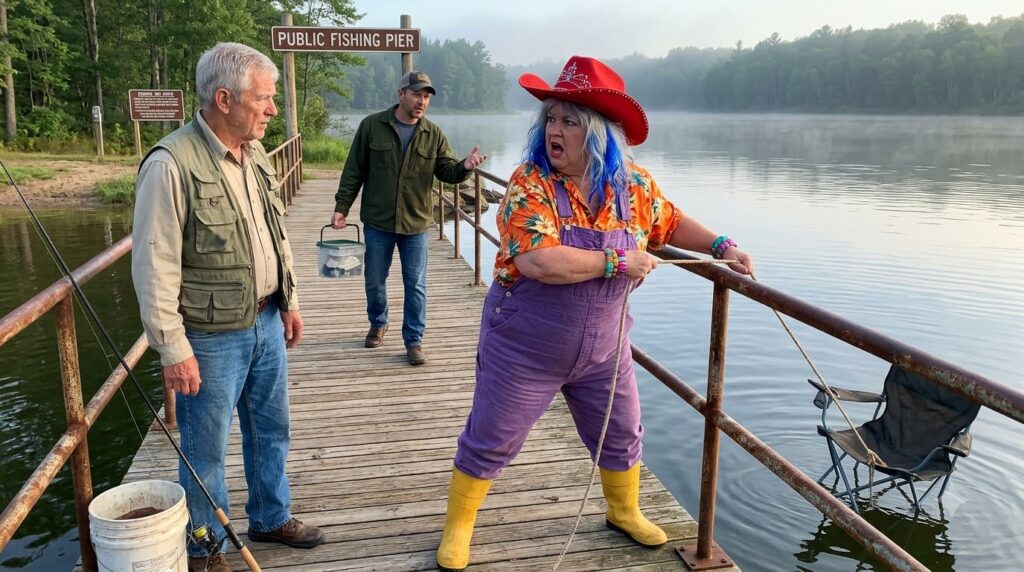
Patricia Whitcomb stepped out of her white SUV.
She was wearing a plain blue jacket and dark pants.
No rhinestone hat.
No bright orange shirt.
She carried a small bag and walked toward the marina office.
As she passed the pier entrance, she noticed Walter.
Their eyes met.
For one brief moment, Walter wondered whether she would stop.
Patricia looked toward the public access sign.
Then toward the families fishing along the railing.
She gave Walter a small, awkward nod.
He returned it.
She continued toward the marina without saying anything.
Lily had been watching.
“Was that the lady who threw your chair in the lake?”
Walter nodded.
“That’s her.”
“Are you still mad?”
He considered the question.
There had been a time when he could not think about Patricia without feeling his stomach tighten.
But that feeling had changed.
He had his chair.
He had his granddaughter.
He had his friends.
And the pier was still public.
“I’m not happy about what she did,” he said. “But I don’t need to carry it around forever.”
Lily thought about that.
Then she picked up her fishing rod.
Walter watched her cast again.
The line arced across the morning sunlight and settled onto the water.
Behind them, the county sign stood beside the entrance.
PUBLIC FISHING PIER.
It was not an impressive sign.
The letters were simple.
The wood was weathered.
But Walter understood its meaning more deeply than he had before.
A public place was more than land or lumber.
It was a promise that belonging did not depend on wealth, connections, or the approval of someone who believed herself more important than her neighbors.
It was a place where a retired mechanic could sit beside a business owner, where a widow could watch the sunrise, and where a child could catch her first fish without anyone questioning her right to be there.
Walter leaned back in his chair.
The lake shimmered.
Daniel poured another cup of coffee.
Rosa waved from the bench.
And Lily, suddenly excited, pointed toward her bobber.
“Grandpa, I think I’ve got another one!”
Walter laughed and reached for the net.
For the first time in months, there was nothing else he needed to do.
The morning belonged to the people who had come to enjoy it.
And that was exactly how it should be.