Chapter 6: The Meeting That Changed Everything
The county scheduled a public information meeting to discuss the preliminary marina expansion proposal.
It was not a final approval hearing.
Rebecca made that clear in the announcement.
But residents would have an opportunity to review the concept, ask questions, and submit comments for the official record.
By the evening of the meeting, the community center parking lot was full.
Walter arrived with Daniel.
Rosa sat near the front beside Harold.
Frank Dobson stood near a display board showing the proposed shoreline changes.
Several marina members attended as well.
Walter recognized Gordon Whitcomb immediately.
He was a tall man in his late sixties, neatly dressed in a navy blazer. He had the polished manner of someone accustomed to business meetings.
Patricia stood beside him.
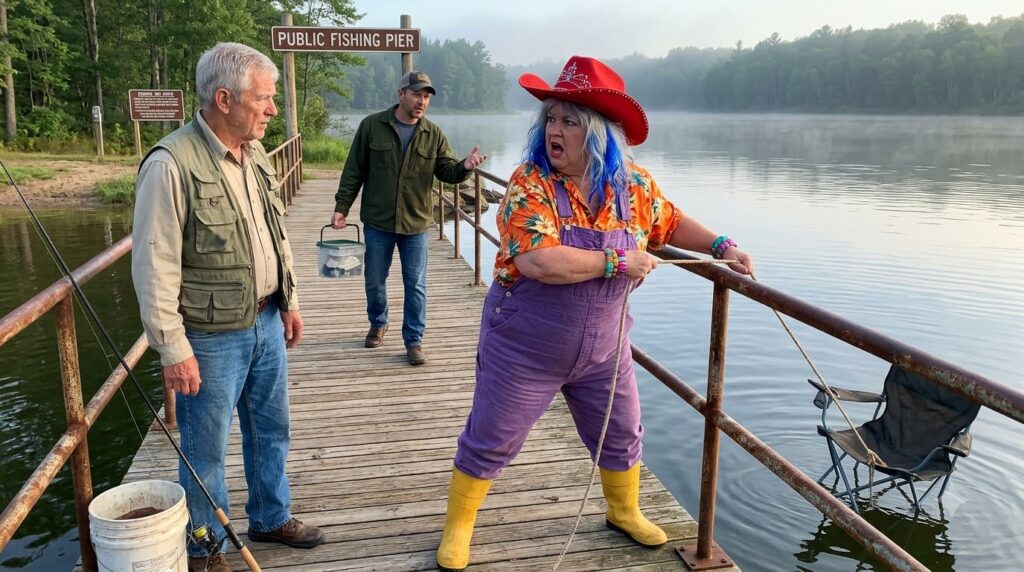
Her outfit was nearly as colorful as the one she had worn at the pier.
This time, however, she wore a purple jacket over a bright patterned blouse. Her red rhinestone cowboy hat remained impossible to miss.
Walter noticed that she avoided looking directly at him.
Rebecca opened the meeting by explaining the county’s existing public access rules.
She then presented the marina proposal.
The concept drawing showed additional boat slips, improved private docking facilities, and a proposed relocation of the fishing area.
Gordon spoke first.
He described the expansion as an investment in the community.
More boat traffic, he argued, could support local businesses and increase tourism.
Some residents nodded.
Walter did not dismiss those benefits.
He knew that lakefront businesses provided jobs.
He also knew that communities sometimes needed improvements.
But the proposal carried a cost that was not obvious in the attractive drawings.
The new fishing location was farther from parking, less accessible, and exposed to stronger winds.
For elderly residents and people with limited mobility, those differences were substantial.
When public comments began, Rosa stood.
Her voice was quiet but steady.
She explained that she had walked to the pier almost every morning since her husband died.
The lake had become part of her daily routine.
It was where she remembered him without feeling trapped inside an empty house.
She did not own a boat.
She did not own shoreline property.
But she paid taxes, followed the rules, and believed that public places belonged to everyone.
The room grew still.
Harold spoke next.
He described how the current pier allowed him to fish safely despite arthritis in both knees.
The proposed location would be difficult for him to reach.
Then Frank discussed parking and pedestrian access.
A younger mother described bringing her children to watch the water.
Their comments were practical, personal, and remarkably consistent.
They were not opposed to every possible marina improvement.
They opposed losing meaningful public access.
Finally, Walter stood.
He had brought Ellen’s photograph.
He placed it on the table near the microphone.
“My wife gave me a fishing chair seventeen years ago,” he began.
He described the morning confrontation without embellishment.
He did not imitate Patricia’s voice.
He did not insult her appearance.
He explained what had happened, what had been damaged, and why the chair mattered.
Then he addressed the larger issue.
“I don’t think owning a boat should decide whether somebody belongs beside a lake their family has enjoyed for generations.”
Several people nodded.
Walter continued.
“If this proposal is good for the community, it ought to stand on its merits. Nobody should have to scare people away to make it happen.”
Patricia shifted in her seat.
Gordon looked down at his papers.
Rebecca thanked Walter and reminded everyone that the incident report would be handled separately from the planning review.
Then Daniel submitted the written accounts, photographs of the unauthorized notices, and documentation of the public access concerns.
He also referenced Susan’s recording, which had been provided to the relevant officials.
Rebecca displayed the association’s supplemental letter.
It described broad community support for restricted pier access.
Several residents immediately objected.
Rebecca asked for order.
Gordon stood.
He said the letter reflected discussions among association members, not a formal survey of every resident.
Rebecca asked whether the association had held a recorded vote approving the statement.
Gordon hesitated.
He had not brought minutes showing such a vote.
Patricia rose abruptly.
“I was appointed to handle access issues!”
A man seated near the back stood.
He introduced himself as Thomas Reed, the association’s treasurer.
He had served on its board for nine years.
“No,” Thomas said.
Patricia turned toward him.
He continued calmly.
“The board discussed marina improvements. We did not authorize you to restrict the public pier.”
A murmur spread through the room.
Thomas held up a folder.
He had brought copies of the association’s meeting minutes.
They showed that members had discussed gathering information about potential improvements.
They did not show approval of unauthorized public access notices.
They did not authorize Patricia to enforce restrictions.
And they did not establish a formal association position supporting the removal of public fishing access.
Gordon stared at Thomas.
Patricia looked furious.
But the most important change was happening elsewhere in the room.
Residents who had been uncertain about the dispute were beginning to understand the difference between a legitimate development proposal and one person’s attempt to control public property.
Rebecca announced that the county would require a clarified submission identifying the actual applicant, documented authority, and accurate public access impacts before any proposal could move forward.
The meeting ended without a decision on expansion.
Outside, Walter stood beneath the community center lights.
Daniel joined him.
For the first time since the chair incident, Walter felt that the conversation had moved beyond Patricia’s anger.
People were finally discussing the lake itself.
And who it was meant to serve.