Chapter 2: A Letter Nobody Was Supposed to See
Daniel recovered the chair using a boat hook kept in a storage box near the pier entrance.
The frame came up dripping, with weeds caught around the legs and lake water pouring from the canvas.
Walter examined the damage without speaking.
One hinge was twisted. The fabric had torn along a seam. Ellen’s embroidered initials remained visible, though the stitching was soaked and muddy.
Daniel offered to carry it to Walter’s truck.
Walter shook his head.
“Set it down a minute.”
He wanted to look at it.
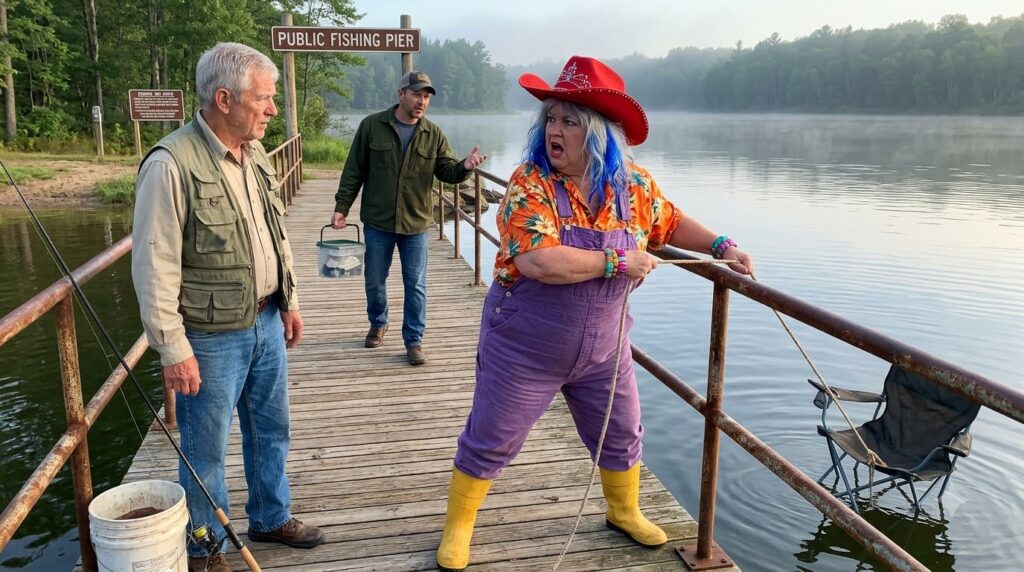
Patricia stood several feet away, arms folded across her orange shirt.
She had stopped shouting, but her silence was not an apology.
Instead, she was studying the marina parking lot, where a few early boat owners were arriving.
Daniel noticed.
“Are you actually with the property owners association?”
Patricia straightened.
“My husband and I are members. We pay substantial fees to maintain this lake community.”
“That wasn’t the question.”
She ignored him.
Walter had little interest in another argument. He gathered his fishing rod and tackle box, then carefully folded what remained of the chair.
That was when Daniel noticed something attached to the pier entrance.
A laminated notice had been fastened beneath the public access sign.
It had not been there the previous weekend.
The notice announced that public fishing access would soon be restricted to designated hours and that certain pier areas would be reserved for registered marina users.
At the bottom appeared the words:
Lakeview Property Owners Association — Access Management Committee.
Daniel read it twice.
Then he photographed it.
“Walter, have you seen this?”
Walter approached slowly.
He adjusted his glasses and read the notice.
His expression hardened.
“This is county property.”
“I know.”
“The county built this pier.”
“I know that too.”
Walter looked toward Patricia.
She had already started walking toward her SUV.
“Mrs. Whitcomb,” Daniel called.
She kept walking.
“Who authorized this notice?”
Patricia stopped but did not turn around.
“The proper people.”
Then she continued toward the parking lot.
Daniel watched her go.
He had worked as a building inspector for seventeen years before taking a maintenance supervisor position with a local manufacturing company. He understood permits, property boundaries, and the peculiar confidence of people who believed that a printed notice automatically became law.
He also understood something else.
People rarely began by throwing chairs into lakes.
Usually, they began by deciding that someone else did not belong.
By eight o’clock, Walter and Daniel were sitting at a small diner outside town.
Walter’s damaged chair lay in the bed of his pickup.
The waitress, Marlene, brought coffee without asking.
She had known Walter and Ellen for decades.
When Daniel explained what had happened, Marlene’s expression changed.
“You’re not the first.”
Walter looked up.
“What do you mean?”
Marlene leaned against the counter.
“Mrs. Alvarez came in yesterday. Said somebody told her she couldn’t walk down to the pier anymore unless she owned property along the lake.”
Walter knew Rosa Alvarez.
She was seventy-four, a retired school secretary who walked to the pier most mornings to watch the sunrise.
Her husband had died three years earlier.
She did not fish.
She simply liked sitting near the water.
Marlene continued.
“And last week, somebody left a warning on Harold Peterson’s windshield. Said he was parking in a members-only area.”
Harold was eighty-one.
He had been fishing Lake Briar since before most of the houses along its shoreline existed.
Daniel set down his coffee.
“Did anyone keep the warning?”
Marlene nodded.
“Harold brought it in here. He was pretty upset.”
She disappeared into the back office and returned with a folded piece of paper.
The notice carried the same association heading as the sign at the pier.
It warned that unauthorized vehicles could be removed at the owner’s expense.
Daniel studied the wording.
There was no county seal.
No ordinance number.
No government contact information.
Only an association name and an instruction to comply.
Walter stared at the paper.
He thought about Rosa walking alone in the morning, about Harold living on a fixed income, and about the families who brought their grandchildren to the pier every summer.
The chair suddenly seemed like a small part of something larger.
“Somebody needs to tell the county,” Walter said.
Daniel nodded.
But Marlene was still looking at the paper.
“There is something else,” she said.
She lowered her voice.
“Patricia was in here Tuesday with a man from the marina. They were talking about making the public access area private.”
Walter looked at her.
“What man?”
Marlene hesitated.
“Gordon Whitcomb. Her husband.”
Daniel knew the name.
Gordon was a retired real estate developer who had recently purchased a large lakefront house.
And according to local gossip, he had been trying to organize a private dock expansion.
Walter looked through the diner window toward the brightening sky.
For the first time that morning, he felt something more troubling than anger.
He felt that his familiar lake was becoming a place where people like him might eventually need permission to stand.