
Chapter 8: What a Neighbor Owes—and What a Neighbor Doesn’t
The settlement was signed in early December.
Karen agreed to reimburse Daniel for the documented garment-care expenses and the reasonable replacement value of clothing that could not be restored.
She also agreed to withdraw her public allegations that Daniel had threatened or assaulted her.
Her attorney sent the required written retraction.
The agreement included a commitment that Karen would not enter Daniel’s home, garage, yard, or other private areas without permission, except where otherwise legally authorized.
It also established that neither party would use the neighborhood association to circulate unauthorized warnings about the other.
The civil dispute was resolved without a trial.
The police matter followed a separate process.
After reviewing the available information, authorities informed Daniel that the report would remain on record but that no criminal charges would be pursued at that time.
Daniel was disappointed, though not surprised.
He had learned that the legal system did not always deliver the dramatic consequences people imagined.
Evidence could be clear about what happened while legal outcomes remained more limited.
But the absence of criminal charges did not erase the settlement, the retraction, or the boundaries now in place.
Daniel had protected his home through documentation, persistence, and restraint.
Karen’s behavior changed gradually.
At first, she avoided Daniel entirely.
She stopped posting about him online.
She no longer approached his driveway.
When she passed his house, she looked straight ahead.
Several neighbors noticed that she had become less demanding.
Helen Brooks reported that Karen had asked permission before borrowing a garden tool.
Frank Delaney said Karen had returned a folding chair on the same day she borrowed it.
These were small changes.
Daniel didn’t know whether they would last.
He didn’t consider them proof that Karen had become a different person.
But they were better than the alternative.
Rachel visited her mother shortly before Christmas.
Daniel saw her car in the driveway one afternoon.
He didn’t approach.
Whatever happened between them was private.
He had no desire to become involved in Karen’s family relationships.
Instead, he focused on his own.
On the Saturday before Christmas, Margaret and Emily came to his house.
The family had postponed sorting Robert’s belongings while the dispute was unfolding.
Now they were ready.
They spread photographs across the dining room table.
They opened old envelopes.
They laughed at pictures of Robert wearing enormous eyeglasses in the 1980s.
Emily found a photograph of their father standing beside his first car, a faded blue Chevrolet he had repaired himself.
Margaret remembered how proud he had been of that vehicle.
Daniel found an old pocket notebook containing measurements, hardware-store lists, and reminders written in Robert’s careful handwriting.
Between two pages was a note:
Fix what you can. Take care of what you keep.
Daniel smiled.
It sounded exactly like his father.
Later that afternoon, he brought out the restored shirts.
Two had survived the cleaning process remarkably well.
The third still showed discoloration across the chest.
The cleaner had done everything reasonably possible.
Margaret examined it.
Then she suggested something Daniel hadn’t considered.
Instead of hiding the damaged shirt in a closet, they could preserve part of it in a memory quilt.
Emily loved the idea.
She had made quilts before and knew a local seamstress who specialized in keepsake projects.
Over the next several weeks, they selected fabric from Robert’s shirts and combined it with pieces from an old flannel work shirt, a favorite plaid jacket, and several other garments.
The quilt would not restore what had been lost.
But it would transform the remaining fabric into something the family could use and remember.
Daniel chose to keep one white shirt intact.
The one with the repaired cuff.
He hung it in his closet beside his own dress clothes.
Every time he saw it, he remembered his father standing at the ironing board, listening to baseball.
By January, life on Willow Creek Drive had largely returned to normal.
Snow covered the lawns.
Children waited for school buses.
Neighbors shoveled sidewalks and exchanged greetings across driveways.
Daniel’s garage remained closed when he wasn’t using it.
The laundry room door stayed locked.
He had installed a new camera covering the garage entrance, not because he wanted to watch his neighbors, but because he wanted a reliable record if another problem arose.
One Saturday morning, Helen knocked on his front door.
Her dryer had stopped heating.
She asked whether he knew a reliable repair company.
Daniel gave her the name of the technician who had serviced his appliances the previous year.
Helen thanked him.
Then she hesitated.
She explained that she had several towels she needed to wash and dry before her grandchildren arrived.
Daniel looked toward the laundry room.
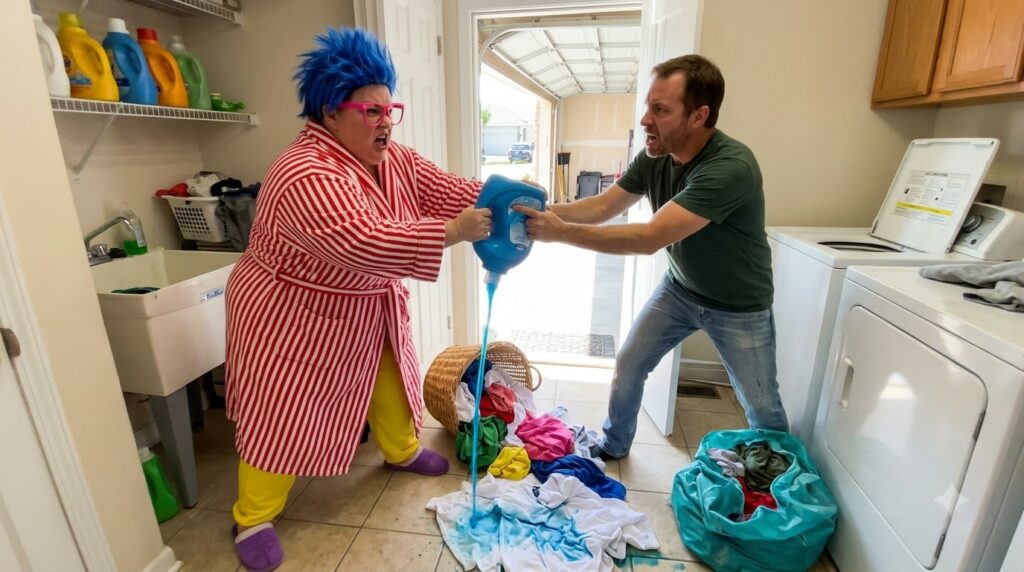
For a brief moment, he remembered the overturned basket and blue detergent spreading across the floor.
Then he looked back at Helen.
She had knocked.
She had asked.
She had respected his right to decide.
Daniel offered to let her use the dryer while they waited for the repair appointment.
Helen accepted gratefully.
She brought her towels over that afternoon.
They drank coffee while the machine ran.
Nothing was damaged.
Nobody shouted.
Nobody demanded anything.
It was an ordinary act of neighborly kindness.
And that was precisely why it mattered.








