
Chapter 2: The Complaint That Arrived Before the Police Report
By seven the following morning, Daniel’s neighborhood was discussing him.
Not Karen.
Daniel.
A message had appeared in the Willow Creek Community Facebook group shortly after midnight.
Karen claimed that she had approached a neighbor for help during a household emergency and had been met with threatening behavior.
She described Daniel as unstable, aggressive, and hostile toward women.
She claimed he had seized her personal belongings and physically intimidated her.
She never mentioned entering his home without permission.
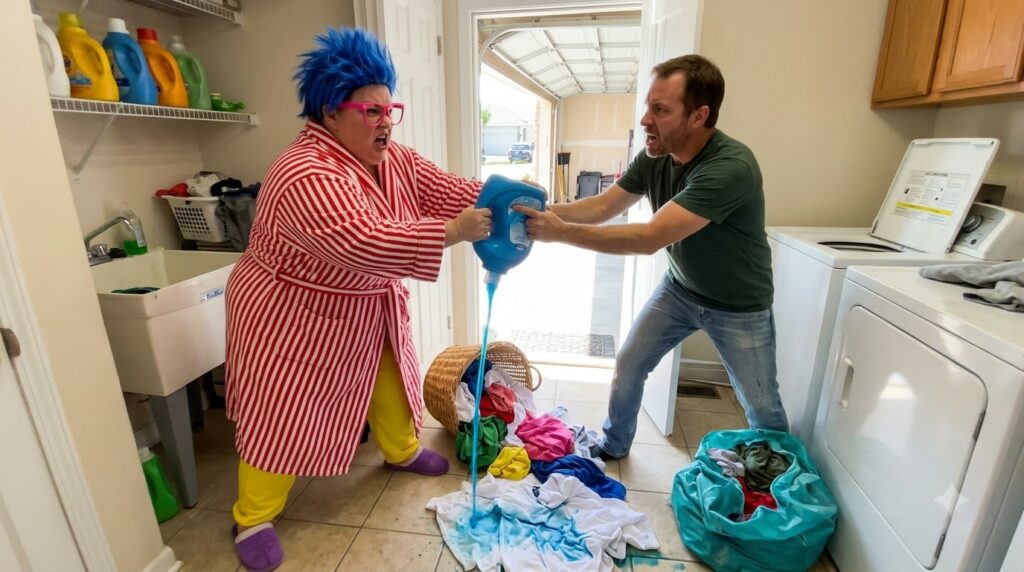
She never mentioned the overturned laundry basket.
And she certainly never mentioned pouring detergent over his clothes.
Daniel discovered the post while drinking coffee at his kitchen table.
There were already thirty-seven comments.
Some neighbors questioned Karen’s account.
Others expressed sympathy.
One suggested that Daniel should apologize.
Another wondered whether the neighborhood association needed to investigate.
Daniel read the comments twice.
His first instinct was to respond angrily.
Instead, he put down his phone.
His father had taught him something years earlier, when Daniel was a teenager and a disagreement with a baseball coach had nearly turned into a shouting match.
When someone wants a fight, don’t give them the one they’re asking for.
Daniel opened his laptop and began organizing the evidence.
He had taken several photographs after Karen left. They showed the spilled detergent, damaged clothing, displaced laundry basket, and blue footprints leading into the garage.
His phone also contained a short recording of the final part of the confrontation.
More importantly, the security camera mounted above his garage had captured Karen approaching the house.
Daniel opened the recording.
At 2:14 p.m., Karen appeared at the edge of his driveway carrying the turquoise bag.
She looked toward his front door.
Then toward the open garage.
Without ringing the doorbell, she walked directly inside.
The camera couldn’t see the laundry room, but its microphone picked up the basket crashing and the raised voices that followed.
Daniel saved the original recording and made a backup.
At nine, he called the Columbus Division of Police nonemergency number to report the unauthorized entry and property damage.
An officer later contacted him, took his account, and explained the next steps for documenting the incident.
Daniel provided the footage and photographs.
He also photographed the damaged shirts individually, including the labels and stitched initials.
The officer made no promises about charges.
The facts would need to be reviewed.
Daniel understood.
He wasn’t looking for a dramatic arrest.
He wanted a record of what had happened and assurance that Karen couldn’t simply enter his home whenever she pleased.
That afternoon, his sister Emily called.
She was forty-four, a middle school principal who had inherited their father’s calm voice and their mother’s stubbornness.
Daniel explained everything.
When he mentioned the white shirts, Emily fell silent.
Their father had been a machinist for thirty-six years. He had worked long shifts, repaired nearly everything in the family home, and never believed that expensive possessions made a person important.
But he took care of what he owned.
Every Sunday evening, he ironed his shirts for the coming week.
Daniel could still picture him standing beside the ironing board, sleeves rolled up, listening to baseball on the radio.
Emily asked whether the shirts could be saved.
Daniel didn’t know.
He had rinsed them carefully, following the fabric-care labels, but several had developed stubborn discoloration.
One shirt had a faint yellowing around the collar that became more noticeable after the detergent soaked through it.
Daniel had hung them in the spare bedroom to dry.
Emily offered to come over.
He declined, saying he had things under control.
But after the call, he sat on the edge of the guest bed and looked at the shirts hanging from the curtain rod.
The room seemed strangely crowded with memories.
That evening, another message appeared in the neighborhood group.
Karen claimed Daniel had invented the entire laundry incident to embarrass her.
She demanded that the community association take action against him.
Daniel took a screenshot.
Then he received an email from the association’s volunteer president, Susan Bell.
Susan was a retired insurance adjuster in her early sixties. She had served on the neighborhood board for six years and had a reputation for being careful with facts.
Her message was brief.
Karen had submitted a formal complaint.
She was alleging harassment, intimidation, and interference with her personal property.
Susan wanted to hear Daniel’s account before the board discussed the matter.
Daniel replied with a factual summary and offered to provide evidence.
He expected that to settle things.
But the next morning, Susan called with an unexpected development.
Karen wasn’t merely asking for an apology.
She was demanding that Daniel pay for an emergency laundry service, compensate her for emotional distress, and receive a formal neighborhood warning.
She had also claimed that Daniel’s open garage constituted an invitation for neighbors to use his household facilities.
Daniel listened without interrupting.
Then Susan added something that changed his understanding of the situation.
Karen had told the board that several neighbors had previously allowed her to use their property.
And she had named three households.
Daniel recognized every one of them.
Two belonged to elderly residents who lived alone.
The third belonged to a widow who had recently moved into the neighborhood.
For the first time, Daniel wondered whether his experience had been an isolated incident at all.








