
Chapter 5: The Meeting Karen Thought She Controlled
The Willow Creek Community Association met in a small multipurpose room at a nearby public library.
By six-thirty Wednesday evening, nearly every chair was occupied.
Daniel arrived with a folder of documents and a flash drive containing the security footage.
He wore a clean dark-green shirt and faded jeans.
He had decided not to dress as though he were appearing in court.
This was a neighborhood meeting.
He was there to tell the truth.
Karen arrived ten minutes later.
Her electric-blue hair was freshly styled into sharp spikes.
She wore a purple floral jacket over a bright orange blouse, oversized pink glasses, and a large silver necklace.
She carried a thick binder.
Her expression suggested that she expected the evening to end with a public apology.
Susan Bell called the meeting to order at seven.
She began by explaining that the association could discuss neighborhood conduct and clarify its own communications, but it had no authority to grant residents access to another person’s home.
Karen immediately objected.
She insisted that Daniel had violated the neighborhood’s spirit of cooperation.
She described herself as a woman facing an urgent household problem.
Her washing machine had broken.
She had needed clean clothes.
Daniel, she claimed, had reacted with unnecessary hostility.
She presented photographs of her turquoise laundry bag sitting outside his laundry room.
She said he had taken it from her.
She also displayed a photograph of her slipper, which she claimed had been damaged during the confrontation.
Daniel listened.
He noticed what she omitted.
She never explained why she was inside his laundry room.
She never mentioned the detergent.
And she never acknowledged the damaged clothing.
When Karen finished, Susan asked Daniel to speak.
He stood, thanked the board, and explained the incident in chronological order.
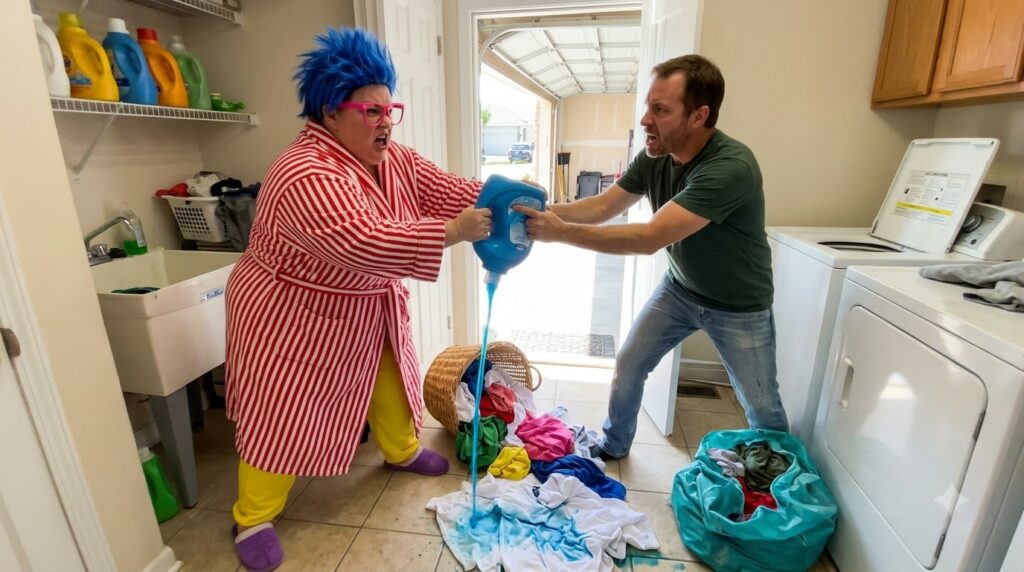
He described hearing the crash, entering the laundry room, and finding Karen pouring detergent over his clothes.
He acknowledged taking the laundry bag away from the washing machine.
He explained that he had done so to prevent Karen from loading her clothing while she refused to leave.
Then he asked permission to show the video.
Susan agreed.
The room grew quiet as the garage footage appeared on the screen.
Karen was visible approaching Daniel’s property.
She looked toward the front door.
Then she walked through the open garage without knocking.
The recording captured the sound of the basket hitting the floor.
Moments later, Daniel’s voice could be heard shouting about his clothes.
Karen’s response followed.
“Your laundry can wait! Mine can’t!”
Several people shifted in their chairs.
Daniel then displayed his photographs.
The overturned basket.
The blue detergent.
The soaked shirts.
The footprints.
He presented them without exaggeration.
The evidence spoke clearly enough.
Karen tried to interrupt, claiming that Daniel had deliberately provoked her.
Susan reminded her that she would have an opportunity to respond.
Daniel continued.
He showed the false neighborhood warning.
Susan immediately addressed the board.
The association had not authorized the document.
It had not voted to issue a warning.
No board member had signed it.
Karen insisted that she had merely been trying to protect neighborhood standards.
Susan asked whether Karen had created the notice.
Karen hesitated.
Then she admitted that she had prepared it herself.
She claimed she believed the board would support her position.
That admission changed the atmosphere.
Several neighbors who had previously seemed sympathetic began looking at one another.
A man near the back asked whether residents could issue warnings on behalf of the association whenever they disagreed with someone.
Susan answered that they could not.
The board’s secretary, Thomas Reed, confirmed that the association’s name and authority had been used without approval.
Karen’s binder remained open on the table.
For the first time that evening, she seemed uncertain.
Then Helen Brooks stood.
She spoke quietly about her missing space heater.
Frank Delaney described the borrowed ladder.
Neither demanded punishment.
Both explained that they had avoided confrontation because they wanted peaceful relationships with their neighbors.
Helen’s final observation was simple.
Being neighborly should not mean being afraid to say no.
Daniel felt the room settle around those words.
Alicia Perez then stood and acknowledged Karen’s past contributions to the neighborhood.
She reminded everyone that Karen had helped people during difficult times.
But Alicia also said that generosity did not excuse entering someone’s home or damaging their belongings.
The distinction mattered.
The meeting wasn’t about deciding whether Karen was entirely good or entirely bad.
It was about whether she had crossed a boundary.
And the evidence was difficult to dispute.
After a short recess, the board returned with its decision.
The association would formally disavow the unauthorized warning.
It would issue a correction to residents explaining that no disciplinary action had been taken against Daniel.
It would also review its communication procedures to prevent anyone from using official-looking documents without authorization.
The board declined Karen’s demands for compensation and an apology, noting that it had no basis to require either.
Property damage and unauthorized entry would remain matters for the appropriate authorities and any civil proceedings.
Karen was furious.
She gathered her binder and announced that the neighborhood had turned against her.
Then she left.
Daniel remained seated.
He had expected to feel triumphant.
Instead, he felt tired.
Susan approached him after the meeting and thanked him for presenting the evidence calmly.
She also warned him about something.
Karen had told several residents that she intended to pursue the matter further.
Daniel looked toward the empty doorway.
The meeting had corrected the public record.
But it hadn’t yet resolved the damage inside his home.
And Karen still seemed determined to avoid responsibility.








