Chapter 4: The Money Behind the View
The certified arborist arrived on Friday morning.
His name was Samuel Ortiz, and he had spent twenty-seven years evaluating trees across northern Georgia.
He inspected Walter’s oak carefully.
He examined the roots, trunk, major limbs, soil conditions, and visible signs of decay. He used professional instruments to investigate several areas that might indicate internal weakness.
Walter followed at a respectful distance.
He had never been particularly interested in the scientific details of tree health.
Margaret had been the gardener.
He had been the man who carried the heavy bags of mulch.
Now every measurement mattered.
After nearly two hours, Samuel removed his gloves.
“The tree is in remarkably good condition for its age.”
Walter felt relief spread through him.
Samuel identified a few dead branches that could be removed during routine maintenance. But he found no evidence supporting emergency removal.
He also confirmed that the tree appeared structurally sound.
A written report would follow.
Rebecca sent the preliminary findings to Thomas.
By afternoon, the attorney had included them in his emergency filing.
Meanwhile, Allison Brooks, the property manager, had begun responding to Rebecca’s records request.
The first batch of documents revealed a troubling pattern.
Several landscaping expenditures had been approved through abbreviated forms bearing Patricia’s signature.
Some lacked supporting invoices.
Others referred to emergency conditions without inspection reports.
Three payments had gone to a company called Whitmore Property Solutions LLC.
Rebecca recognized the surname immediately.
She searched Georgia business registration records.
The company was registered to a man named Brian Whitmore.
Patricia’s younger brother.
The company appeared to provide landscaping consulting, property improvement coordination, and maintenance management.
Its listed business address was a small commercial office twenty miles away.
Rebecca called Thomas.
He asked her to send everything.
He also warned her not to assume that a family connection automatically proved fraud.
Related-party transactions could be lawful if properly disclosed and authorized.
The critical questions were whether the board knew, whether the services were actually performed, and whether association money had been used appropriately.
Those questions soon became harder for Patricia to answer.
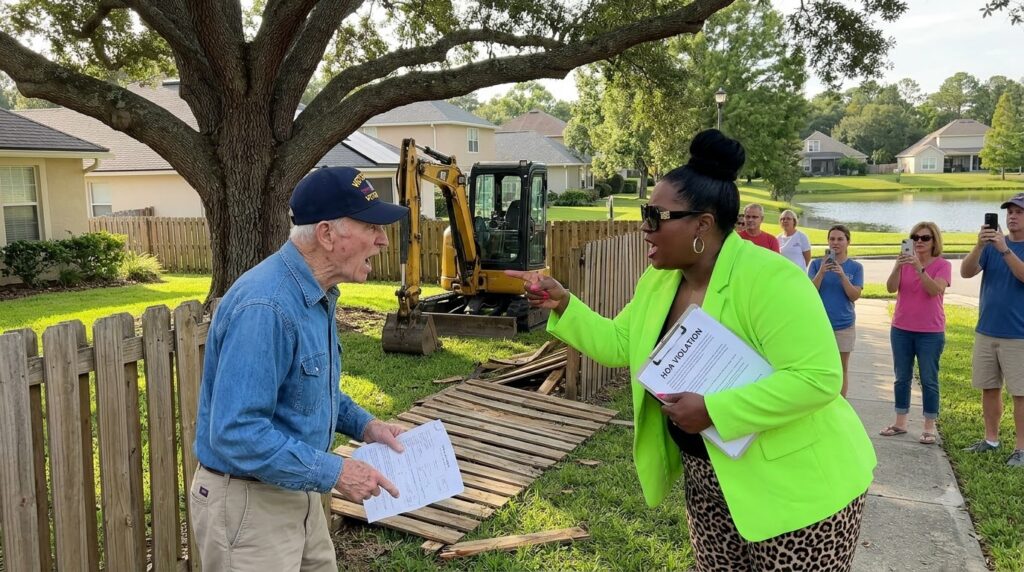
Daniel Price, the excavator operator, contacted Walter on Saturday.
He had spoken with his employer, who had reviewed the work order and suspended further work pending clarification of the property owner’s consent.
Daniel wanted Walter to know that he had not been told the oak belonged to a private homeowner.
He had been instructed to remove a hazardous tree from an HOA-controlled landscape corridor.
The instructions came from Patricia.
The deposit came from the association.
But the contract listed Whitmore Property Solutions as the project coordinator.
Daniel forwarded the original paperwork to Thomas.
A second discovery emerged when Frank Miller visited Walter.
Frank had served on the HOA board four years earlier.
He remembered Patricia proposing a new policy to preserve lake views.
The proposal had failed.
Several board members objected because it would have imposed expensive restrictions on established trees.
Frank still had the meeting minutes.
The minutes showed that the board had specifically rejected a blanket right to remove privately owned trees for scenic purposes.
Patricia had voted in favor.
Everyone else had voted against.
Walter studied the document.
He could almost hear Margaret’s voice.
She had always believed that written records mattered, especially when powerful people preferred everyone to rely on memory.
She kept receipts in labeled envelopes.
She saved warranties.
She even preserved the handwritten agreement Walter made with a neighbor about sharing the cost of a fence.
He used to tease her about it.
Now he wished he could thank her.
On Monday, Thomas informed Walter that the court had scheduled an expedited hearing on the request for temporary relief.
The hearing would address whether work should be prohibited while the underlying dispute continued.
Patricia responded through an attorney hired by the HOA.
Her position was that Walter’s tree presented an immediate hazard and that the association had acted within its powers.
She also claimed that Walter had behaved aggressively toward workers.
Eleanor’s video told a different story.
So did Daniel.
The more records Thomas collected, the more obvious it became that Patricia’s public explanation had shifted.
First, the tree obstructed her view.
Then it was a landscaping violation.
Then it became an emergency hazard.
Now it was supposedly a safety threat requiring immediate action.
Walter wondered how many different explanations one person could offer before someone demanded proof.
That night, he received a call from a man he barely knew.
His name was Charles Dunlap, the HOA’s treasurer.
Charles sounded nervous.
He asked whether they could meet privately.
Walter agreed to meet at Thomas’s office the following morning.
Before hanging up, Charles said something that made Walter sit straighter.
“I think the board has been signing documents it never actually voted on.”