Chapter 10: What Remains Standing
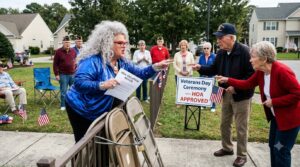
The following spring, Willow Creek held its first neighborhood picnic in years.
Not a formal HOA event with speeches, fines, or reminders about landscaping standards.
Just neighbors gathering beside the lake.
There were folding tables covered with homemade food, children running through the grass, and older residents sitting beneath umbrellas telling stories.
Walter brought Margaret’s famous potato salad.
Or rather, he brought his best attempt at it.
Rebecca tasted a spoonful and raised an eyebrow.
“Too much mustard.”
Walter shrugged.
“Your mother always said that.”
“Because you always used too much.”
He smiled.
For a moment, he could almost hear Margaret laughing beside them.
The neighborhood had changed in ways both visible and quiet.
The HOA board published meeting agendas in advance.
Homeowners could inspect records through established procedures.
New financial controls required multiple approvals for significant expenditures.
Disputes were handled with written explanations and opportunities to respond.
No system was perfect.
But authority was no longer treated as a personal privilege.
Walter had been asked to join the board.
He declined.
He had spent enough of his life in meetings.
Instead, he volunteered for a small committee that helped elderly homeowners understand association notices and find the correct information before paying questionable charges.
He enjoyed that work.
Sometimes all someone needed was a neighbor willing to sit at a kitchen table, read a letter, and explain what questions to ask.
Other times, the situation required professional advice.
Walter knew the difference now.
He also knew how important it was to speak before a small problem became a crisis.
One afternoon, George Palmer invited him over.
George had planted a young maple where the old tree once stood.
It was barely seven feet tall.
Its thin branches swayed in the breeze.
Walter helped spread mulch around the base.
George stood back and examined their work.
“I won’t live long enough to see it as big as the other one.”
Walter rested both hands on the shovel.
“Maybe not.”
George looked at him.
Walter continued.
“But somebody will.”
The two men stood quietly, watching the young leaves move.
That evening, Walter returned home as the sun began setting over the lake.
Golden light passed through the oak’s branches and fell across the lawn.
The new fence cast long, straight shadows.
The yellow birdhouse still hung from its branch.
A bluebird landed on the entrance, hesitated, and disappeared inside.
Walter sat in his old wooden chair.
For a long time, he watched the tree.
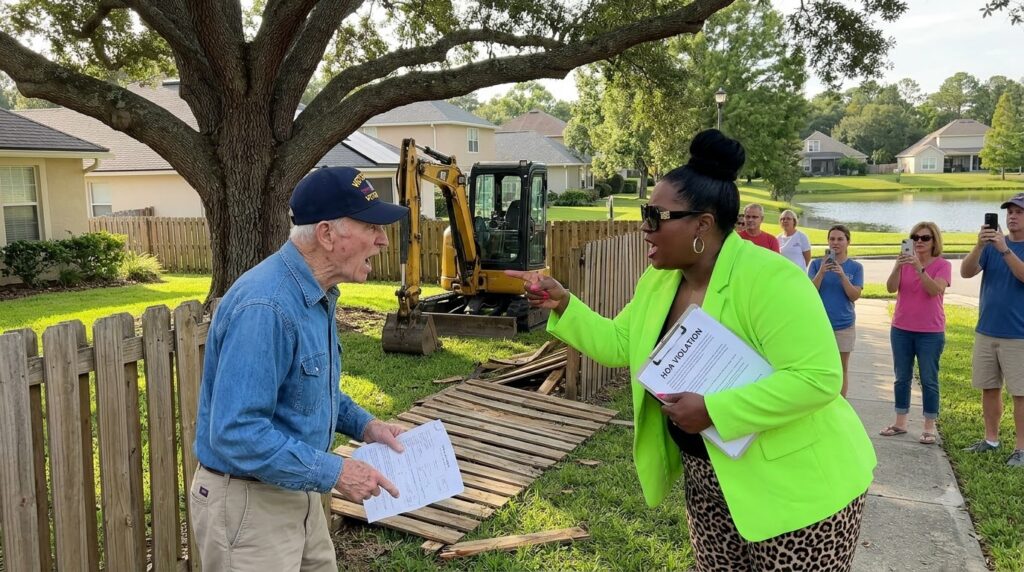
He thought about the day the excavator arrived.
He remembered the sound of splintering wood, Patricia’s furious face, and the terrible words she had spoken about Margaret.
He remembered the fear that the tree might be gone before he could stop it.
But he also remembered Eleanor standing on the sidewalk with her phone.
Daniel shutting down the excavator.
Rebecca driving ninety miles without being asked.
Charles walking into an attorney’s office with a briefcase full of records.
Neighbors finding the courage to tell their stories.
A judge ordering the destruction to stop.
A community deciding that its rules belonged to everyone, not merely to the person holding the clipboard.
The victory had not been simple.
It had cost time, money, and peace of mind.
Yet the oak still stood.
And something else had grown around it.
Trust.
Not the unquestioning kind that allowed Patricia to operate without oversight, but the stronger kind built through honesty, accountability, and neighbors looking out for one another.
Walter reached into his shirt pocket and removed the photograph taken on the day he and Margaret planted the sapling.
The edges were worn now.
The colors had faded.
But Margaret’s smile remained bright.
He placed the photograph on his knee and looked at the enormous tree before him.
Thirty-eight years earlier, they had dug a hole in the red Georgia soil and lowered a fragile young oak into the ground.
They had no idea how tall it would grow.
They did not know what storms it would survive.
They could not have imagined grandchildren playing beneath it, or Margaret spending her final spring in its shade.
And they certainly could not have imagined a woman in a neon-green blazer ordering an excavator to destroy it for a better view.
But Margaret had understood something about planting trees.
You did not plant them only for yourself.
You planted them for the people who would come after you.
Walter looked at the brass plaque near the trunk.
He thought of the promise he had made to his wife.
For years, he had believed keeping that promise meant preserving the house exactly as she remembered it.
Now he understood it differently.
Margaret had not wanted him to spend the rest of his life guarding memories.
She had wanted him to keep making them.
That was why she had asked him to keep living.
A car pulled into the driveway.
Michael had arrived with his wife and two grandchildren.
The children rushed across the lawn, calling for their grandfather.
Walter tucked the photograph safely into his pocket.
He stood slowly, his knees protesting.
The youngest child pointed toward the oak.
“Grandpa, can we put a swing back up?”
Walter looked at the branch where Michael’s old rope swing had once hung.
It was thick and sturdy.
He smiled.
“We’ll have an arborist check the branch first.”
The children laughed and ran toward the porch.
Walter followed them, feeling the warmth of the evening sun against his back.
Behind him, the oak’s leaves rustled gently.
The lake shimmered beyond the houses.
The new fence stood firm.
And the tree Margaret had planted continued to grow.
Patricia Whitmore had wanted a million-dollar view.
Walter Bennett had fought for something no amount of money could replace.
A home.
A promise.
And the right to leave something beautiful standing for the next generation.
THE END