Chapter 2: The Tree Margaret Planted
That evening, Walter sat beneath the oak tree with a cardboard box resting beside his chair.
Inside were photographs, letters, and small keepsakes from his marriage.
He had brought the box out of the bedroom closet after Daniel left.
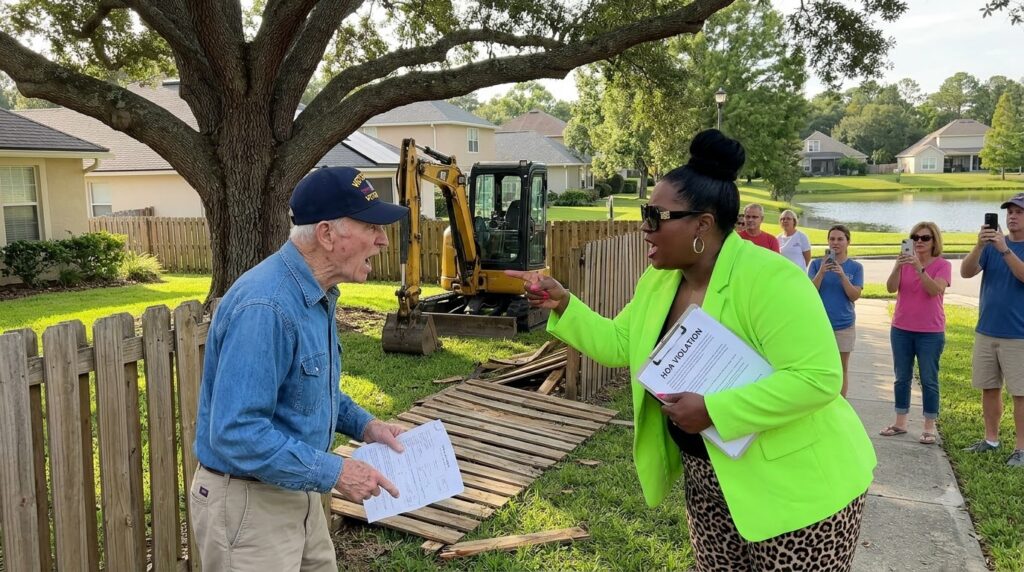
The broken fence remained exactly where it had fallen. Eleanor had suggested cleaning up the debris, but Walter wanted everything documented before anyone moved it.
A neighbor’s grandson had taken photographs from several angles. Daniel had provided his business card and a copy of the work order. Eleanor had already emailed Walter the video she recorded.
For the first time since Margaret’s funeral, Walter felt grateful that people carried cameras everywhere.
He opened the box.
The first photograph showed a much younger Walter standing beside Margaret on the day they planted the oak.
He was thirty-six, still wearing his Army haircut. Margaret wore faded jeans, gardening gloves, and the bright smile that had convinced him to ask her to dance at a church social in 1969.
Between them stood a sapling no taller than their youngest daughter.
On the back, Margaret had written:
Our little piece of forever. April 12, 1988.
Walter ran his thumb over the handwriting.
They had bought the house after years of military moves. Fort Bragg, Germany, Texas, Kentucky—every place had been temporary.
Willow Creek was supposed to be permanent.
The lake had reminded Margaret of childhood summers with her grandparents. She wanted a porch, a vegetable garden, and a tree large enough to shade their grandchildren someday.
They had gotten all three.
Their daughter, Rebecca, had married beneath the oak’s branches during a small backyard ceremony. Their son, Michael, had built a rope swing there as a teenager. Five grandchildren had collected acorns beneath it.
When Margaret became sick, Walter moved a comfortable chair beneath the tree so she could sit outside on warm afternoons.
She had asked him to promise one thing.
Keep living in the house.
Not merely maintaining it. Living in it.
She wanted laughter to return after she was gone.
Walter had struggled with that part of the promise.
A car pulled into his driveway.
Rebecca stepped out carrying two grocery bags and the expression she wore whenever she was worried about him.
At fifty-one, she had inherited Margaret’s dark eyes and Walter’s stubbornness. She worked as a real estate attorney in Atlanta, though she preferred to spend weekends away from legal disputes.
Today, however, she had driven nearly ninety miles after seeing Eleanor’s video.
She looked at the damaged fence.
Then she looked at her father.
“Dad, why didn’t you call me immediately?”
Walter gave a tired smile.
“I was busy keeping a bulldozer out of the yard.”
“Excavator,” Rebecca corrected automatically.
“Whatever it was, it wasn’t invited.”
She set down the groceries and hugged him.
For several moments, neither spoke.
Rebecca had seen the video. She had heard Patricia’s remarks about her mother.
Walter felt his daughter’s shoulders tighten.
Inside, they spread the documents across the kitchen table.
The property survey was clear. The oak stood approximately nineteen feet inside Walter’s property line. The destroyed fence had also been entirely within his lot.
Rebecca reviewed the HOA’s governing documents on her laptop.
The association had authority over certain exterior alterations, common areas, and architectural standards.
It did not have authority to enter private property and remove mature trees simply because a board member disliked the view.
More importantly, any major landscaping expenditure required board approval.
The work order Daniel provided named Willow Creek Lakeside HOA as the customer.
The authorization bore Patricia Whitmore’s signature.
But Rebecca noticed something unusual.
The invoice described the project as Emergency Storm Hazard Mitigation.
There had been no storm.
The oak was healthy.
And the contractor had been told to remove the fence first, then the tree.
Rebecca leaned back.
“She didn’t just order a tree removed. She created a paper trail claiming it was dangerous.”
Walter remembered something.
Three weeks earlier, Patricia had approached him while he was collecting his mail.
She had offered to pay for trimming the oak.
When Walter declined, she suggested removing several large branches.
He refused again.
A week later, a violation notice appeared in his mailbox, claiming the tree interfered with neighborhood sightlines.
Walter had ignored it after consulting the HOA handbook.
Now he understood why Patricia had stopped asking.
She had decided to act.
Rebecca began organizing the evidence into folders.
Then she asked whether Walter had ever received a certified arborist’s report declaring the tree unsafe.
He shook his head.
She made a note.
By nine that evening, they had photographs, video footage, the property survey, the work order, and copies of Patricia’s previous notices.
Rebecca suggested seeking an emergency court order to prevent further entry onto the property.
Walter agreed.
But before they finished, Eleanor called.
She had been speaking with another homeowner.
Apparently, Walter was not the first resident to have trouble with Patricia’s landscaping decisions.
Three families had paid expensive fines for trees that supposedly violated HOA rules.
One elderly couple had been forced to remove a garden shed after Patricia claimed it obstructed a community easement.
Another homeowner had paid nearly eight thousand dollars for drainage repairs that never seemed necessary.
Rebecca listened carefully.
“Do those people still have their paperwork?”
Eleanor said they did.
Walter looked toward the dark window.
Beyond the porch light, the oak stood against the evening sky.
He had thought he was fighting for one tree.
Now he wondered how many neighbors had been quietly surrendering pieces of their homes.