Chapter 5: The Seven Minutes Nobody Could Explain Away
The official fire department timeline arrived eleven days after the blaze.
Captain Reyes had been precise.
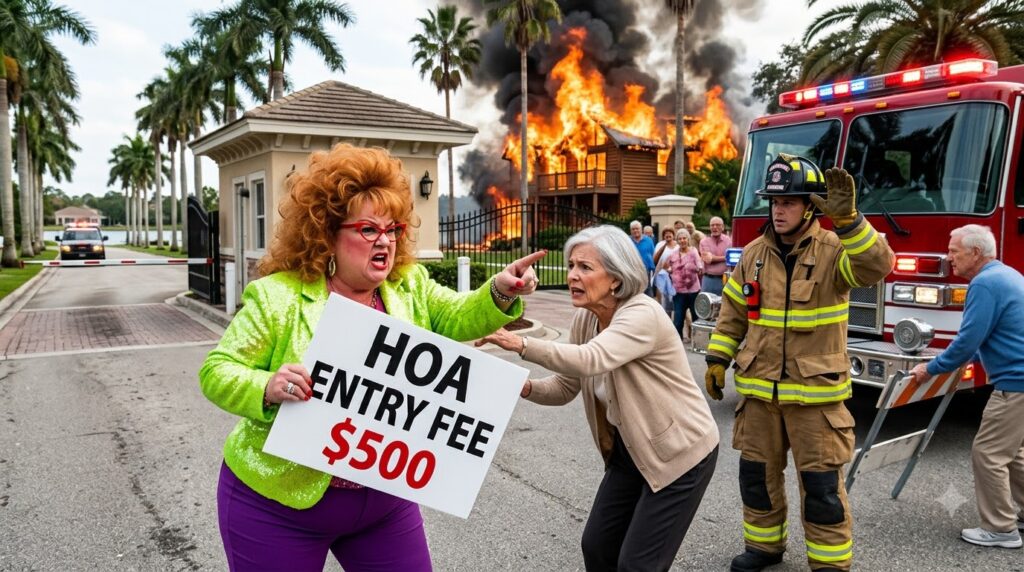
The first engine reached the Cypress Lake Estates entrance at 2:17 p.m.
The vehicle remained unable to proceed for approximately seven minutes while the barricade was removed and the confrontation resolved.
The crew entered the neighborhood at 2:24 p.m.
Those seven minutes became the center of the investigation.
Elaine Porter reviewed the records with an independent fire protection consultant, a retired battalion chief named Samuel Whitaker.
Samuel had spent thirty-one years responding to structure fires across central Florida.
He understood the difference between an emotionally compelling story and a conclusion that could withstand scrutiny.
The delay was documented.
The obstruction was documented.
The unauthorized payment demand was documented.
But whether the delay had changed the extent of the damage required careful analysis.
The fire had already spread into the upper floor before the first engine arrived.
Investigators were examining the laundry room’s electrical components as a possible ignition source.
The consultant explained that a residential fire could grow rapidly once heat, oxygen, and combustible materials combined.
Seven minutes could matter enormously.
But no responsible expert could simply declare that Margaret’s house would have been saved if the engine had arrived sooner.
Elaine appreciated his caution.
So did Margaret.
She wanted accountability, not a story built on exaggeration.
The fire department’s report also confirmed that the firefighters had followed emergency response procedures.
They had not been required to pay an entry fee.
They had not been required to obtain Beverly’s permission.
The barricade had been an obstruction, not a legitimate condition of access.
Meanwhile, the video had become public.
Helen had initially respected Margaret’s request for privacy.
But after Beverly issued a second neighborhood statement accusing the homeowner of creating a dangerous disturbance, Margaret agreed to let Helen provide the relevant footage to a local television station.
The station aired a short report.
It showed the sign striking the fire engine.
It showed Margaret struggling with Beverly.
And it captured the HOA president’s final outburst.
The report did not reveal Margaret’s temporary address.
It did not display private insurance documents.
And it did not turn her loss into entertainment.
That mattered to her.
Within days, the story spread across central Florida.
Residents from other HOA communities began sharing their experiences.
Some described excessive fines.
Others recalled aggressive board members, unexplained fees, or threats involving minor property violations.
Margaret read only a few of the messages.
She found them overwhelming.
She had never wanted public attention.
She wanted a safe home, a fair process, and the ability to live without being intimidated.
Beverly responded differently.
She hired a public relations consultant.
Through the consultant, she released a statement claiming that the video had been taken out of context and that her comments had been made during an emotionally charged misunderstanding.
She also insisted that she had never intended to interfere with firefighting operations.
The statement might have carried more weight if the sign had not been so clearly visible.
And if the barricade had not been placed directly across the road.
Richard Sloan called another emergency board meeting.
This time, Beverly arrived with an attorney.
The association’s own attorney attended as well.
The two lawyers sat at opposite ends of the conference table.
Richard presented the fire department timeline.
He presented the governing documents.
Then he presented Thomas Collins’s original emergency access agreement.
Beverly’s attorney argued that his client had misunderstood the scope of her authority.
Richard listened.
Then he asked why she had prepared a five-hundred-dollar sign before the fire engine arrived.
Beverly claimed she had been trying to collect an outstanding neighborhood security assessment.
But Margaret did not owe such an assessment.
And the fire department certainly did not.
The explanation failed to resolve the contradiction.
The board voted to suspend Beverly’s administrative authority pending a formal membership vote and legal review.
She would no longer control the gate system, issue violation notices, or authorize discretionary spending on behalf of the association.
Beverly rose from her chair so abruptly that it struck the wall.
She accused the board of betrayal.
Then she walked out.
The members sat in silence.
No one celebrated.
They understood that the community had reached a point where ordinary governance had failed.
And the problems were not limited to Beverly’s conduct at the fire.
The association’s accountant had discovered that Lakeside Compliance Services was registered to a mailing address associated with Beverly’s adult nephew.
The invoices required further examination.
Richard felt sick when he learned the connection.
He had signed several payment approvals based on Beverly’s representations.
Now he wondered how many warnings he had overlooked.
That evening, he drove to Helen’s house.
Margaret was sitting at the dining table reviewing rebuilding estimates.
Richard told her about the financial discovery.
She listened quietly.
Then she asked the question that had been troubling her since the fire.
Had Beverly tried to collect five hundred dollars because she genuinely believed the rule existed?
Or had she been using the HOA to collect money she had no right to demand?
Richard could not answer.
But he knew who might.
The association’s outside accountant had requested the original Lakeside Compliance Services contract.
And Beverly had been given forty-eight hours to produce it.