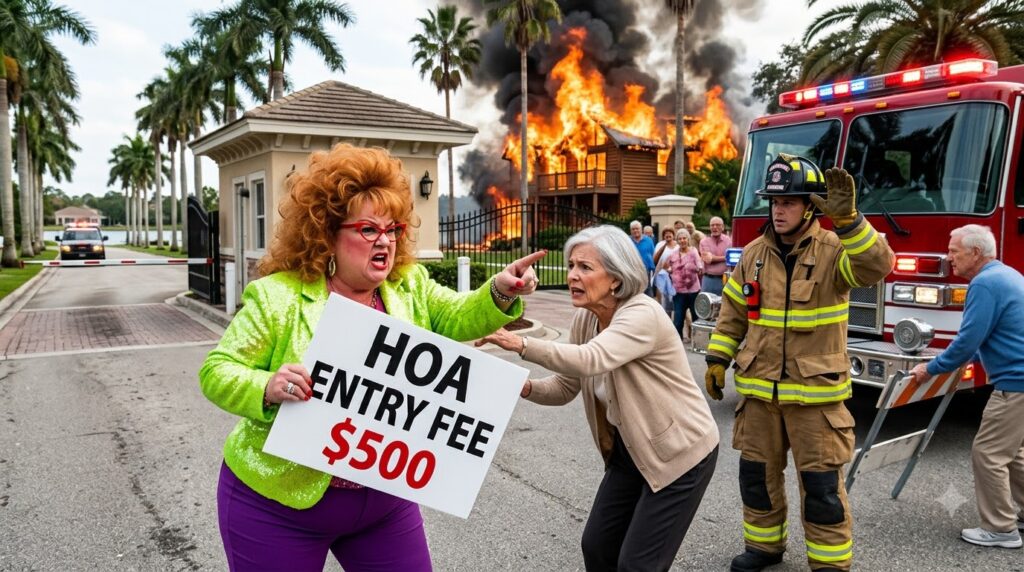
Chapter 3: The Rule That Didn’t Exist
The next morning, Beverly Hargrove woke to forty-three missed calls.
By breakfast, there were sixty-one.
Her phone vibrated continuously on the marble kitchen counter of her waterfront home.
Beverly ignored most of them.
She was convinced the entire situation had been exaggerated.
In her mind, she had simply enforced the standards that made Cypress Lake Estates desirable.
Rules maintained property values.
Rules kept outsiders from treating the community like a public parking lot.
Rules distinguished responsible homeowners from people who believed exceptions should be made whenever they became inconvenient.
Beverly had repeated those arguments at nearly every HOA meeting since her election.
But that morning, her confidence faced an unexpected challenge.
The association’s treasurer, Richard Sloan, had requested an emergency board meeting.
Richard was sixty-nine, a retired bank manager who had served on the HOA board for eight years.
He was not a confrontational man.
He preferred spreadsheets, carefully written minutes, and meetings that ended before dinner.
For most of Beverly’s presidency, he had tolerated her aggressive leadership because the neighborhood landscaping had improved and dues collection had become more consistent.
But he had watched Helen’s recording three times.
And he could not reconcile it with Beverly’s email.
At ten o’clock, four board members gathered in the clubhouse conference room.
Beverly arrived fifteen minutes late.
She wore a navy designer jacket, oversized sunglasses, and an expression of profound irritation.
Richard had printed the association’s governing documents.
He placed them on the table.
The rules contained provisions for visitor registration, contractor access, gate maintenance, and security procedures.
They also explicitly exempted emergency responders from routine visitor authorization requirements.
Richard pointed to the section.
Beverly dismissed it as outdated.
She claimed that the board had approved a special emergency access assessment during a security review earlier that year.
Richard asked for the meeting minutes.
Beverly said they were in the administrative files.
He asked for the resolution number.
She could not provide one.
The room grew quiet.
Finally, Richard explained that he had reviewed the minutes from every board meeting held during the previous eighteen months.
No such fee had been approved.
No emergency access assessment had been proposed.
And no recorded amendment authorized the HOA president to demand payment from firefighters.
Beverly folded her arms.
She accused Richard of undermining her authority during a crisis.
But Richard did not raise his voice.
He simply asked who had printed the sign.
Beverly’s expression changed.
Only slightly.
But everyone noticed.
She said the sign was a temporary security notice.
Richard asked why it stated a specific dollar amount.
Beverly refused to answer.
The meeting ended without a resolution.
Two board members wanted Beverly suspended immediately.
A third argued that they should consult the association’s attorney before taking formal action.
Richard agreed.
He also requested that all HOA financial records, access-control records, and relevant emails be preserved.
Beverly objected.
The board voted three to one in favor.
For the first time since becoming president, Beverly had lost control of a meeting.
Meanwhile, Margaret was sitting at Helen’s kitchen table, wearing borrowed clothes.
Sarah had arrived from Charlotte shortly after midnight.
She sat beside her mother, helping her contact the insurance company, replace medications, and make a list of important documents that might have been destroyed.
The list grew longer by the minute.
Birth certificates.
Tax records.
Thomas’s military discharge papers.
Family photographs.
Jewelry passed down from Margaret’s mother.
The handwritten recipe book that had belonged to her grandmother.
Margaret knew most of the paperwork could be replaced.
The photographs and handwritten pages could not.
Sarah suggested that Margaret stay with her in North Carolina.
Michael offered his guest room in Jacksonville.
Both children wanted her somewhere safe, away from the ruined house and the neighborhood that had failed her.
Margaret appreciated their concern.
But she was not ready to leave.
She had spent thirty-four years building a life beside Cypress Lake.
Leaving immediately felt like surrendering the last thing the fire had not taken.
Her right to decide where she belonged.
That afternoon, an insurance adjuster arrived to inspect the property.
He was accompanied by a fire investigator and a restoration contractor.
Margaret stood outside the temporary safety fence while they examined the remains.
The adjuster explained that her policy appeared to include replacement-cost coverage, subject to its terms and limits.
But rebuilding would take time.
The cause of the fire still needed to be established.
And any claims involving the delay at the gate would require separate investigation.
Margaret listened carefully.
She did not want promises.
She wanted facts.
As the inspection ended, the restoration contractor approached her carrying a smoke-stained metal box.
It had been recovered from the detached garage.
Thomas’s toolbox.
The outside was scratched, but the latch still worked.
Margaret opened it.
Inside were a few old screwdrivers, a measuring tape, a folded photograph, and a small envelope.
The photograph showed Margaret and Thomas standing beside their unfinished house in 1991.
Thomas had one arm around her waist.
Both were smiling.
Margaret held the picture against her chest.
Then she noticed the envelope.
Her name was written across the front in Thomas’s handwriting.
She recognized it immediately.
But she had never seen the envelope before.