Chapter 2: The Things Fire Couldn’t Take
By six that evening, the fire was under control.
Margaret’s house was not.
The second floor had collapsed into the rooms below. Blackened rafters jutted toward the sky, and water streamed down the front steps where she had once placed pots of red geraniums.
The firefighters had saved the detached garage and prevented the flames from spreading to the neighboring homes.
But the main house was a ruin.
Margaret stood beside an ambulance with a wool blanket around her shoulders. A paramedic had cleaned a small burn on her foot and checked her breathing.
She kept staring at the front porch.
It was the only recognizable part of the house.
The white columns were scorched, but still standing. One rocking chair remained upright, its paint blistered by the heat.
Her husband, Thomas, had built that chair for her fifty-fifth birthday.
He had died four years earlier after a long struggle with heart disease.
In the months following his death, Margaret had spent countless mornings in that chair, drinking coffee and watching the lake turn silver beneath the sunrise.
Now she wondered whether it would survive another night.
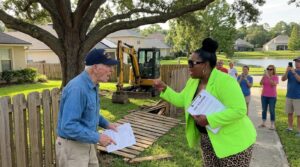
Walter Bennett approached with a bottle of water.
He had lived three houses away for twenty-one years. A retired electrician with a bad knee and a habit of wearing faded baseball caps, Walter was the kind of neighbor who quietly fixed broken porch lights without expecting anything in return.
He handed Margaret the bottle.
She thanked him but did not open it.
Walter stood beside her for a while before speaking.
He told her that Helen had offered a guest bedroom.
Margaret nodded.
The idea of sleeping in someone else’s house felt strangely unbearable.
Not because she was ungrateful.
Because accepting the offer meant admitting she had nowhere else to go.
Her daughter, Sarah, lived in Charlotte, North Carolina. Her son, Michael, worked as a physical therapist in Jacksonville.
Both had already been called.
Both were on their way.
Margaret had insisted they drive carefully, though she knew neither would listen.
Across the street, Beverly’s white SUV remained parked near the entrance.
She had not approached Margaret.
She had not offered condolences.
Instead, she had been seen speaking with two HOA board members beside the clubhouse.
By early evening, she had sent an email to the neighborhood.
Its subject line read:
UNAUTHORIZED EMERGENCY ACCESS INCIDENT — COMMUNITY SECURITY NOTICE
Margaret did not see the message until Helen showed it to her.
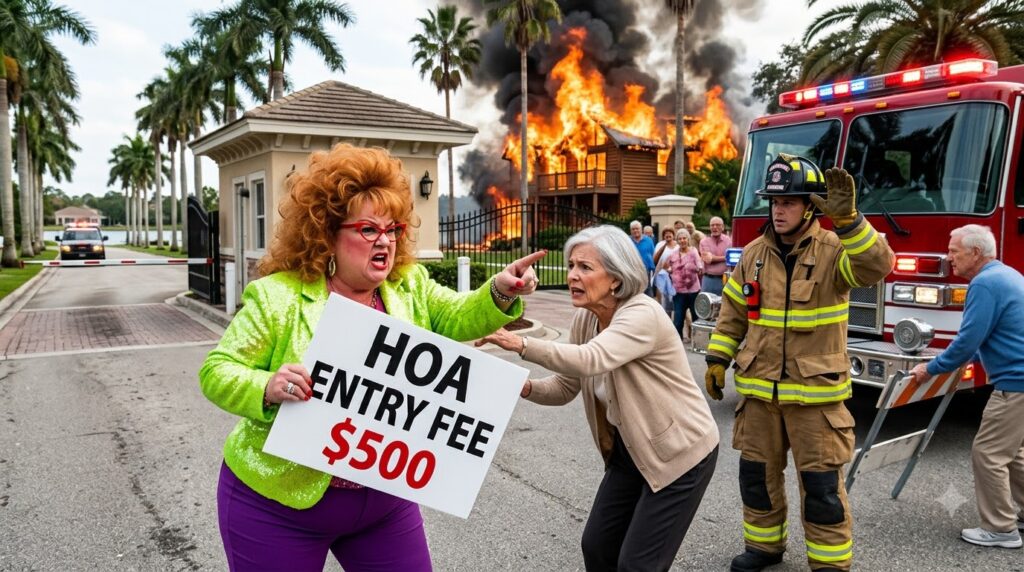
The email claimed that emergency personnel had entered Cypress Lake Estates without completing established security procedures. It described the confrontation as an unfortunate misunderstanding caused by an emotionally distressed homeowner.
Beverly also claimed that the HOA president had acted to protect community infrastructure and maintain orderly access.
There was no mention of the five-hundred-dollar sign.
No mention of the barricade.
And certainly no mention of telling Margaret to let her house burn.
Helen’s hands trembled as she scrolled through the message.
She had worked as a public school librarian for thirty-seven years and had little patience for people who twisted words to escape responsibility.
She opened the video she had recorded.
The image was shaky, but the sound was unmistakable.
Beverly’s demand rang through the phone speaker.
Then Margaret’s desperate protest.
Then the final words.
“THEN LET IT BURN! RULES ARE RULES!”
Margaret turned away.
Hearing the sentence again was worse than hearing it the first time.
During the confrontation, she had been consumed by panic.
Now, with her house reduced to smoking debris, she understood the full cruelty of what Beverly had said.
Helen quietly explained that she had sent the original video to her daughter, who worked in local television news.
Margaret looked up.
She was not sure she wanted strangers watching the worst afternoon of her life.
She had always valued privacy.
She and Thomas had been careful people. They paid their bills, minded their business, and avoided neighborhood gossip.
Margaret did not want to become a spectacle.
Helen understood.
She promised not to distribute the footage publicly without Margaret’s permission, though the recording might be needed by investigators.
That distinction mattered.
For the first time since the fire began, Margaret felt someone was considering what she wanted rather than deciding for her.
At seven-thirty, Captain Reyes returned.
His uniform was streaked with soot. His voice had grown hoarse.
He told Margaret the fire appeared to have started near the upstairs laundry room, but investigators would need to determine the cause.
He also explained that the delayed entry would be documented.
Margaret asked how long the truck had been stopped.
Reyes did not guess.
He said the department’s dispatch records, vehicle data, and body-camera footage would establish the timeline.
His answer was measured.
But Margaret noticed the seriousness in his eyes.
Before leaving, Reyes asked whether she needed anything.
Margaret looked toward the garage.
Thomas had kept a small metal toolbox near the back wall. Inside was a photograph of the two of them taken during their first summer at the lake.
She asked whether someone might retrieve it once the property was safe.
Reyes said they would see what could be done.
That small promise nearly broke her.
She pressed her lips together and nodded.
An hour later, Michael arrived.
He pulled into Helen’s driveway, climbed out of his truck, and hurried toward his mother.
Margaret had not cried when she saw the flames.
She had not cried when the roof collapsed.
But when her son wrapped his arms around her, she finally did.
Michael held her while the last fire engines left the neighborhood.
Across the lake, the sky darkened.
And in Beverly Hargrove’s office, a different kind of emergency was beginning.
Three HOA board members had received Helen’s video.
One of them had already discovered that the five-hundred-dollar emergency entry fee did not appear anywhere in the association’s recorded rules.