Chapter 10: Rules Are Supposed to Protect People
Margaret moved into her new home fourteen months after the fire.
The morning was clear and cool.
A moving truck pulled into the driveway shortly after eight.
Sarah and Michael arrived with their families, carrying boxes, groceries, and far more advice than Margaret needed.
Walter brought a toolbox.
Helen arrived with a casserole and a fresh lemon cake.
The new house smelled of clean wood, fresh paint, and possibility.
Margaret walked slowly through the rooms.
The kitchen was bright and open.
The living room faced the lake.
The guest bedrooms were ready for family visits.
And beside the front door, mounted at exactly the height Thomas had chosen years earlier, was the brass knocker recovered from the old house.
Margaret touched it with her fingertips.
Its surface still carried a few tiny marks from the fire.
She had asked the contractor not to polish them away.
They reminded her that survival did not require pretending nothing had happened.
That afternoon, the neighbors gathered for a small housewarming celebration.
There were folding tables on the lawn, homemade food, and children chasing one another near the garden.
Someone had brought a tray of deviled eggs.
Someone else had made sweet tea.
Walter argued cheerfully with Michael about the proper way to assemble a patio chair.
For the first time in more than a year, Margaret looked around her property and saw ordinary life.
Not emergency vehicles.
Not smoke.
Not reporters.
Just family and neighbors.
Richard Sloan arrived carrying a framed photograph.
It showed the original Cypress Lake Estates entrance in the early 1990s.
Thomas Collins stood near the center of the picture with several other founding homeowners.
They were younger, smiling, and dressed for a ribbon-cutting ceremony.
Richard had found the photograph while organizing the association’s archives.
He thought Margaret should have it.
She held the frame for a long moment.
Thomas looked so happy.
So certain that the neighborhood would become a good place to grow old.
Margaret felt tears gather in her eyes.
But she smiled.
She placed the photograph on a shelf near the living room window.
Later, as the gathering began to wind down, Helen joined her on the porch.
The two women sat in rocking chairs overlooking the lake.
Helen asked whether Margaret ever thought about Beverly.
Margaret considered the question.
Occasionally, she admitted.
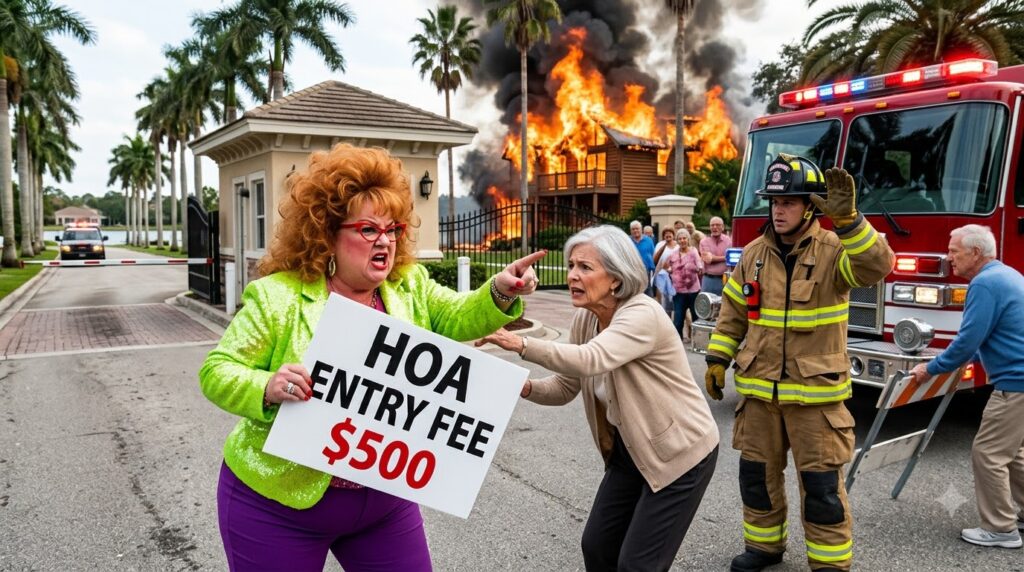
Sometimes she still heard that terrible voice demanding five hundred dollars while her house burned.
Sometimes she remembered the helplessness of standing at the gate.
But she no longer wondered what she should have said.
She no longer replayed the confrontation searching for a way to change it.
Beverly had made her choices.
The community had made its own.
And Margaret had made hers.
She had chosen to rebuild.
She had chosen not to let bitterness determine the rest of her life.
Most importantly, she had chosen not to confuse forgiveness with pretending the harm had never occurred.
The rules had changed.
The financial controls had changed.
The emergency access procedures had changed.
And the residents had learned to question authority without surrendering their dignity.
That was enough.
As the sun lowered over the lake, a red fire engine appeared on the neighborhood road.
Margaret noticed it through the trees.
For one brief second, her chest tightened.
Then she saw that the truck was moving slowly, without emergency lights or sirens.
The local fire department had been invited to participate in a community safety event at the clubhouse.
Captain Reyes was among the firefighters attending.
He had stopped by earlier to congratulate Margaret on her new home.
She had thanked him for his crew’s efforts on the day of the fire.
He had reminded her that firefighters were there to serve the community.
That was their job.
Margaret had thought about those words afterward.
Serving the community.
It was such a simple idea.
And yet Beverly had managed to turn it upside down.
The fire engine continued down the road and disappeared beyond the clubhouse.
No barricade blocked its path.
No one demanded money.
No one claimed that neighborhood authority mattered more than a human life.
Margaret watched until the truck was gone.
Then she looked toward the front garden.
The reclaimed bricks from her old house formed a neat path between two beds of red geraniums.
Thomas had always liked those flowers.
She imagined what he might say if he could see the new house.
He would probably inspect the porch railing, question the contractor’s choice of screws, and insist on adjusting one of the doors.
Then he would sit beside her with a cup of coffee and admit that she had done well.
Margaret smiled at the thought.
Inside, her grandchildren were laughing.
Sarah was putting away dishes.
Michael was helping Walter carry the last folding table to the garage.
The sounds drifted through the open screen door.
Familiar sounds.
Family sounds.
The sounds of a house becoming a home.
Margaret rose from her chair and stepped inside.
Before closing the door, she glanced once more toward the neighborhood entrance.
A year earlier, she had stood there watching everything she loved disappear behind a wall of fire.
She had believed that losing her home meant losing the life she had built.
But she had discovered something the flames could not destroy.
Her right to be treated with dignity.
Her right to ask questions.
Her right to expect fairness from people entrusted with authority.
And her right to begin again.
The old house was gone.
Beverly Hargrove was gone.
But Cypress Lake Estates remained.
So did the neighbors who had moved the barricade.
So did the firefighter who had stepped between cruelty and common sense.
So did the family that had gathered around Margaret when she had nothing left but the clothes on her back.
Margaret closed the front door.
The old brass knocker caught the last light of the afternoon.
And for the first time since the fire, she felt completely at home.
Because a neighborhood was never made safe by the size of its gates, the beauty of its lawns, or the strictness of its rules.
It was made safe by people who understood that rules were supposed to protect human lives, not stand in the way of saving them.
And when someone forgot that truth, it was the responsibility of everyone else to remember.