Chapter 7: The Vote That Changed Magnolia Pines
The special board meeting took place three weeks after Brenda shut off Thomas’s electricity.
This time, the clubhouse was filled well before the scheduled start.
Residents stood in small groups, speaking quietly.
The atmosphere was serious rather than angry.
People had come prepared.
The independent accountants had completed an initial report.
Their findings were troubling.
They identified undocumented administrative payments, inconsistent fine collection records, inadequate oversight of related-party transactions, and failures to follow established approval procedures.
The report did not conclude that every questionable payment was fraudulent.
It recommended additional investigation and possible recovery of improperly authorized expenditures.
The board had already referred the relevant records to legal counsel.
Brenda arrived ten minutes late.
She wore a dark burgundy suit instead of her usual bright colors.
Her platinum hair was carefully arranged, but her expression was strained.
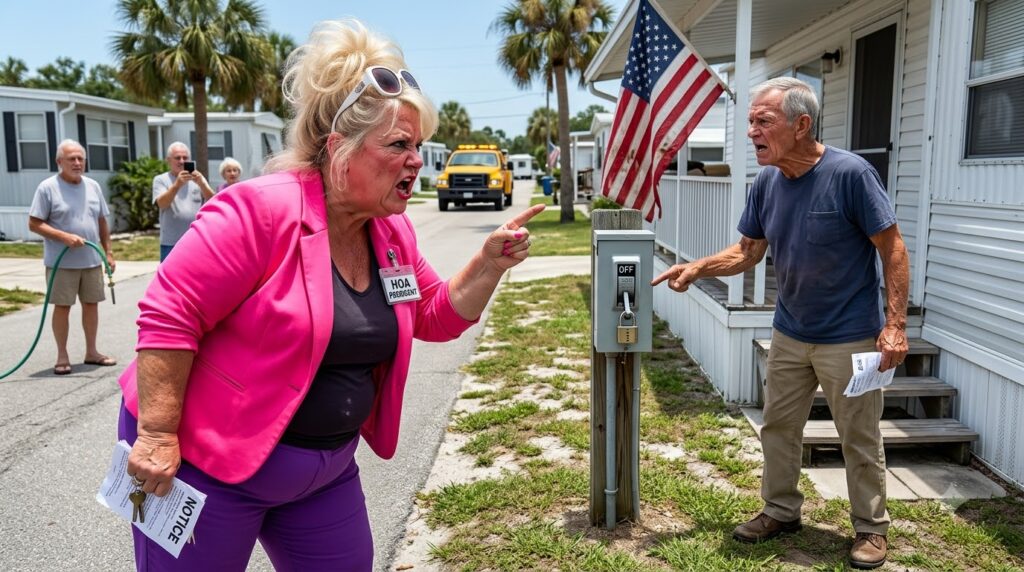
For the first time, she did not wear the large HOA PRESIDENT badge.
Thomas noticed its absence.
He remembered how she had pointed to it while declaring that his rights did not matter.
Now the badge was nowhere to be seen.
The board secretary opened the meeting.
The agenda included consideration of Brenda’s removal as president, reassignment of her officer responsibilities, and further action concerning the financial review.
Rebecca Sloan attended as Thomas’s attorney, but she did not control the proceedings.
The association had its own legal counsel.
The distinction mattered.
This was not Thomas’s personal trial against Brenda.
It was the association deciding whether its leadership had acted properly.
The board’s attorney explained the governing procedures.
Under the association’s documents, the directors could remove Brenda from the office of president by the required board vote, although removal from her elected director seat would involve a separate process.
The directors discussed the unauthorized electrical shutoff.
They reviewed the violation enforcement procedures.
They considered the accounting report.
Brenda was given an opportunity to respond.
She argued that she had acted to preserve community standards.
She said residents had become increasingly disrespectful of the rules.
She insisted that firm leadership was necessary to prevent Magnolia Pines from deteriorating.
But she could not explain why a dispute over a porch flag justified disconnecting electricity.
Nor could she identify a board resolution authorizing her to operate the electrical enclosure.
When questioned about the payments to her son’s company, she said she believed the arrangement had been understood by the board.
Two directors stated that they had never been informed of Kevin’s ownership.
A third said he had approved some administrative expenses but had not understood that the vendor was connected to Brenda.
The board attorney advised that the financial questions required further review and should not be resolved through speculation.
Then the vote began.
One director voted against removing Brenda.
Three voted in favor.
The remaining director, Brenda herself, abstained after being advised of the conflict concerns surrounding the matter.
The motion passed.
Brenda Whitmore was removed as president of the Magnolia Pines Homeowners Association.
For a moment, nobody spoke.
Then a few residents began applauding.
The applause grew, but Thomas did not join immediately.
He watched Brenda gather her papers.
She looked smaller without the badge, though her physical presence had not changed.
Thomas did not feel victorious.
He felt relieved.
There was a difference.
A new interim president, retired nurse Linda Parker, was selected from the remaining board leadership.
Linda had lived in Magnolia Pines for fourteen years.
She had never sought the presidency.
But she agreed to serve until the association could complete a broader governance review.
Her first public statement was brief.
The board would review disputed fines, strengthen financial oversight, and establish a clear process for resident complaints.
No individual officer would be permitted to impose penalties or interfere with essential services outside lawful and properly authorized procedures.
The room responded warmly.
Then Linda turned toward Thomas.
She announced that the association was withdrawing the disputed flag penalties against him.
The board would also reimburse documented costs directly resulting from the unauthorized electrical shutoff, subject to verification and legal review.
Thomas nodded.
He appreciated the decision.
But he had one question.
“What about everyone else?”
Linda understood immediately.
The review would include other residents’ disputed penalties, not just his.
Evelyn wiped her eyes.
Harold leaned back in his chair.
Patricia Wells, seated near the aisle, clasped her hands tightly.
For the first time, people who had felt powerless were hearing that their complaints would receive serious consideration.
After the meeting, Brenda approached Thomas near the clubhouse entrance.
Laura moved closer, concerned that another argument might begin.
But Brenda did not shout.
She looked at Thomas for a long moment.
“You’ve made my life very difficult,” she said.
Thomas considered his answer.
Then he spoke quietly.
“I wanted to live in my home without being threatened.”
Brenda looked away.
There was nothing more to say.
She walked toward the parking lot.
Thomas watched her leave.
He knew the financial investigation was not finished.
He knew the legal questions remained.
But the immediate threat to his home had ended.
And Magnolia Pines had taken its first real step toward repairing the damage.