Chapter 5: The Meeting Brenda Thought She Controlled
The Magnolia Pines clubhouse had never held so many people.
By six-thirty on Friday evening, nearly seventy residents had crowded into the room.
Some carried folding chairs.
Others stood along the walls.
A few held folders filled with violation notices and payment receipts.
Thomas sat in the second row beside Laura.
Harold occupied the chair behind them, his phone fully charged.
Evelyn sat near the front with three other longtime residents.
At the head table, Brenda Whitmore arranged her papers with exaggerated confidence.
She wore a royal-blue blazer, heavy gold jewelry, and her familiar HOA PRESIDENT badge.
Beside her sat two board members, a property management representative, and a secretary who looked increasingly uncomfortable as the room filled.
Brenda opened the meeting by announcing that Thomas Bennett had repeatedly violated community appearance standards.
She described his American flag as an unauthorized exterior attachment.
She claimed his refusal to pay fines represented a threat to the association’s authority.
Then she announced that his account would remain subject to enforcement until the full balance was paid.
Thomas listened without interrupting.
He had promised Laura he would remain calm.
When Brenda finally allowed him to speak, he rose slowly.
His knees were stiff, and the room was warm.
But his voice was steady.
He explained that he had paid every regular association assessment and every electricity bill.
He had requested clarification about the flag restriction.
He had never received a proper response.
Then he described what happened on Tuesday.
Brenda interrupted.
Thomas waited.
She interrupted again.
He waited again.
Finally, Laura stood and asked the board secretary whether Thomas’s statement could be entered into the meeting record without further interruption.
The secretary agreed.
Brenda looked furious.
Thomas continued.
He described the power shutoff, the padlock, the heat inside his home, and the night he had been forced to spend away from his property.
He did not exaggerate.
He did not insult Brenda.
He simply told the room what had happened.
When he finished, Harold stood.
He asked permission to show his recording.
Brenda immediately objected.
She claimed the video had been obtained without HOA authorization.
The property management representative quietly reminded her that a resident recording an incident from his own property did not automatically make the footage HOA property.
After a brief discussion, the board allowed the video to be shown.
Harold connected his phone to the clubhouse television.
The room fell silent.
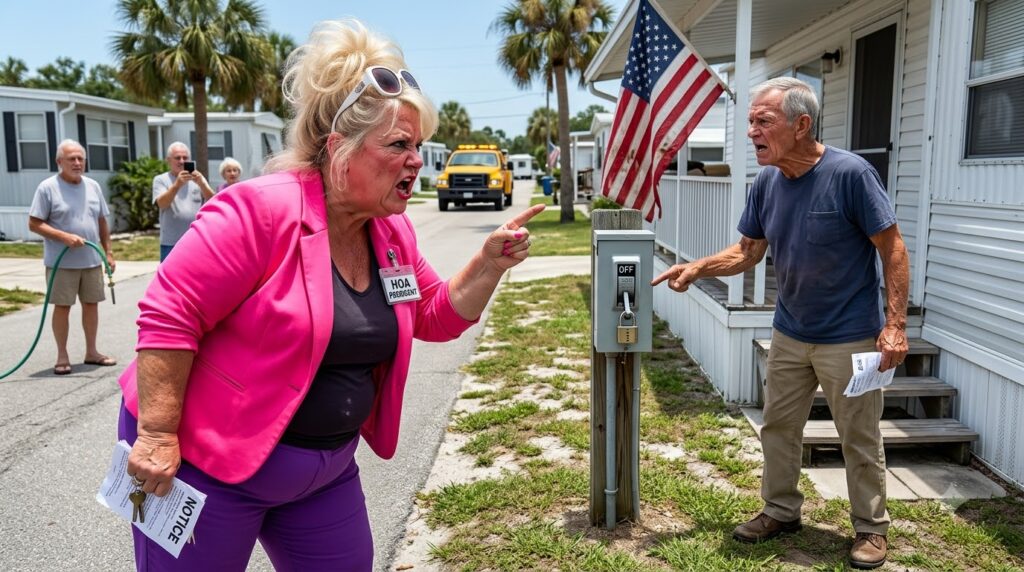
There was Brenda, standing beside the disconnect enclosure.
There was the switch being thrown.
There was the padlock.
And there was her furious declaration that Thomas’s rights did not matter.
Several residents shook their heads.
One woman covered her mouth.
An elderly man near the back whispered that he could not believe what he was seeing.
Brenda tried to explain that the footage lacked context.
But the recording showed the essential facts clearly.
Then Daniel Ruiz stood.
He had attended at Thomas’s request, with his employer’s permission, to explain the electrical equipment and the service interruption.
Daniel confirmed that SunCoast Community Utilities had received no authorized disconnection request for Thomas’s home.
He explained that the HOA president was not an authorized operator of the equipment.
He also confirmed that the enclosure had required inspection and repair before service could be restored.
He did not speculate about Brenda’s motives.
He did not accuse her of intentionally damaging the mechanism.
He stated what the company had documented.
That was enough.
A murmur spread through the room.
Brenda’s fellow board members began looking at one another.
For the first time, they appeared to understand the seriousness of what had happened.
Then Robert Ellis stood near the back.
He introduced himself as the former treasurer.
He asked whether the board had approved the contract with Whitmore Administrative Services.
Brenda’s expression changed.
The room grew quiet again.
Robert held up copies of the financial statements.
He asked whether Brenda had disclosed her son’s ownership of the company.
One board member turned toward her.
“Brenda,” he said, “what contract?”
She insisted that the payments were legitimate administrative expenses.
Robert asked to see the approval minutes.
Brenda could not produce them.
The board secretary began searching through her records.
The property management representative requested copies of the invoices.
Brenda accused Robert of conducting a personal vendetta.
But the discussion had moved beyond personal accusations.
The other board members wanted answers.
Thomas watched Brenda shuffle through her papers.
The woman who had screamed that she made the rules was suddenly struggling to explain how those rules had been applied.
Before the meeting ended, the board voted to suspend enforcement of Thomas’s disputed flag penalties pending legal review.
It also voted to request an independent examination of the association’s financial records.
Brenda opposed both motions.
She lost both votes.
Then one of the board members made a third motion.
He requested a special meeting to consider removing Brenda from the presidency.
The room became completely still.
Brenda stared at him as though he had betrayed her.
Thomas remained seated.
He felt no satisfaction in watching someone panic.
But he understood something important.
For the first time in months, Magnolia Pines was beginning to function like a community rather than a kingdom.