Chapter 6: The Price of Speaking Up
The week after the clubhouse meeting was not peaceful.
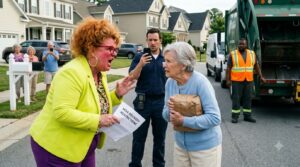
Brenda refused to accept the board’s decisions gracefully.
She sent residents a lengthy email claiming that outside agitators were attempting to destroy the association.
She accused Robert of spreading misleading financial information.
She described Thomas as a troublemaker who had deliberately provoked a confrontation.
Several residents received warnings about discussing HOA business on social media.
One woman was told that distributing copies of association documents could result in legal action.
The threats had the opposite effect Brenda intended.
People who had remained silent began sharing their experiences.
Evelyn collected written statements from residents who believed they had been treated unfairly.
Harold helped neighbors preserve photographs, emails, and payment receipts.
Laura created a simple chronological record of her father’s dispute.
Thomas contacted a Florida attorney named Rebecca Sloan, whose practice included community association disputes and property rights.
Rebecca reviewed the governing documents, the violation notices, the video, and the utility company’s records.
She was careful not to promise an easy victory.
HOA disputes could become expensive.
Florida law and the community’s recorded documents mattered.
The specific powers granted to the board had to be examined.
But she identified several serious concerns.
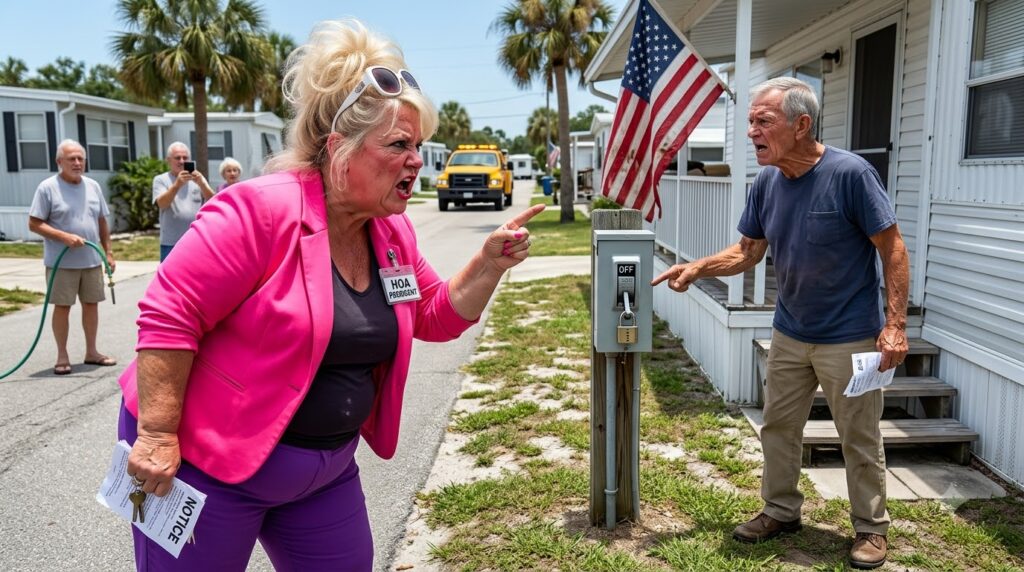
The association’s rule about porch attachments did not appear to justify the broad flag prohibition Brenda claimed.
Federal protections for displaying the American flag also had to be considered.
The electricity shutoff presented a separate and potentially more serious issue because Brenda had physically interfered with equipment outside her authorized control.
Rebecca advised Thomas to preserve every document and avoid direct confrontations with Brenda.
She also contacted the utility contractor to request its incident records.
Meanwhile, the independent financial review began.
The board hired an outside accounting firm to examine the disputed enforcement fees and related-party payments.
Within days, the reviewers found that several invoices lacked supporting documentation.
Some payments had been approved without the required signatures.
Others were coded as emergency services even though the associated work appeared to involve ordinary administrative tasks.
The accountants also discovered that certain penalty payments had been directed through a separate collection account not properly reconciled in the association’s monthly reports.
The findings were preliminary.
They did not establish that Brenda had personally stolen money.
But they showed weaknesses in financial controls and raised questions about who had authorized the transactions.
The board suspended further payments to Whitmore Administrative Services while the review continued.
Kevin Whitmore, Brenda’s son, responded through an attorney.
He claimed his company had performed legitimate services and that any documentation problems were administrative mistakes.
The board requested evidence of the work.
Then another development complicated matters.
A resident named Patricia Wells contacted Laura.
Patricia was sixty-seven and lived alone near the community entrance.
She had paid a seven-hundred-dollar emergency compliance assessment six months earlier after Brenda threatened additional penalties over a temporary accessibility ramp.
Patricia had kept the receipt.
But the payment did not appear in the association account summary provided to her.
Laura passed the information to Rebecca and the independent reviewers.
Patricia’s case became one of several requiring closer examination.
Thomas began to feel the weight of what had started with his flag.
He had never wanted to become the center of a neighborhood dispute.
He missed his ordinary routine.
He missed sitting quietly on the porch without worrying about who might be watching.
He worried that his neighbors would eventually grow tired of the conflict.
One afternoon, he found himself staring at Margaret’s photograph.
He remembered how she handled difficult people.
She rarely raised her voice.
She believed that anger could make a person feel powerful without accomplishing anything.
What mattered, she used to say, was whether you left a situation better than you found it.
Thomas sat with that thought for a long time.
Then he went outside.
Harold was trimming a hedge across the street.
Evelyn was carrying groceries from her car.
A young maintenance worker was repairing a broken sprinkler near the community entrance.
Life was continuing.
And that, Thomas realized, was what he wanted to protect.
Not simply his own flag.
Not merely his own electricity.
He wanted Magnolia Pines to become a place where people could grow old without being frightened by the individuals elected to represent them.
That evening, he wrote a short letter to the board.
He did not demand Brenda’s humiliation.
He asked for clear rules, fair procedures, transparent finances, and protection against retaliation.
He requested that all residents be treated with dignity, regardless of age, disability, income, or willingness to challenge a decision.
The letter circulated throughout the neighborhood.
By the next morning, forty-three households had signed a statement supporting those principles.
The movement was no longer about one veteran.
It was about the kind of community they wanted to live in.