Chapter 8: The Door That Stayed Open
The envelope arrived on a cool Saturday morning in late November.
There was no HOA logo.
No threatening language.
No official-looking seal.
Only Daniel’s name written in careful blue ink.
Inside was a handwritten letter from Karen Whitmore.
Daniel stood at his kitchen counter and read it.
Karen did not ask him to forgive her.
She did not claim that he had misunderstood her intentions.
Instead, she acknowledged entering his garage without permission and damaging his bicycle.
She admitted that covering the security camera had been wrong.
She also acknowledged that she had confused her responsibilities as HOA president with personal authority over other homeowners.
The letter was not perfect.
Karen still wrote defensively about the pressure of managing neighborhood complaints and the years she had spent volunteering.
But she no longer insisted that her position had entitled her to Daniel’s garage.
She ended by saying she would respect his property and leave him alone.
Daniel folded the letter.
He did not feel sudden affection for Karen.
Trust, once broken, could not be restored by a few paragraphs.
But he recognized the difference between an apology and another excuse.
He placed the letter in his folder and went outside.
His garage door was open.
Inside, the blue bicycle stood on a repair stand.
The replacement wheel had arrived the previous afternoon.
Laura and Ethan were coming over to help finish the restoration.
Daniel had already cleaned the frame and polished the old metal components.
A local bicycle mechanic had inspected the frame and confirmed that the damage could be repaired safely.
The work had taken longer than expected.
But Daniel had not wanted to rush it.
Every scratch seemed connected to a memory.
Every repaired part reminded him of his father.
By noon, Ethan was tightening the final bolts while Laura organized the tools.
Daniel checked the brakes, adjusted the seat, and tested the wheels.
Then he rolled the bicycle onto the driveway.
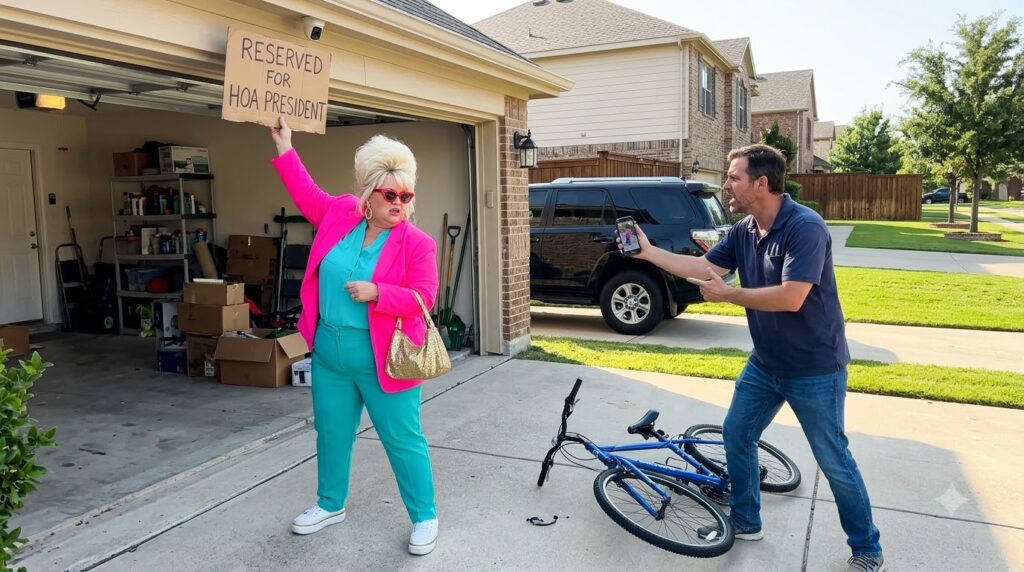
The same driveway where Karen had thrown it months earlier.
This time, the bicycle stood straight.
The blue paint caught the afternoon sunlight.
Ethan asked whether he could ride it.
Daniel hesitated.
Then he remembered his father teaching neighborhood children how to repair their own bicycles.
Robert had never treated his possessions as objects meant to remain untouched.
He believed useful things should be used.
Daniel adjusted the seat for Ethan and watched him ride slowly down the street.
Laura stood beside him.
Neither spoke for a while.
Across the neighborhood, life was changing in quieter ways.
Margaret Collins had returned her husband’s wooden bench to the front porch after the association reviewed and withdrew the unsupported demand against it.
Thomas Reed had received a refund for a fine the board determined had been improperly assessed.
Several other homeowners had their cases reviewed, with corrections made where the records supported them.
The independent financial review had also produced consequences.
The association recovered certain questioned payments through a negotiated repayment arrangement and adopted new accounting safeguards. The board preserved the remaining records for any further review by the appropriate authorities.
Karen no longer attended HOA meetings.
Her black SUV remained parked at her own home.
She had arranged to clear enough space in her garage to accommodate it.
Daniel occasionally saw her driving through the neighborhood.
They did not wave.
They did not argue.
They simply continued with their separate lives.
And that, Daniel decided, was enough.
The following spring, Oakridge Estates held its annual neighborhood gathering.
Evelyn helped organize a community bicycle safety day.
Daniel volunteered to inspect brakes, adjust seats, and teach children basic maintenance.
He brought his father’s blue bicycle.
Beside it, he placed a small framed photograph of Robert Mercer standing in the driveway years earlier, surrounded by children holding bicycles.
Evelyn looked at the photograph for a long time.
She remembered those afternoons.
She remembered Robert laughing as children struggled to understand how bicycle chains worked.
And she remembered the quiet pride he took in helping someone learn a useful skill.
By the end of the afternoon, Daniel had repaired seven bicycles.
Ethan had helped with four.
Margaret sat on a folding chair nearby, watching the children ride through the cul-de-sac.
Richard stopped by to thank Daniel for helping the neighborhood move forward.
Daniel shook his hand.
He did not consider himself a hero.
He had simply refused to surrender something that belonged to him.
But the experience had taught him that fairness required more than good intentions.
It required records, procedures, accountability, and people willing to speak when something was wrong.
That evening, after the last family left, Daniel carried his tools back into the garage.
He placed the blue bicycle beside the storage shelves.
The gardening equipment was neatly arranged.
The cardboard boxes were stacked against the wall.
Everything was exactly where he wanted it.
Above the garage entrance, the security camera remained mounted in its original position.
Daniel glanced at it.
He hoped he would never need footage like that again.
Then he looked toward the street.
Evelyn was sitting on her porch, enjoying the evening air.
Margaret’s garden bench was visible farther down the block.
Children were riding bicycles under the fading Texas sky.
The neighborhood was not perfect.
It never would be.
But it belonged to people who were learning to respect one another again.
Daniel reached for the garage-door button.
Before pressing it, he looked once more at his father’s bicycle.
For months, the garage had represented a battle over authority, privacy, and personal dignity.
Now it was simply his garage again.
A place for tools.
A place for memories.
A place where a father could leave something meaningful to his son, and where that son could pass the memory to another generation.
Daniel pressed the button.
The door descended slowly, shutting out the evening breeze.
He watched until it reached the concrete.
Then he turned toward the house, where Laura and Ethan were waiting for dinner.
He had never wanted power over his neighbors.
He had only wanted the freedom to live peacefully in his own home.
And in the end, that was what he had protected.
THE END