
Chapter 4: The Neighbors Who Had Stayed Silent
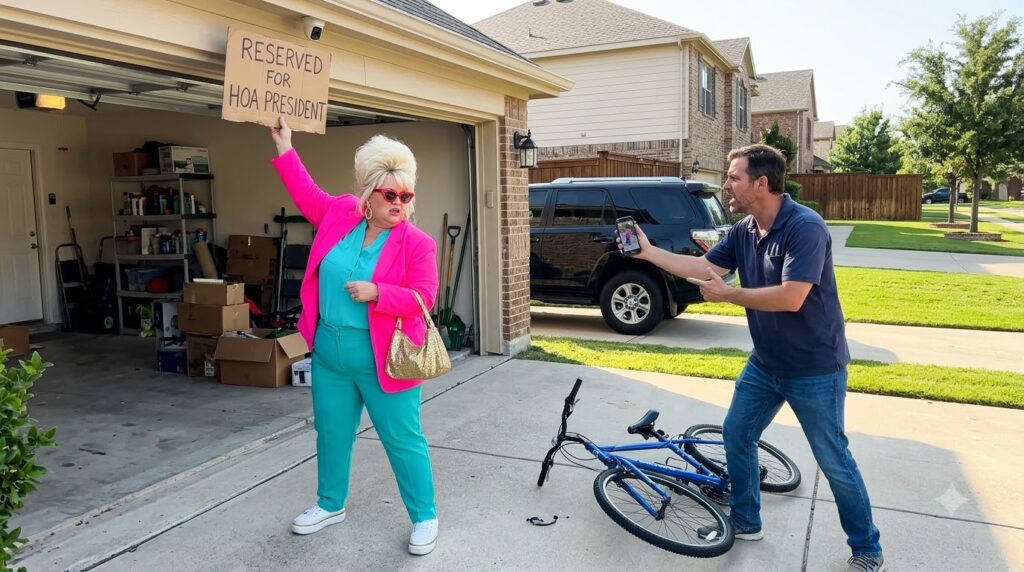
Daniel did not post the security footage online.
He wanted the facts documented before the neighborhood turned into a battlefield of rumors.
Instead, he contacted several homeowners he trusted.
Evelyn helped him arrange a small gathering at her house on Sunday afternoon.
Eight neighbors attended.
Among them was Margaret Collins, a 72-year-old widow who lived near the community pond.
Margaret had rarely spoken at HOA meetings.
She disliked confrontation and had spent the previous year caring for her husband before his death.
When Daniel described Karen’s attempt to take over his garage, Margaret lowered her eyes.
Then she opened her purse.
Inside was a folded letter.
Six months earlier, Karen had ordered Margaret to remove a wooden garden bench from her front porch.
The bench had been built by Margaret’s husband.
Karen claimed it violated neighborhood appearance standards.
Margaret had asked for the specific rule.
Karen never provided one.
Instead, she threatened escalating fines.
Margaret eventually moved the bench into storage.
She had not sat on it since.
Another neighbor, Thomas Reed, described receiving a fine for parking his daughter’s car in his driveway during a holiday visit.
A third homeowner had been warned about an allegedly unauthorized security camera.
A fourth had paid a landscaping penalty despite producing photographs showing the work had been completed before the deadline.
Individually, the incidents had seemed like unpleasant but ordinary HOA disputes.
Together, they suggested a pattern.
Karen issued demands with confidence.
Homeowners complied because they feared fines, legal costs, or public embarrassment.
Few challenged her authority.
Evelyn listened to each account.
She had spent thirty-five years teaching children about responsibility and fairness.
She knew that rules mattered.
But she also knew that rules lost their legitimacy when the people enforcing them stopped following them.
Daniel asked the neighbors to collect their notices and payment records.
He explained that he was not trying to destroy the HOA.
He wanted it to function properly.
Most homeowners had joined Oakridge Estates because they valued the neighborhood’s quiet streets, maintained landscaping, and shared amenities.
They did not want chaos.
They wanted accountability.
By Monday, Daniel had received copies of twelve questionable violation notices.
Several cited provisions that did not exist in the governing documents.
Others imposed penalties without documenting the required enforcement process.
Two contained signatures from board members who said they had never approved them.
Richard Bell agreed to review the association’s financial records.
He discovered that Karen had approved reimbursements totaling $8,460 over the previous eight months.
The payments were described as parking-management expenses, security improvements, and emergency administrative supplies.
Some receipts appeared legitimate.
Others lacked vendor details.
One invoice was issued by a business called Whitmore Property Solutions.
Richard recognized the name.
Karen’s former decorating business had operated under a similar name.
He requested additional records from the management company.
The response revealed that the payment account belonged to a company registered by Karen’s adult son, Brandon Whitmore.
That did not automatically prove wrongdoing.
The HOA could legally hire a company connected to a board member under some circumstances, depending on its governing documents and applicable law.
But the relationship had not been disclosed in the records Richard reviewed.
And there was no clear evidence of competitive bids or proper board approval.
Richard brought the information to Daniel and Evelyn.
Daniel felt his stomach tighten.
The garage incident had begun with Karen wanting a convenient place to park.
Now the evidence suggested that she had also been using her position to direct association business toward her family.
The group agreed to request a formal board meeting and an independent review.
They also decided to consult an attorney experienced in Texas property and HOA disputes.
Karen learned about the gathering within hours.
On Tuesday morning, Daniel found a new sign attached to the community bulletin board.
It warned residents against participating in unauthorized neighborhood meetings.
The notice described such gatherings as potentially disruptive to community harmony.
At the bottom was Karen’s signature.
But the sign did not produce the effect she expected.
By that evening, twenty-three homeowners had asked to join the next meeting.
For the first time in years, Karen was losing control of the conversation.
And the more neighbors compared their experiences, the clearer it became that Daniel’s garage had not been an isolated target.








