Chapter 7: The Settlement That Came With Strings
Daniel read the proposed settlement twice.
Karen offered to pay for the bicycle repairs and reimburse Daniel for certain expenses.
In exchange, she wanted a broad confidentiality agreement.
The document would prohibit Daniel from sharing the garage footage, discussing the dispute with neighbors, or assisting future claims against her.
It also required him to acknowledge that the matter had resulted from a misunderstanding.
Daniel set the papers on his kitchen table.
There had been no misunderstanding.
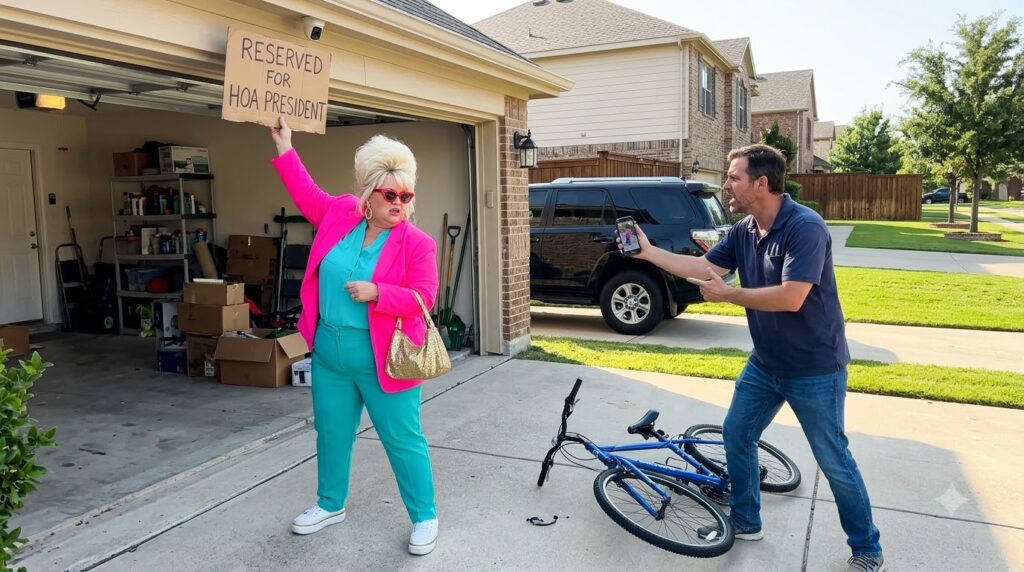
Karen had entered his garage without permission.
She had thrown his father’s bicycle onto the driveway.
She had claimed authority she did not possess.
And she had attempted to conceal the security camera.
Sarah explained that confidentiality provisions were common in settlements.
But Daniel did not have to accept terms that were broader than he considered reasonable.
They could negotiate.
Daniel told her he would consider resolving his personal financial claims, but he would not agree to erase the truth or prevent himself from cooperating with legitimate investigations.
Sarah sent a counterproposal.
Karen’s attorney did not respond immediately.
Meanwhile, the HOA board began the formal process of removing Karen from her leadership position.
Under the association’s bylaws, the board could replace its officers, while removal from an elected board seat required a separate membership procedure.
The distinction was important.
The board scheduled a vote on the presidency and initiated the required process for a homeowner recall election.
For weeks, residents discussed the upcoming decisions.
Some still supported Karen.
They believed she had made mistakes but argued that she had also improved the neighborhood.
Others wanted her removed immediately.
Evelyn urged everyone to follow the rules.
She reminded the neighbors that the entire controversy had begun because Karen believed rules applied only when they served her.
The community could not repair that damage by ignoring its own procedures.
At the next board meeting, Karen was removed as president by the required vote.
Richard Bell was appointed interim president.
He accepted reluctantly.
His first action was to ask the management company to review outstanding violation notices for procedural errors.
His second was to propose stronger financial controls.
Future expenditures above a specified threshold would require documented approval.
Vendor relationships involving board members or their families would have to be disclosed and handled under applicable conflict-of-interest procedures.
Homeowners would receive clearer information about enforcement hearings and appeal rights.
The board also approved a review of existing policies to distinguish genuine property restrictions from informal preferences that had accumulated over the years.
For Daniel, the most important change was simpler.
No HOA officer would be allowed to treat a private garage as association parking.
That should never have needed clarification.
But now it was written plainly in the board’s records.
The recall election took place three weeks later.
Homeowners returned ballots through the procedures specified in the governing documents.
The turnout was unusually high.
When the votes were counted, Karen lost her board seat.
The result was decisive.
She no longer held any elected HOA position.
A few days later, Karen’s attorney contacted Sarah.
This time, the settlement proposal was different.
Karen agreed to pay the documented bicycle restoration costs and Daniel’s reasonable out-of-pocket expenses associated with the property damage.
She also agreed not to enter his property without permission or interfere with his lawful use of the garage.
The broad confidentiality demand had been removed.
The agreement made clear that Daniel could comply with lawful requests for information and participate in HOA proceedings.
It did not require him to describe the incident as a misunderstanding.
Daniel accepted the revised terms after Sarah reviewed them.
The settlement resolved his civil dispute with Karen.
It did not determine whether any separate criminal or financial violations had occurred.
Those questions remained with the appropriate authorities and the association’s independent review process.
For the first time in months, Daniel felt that the end was approaching.
But he still had one unresolved concern.
Karen had not apologized.
And although the settlement required her to respect his property, Daniel wondered whether she understood why what she had done was wrong.
He received an answer sooner than expected.
Not through another confrontation.
Through a letter delivered to his mailbox.