
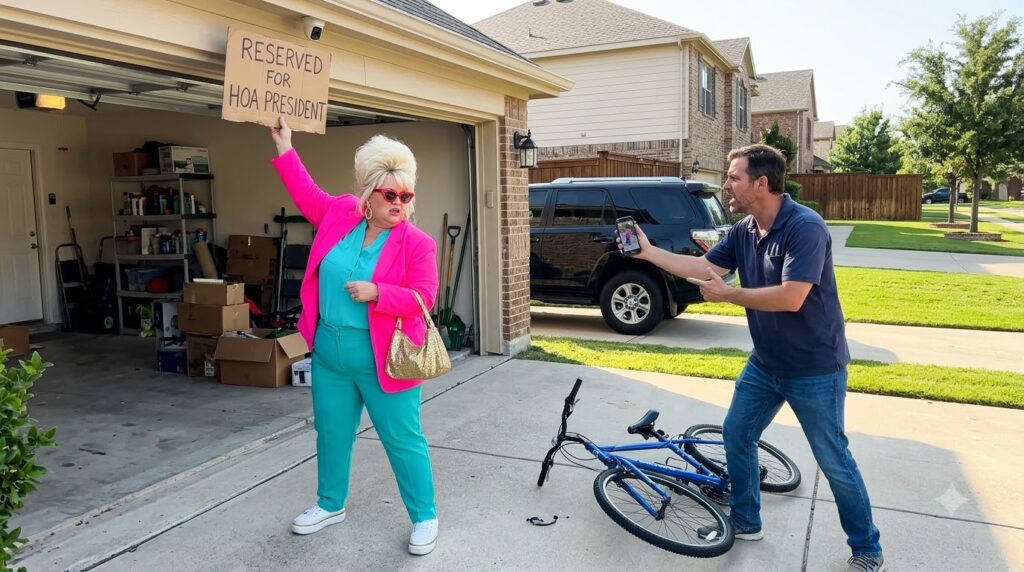
Chapter 2: The Authority She Never Had
Officer Marcus Hill arrived at 3:42 that afternoon.
He had worked in the Dallas area for nearly fifteen years and had handled more neighborhood disputes than he cared to remember.
Most involved fences, barking dogs, parking spaces, or arguments about property lines.
He had never encountered an HOA president who claimed the right to occupy another homeowner’s garage.
Karen approached him before Daniel could speak.
She introduced herself as president of the Oakridge Estates Homeowners Association and presented a laminated identification badge.
She explained that Daniel was refusing to cooperate with an authorized neighborhood parking arrangement.
Officer Hill listened without interrupting.
Then he asked whether Karen owned the garage.
She said no.
He asked whether Daniel had given her permission to use it.
She said permission was unnecessary.
He asked whether she had a written agreement, court order, or other document granting access.
Karen opened her glittering handbag and produced a printed notice bearing the HOA logo.
The document was titled Temporary Executive Parking Allocation.
It stated that the association president could designate underutilized residential parking areas for temporary administrative use.
Daniel had never seen it.
Officer Hill examined the paper.
There was no signature from Daniel, no reference to his deed, and no evidence that the association possessed any ownership or easement rights over his garage.
Karen insisted that the document was sufficient.
Officer Hill explained that an HOA title did not, by itself, authorize entry into privately owned property.
He asked Karen to leave Daniel’s driveway.
Her face reddened.
She began talking about the money she had contributed to the neighborhood, the improvements she had supervised, and the disrespect she endured from younger homeowners.
Officer Hill remained calm.
He asked again.
This time Karen returned to her SUV.
Daniel showed the officer his security footage.
The recording clearly captured Karen entering the garage, removing the bicycle, and placing the sign near the entrance.
It also showed her attempting to cover the camera.
Officer Hill documented the incident, took photographs of the damaged bicycle, and recorded the details for an official report.
He explained that further investigation would determine whether any criminal charges were appropriate. Daniel could also pursue compensation for the damaged property.
Before leaving, the officer warned Karen not to enter Daniel’s garage again without permission.
She drove away with her tires crunching angrily over the driveway.
For a moment, Daniel believed the worst was over.
Then his phone vibrated.
An email had arrived from the HOA management address.
NOTICE OF NONCOMPLIANCE — GARAGE STORAGE VIOLATION
Daniel opened it.
The association was demanding that he remove all non-vehicle items from his garage within seven days.
Failure to comply could result in daily fines.
A second paragraph accused him of obstructing an authorized association inspection.
The notice was signed electronically by Karen Whitmore.
Daniel stared at the screen.
She had sent it less than ten minutes after leaving his property.
That evening, Evelyn crossed the street carrying a covered casserole dish.
Daniel invited her into the kitchen.
His house was modest compared with some of the newer homes in Oakridge Estates. Family photographs lined the hallway. A framed picture of his father standing beside the blue bicycle hung near the dining room.
Evelyn noticed it immediately.
She had known Robert Mercer.
Years earlier, Robert had volunteered to repair bicycles for children whose families could not afford new ones. During summer weekends, he would set up a folding workbench in Daniel’s driveway and teach neighborhood children how to fix flat tires.
Evelyn remembered those afternoons.
She remembered Robert’s patience.
And she remembered how proud he had been when Daniel bought his first home.
Daniel told her about the violation notice.
Evelyn read it twice.
Then she frowned.
She had served on the original neighborhood advisory committee before Oakridge Estates elected its first formal HOA board.
The association’s governing documents contained restrictions on exterior appearance, landscaping, and certain visible property conditions.
But she remembered no rule prohibiting ordinary household storage inside a private garage.
More importantly, she remembered a specific provision limiting the association’s access to private property.
She offered to find her old documents.
Before leaving, Evelyn showed Daniel the video she had recorded from her porch.
Her recording captured Karen throwing the bicycle and later covering the security camera.
It also captured the black SUV’s license plate and the homemade sign.
Daniel thanked her.
After she left, he opened his security application again.
He searched through the previous week’s recordings.
At first, he found nothing unusual.
Then he noticed a motion alert from three nights earlier.
The timestamp read 11:47 p.m.
A black SUV had pulled into his driveway.
Karen had stepped out carrying a flashlight.
She had walked toward his garage door, examined the keypad beside it, and photographed the security camera.
Daniel watched the recording twice.
Karen’s invasion had not been a sudden impulse.
She had been planning it.
And when he examined the footage from the following night, he discovered that she had not been working alone.








