
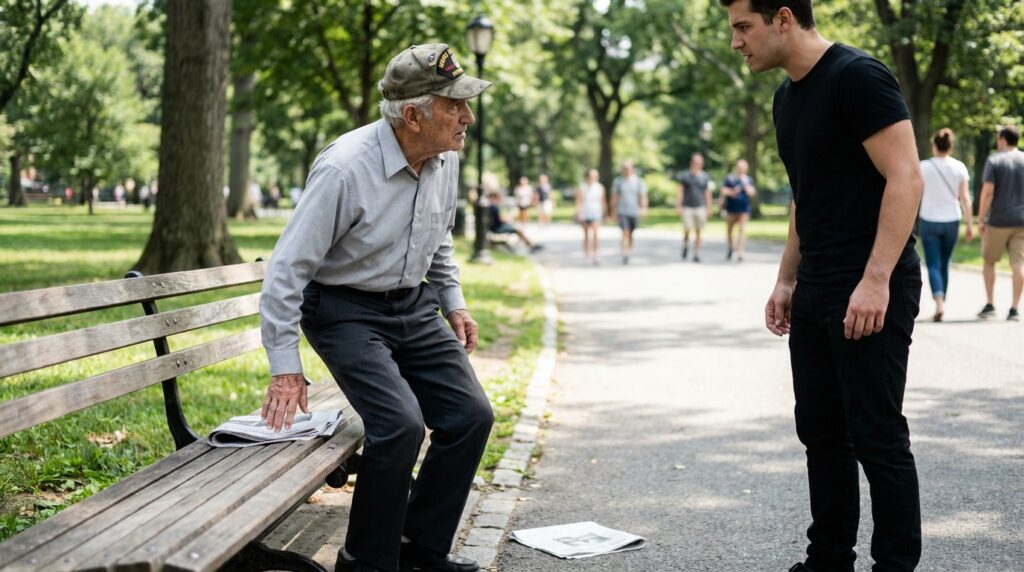
The Cold Geometry of Restraint and the Price of Unearned Arrogance on the Asphalt Line
CHAPTER 1: THE GEOMETRY OF PRESSURE
The shadow fell across the crisp pages of the morning ledger before the boots even registered on the cracked asphalt. It was a heavy, calculated shadow, wide in the shoulders and completely wrong for the easy, golden angle of the 9:00 AM sun.
John did not look up immediately. He kept his thumbs pressed flat against the outer margins of the newsprint, feeling the faint, rhythmic pulse of his own blood against the paper. In his front pocket, the hard, serrated rim of the brass challenge coin bit into his thigh—a familiar, grounding friction. He counted three short breaths, mapping the exact proximity of the intruder by the scraping sound of thick rubber soles against the loose grit near the green wood slats of his bench.
“You old timers think you own this park just because you’re wearing a faded hat? Get out of my way.”
The voice was too loud for the morning. It carried the sharp, synthetic edge of unearned confidence, intentionally projected to ensure the scattered joggers and the mother with the stroller near the treeline would turn their heads. Public pressure. An asymmetric arena. John noted the cadence—rapid, shallow breathing underneath the bluster, the classic markers of a man who needed an audience to validate his weight.
John lowered the newspaper with a slow, deliberate folding motion, creasing the center line until the stark black text vanished. He adjusted his dark blue veteran cap, the structured buckram behind the crest stiff against his forehead, forcing his spine to settle into a rigid, unyielding vertical axis. His joints popped—a dry, metallic sound that felt loud in his own ears—but his shoulders didn’t drop. He rose from the green slats, his movement economical, reclaiming his six feet of height with the steady, heavy geometry of a drill instructor correcting a line.
The younger man didn’t back off. He smelled of synthetic laundry detergent and sour, nervous sweat. Up close, the black fitted t-shirt stretched tight over an athletic frame that had never known the specific, hollow exhaustion of a multi-day march. His chest was puffed, his chin tilted up to use his size as a blunt instrument. He was less than an arm’s length away now, a direct violation of tactical distance.
John looked straight through the glare, his internal monologue stripped of everything except the calculation of risk. Left foot anchored on the asphalt crack. Right hip slightly dropped. The young man’s weight was centered on his heels—arrogant balance. Soft.
“Respect the people who built the freedom you enjoy today,” John said. His voice wasn’t loud, but it had the low, gravelly timbre of iron sliding over granite. It stayed within the tight circle of their interaction lane, solid and heavy.
A sneer twitched the corner of the younger man’s mouth. “Old meat,” he muttered, and his right shoulder hitched forward—a crude, telegraphed lunging motion meant to crowd John back onto the wood slats. A thick, clean-shaven hand rose to grip John’s collar.
The air between them vanished. John didn’t flinch. His mind didn’t seek violence; it executed physics. As the fingers brushed the light gray fabric of his button shirt, John’s left hand snapped up, thumb locking into the soft meat between the challenger’s thumb and index finger, a sudden, freezing vice. Simultaneously, John pivoted his right heel forty-five degrees outward, dropping his center of gravity into the pavement, letting the younger man’s aggressive forward momentum carry him past the point of recovery.
There was no spectacular combat choreography. There was only friction, weight, and a brutal redistribution of force. John’s right forearm cleared the space with a short, blunt horizontal strike against the challenger’s extended bicep, breaking the posture completely.
The newspaper slipped from John’s fingers, the crisp pages catching the wind as the young man’s athletic frame met the uncompromising reality of the asphalt. A dense, hollow thud rattled through the path.
John stood perfectly upright over the fallen shape, his breathing unchanged, his eyes locked onto the stunned, pale face looking up from the dirt-smudged ground. But as the younger man rolled back, his phone slipped from his pocket, the screen lighting up to reveal an incoming text message with an unredacted tactical coordinate John hadn’t seen in thirty-two years.

CHAPTER 2: THE GRAVITY OF AN ANCHOR
“Pick it up.”
The command didn’t leave John’s throat so much as it fell from his jaw, flat and unyielding like a lead weight dropped into soft mud. He didn’t reach for the phone glowing against the gray stone. His boots remained anchored, his heels locked into the crack of the path, maintaining the exact vertical alignment that had just put two hundred pounds of athletic muscle on the ground.
The younger man was still on his back, his breath escaping him in a ragged, whistling hiss that signaled a bruised rib or a clean loss of wind. His black t-shirt was tore at the shoulder, the synthetic fabric smeared with a gray streak of park dust. The unearned confidence had drained from his eyes, replaced by the wide, empty white of a biological system experiencing sudden, total system failure. He looked at the glass screen, then up at John’s faded cap, his fingers twitching against the gravel.
“I said,” John repeated, his voice dropping into that low, gravelly register where the edges of his words scraped together like dry slate, “pick it up. And turn the face down.”
Around them, the park had gone completely cold. The jogger who had slowed down fifty yards back was now a static shape against the oak trees, her phone held out at chest level, capturing the frame but not the context. John didn’t look at her. He didn’t look at the stroller forty yards to his left either. His world had narrowed to the hard lines of the asphalt and the specific numbers flickering on the glass.
04-Alpha-09.
The characters were small, nestled in the top corner of an encrypted thread, but the syntax was unmistakable. It was the old Department of Defense routing string for the western sector of the Panmunjom corridor—a network that had been officially decommissioned and scrubbed from the active ledgers before the man on the ground was even a mark on a sonogram.
The challenger scrambled backward, his palms scraping against the grit as he reached out, snatched the device, and shoved it face-down into the grass. His athletic frame looked smaller now, his shoulders hunched as he tried to find his footing without breaching the invisible perimeter John’s posture had established.
“Alright,” the young man muttered, his teeth clicking together as he forced the words through a tight jaw. “Alright, I get it. I’m moving.”
“Who gave you the alignment?” John asked. He didn’t move an inch. His hands were loose at his sides, fingers hooked slightly, the brass coin in his pocket cold against his thumb. He was calculating the distance to the treeline, the visibility from the perimeter road, the exact seconds it would take for a standard municipal patrol car to answer a disturbance call if the girl with the phone hit the three-digit dial.
“Nobody,” the kid said, his voice rising a fraction as he found his balance, his knees shaking slightly within his black pants. “It’s just an app. A job. Some guy on the forum paid five hundred bucks to see if the guy on the third bench on Saturdays was still an active placeholder. That’s it. Just a check-in.”
“A check-in doesn’t use sector routing from eighty-four,” John said. He stepped forward—one short, heavy stride that closed the distance by twelve inches. The movement was so deliberate, so devoid of hesitation, that the younger man instinctively flinched, his heel catching on the iron rim of the flower bed behind him. “And a check-in doesn’t send a runner who knows how to drop his weight before a shoulder check. You were testing the brace.”
The kid didn’t answer. He couldn’t. His mouth stayed shut, but his eyes darted toward the phone hidden in his palm. He was a contractor, a low-tier asset bought with digital scrip and a generic description, but the hand that had programmed the interface knew exactly which nerve to poke.
John looked down at his own light gray sleeve. The fabric was unwrinkled, save for the single small smudge where the kid’s fingers had almost found a grip before the redirection took his balance. His joints didn’t ache yet—that would come in the late afternoon when the dampness from the lake crawled into his lower lumbar—but right now, the old adrenaline was working like grease in a dry transmission.
“Leave the park by the north gate,” John told him, his words clipped and transactional. “If I see your shadow on this path before the sun hits the treeline next week, we won’t use the asphalt. We’ll use the iron.”
The younger man didn’t wait for a third warning. He turned, his rubber soles slurring against the gravel as he broke into a clumsy, uncoordinated jog, his head down, his phone tucked deep into his pocket where the screen couldn’t reflect the light. He didn’t look back at the witnesses. He didn’t look at John. He just ran toward the concrete stairs leading up to the street level, his black shirt a fading dot against the gray limestone walls of the park boundary.
John stayed in the lane for exactly sixty seconds, letting his heart rate drop back into the double digits by counting the gray slats on his bench. One. Two. Three.
When the air in his lungs tasted like old dust instead of iron, he reached down and picked up his newspaper. The front page was torn near the bottom margin, a jagged white scar running through the local real estate listings. He smoothed it out with the palm of his hand, pressing the paper against his thigh until the crease was straight again.
But as he lifted the ledger to tuck it under his arm, he noticed something else. Where the kid’s phone had hit the asphalt, a small, square piece of plastic had broken away from the cheap protective casing. It was a gray SIM tray adapter, the kind used for old-generation satellite modules, and scratched into the plastic with the point of a needle was a single five-digit number: 74412.
John’s thumb went static against the paper. That wasn’t a coordinate. It was an operator insurance policy number from the old corporate oversight division in Virginia. The desk that had handled his retirement—and his erasure—thirty years ago.
He tucked the plastic fragment into his shirt pocket, right behind his veteran cap’s shadow, and began walking toward the south exit. The park was still silent, but the edges of the trees felt closer now, like the walls of an approach trench narrowing down to a single lane.
CHAPTER 3: THE BREADCRUMB ANCHOR
The limestone archway of the south gate met the street at a sharp, ninety-degree intersection. John stopped beneath the shadow of the stone, his back pressed into the cold, rough-hewn seam where the mortar had cracked over thirty winters. He folded the newspaper under his left arm, his hand resting directly above the shirt pocket containing the tiny gray piece of shattered plastic.
A silver sedan sat idling forty yards down the curb, its exhaust casting a light, rhythmic tremor through the damp morning air. The front windows were tinted to a dark, featureless sheen that defied the unfiltered sunlight. John didn’t stare at the vehicle. Instead, he watched the side-view mirror of a parked delivery truck across the asphalt lane, using the curved glass angle to track the reflection of the sedan’s front wheel alignment. The tires were turned outward toward the roadway at precisely fifteen degrees—the standard orientation for an emergency getaway or an immediate pursuit loop.
He turned the gray SIM adapter over inside his pocket with his index finger, feeling for the distinct, sharp imperfection he had noted earlier. It wasn’t just scratched with a number. Near the bottom corner, the plastic had been intentionally pierced by a circular punch—a micro-aperture used exclusively by field technicians in the late eighties to verify wire-tap integrity on analog lines before the data reached the Virginia relays.
The kid back on the path had been a crude weapon, but the hand that had packed his kit possessed an engineering signature that John could identify blindfolded.
He left the shadow of the archway, his gait even, his posture maintaining that rigid, unyielding vertical column. His boots struck the concrete pavement with a dull, rhythmic cadence. He wasn’t running; running changed the atmospheric baseline of a street, drawing the eyes of bored drivers and municipal cameras. He walked with the heavy, unhurried certainty of a man who belonged to the concrete.
The silver sedan didn’t accelerate as he moved past the bumper, but the faint, mechanical whine of an electric window motor cut through the engine noise. The glass dropped three inches. No face appeared in the gap, only the matte-black barrel of a compact directional microphone, its foam-padded tip angled directly at his left flank to catch the scrape of his boots and the rustle of his newspaper.
“The registry is closed, John,” a voice spoke from the interior darkness of the car. It wasn’t the voice of a kid from an online forum. It was dry, precise, and entirely devoid of regional inflection—the sanitized dialect of an analyst who spent decades in windowless basements reading transcripts. “You should have dropped the hat.”
John didn’t break his stride. He kept his eyes on the path ahead, his peripheral vision locked onto the sharp reflection of the car’s chrome trim. “The hat belongs to the uniform. The uniform is on the ledger.”
“The ledger was burned in ninety-four,” the voice replied, flat and transactional. “The assets were reallocated. You’re an unaccounted-for balance on an old spreadsheet, and the auditors are getting thorough.”
“Tell your operator that the runner he sent needs to work on his balance,” John said. His gravelly tone didn’t rise. It carried the solid, unhurried weight of a man who had already calculated the distance to the next brick corner. “His weight distribution is soft. If he comes back, I’ll take the leg next time instead of the shoulder.”
“He wasn’t sent to take the bench,” the voice murmured as the silver sedan began to roll forward, keeping perfect pace with John’s footsteps. “He was sent to see if you still use the left thumb lock when someone crowds your collar. You did. The sensor under his t-shirt mapped the kinetic signature in real-time. The system recognizes your signature, John. It always will.”
The window slid back up with a muted hiss, sealing the dark interior. The vehicle accelerated smoothly into the center lane, its tires humming against the asphalt as it integrated into the city traffic, leaving a faint smell of burnt premium fuel behind.
John reached the corner of Fourth and Elm, his hand going deep into his pocket to press his thumb against the hard, grooved edge of his challenge coin. The metal was warm now, heated by his skin, but it offered no comfort. The confrontation at the bench hadn’t been an act of random disrespect. It had been a calibration exercise—a physical interrogation disguised as a public humiliation attempt to force his nervous system to reveal its old training.
He turned into the narrow entryway of a basement-level diner, the door’s rusted brass latch clicking sharply under his fingers. The air inside smelled of old grease, chicory coffee, and damp wool. A row of low stools with cracked vinyl tops lined the laminate counter. He took the third stool from the end—the one that allowed a clear, unobstructed line of sight to both the street-level windows and the rear dishwashing exit.
He laid the torn newspaper on the counter, the jagged white tear on the front page exposing the blank margins underneath. He pulled the gray SIM adapter from his shirt pocket and set it down directly on top of the real estate columns, the five-digit number 74412 facing the light.
The counter clerk, an older woman with a faded blue apron and tired eyes, set a thick ceramic mug of black coffee down beside his ledger without asking for an order. She looked at the veteran cap, then at the scarred piece of plastic on the newsprint.
“Bad day at the park, John?” she asked, her voice carrying the dry, familiar cadence of someone who had seen twenty years of neighborhood regulars come and go.
John didn’t answer immediately. He picked up the coffee mug, feeling the intense, dry heat of the ceramic against his calloused palms. He looked through the low window at the street above, where the feet of anonymous pedestrians moved past in an endless, rhythmic blur.
“The park is fine, Martha,” John said, his voice dropping into the low, gravelly baseline of the room. “The ground just doesn’t hold its shape the way it used to.”
He reached down, turning the SIM adapter forty-five degrees to the right until the circular punch hole aligned perfectly with a grease smudge on the laminate counter. As the light hit the inner lip of the tiny aperture, he realized the hole wasn’t empty. Tucked inside the microscopic recess was a translucent thread of optical fiber, still pulsing with a faint, intermittent red spark that matched the cadence of his own heartbeat.
CHAPTER 4: THE SILENT PERIMETER
“Don’t look at the window, John.”
The voice came from two stools down. It was low, raspy, and carried the heavy, rhythmic wheeze of a smoker who had spent too many years breathing sub-zero air in northern listening posts.
John didn’t pivot his neck. His fingers remained wrapped tightly around the cold porcelain of his coffee mug, his thumbs mapping the tiny glaze cracks near the handle. In the reflection of the stainless-steel napkin dispenser directly ahead, a face took shape through the greasy laminate glare. It was an old face, structured with sharp, broken angles, half-hidden beneath the collar of a heavy wool coat that didn’t match the June morning heat.
“You’re late, Miller,” John said, his gravelly tone barely clearing the edge of his own saucer. “The lane at the south gate was cleared ten minutes ago.”
“The lane wasn’t cleared. It was rerouted,” Miller replied. He didn’t turn his head either. He kept his eyes locked on his own plate of untouched toast, his hands tucked deep inside his pockets. “The kid from the bench didn’t have an app, John. He had a transponder stitched into the waistband of those black pants. The fiber thread you’re looking at on that SIM tray? It’s not a relay link. It’s a proximity sensor. It didn’t just map your thumb lock—it broadcast your resting respiration rate and your weight-shift latency to an active satellite overhead.”
John’s internal calculation shifted instantly. The decoy secret—the five-digit insurance code 74412 pointing toward the old Virginia registry—was an intentional piece of meat dropped on the path to keep him looking down at the pavement. The true target wasn’t his past; it was his present operational capacity.
“They aren’t auditing the spreadsheet,” John muttered, his voice dropping into a flat, dangerous register. “They’re verifying the reflexes.”
“They’re verifying if you’re still a liability,” Miller said, his reflection in the napkin dispenser nodding slightly. “The old Panmunjom logs aren’t in Virginia anymore. They were migrated to a private server in a black-site bunker beneath the range in West Virginia three weeks ago. Someone is clearing the old names, John. Every single operator who carried the command codes for the eighty-four extraction is being run through a live field test. If you pass, you’re a threat. If you fail, you’re an obituary.”
A sudden, sharp click rattled through the diner’s old fuse box near the back kitchen. The buzzing fluorescent tube overhead flickered twice, casting long, erratic shadows across the grease-smeared laminate counter.
John didn’t wait for the third flicker. His strategic pursuit logic had already mapped the room’s physical layout: six paces to the heavy iron cash register, four paces to the basement stairs, and a single, unblocked exit route through the rear dishwashing scullery. He dropped two dollar bills onto the counter, his thumb brushing the torn edge of his newspaper as he gathered the ledger under his left forearm.
“Martha,” John said, his voice cutting through the low hum of the kitchen refrigerator with a clean, command-level authority. “Get behind the ice machine. Now.”
The older woman didn’t ask questions. She saw the sudden, rigid vertical alignment of John’s spine—the shift from a tired elder to an active weapon. She dropped her dish towel and stepped smoothly back into the dark recess of the pantry, her boots making no sound against the rubber floor mats.
The glass door at the top of the basement stairs didn’t open; it shattered.
A single, high-velocity projectile punched through the reinforced wire glass, showering the narrow concrete stairwell with a metallic spray of sharp fragments. The pressure wave didn’t carry the roar of a standard firearm; it was the dull, pneumatic cough of an internally suppressed tactical carbine, its cyclic rate optimized for enclosed urban spaces.
John dropped his center of gravity into the floorboards, his left hand snapping out to grab Miller’s wool collar before the older man could freeze on his stool. With a single, explosive burst of momentum, John dragged Miller off the vinyl top, using the heavy iron base of the counter stools as a partial ballistic deflector.
“They’re inside the perimeter,” Miller hissed, his breath coming in short, ragged gasps as his back hit the cold linoleum floor. His hands came out of his pockets, revealing a small, vintage revolver with a worn cylinder, its bluing completely scraped away by decades of friction. “The sedan didn’t leave. It was the blocking vehicle.”
A second projectile tore through the laminate counter six inches above John’s head, spraying a white cloud of pulverized particle board and hot grease across the newsprint. The physics of the trajectory were precise—the shooter was firing from an elevated position on the third step, using a thermal optic to trace the heat signatures through the thin wooden partition.
John looked at the gray SIM adapter lying in the dust near his boots. The tiny red spark inside the optical aperture wasn’t flashing anymore. It was solid, unblinking crimson—a complete lock. The sensor had guided the shooter directly to his seat.
He didn’t reach for a weapon; he didn’t have one. He had a faded cap, a torn newspaper, and forty years of ingrained, non-graphic tactical movement. He reached out and wrapped his calloused hand around the heavy, industrial-grade steel leg of the laminate counter table, his muscles tensing against the cold metal as the shadow of a tactical boot appeared at the top of the broken stairwell.
The decoy was gone. The survival line was narrowing to zero.
CHAPTER 5: THE TRANSACTION OF SILENCE
The steel stool leg groaned under the sudden allocation of John’s weight. He didn’t lift his upper torso; he drove his shoulder directly into the wood grain of the lower laminate trim, creating an immediate structural barrier between the shooter’s line of sight and Miller’s exposed ribs.
A third pneumatic cough vibrated through the basement air. The projectile punched a neat, circular aperture through the stainless-steel napkin dispenser, sending a sharp, glittering shower of paper scraps and torn chrome foil over the linoleum. The physics of the ricochet were precise—the shooter was moving down the steps with a slow, mechanical stride, the weight of a heavy tactical boot compressing the cracked concrete with calculated regularity.
“He’s using the center lane,” John whispered. His gravelly voice stayed underneath the high-pitched hiss of a punctured water line behind the dishwashing station. He didn’t look at Miller’s trembling hands. He focused strictly on the sharp shadow lengthening across the floor tiles near the broken doorframe. “He knows the layout. He’s not clearing corners; he’s tracking the fiber signature.”
“The revolver’s dry after five,” Miller muttered, his face pressed against the cold base of the counter. His fingers were locked around the old ivory grip of his weapon, but his wrist lacked the rigid tension needed to suppress a high-velocity recoil. “They didn’t give us five, John. They gave us forty-five seconds before the secondary blocking asset closes the alley.”
John didn’t answer with words. He reached out with his right hand, his thumb catching the edge of the torn morning newspaper lying in the dust. The paper was saturated with hot counter grease and pulverized particle board, but the structure was still coherent enough to serve as an environmental disruption tool. He rolled the ledger into a tight, dense cylinder, the black text of the real estate listings wrinkling beneath his calloused palm.
The shadow at the doorframe stopped. The matte-black muzzle of the carbine cleared the splintered wood, its laser guidance line a tiny, intense dot of crimson that danced across the vinyl stool caps before settling exactly on the gray SIM tray adapter on the floor.
John executed the movement before the crimson dot could shift three inches to the left.
He didn’t rise into a standing stance. He swung the heavy, rolled ledger in a short, horizontal arc across the floorboards, striking the shattered glass fragments with enough force to spray a glittering cloud of sharp debris directly toward the shooter’s low-angle visibility lane. At the exact micro-second the glass spray left the floor, John drove his boots into the linoleum, using his left hip to pivot his entire vertical column forward in a low-line tactical tackle.
The carbine discharged twice, the high-velocity rounds tearing through the back of the green stool cushions, releasing a white cloud of synthetic foam. But the momentum of the shooter was already compromised. The spray of glass fragments had forced a brief, instinctive retraction of the weapon’s hand-guard—a human flaw in a machine-like assault.
John’s left hand closed over the warm metal of the carbine’s suppressor, his thumb locking into the specific groove between the rail system and the gas block. It was the exact redirection mechanism he had used on the park path three hours earlier, expanded to accommodate the leverage of a long-gun system. He didn’t try to pull the weapon away; he added his own eighty years of mass to the shooter’s forward vector, driving the barrel down into the hard concrete edge of the lower counter step.
The steel met the concrete with a sharp, structural crack. The weapon’s bolt carrier group jammed mid-cycle as the frame warped under the weight of the impact, ejecting an unspent casing into the dust.
The shooter didn’t monologue. He didn’t drop his hands to reach for a secondary blade. He was an equal intellect—a modern asset who recognized the total failure of his primary system within a fraction of a second. He disengaged his fingers from the pistol grip, used his left knee to deliver a sharp, blunt strike against John’s anchored thigh, and used the recoil of the impact to launch himself backward through the broken doorframe.
The rubber soles of his tactical boots slurred against the concrete stairs as he retreated into the daylight above, his movements swift, silent, and entirely disciplined. He wasn’t running in panic; he was preserving his asset value for a secondary engagement lane.
John stayed on his knees for three long breaths, his fingers still wrapped around the warped barrel of the jammed carbine. His left thigh was throbbing where the knee strike had found the muscle tissue—a cold, deep ache that reminded him his system was operating far past its designed warranty date.
Miller rolled over, his old wool coat gray with linoleum dust. He looked at the disabled weapon, then up at John’s faded veteran cap, which had remained firmly on his head throughout the entire physical exchange.
“He left the transponder,” Miller said, pointing a shaking finger toward the gray SIM adapter on the floor. The crimson spark inside the microscopic aperture had vanished, replaced by a steady, dead amber light. “The satellite link is broken. But the failure code just logged in West Virginia.”
John rose slowly, his spine clicking like an old clock winding down. He reached down, picked up the warped carbine by the sling, and set it flat on the grease-stained counter beside his ruined coffee mug. He didn’t feel vindication. He felt the cold, creeping reality of a sovereign protector who had just discovered his fence lines were completely compromised.
He walked over to the pantry door and knocked twice with the back of his knuckles. “Martha. The counter is clear. Call the municipal line and tell them a grease fire shattered the front glass.”
He turned back to Miller, his gravelly voice dropping into a transactional whisper that left no room for old memory lane sentiment. “Get your coat. We aren’t going to the north gate. We’re going to the range.”
But as he pulled his hands from his pockets to adjust his cap, his fingers brushed against a secondary item that had been slipped into his pocket during the struggle—a small, laminated identification card belonging to the shooter. The photograph on the plastic wasn’t a modern contractor. It was an old portrait from the eighty-four deployment, and the face staring back through the scratches was John’s own younger self.
CHAPTER 6: THE ARCHITECTURE OF SECRETS
The concrete ramp descended into a desaturated gloom that smelled of stagnant mountain dampness, spent graphite lubricant, and eighty-weight gear oil. This was the auxiliary maintenance vault beneath the old training range—a subterranean redoubt built during the height of the mid-century structural expansion, long before the digital migration stripped the teeth from the old field infrastructure.
John walked down the center lane of the ramp, his boots striking the ribbed concrete with a heavy, deliberate friction. He kept his left hand inside his pocket, his thumb locked over the cold, grooved ridges of his brass challenge coin. In his right hand, he carried the warped, jammed tactical carbine he had stripped from the diner shooter. He used the dead mass of the weapon as an equilibrium anchor, balancing the dull, throbbing ache in his left knee where the contractor’s strike had found the joint tissue.
Miller stayed three paces behind him, his breath a ragged, wet whistle that bounced off the unpainted cinder-block walls. His vintage revolver was held low against his thigh, his finger resting outside the guard with the stiff, fragile discipline of a mechanism that hadn’t seen an operational baseline in thirty-two winters.
“The server isn’t a registry, John,” Miller whispered, his voice dry as old parchment sliding across a desk. “It’s a dead-man’s loop. When the eighty-four extraction went dark, they didn’t delete our personnel files. They compartmentalized them behind a hardware firewall that requires a specific kinetic key to reset. A physical prompt.”
John stopped at the foot of the ramp. A single fluorescent fixture buzzed overhead, casting a cold, flickering glare across an industrial steel workbench bolted to the concrete floor. Sitting directly in the center of the clean metal surface was an antique communications terminal—a heavy, olive-drab casing with mechanical toggle switches and a green phosphorus cathode-ray tube that hissed with a static baseline.
Next to the terminal sat an unpainted aluminum box, its lid flipped back to reveal a high-definition optical camera lens angled precisely at the workspace.
There was no shadow hiding in the corners. There was no third operator waiting with a suppressed barrel. The room was a pure architectural void, engineered with the clean, terrifying symmetry of an automated laboratory.
John stepped up to the bench, his movements slowing into an emotional slow-motion where every micro-action dragged against the weight of his history. He looked down at the laminated identification card he had pulled from his pocket—the vintage portrait bearing his own razor-sharp jawline and the intense, unblinking eyes of a thirty-year-old sergeant who believed the perimeter would hold forever.
He laid the card down on the steel table next to the gray SIM tray adapter. The tiny red spark inside the adapter’s circular punch hole didn’t flash anymore; it remained a cold, steady crimson light that reflected perfectly in the glass of the cathode tube.
“The kid at the park bench wasn’t an accident,” John said, his gravelly tone dropping into a flat register that carried no human heat. He looked straight into the dark glass of the automated camera lens. “The push at his shoulder. The alignment of his hip. He didn’t come to humiliate an old man. He was a mechanical template. He was sent to replicate the exact spatial angle of the defector we pulled through the fence at Panmunjom.”
The green screen of the terminal flickered, a single line of amber text printing across the phosphorus grid with a series of sharp mechanical clicks: KINETIC PROMPT CONFIRMED. SIGNAL LATENCY: 0.04 SECONDS. STRUCTURAL INTEGRITY: 98.2%.
“The handler didn’t forget us, Miller,” John continued, his chest tightening as the ultimate truth of the trap settled into his spine. He reached up, adjusting the rim of his faded veteran cap, his fingers unhurried, tracking the stiff buckram fabric. “The handler isn’t even alive. It’s an automated system. A security protocol programmed in eighty-nine to monitor the surviving code-holders. The system doesn’t care about our loyalty or our retirement. It only checks the muscle memory. It checks if the tool still cuts at the designated angle.”
Behind them, the hydraulic seals on the heavy steel entry door at the top of the ramp hissed, the iron locking bolts sliding into their concrete recesses with a deep, structural thud that sealed the chamber from the outside world.
Miller dropped his head, his shoulders slumping under the weight of his old wool coat. “If the tool still cuts, John… what happens to the ledger?”
John didn’t look back at him. He didn’t look at the small, vintage revolver in Miller’s hand or the white dust settling on the newsprint tucked under his own arm. He reached down, took the warped carbine, and set it flat across the communications terminal, his calloused palms pressing into the cold iron of the receiver until the green text on the phosphorus screen went static.
“The tool doesn’t belong to the ledger anymore,” John said, his voice carrying the final, unyielding gravity of an anchor hitting the sea floor. “The tool belongs to the bench.”
He reached out with his left thumb, placing it flat against the circular punch hole of the SIM tray adapter, covering the crimson spark completely, crushing the optical fiber until the red light died behind his skin. The green cathode screen went black, the static hum of the transformer fading into an absolute, breathless silence that filled the subterranean vault from wall to wall.
He didn’t run. He didn’t seek rescue. He stood perfectly upright in the desaturated center of the room, his spine rigid, his cap straight, holding the perimeter he had built with his own two hands against the dark.







