Chapter 7: The Space Between Houses
Six months later, Harold’s house was still being repaired.
The roof had been replaced.
The upstairs bedroom was rebuilt.
The old kitchen was gone.
But the tree beside his front porch had survived.
It had been badly scorched on one side, yet new green leaves had appeared.
Karen noticed it every morning.
She had also changed in smaller ways.
She still complained when someone parked carelessly.
She still disliked people blocking her driveway.
She still believed homeowners deserved respect.
But now she understood that respect could run in both directions.
One Saturday morning, the neighborhood held its annual safety meeting.
Karen arrived early.
The emergency access map was displayed near the entrance.
Her name was not on it.
Nobody needed to mention what had happened.
The markings spoke for themselves.
During the meeting, Daniel explained that the department had used the neighborhood as an example of how unclear emergency access could create confusion during a crisis.
He did not mention Karen’s confrontation.
He didn’t need to.
Everyone there remembered it.
Afterward, Karen walked outside.
Harold was sitting beneath the surviving tree.
She joined him.
“You know,” he said, “I never blamed you for the fire.”
Karen looked at him.
“I know.”
“You were worried about your house.”
Karen smiled.
“I was more than worried.”
Harold laughed softly.
“Yes. You were.”
For a moment, they watched children ride bicycles along the sidewalk.
Cars passed slowly.
The emergency corridor remained empty.
Then a fire engine turned onto the street.
Everyone noticed.
The engine stopped briefly near the new markings.
A firefighter stepped out and checked the clearance.
Karen instinctively moved her trash bin farther from the curb.
Harold noticed.
“You didn’t have to do that.”
Karen shrugged.
“I know.”
She looked at the fire engine.
Then at the houses.
Then at the space between them.
“That doesn’t mean I shouldn’t.”
The fire engine continued down the street.
No argument followed.
No one demanded anything.
No one had to.
The neighborhood had learned something that couldn’t be written into a fine or enforced by a sign:
A home was more than a driveway, a mailbox, or a patch of pavement.
It was the place where people expected to feel safe.
And sometimes protecting that safety meant giving emergency workers the room they needed to protect someone else’s home.
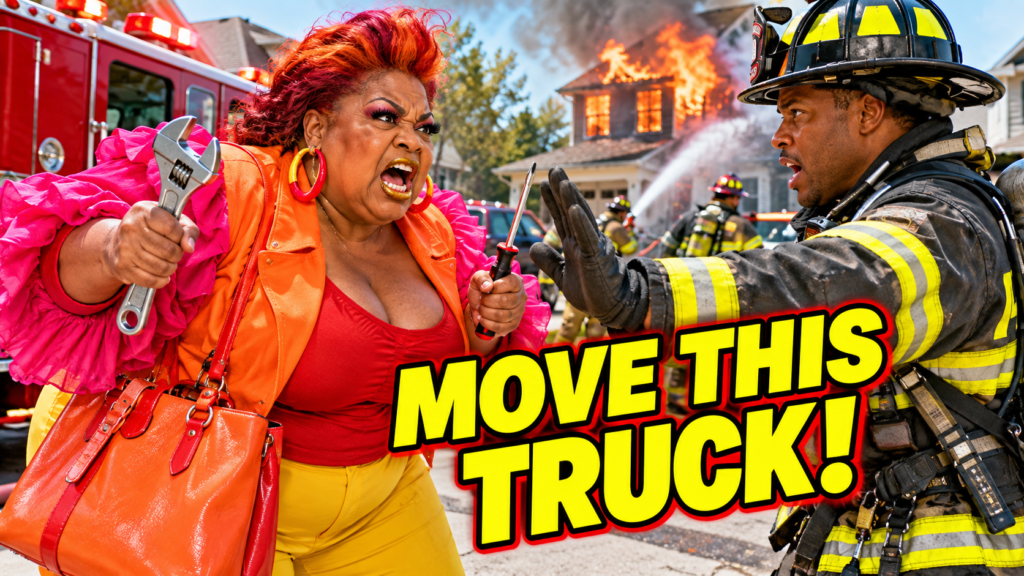
Karen never forgot the afternoon she stood at the fire line with a wrench and screwdriver, convinced that her rights were being ignored.
But she remembered something else too.
The moment Harold was carried out of the smoke.
The moment the ladder reached his window.
The moment she finally understood why the fire truck had stopped where it did.
Years later, she would still keep the old wrench and screwdriver in her garage.
Not as reminders of the argument.
As reminders of the line she had once been determined to cross—
and the much more important line she eventually learned to protect.