
Chapter 4: The Photograph
The complaint contained a photograph.
Karen opened it on her phone.
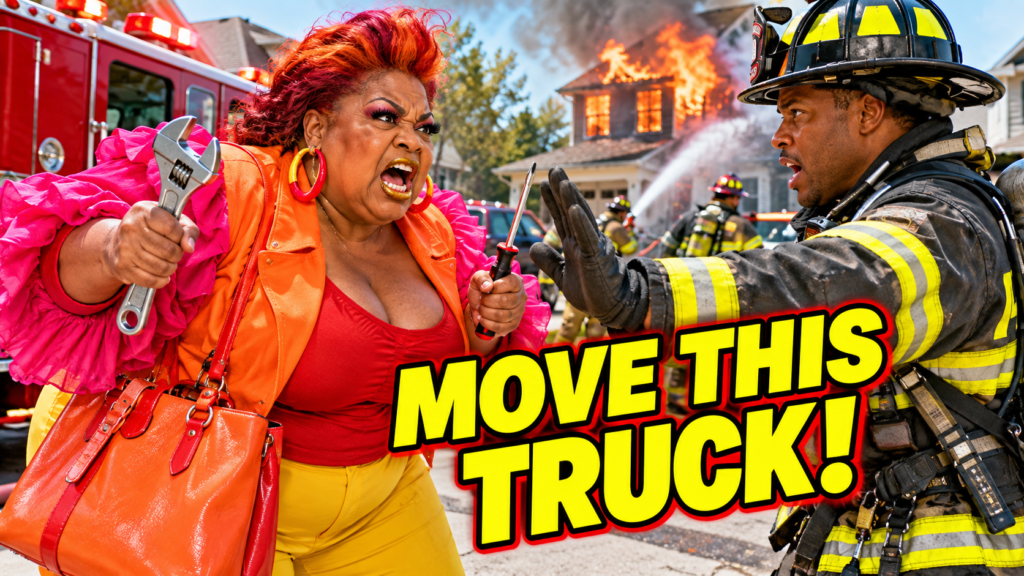
It showed her standing at the edge of the emergency perimeter, holding the wrench and screwdriver.
But the image had been taken from behind her.
In the background, the fire engine filled the frame.
And beyond it was Harold’s house.
The timestamp was clear.
The association had also received another photograph.
This one showed Karen earlier that afternoon, before the fire department had established the full perimeter.
She was standing beside the driveway, arguing with a neighbor.
The neighbor was pointing toward the street.
Karen remembered the moment.
She had accused him of parking too close to her property.
He had told her that the fire department needed access.
She had dismissed him.
What Karen didn’t remember was what happened immediately afterward.
The association’s letter explained it.
Karen had moved a temporary traffic cone because she believed it was obstructing her driveway.
That cone had marked the approach route for emergency vehicles.
She hadn’t moved it far.
Only a few feet.
But those few feet had forced one responding vehicle to stop and reposition.
Nobody had been injured.
No firefighter had been disciplined.
But the incident had been documented.
Karen read the report twice.
Then a third time.
Her first reaction was anger.
She wanted to argue.
She wanted to explain.
She wanted to say that nobody had told her what the cone meant.
Then she noticed the final sentence.
“Resident was instructed to remain clear of emergency access routes.”
Karen remembered Daniel’s face.
Not angry.
Tired.
She remembered Harold being carried from his house.
She remembered the ladder.
She remembered the roof collapsing.
Her phone rang.
It was the neighborhood association president.
He explained that the complaint wasn’t a criminal matter. It was an internal safety review because the street was part of a community emergency-access plan.
Karen asked what would happen.
He said she would be required to attend a meeting.
She almost refused.
Then he added one more detail.
The fire department had requested that the association review access around her property because of the driveway layout.
Karen looked at her house.
Her driveway.
Her garage.
Her mailbox.
The things she had spent years protecting.
And suddenly she understood something uncomfortable.
The issue wasn’t only what she had done.
The problem was that her property was positioned in a way that could become an obstacle during another emergency.
She had spent the afternoon demanding that everyone respect her home.
Now she was being asked to make sure her home didn’t prevent someone else from reaching theirs.
The meeting was scheduled for Monday.
But before Monday came, Karen received a visit from Melissa Bennett.
Melissa wasn’t angry.
That somehow made it worse.
She brought a folder.
Inside was an insurance document and a photograph of Harold standing beside the house years earlier.
Melissa placed the photograph on Karen’s kitchen table.
“Dad asked me to bring you this.”
Karen looked at the picture.
Harold was smiling beside a freshly planted tree.
On the back, he had written a date.
It was the day he moved into the neighborhood.
Then Melissa said:
“There’s something else Dad wants you to know.”
Karen looked up.
“What?”
Melissa slid a second document across the table.
It was a copy of the emergency access plan.
And Karen’s property was marked in red.








