
Chapter 3: The Man Behind the Smoke
By late afternoon, the fire was finally under control.
Harold Bennett survived.
His house did not.
The upper floor was heavily damaged, part of the roof had collapsed, and water had flooded the rooms below.
The street smelled of smoke, wet ash, and burned insulation.
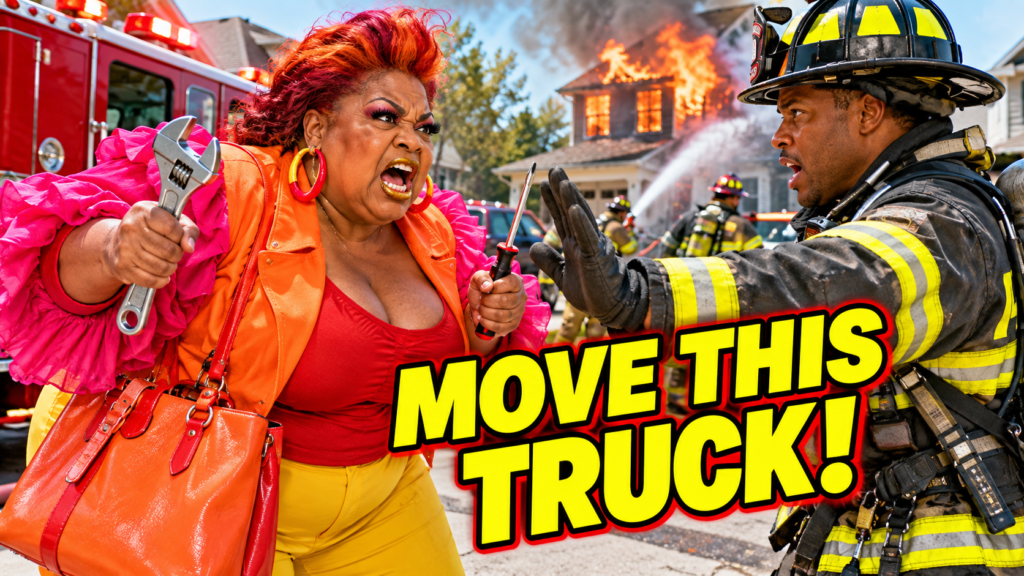
Karen stood in her driveway watching firefighters pack their equipment.
She had expected someone to apologize.
Nobody did.
Instead, Daniel approached her.
He looked exhausted.
“Your driveway will be clear in a few minutes.”
Karen crossed her arms.
“That isn’t the point.”
Daniel looked at the wrench sitting on a nearby garden wall.
“No. It wasn’t.”
Karen followed his gaze.
“I never touched your truck.”
“No.”
“I didn’t damage anything.”
“No.”
“Then what exactly did I do?”
Daniel hesitated.
“You tried to enter an active emergency area with tools.”
“I was standing outside it.”
“You tried to move toward the engine.”
“I wanted an explanation.”
“You got one.”
Karen looked away.
For once, she had nothing immediate to say.
Daniel continued.
“Your neighbor’s bedroom was directly above the area that collapsed.”
Karen looked toward Harold’s house.
“If we had moved that engine when you asked, we would have lost our ladder position.”
Karen swallowed.
Daniel didn’t raise his voice.
He didn’t threaten her.
He simply said what happened.
“That truck wasn’t blocking your driveway because we didn’t care about your property. It was positioned there because someone’s life depended on it.”
Then he walked away.
Karen remained in the driveway.
A few minutes later, Harold’s daughter, Melissa, arrived.
She was carrying a plastic bag containing her father’s wallet, medication, and glasses.
She looked at Karen.
Neither woman spoke.
Finally Melissa said, “Dad told me you were upset about the truck.”
Karen stiffened.
“I didn’t know—”
“He heard you from the porch.”
Karen looked toward the damaged house.
Melissa continued.
“He said he understood. He said if it were his driveway, he’d probably be angry too.”
Karen didn’t know what to say.
Melissa opened the bag and checked the contents.
Then she added quietly, “He also told me the fire started in the kitchen.”
Karen nodded.
“That doesn’t have anything to do with me.”
“No.”
Melissa looked at the fire engine.
“But the firefighters thought Dad might still be upstairs.”
Karen looked down.
“He was.”
“Yes.”
The two women stood in silence.
Then Melissa said something that stayed with Karen long after the fire trucks left.
“Dad said the firefighters never asked permission before saving him.”
Melissa walked away.
Karen remained alone.
That evening, the neighborhood association sent her another message.
There had been a formal complaint.
Not about the tools.
Not about the shouting.
About something Karen had done before the fire.
Something she had completely forgotten.








