
CHAPTER 2: THE COST OF THE GRIP
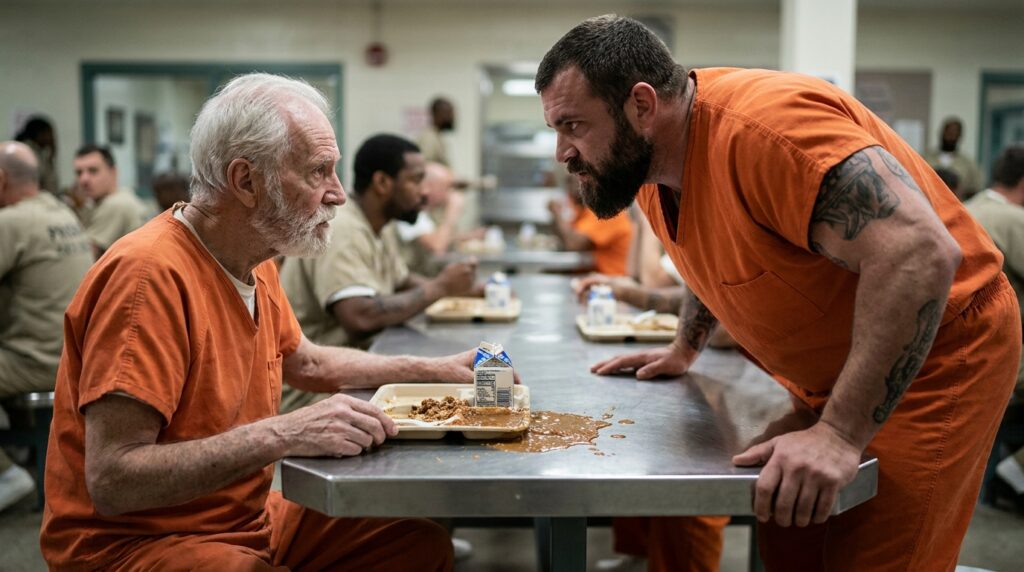
The brass key sat embedded in the gray grease of the spilled cabbage, its stamped serial number gleaming like a gold tooth in a jawful of rot. Cobb did not reach for it immediately. A man who grabbed too quickly in the central block was a man who revealed the shape of his hunger, and hungry men were chewed up first. Instead, he let his thick palm flatten against the pitted aluminum of the table, his thumb tracking the rusted grain of the metal edge, feeling the vibration of four hundred inmates slowly returning to their low, rhythmic chatter as the immediate threat of a riot subsided.
Across the bench, Miller was still breathing in short, ragged gasps, his boots grinding against the salt-rimmed concrete floor as he pulled himself up. His eyes didn’t drop to the tray; they remained pinned to Cobb’s face, wide and defensive, tracking the old man’s hands with the frantic intensity of a dog that had just felt the boots. The dark purple imprint of Cobb’s knuckles was already darkening along the soft skin beneath his jaw, a stark contrast to the sharp, black lines of his throat tattoo.
“Take your tray, Miller,” Cobb said. His voice was a low, dry rasp, the sound of iron dragging over gravel. He didn’t look at the guards stationed near the high reinforcement pillars, but he could feel the shift in their weight, the metallic clink of heavy key rings swinging against utility belts as they prepared to clear the room. “The slop’s getting cold.”
Miller didn’t answer with the bravado he had carried into the lane three minutes ago. His mouth twitched, a sour taste clearly rising in his throat. He reached out with a hand that shook just enough to rattle the plastic edge, his tattooed fingers closing over the lip of the tray. As he dragged the mess toward himself, his thumb naturally covered the brass key, sweeping it into the palm of his hand with a clumsy, desperate theft. He didn’t look at it. He just stuffed the wet metal into his uniform pocket, left his stool, and vanished into the gray sea of orange shirts moving toward the tray-return line.
Cobb stood up slowly, the joints in his knees popping with a sound like dry kindling. His right hand remained deep in his pocket, his fingers rolling the iron hex-nut against his thigh, the constant friction his only shield against the deep, throbbing ache settling into his wrist. The surge had cost him. The cartilage in his shoulder felt dry, scraped clean by the sudden expenditure of force, and a dull heat was beginning to bloom across his knuckles. He followed the slow, single-file march out of the cafeteria, his boots tracking the thin film of dust that seemed to permanently coat the facility’s lower decks.
The transition back to the cellblocks was governed by the heavy, mechanical rhythm of the tier locks—the sequential slam of steel against steel that punctuated every hour of his life. But as Cobb reached the threshold of Tier 3, the floor officer didn’t check his name off the standard clipboard. The guard, a thick-necked man named Henderson whose uniform always smelled of scorched coffee, reached out with a blunt forearm, barring the gate.
“Not that way, Cobb,” Henderson said, his eyes fixed on the ledger page rather than the old man’s face. “You’ve been reallocated. Floor four, section D. Moving today.”
The iron nut stopped rolling in Cobb’s pocket. Section D was the old boiler block, a desaturated corridor of leaking steam pipes and rusted cell doors that had been partially condemned three winters ago. It was a blind spot in the prison’s architecture, a place where the air was thick with the smell of wet coal and old damp, and where the guards rarely walked the galleries after the evening lock. It was where the administration put the men they wanted the house to forget.
“Who signed the order, Henderson?” Cobb asked. He kept his posture relaxed, his weight shifted onto his heels, a sovereign protector defending the small boundary of his remaining stability.
“The house signs the orders, Cobb. I just turn the key,” Henderson muttered, his finger tapping the bottom of the carbon sheet. He didn’t show the signature line, but Cobb’s eyes, sharpened by decades of tracking the subtle shifts in institutional paper, caught the purple ink of the stamp at the margin. It wasn’t the standard housing lieutenant’s mark. It was the heavy, double-bordered seal of the Warden’s private administrative office.
Cobb didn’t argue. He knew the friction of a useless protest only wore down the gears. He turned his face toward the rusted iron stairs leading up to the fourth tier, his boots heavy on the open metal risers. Every step echoed through the central well, a hollow, metallic ring that felt less like a walk to a new cell and more like the slow lowering of a crate into a dark hold.
When he reached Cell 412, the door was already racked open. The interior was narrow, the concrete walls weeping a thin line of lime-white mineral crust where the upper yard’s drainage leaked through the seams. A single iron cot was bolted to the left wall, its canvas mattress stained with the grease of a dozen previous tenants.
Sitting on the lower stool, his back pressed against the rusted utility pipe that ran from the floor to the ceiling, was Miller.
The younger man looked up, his face silhouetted against the narrow, dirt-crusted window at the back of the cell. The brass key he had taken from the cafeteria tray was sitting on the edge of the sink, catching the faint, orange glow of the setting sun as it cut through the yard’s perimeter wire. Miller wasn’t holding a weapon, but his posture was wired tight, his muscles coiled like a spring that had been compressed past its safety margin.
“They put me in here twenty minutes ago,” Miller said, his voice no longer carrying the mocking edge from the cafeteria, replaced instead by the hard, flat tone of a man who realized he had been dropped into a trap with the door already welded shut. He reached out with one finger, tapping the brass key until it slid into the porcelain bowl of the dry sink with a sharp click. “They told me if you didn’t look handled by the evening bell, neither of us makes the morning shift.”
Cobb stepped into the cell, his shoulder brushing the cold iron frame as the mechanical track above them groaned, the heavy door sliding forward until the lock dropped with a final, unyielding thud.








