
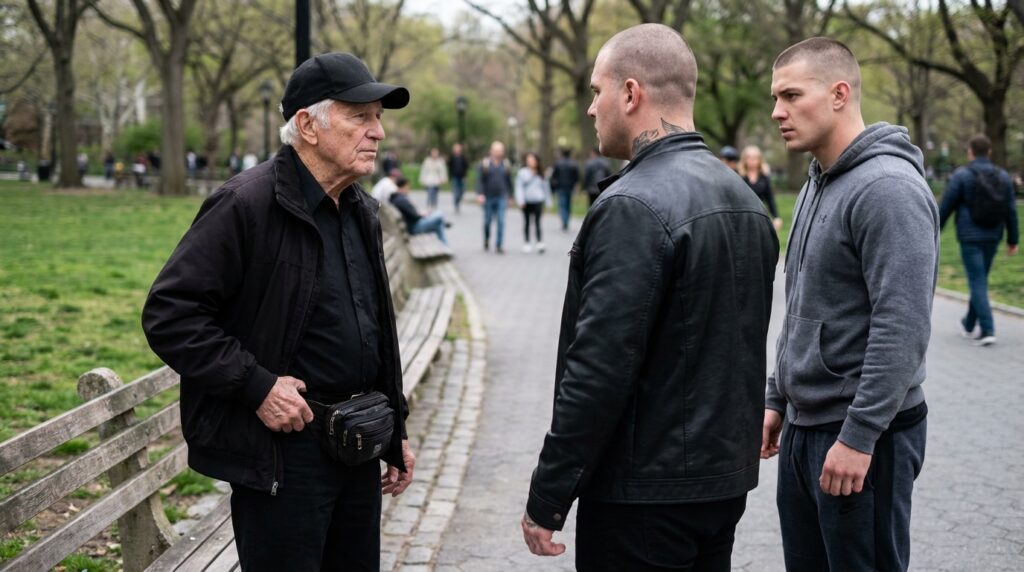
CHAPTER 3: THE DECOY POSTURE
“The brass on that door hasn’t been polished since the winter of eighty-eight, Elias. You shouldn’t have touched the frame.”
The man by the microfiche machines didn’t turn his head when he spoke. His fingernail kept up its relentless rhythm against the plastic library card—snick, snick, snick—a sound that mimicked the cooling of a hot rifle barrel. He was smaller than Elias remembered, his shoulders sloped beneath a brown oilskin duster that had lost its waterproofing a decade ago. The fabric was stiff, coated in a fine layer of gray limestone dust from the western railyards.
Elias walked down the center aisle, his rubber soles flat against the linoleum. The floor was buckled over structural joists that were slowly rotting into pulp beneath the municipal foundation. Every stride felt like walking on a ship’s deck in low swells. He chose a chair across the oak table, the wood scarred with forty years of ink stains and deep, gouged initials from schoolboys who were probably dead or grandfathers by now.
“The tape on the door handle,” Elias said, his gravelly voice dropping into the low register that didn’t carry past the radius of the table. “You used a double-sheet bend knot. The city utility crews don’t teach that anymore. They use cheap plastic clips.”
The smaller man finally stopped his thumbnail. He placed the card flat on the table. It was a local senior transit voucher, but the name printed on the faded laminate didn’t match the face above it. The face belonged to Miller—or what was left of Miller after thirty years of breathing dry alkali in the Nevada camps. His skin was the color of old cedar, cross-hatched with fine, dry lines that gathered tightly around the corners of his left eye where a steel splinter had settled in the nineties.
“They’re tracking the profile, not the man,” Miller said. He reached down into the deep pocket of his duster, his hand returning with a small, rusted iron tin that used to hold throat lozenges. He didn’t open it. He just slid it across the oak finish, the metal base scraping against the grit with a sound that made Elias’s jaw tighten. “The two boys in the park were local talent from the South Side docks. Ten-dollar mules. They were told an old man with a black cap had a pouch full of un-stamped silver certificates. They didn’t even know what a thermal signature was.”
“The camera was set for eighty-five degrees,” Elias noted, his arms remaining loose at his sides, his eyes fixed on Miller’s collarbone. Never watch the eyes; the collarbone tells you when the weight is shifting for a draw. “It was positioned to catch the drop in core temperature during a dynamic chest strike. That’s deniable unit curriculum. The street crews don’t buy that gear at a surplus store.”
“No,” Miller agreed. He leaned forward, the smell of stale chicory coffee and damp wool rolling off his coat. “They don’t. The order came down from the regional office on 6th. They wanted to see if the machine still turned over, or if the gears had rusted solid. They got their answer. The tattooed kid is going to need three pins in his jawbone to keep his teeth from sliding into his throat.”
Elias reached down and patted the side of his nylon crossbody pouch, his fingers feeling the rigid outline of the drive. The micro-mystery of the park sensor was solved, but it left a larger, colder residue in its place. If Miller was here, the perimeter wasn’t just leaking; it had been completely dismantled.
“The drive is dead,” Elias said. “The encryption cipher was locked out when the central server in Alexandria went dark during the reorganization. It’s just old aluminum and dead copper now.”
“That’s what they think,” Miller whispered. He tapped the rusted lozenge tin with his middle finger. “They think it’s a list of the safe houses in the interior. The decoy works because it’s exactly what an old, paranoid veteran would keep if he wanted to buy his way out of a state home. They think you’re holding a retirement policy.”
“And you?” Elias asked. His hand remained an inch from the pouch zipper. Zzzzt. The mental shadow of that sound was louder than Miller’s breathing. “What do you think is in the bag, Miller?”
Miller looked up, his one good eye cloudy with cataracts but sharp enough to catch the light from the high library windows. “I don’t think anything, Elias. I know what we buried in the limestone back in ninety-one. I know the dog tags behind that drive don’t belong to a traitor. They belong to the man who signed the authorization orders for our pensions. The man they said never existed.”
A sudden draft blew through the open library doors, carrying the sharp, chemical tang of the river fog. The yellow surveyor’s tape on the brass handle rattled against the wood outside—a short, frantic tapping that sounded like code.
Elias stood up. He didn’t use the table for leverage; his legs did the work, his old thighs tightening with a dull, familiar ache that had been his companion since the crossing at the DMZ. “The sedan followed me to Elm,” he said, looking down at the cedar-skinned man. “They’re circling the block every twelve minutes. You have six left before the next pass.”
Miller didn’t move to get up. He picked up his library card and began his rhythmic scratching once more. Snick. Snick. Snick.
“They aren’t looking for me, Elias,” Miller said softly, his voice dying into the musk of the old books. “They already found me. Why do you think I’m sitting in the dark?”
Elias froze. His eyes dropped to the leg of the oak table where Miller sat. A thin, braided wire of gray steel ran from the base of Miller’s chair, tucked neatly into the seam of the linoleum floor, disappearing behind the microfiche cabinets where a small green battery pack hummed with a low, parasitic vibration. It wasn’t an explosive trigger. It was a localized jamming loom—and the indicator light on the side had just turned from steady green to an intermittent, warning amber.
The front doors of the library didn’t slam, but the air pressure in the room shifted instantly, a sudden vacuum that rattled the loose glass in the clerestory windows thirty feet above their heads. Heavy soles—not sneakers, but standard-issue tactical leather with vibram heels—hit the granite steps of the vestibule. Two men. Moving in a synchronous flank.
Elias didn’t look at Miller again. He turned toward the rear fire exit, his black cap pulled down until the brim met the line of his eyebrows. The consequence loop had closed. The park was just the prelude; the city was the trap.








