
Chapter 4: The Missing Pages
The next morning, Margaret and Claire met with an attorney named Evelyn Harper.
Evelyn was in her early sixties and had spent much of her career handling property disputes, estates, and family trusts.
She listened.
She studied the documents.
Then she asked one question.
“Do you have the originals?”
Margaret shook her head.
“Only copies.”
Evelyn examined the photograph.
“The photograph is interesting, but this isn’t enough by itself.”
Margaret expected that.
She had not come looking for drama.
She wanted facts.
Evelyn explained that the key issue was whether the original property boundaries and easement rights had ever been legally altered.
If they had not, then later neighborhood maps might not reflect the actual legal situation.
If they had, there should be recorded documents showing when and how the change occurred.
“Your husband may have been trying to find that record,” Evelyn said.
“Where would it be?”
“County records. Possibly an old title company. Possibly in the files of the original developer.”
Margaret remembered something.
“Daniel had a safe.”
Claire looked at her.
“A safe?”
“In the basement.”
They had forgotten about it.
Daniel had installed it decades earlier after Margaret joked that their grandchildren were becoming too curious.
The combination was written inside his old address book.
Inside the safe were three folders.
The first contained insurance papers.
The second contained old deeds.
The third contained a handwritten note.
If this is open, look behind the workbench.
Margaret laughed despite herself.
“Of course.”
Daniel had never met a straight line when a detour would do.
Behind the workbench was an old metal cabinet.
Inside the cabinet was a sealed envelope.
This time, there were originals.
The 1988 survey.
A signed access agreement.
And a handwritten statement from one of the neighborhood’s original developers.
The disputed strip of land had never been transferred to the neighborhood association.
It remained attached to the individual lots.
Margaret’s property included a section of it.
But there was more.
A second document showed that years later, a revised neighborhood map had been circulated without the original owners’ signatures.
Evelyn read it carefully.
“This is significant.”
Claire asked, “Does it prove someone stole the land?”
“No. Not by itself.”
Evelyn was precise.
“It proves there is a discrepancy worth investigating. We need the county recording history.”
They obtained the records.
The discrepancy was real.
But the biggest surprise came from a document filed seventeen years earlier.
The association had requested permission to install landscaping and drainage improvements across the disputed area.
Several homeowners had signed.
Margaret’s husband had not.
Instead, Daniel had written:
Temporary permission only. No transfer of ownership.
Someone had altered the neighborhood’s internal map afterward.
The map made the area look like common property.
That explained the pressure.
But it raised another question.
Why had they suddenly become aggressive now?
Evelyn found the answer in a planning document.
A developer had recently submitted preliminary plans for a new commercial project near the neighborhood.
The project would require access through the disputed strip.
If the association could establish that the strip was common property, the access would be much easier to obtain.
Margaret stared at the document.
“So this was never about my moving truck.”
“No,” Evelyn said.
“The truck was simply convenient.”
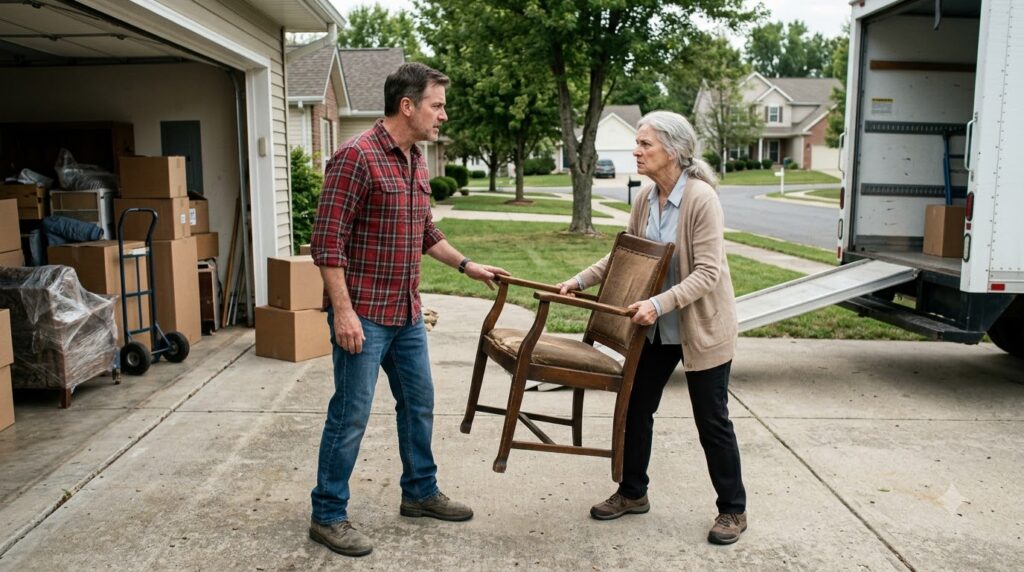
That evening, Margaret stood in the garage.
The moving crew had packed nearly everything.
Only a few things remained.
The antique chair.
Daniel’s workbench.
And several boxes he had marked with dates.
Margaret realized something.
Daniel had not merely discovered a property problem.
He had been trying to protect something.
And now she understood why someone had wanted her to leave quickly.
But she still did not know how far the pressure would go.








