Chapter 2: The Box Marked Christmas Decorations
Margaret did not ask Frank what he meant.
Not yet.
She had learned something during forty-three years of marriage: when a person said something strange and then refused to explain it, the worst thing you could do was rush to fill the silence for them.
So she watched him.
Frank looked at the garage.
Then at the moving truck.
Then at the other neighbors.
No one spoke.
The silence told Margaret more than an argument would have.
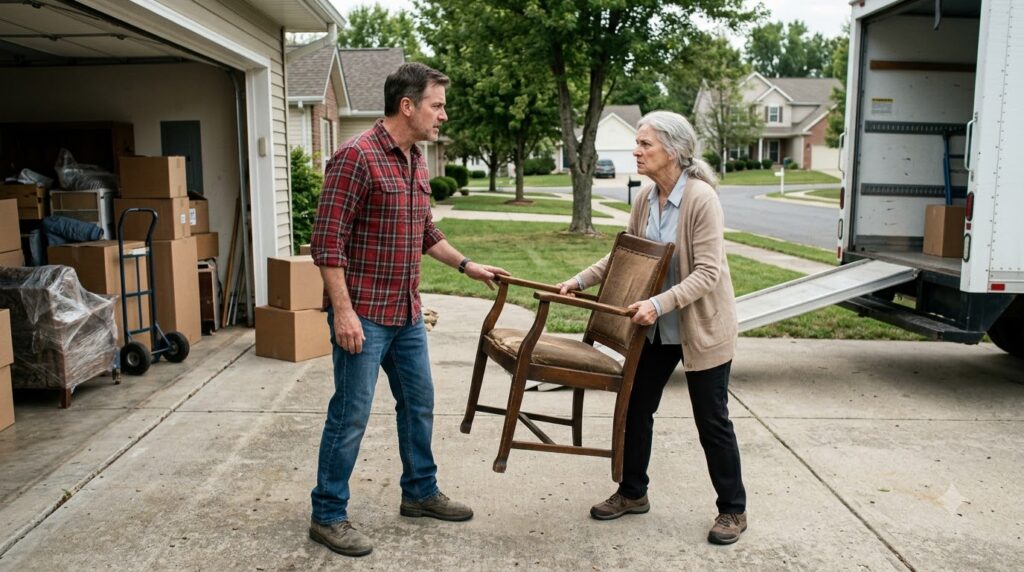
She turned to the moving crew.
“Leave the truck here.”
The crew leader hesitated.
Frank immediately objected.
“That isn’t what we agreed.”
Margaret looked at him.
“I don’t remember agreeing to anything with you.”
That ended the conversation.
For the next hour, the movers worked.
Margaret carried smaller boxes. The crew handled the heavier furniture. Frank remained outside for several minutes, then finally walked away.
But he did not leave the neighborhood.
Margaret could see him from the garage window.
He stood across the street speaking to two other residents.
She had never thought of her neighbors as a group.
They were just people who waved from porches, collected mail, complained about tree branches, and occasionally shared casseroles after storms.
That morning, they suddenly seemed organized.
And nervous.
Margaret began opening boxes.
Most contained ordinary things.
Daniel’s fishing equipment.
Old tax documents.
Christmas decorations.
Photographs.
A collection of baseball cards their son had forgotten when he moved away.
Then she found a box labeled in Daniel’s handwriting:
CHRISTMAS — DO NOT DISCARD
She almost smiled.
Daniel had labeled everything.
He could never simply write “Christmas.”
It had to be “Christmas — upstairs closet,” or “Christmas — fragile,” or “Christmas — lights that actually work.”
She opened the box.
There were ornaments.
A wooden angel.
A strand of lights.
A faded stocking.
At the bottom sat a smaller cardboard box.
It had no label.
Margaret lifted the lid.
Inside was a manila envelope.
Her husband’s name was written across the front.
DANIEL WHITMORE — PROPERTY
Her hands began to tremble.
She sat on the garage floor.
Inside the envelope were photocopies of old property maps, several letters, and a photograph of a younger Daniel standing beside a group of men she recognized as some of the neighborhood’s original homeowners.
Margaret studied the photograph.
At the far left stood Frank’s father.
Arthur Dalton.
He had been dead for nearly fifteen years.
On the back of the photograph, Daniel had written:
September 1988. Before the easement was changed.
Margaret frowned.
She knew the word “easement.”
She did not know why Daniel had been keeping documents about one.
She kept reading.
The neighborhood had been built in the late 1980s. A narrow strip of land behind several homes had originally been designated for drainage access and emergency vehicles.
The strip ran along the back of Margaret’s property.
Years later, landscaping had covered much of it.
Residents treated it like common land.
But one of the documents showed something different.
According to the old survey, part of the strip had remained attached to several private lots.
Including Margaret’s.
Her husband had apparently discovered a discrepancy between the original survey and a later neighborhood map.
Then she found a letter.
It was from Daniel to an attorney.
The date was three weeks before his death.
Margaret read the first page twice.
Daniel believed someone was preparing to sell or transfer the disputed strip of land without proper authorization.
He had been trying to verify the records.
And then, near the bottom of the page, Margaret saw a sentence that made her stop breathing.
If they ever pressure Margaret to move quickly, she needs to know why.
The garage suddenly felt very quiet.
The truck engine rumbled outside.
Margaret folded the letter carefully.
She thought of Frank standing in her driveway.
She thought of his words.
Your husband wasn’t supposed to leave that house with you.
Suddenly, the moving truck was no longer the most important thing in the driveway.
The garage was.