
Chapter 6: The Cost of Being Right
The hearing lasted nearly two hours.
Karen spoke first.
She described herself as a resident who had been treated disrespectfully.
She said she felt ignored.
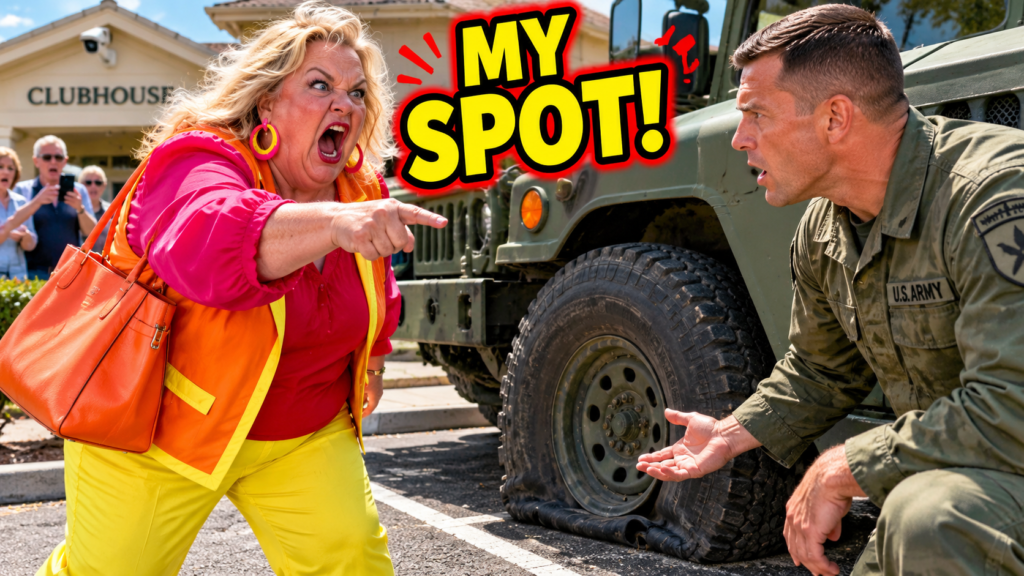
She said the parking space had become symbolic of something larger—the feeling that people with authority could enter a community and disregard the people who lived there.
Some of the board members understood that frustration.
But understanding someone’s feelings was not the same as accepting their actions.
Linda then presented the timeline.
Daniel’s arrival.
Karen’s confrontation.
Karen’s movement toward the vehicle.
Her disappearance behind the planter.
Her departure.
The flat tire.
The driver’s return.
The later discovery of the mechanical damage.
Nothing was exaggerated.
Nothing was presented as proof beyond what the evidence actually established.
That made the presentation more powerful.
Karen’s attorney pointed out that the actual moment of damage was not visible.
Linda agreed.
“Yes.”
There was no argument.
No attempt to fill the gap with speculation.
That honesty changed the room.
The board then reviewed Karen’s written complaint.
One sentence received particular attention.
Karen had written that she had been “standing directly beside the vehicle when the driver returned.”
Later, she had told investigators she had not been near the tire.
The contradiction was difficult to explain.
Karen looked down.
For several seconds, nobody spoke.
Then Daniel did something unexpected.
He asked whether he could say something.
The board allowed it.
Daniel did not talk about punishment.
He talked about Robert.
He explained that his father had been waiting for him to repair a porch step.
He explained that the incident had delayed that visit twice.
Then he looked at Karen.
“I don’t need you to like me,” he said. “I don’t even need you to agree with me. I just need people in this community to understand that property, privacy, and personal boundaries matter.”
Karen’s eyes remained fixed on the table.
Daniel continued.
“A parking space is replaceable. Trust isn’t.”
The room was silent.
The board eventually reached its decision.
Karen was found responsible for violating HOA conduct and property-related rules based on the available evidence.
The matter involving the damaged vehicle was separately referred to the appropriate authorities.
She was required to reimburse documented community costs connected to the incident and was temporarily restricted from certain HOA privileges while the matter was resolved.
But the most significant consequence wasn’t written in the decision.
It was visible in the faces around the room.
People no longer trusted her.
That hurt Karen more than she expected.
She had spent years believing that being forceful protected her.
Now she was discovering that force could also isolate a person.
After the hearing, Daniel walked outside.
His phone rang.
Robert.
Daniel answered.
“You coming Saturday?”
Daniel smiled for the first time in days.
“Yes.”
“You sure?”
“Yes.”
“Good. The porch isn’t fixing itself.”
Daniel laughed.
Across the parking lot, Karen watched them from the clubhouse window.
She could have walked away.
Instead, she picked up her coat and followed him outside.
She stopped several feet away.
“Daniel.”
He turned.
Karen hesitated.
The apology did not come easily.
“I shouldn’t have touched your vehicle.”
Daniel waited.
She swallowed.
“I was angry.”
“I know.”
She looked toward the empty parking space.
“I thought if I pushed hard enough, people would finally respect me.”
Daniel’s expression softened slightly.
“Respect isn’t something you can force.”
Karen looked down.
For once, she didn’t argue.
But there was still one unresolved matter.
The authorities had not yet completed their review.
And the final consequence of what happened to the tire had not been determined.








