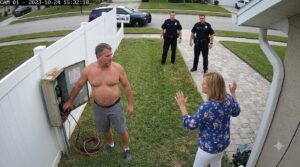
Chapter 5: The Record Becomes the Evidence
David stopped trying to win arguments.
Instead, he started documenting facts.
He contacted the association manager again and asked for all complaints involving his property to be handled in writing.
He asked that future communication go through the association rather than directly between homeowners.
Megan helped him create a simple timeline.
No insults.
No assumptions.
No descriptions of Karen’s personality.
Just dates, photographs, messages, and events.
That discipline changed everything.
A week later, the association called another meeting.
This time, there were three board members present.
Karen arrived with her folder.
David arrived with his.
The manager began with the original complaint.
Then the evidence was reviewed in order.
Karen’s pre-recording.
The hidden speaker.
The LED system.
The activation remote.
The photograph showing her preparing before David approached.
Then the written list documenting David’s activities.
One board member asked Karen a direct question.
“Why were you recording before the incident?”
Karen said she had been protecting herself.
“From what?”
She couldn’t give a specific answer.
The room became quiet.
Then the manager played the recording again.
But this time, they watched the first thirty seconds.
Karen could be seen looking toward David’s house.
She checked the phone.
She looked at the fence.
Then she pressed the remote.
Only afterward did David touch the rail.
The prank itself lasted seconds.
The preparation lasted much longer.
That distinction mattered.
The board did not treat the fake shock as a dangerous electrical incident because there was no actual electricity involved.
But they treated the deliberate recording and repeated boundary confrontations as a neighborhood conduct issue.
Karen was instructed to remove the prank equipment and stop using the fence as a trigger for confrontations.
She was also told to direct any legitimate property concerns through the association.
Karen stared at David.
He expected another argument.
Instead, she asked a question quietly.
“You really think I was watching you?”
David didn’t answer immediately.
He looked at the photographs on the table.
“I think you were paying attention to my life when you should have been living your own.”
Karen looked away.
It was the first time she seemed smaller than the enormous personality she had brought into every previous confrontation.
But the story wasn’t finished.
Because when David returned home that afternoon, he found an envelope pushed beneath his door.
Inside was a printed photograph.
It showed his backyard.
Taken from Karen’s side of the fence.
On the back, someone had written:
“You still don’t understand why I did it.”
David stood in his hallway holding the photograph.
For the first time, he wondered whether the prank had never really been about the fence.