Chapter 5: They Live Here Too
The answer came gradually.
Sarah mentioned the incident to one neighbor.
That neighbor shared her own experience.
Then another did.
Soon, people were talking about the same pattern: complaints over grandchildren visiting, complaints about daytime yard work, complaints about children riding bicycles, complaints about ordinary sounds that came with ordinary lives.
Nobody claimed Marlene had no right to quiet.
The problem was the direction of the demand.
She wanted everyone else to become quiet so she would never have to tolerate inconvenience.
One Saturday afternoon, several neighbors gathered near the Reeds’ driveway while the children played.
Marlene came outside.
She looked at the group.
“What is this?”
Nobody answered immediately.
Then an older neighbor, a retired teacher named Helen, stepped forward.
“We’re talking.”
“About me?”
“About the neighborhood.”
Marlene folded her arms.
Helen looked toward the children.
“They live here too.”
The same words Sarah had spoken weeks earlier.
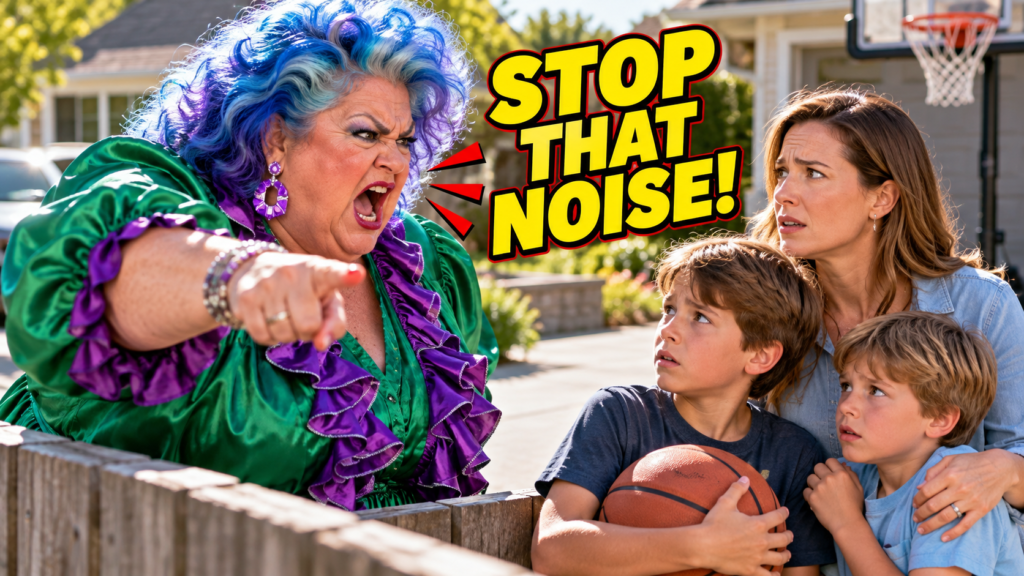
Marlene looked at the boys.
The older one was dribbling the ball.
The younger one was waiting for his turn.
Neither was bothering anyone.
Marlene pointed toward Daniel.
“And he destroyed my peace.”
Daniel shook his head.
“I never destroyed anything. I turned the speaker down when you asked.”
“You shouldn’t have needed to be asked.”
“And you shouldn’t have broken it.”
Marlene looked around.
No one defended her.
That was the moment she seemed to understand that the argument had moved beyond one family.
She tried another approach.
“I have a right to quiet.”
Helen nodded.
“Yes. Within reason.”
Marlene’s expression tightened.
“Who decides what is reasonable?”
Helen looked at the children.
“Sometimes living in a neighborhood means accepting that other people have rights too.”
Daniel stepped forward.
“We’ll keep our music reasonable. The kids will respect the property line. That’s our part.”
Sarah added, “But we’re not going to stop them from playing outside.”
The children had stopped dribbling.
The younger boy watched Marlene.
She looked back at him.
For several seconds, neither moved.
Then the boy lowered the ball.
Marlene’s face changed.
She seemed almost surprised by what she had created.
The children were no longer laughing.
They were afraid of being noticed.
Sarah gently placed a hand on her son’s shoulder.
“Go ahead,” she said.
The boy bounced the ball.
Once.
Then twice.
The sound echoed through the driveway.
Marlene turned away.
But she did not walk back into her house.
She stood there listening.
And for the first time, she had to confront the fact that the noise she hated was not a violation.
It was life happening next door.