
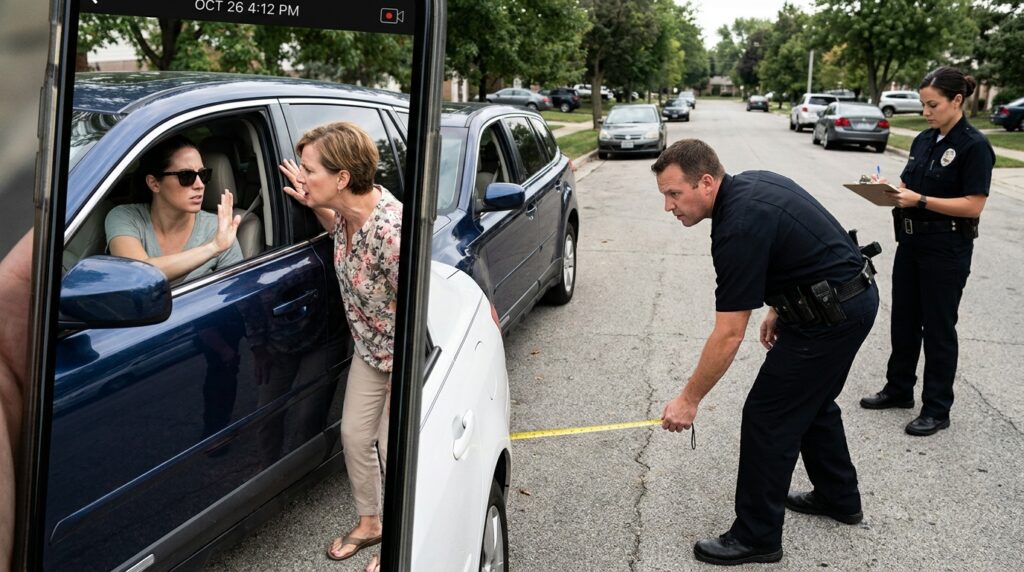
The Measured Boundary of a Sun-Bleached Suburban Street Where Silence Holds the Line
CHAPTER 1: THE SUNBLEACHED PERIMETER
“You’re violating the easement and blocking my visual right-of-way—this vehicle doesn’t belong on this block!” The voice didn’t just carry across the baked asphalt; it scraped against the side of the blue crossover SUV like a gravel slide.
Through the dark tint of my sunglasses, the world outside was a desaturated expanse of midsummer heat and cracked concrete. The steering wheel felt hot under my fingers, the textured leather holding the ambient cabin air at a steady, suffocating premium. I didn’t turn my head. To turn was to acknowledge the shifting weight of the shadow currently cutting off the midday light through my driver-side window. Instead, I kept my eyes fixed straight ahead, where the hood of a parked white sedan gleamed with a blinding, oily reflection under the noon sun.
The shadow moved closer. It was a rhythmic, heavy stride—the sound of synthetic sandals dragging against raw curb concrete. Then came the smell of stale floral perfume mixed with dry, radioactive lawn dust.
A hand descended onto the door frame. The fingers were short, the skin dry and cross-hatched by years of obsessive yard work, planting themselves firmly against the blue metallic paint of my car. Then came the face. Framed by short, light-brown hair that had been sprayed into a rigid, unyielding shape, she leaned inward. Her floral blouse pressed against the rubber weather-stripping of the window lane, her upper body tilting forward until she was crowding the interior air of the cabin. Her expression wasn’t angry; it was tight, clinical, infused with the terrifying certainty of a person who believed she was the sole administrator of the street’s municipal soul.
I didn’t roll the glass down any further. The three-inch gap was a deliberate boundary, a slit in a bunker.
“I have the plat maps inside,” she whispered, her breath fogging a tiny crescent onto the glass. Her sunglasses were mirrored, reflecting two tiny, distorted versions of my own guarded posture back at me. “The city requires twenty feet of clearance from the radius of my driveway flare. Look at your tires. You’re three inches into the transition zone. I’ve already logged the timestamp.”
My hand left the steering wheel. I didn’t open my mouth. I didn’t offer the defense of a legal resident who had spent seven years paying a mortgage three doors down. Instead, I raised my right palm, lifting it slowly, deliberately, until it sat exactly three inches from the window gap—a flat, unyielding wall of skin and bone that stopped her forward lean dead.
She braced her weight against the car door, the suspension giving a slight, metallic groan under the pressure. “You don’t get to sit in my place and judge me,” I said. My voice was sparse, transactional, stripped of any rising heat. It was the sound of iron hitting iron.
For a second, her fingers twitched against the paint. Her eyes shifted behind her lenses, scanning the empty lawns behind her, looking for the witness layer—the porch watchers who usually hid behind twitching blinds when she went to work. But the street remained locked in a dead, midday freeze. The only movement was the shimmering heat rising from the dark asphalt between us, and a tiny, hairline fracture on my window glass that seemed to split her floral reflection right down the middle.
Then, from the far end of the block, the low, mechanical whine of a heavy alternator broke the suburban silence.

CHAPTER 2: THE GRIT OF THE CURB LINE
The heavy, mechanical rattle of the diesel engine vibrated right through the floorboards of the crossover SUV, humming upward into the soles of my sneakers. It wasn’t the sound of an ordinary commuter car. It was the low, industrial idle of a municipal cruiser, the suspension squeaking subtly as its tires ground against the loose gravel and dried mud gathered at the mouth of the cul-de-sac.
Behind the mirrored surface of her sunglasses, my neighbor’s eyes did not widen. Instead, her jaw set into a rigid, defensive block, the muscles along her neck tightening like cables under the faded floral pattern of her blouse. She didn’t pull her hand off my car door. Her short, light-brown hair remained perfectly static in the dead midday heat, but her fingers pressed down harder against the paint, leaving tiny, smudged crescents of oil and suburban grime on the blue metallic finish.
“Good,” she muttered, her voice dropping into a flat, raspy register that barely cleared the three-inch gap in my window. “They’re finally here. I told the dispatcher this was an active blockade. I told them you were obstructing the residential right-of-way.”
I didn’t break my gaze. Through the dark tint of my lenses, I watched the white reflection of the local police cruiser expand across the hood of the white sedan parked across the street. The cruiser slid into the curb lane with a slow, grinding friction, its tires kissing the concrete line with practiced precision. The engine cut out with a heavy, metallic sigh that sent a puff of hot exhaust across the scorched asphalt.
Inside the SUV, I kept my right palm raised, a steady three inches from the glass, holding the boundary line. My skin felt dry, coated in the fine, invisible silt that rose off the lawns every time the summer wind died down. Every instinct in my body calculated the space between her knuckles and the door handle. She was leaning so close now that if I cracked the door, the steel edge would catch her right in the midsection. She knew it too. It was a tactical placement—using her own heavyset silhouette to pin me inside the cabin, forcing me to negotiate from a position of physical disadvantage.
The cruiser doors opened simultaneously. The sound of two heavy utility belts clicking and shifting broke the immediate quiet of the block. From the driver’s side, a tall, blocky officer in a dark, non-branded uniform stepped out into the heat. His short dark hair was damp at the temples, his face settled into the dull, exhausted focus of a man who spent his afternoons untangling civil complaints in identical cul-de-sacs. Behind him, a younger female officer emerged, already unclipping a rigid city clipboard from her equipment vest.
“Ma’am,” the lead officer said, his boots crunching on the loose gravel as he rounded the front bumper of his car. He didn’t look at me first. His eyes locked on the position of my neighbor’s body, which was still wedged tightly against my driver-side panel. “Step back from the vehicle.”
My neighbor didn’t move. Instead, she reached down with her left hand, her fingers diving into the canvas tote bag slung over her shoulder. “Officer, thank God. I’m the neighborhood coordinator for this quadrant. This vehicle has been parked outside the permissible easement for over forty minutes. I have the municipal code indexed right here.”
As she pulled at the strap of her bag, the canvas shifted, exposing the interior pocket. My eyes caught the worn, yellowed leather edge of a standard city-issue document folder tucked deep inside—the corner stamped with a faded municipal seal that didn’t match the current county layout. It was a minor detail, an old piece of official stationery that had no business being in a civilian’s tote bag, but the leather was frayed, split along the spine from repeated, obsessive handling.
“I said step back, ma’am,” the officer repeated. His voice wasn’t loud, but it possessed the cold weight of a man who didn’t negotiate with neighborhood coordinators. He stepped into the midground, his shadow falling over the SUV’s hood, effectively cutting the noon glare in half. “We’re documenting the curb and the vehicles first. Let go of the door frame.”
A tight, resentful twitch pulled at the corner of her mouth. Slowly, with deliberate reluctance, she lifted her fingers off my paint, leaving five distinct ovals of moisture on the blue metal. She took a single step back onto the raw concrete edge of the curb, her sandals scraping against the grit, her hands clamping tightly around her tote bag as if she were guarding a piece of classified turf.
I didn’t lower my palm until the officer’s dark uniform filled the space completely, his body forming a physical wedge between the driver-side window and her floral blouse. The texture of the street had changed; the quiet was no longer the empty silence of a suburban afternoon, but the heavy, expectant pause of an official record beginning to turn.
“Keep your hands where I can see them,” the lead officer said, turning his head slightly toward my neighbor, though his eyes remained fixed on the yellow contractor-grade tape measure already dangling from his left hand. “We do the tracking by the numbers, not the phone calls.”
Behind him, the second officer adjusted her clipboard, the heavy steel clip snapping down onto a fresh sheet of white paper with a sound like a small pistol shot.
CHAPTER 3: THE ARRIVAL OF THE CHRONICLE
The heavy steel clip of the second officer’s clipboard snapped down onto a fresh sheet of paper with a sharp, dry report that didn’t just echo off my SUV’s chassis—it cut clean through the dense, suburban humidity.
With the lead uniform now filling the entire space between my driver-side window and my neighbor’s floral blouse, the micro-climate of the block dropped into a tactical freeze. The sun beat down relentlessly, baking the dark asphalt until the smell of hot tar and old motor oil became a thick, industrial grease in the back of my throat. Across the street, the white sedan sat motionless, its hood throwing off a shimmering wall of heat that distorted the manicured hedges behind it.
“Identify yourself for the record, ma’am,” the lead officer said, his eyes dropping to the yellow tape measure coiled in his calloused palm. He didn’t pull the blade out yet. He just thumbed the brass locking mechanism, a faint, rhythmic click-click-click that sounded remarkably like a ticking fuse.
“Evelyn Vance,” my neighbor said, her chest heaving underneath her pattern dress. She shifted her canvas tote bag, her knuckles whitening around the strap as she pulled it tighter against her hip, explicitly shielding the yellowed leather edge of the old city folder I had spotted an instant earlier. Her sandals ground into the fine dust at the curb’s edge. “I am the designated neighborhood watch coordinator for Sector Four. I have held the municipal ledger for this block since ninety-eight.”
“Sector Four isn’t a city designation, Ms. Vance,” the documenting officer muttered from the midground. Her voice was flat, rhythmic, entirely devoid of neighborly deference. She didn’t look up from her page. Her pen—a cheap, blue plastic ballpoint—scrawled a single line across the sheet, the tip making a faint scratching sound against the grain of the wood-composite clipboard. “That’s an association boundary. We operate under county parcel codes.”
“It’s a recognized district easement,” Evelyn snapped back, her voice tightening, rising a fraction of an octave into that familiar, weaponized frequency she used whenever a delivery truck dared to let its rear tires touch the edge of her grass. She pointed a short, thick index finger toward my front bumper. “The public vehicle code states clearly that any crossover chassis exceeding sixty-five inches in lateral width must maintain a four-foot setback from the primary residential apron. She’s encroaching. She’s been notified three times this month alone.”
I leaned back into the worn fabric of my seat, my sunglasses remaining perfectly level as I tracked the interaction through the three-inch slit in my window. The internal monologue of my strategy was simple: say nothing that could be logged as an admission; let her exhaust her manufactured authority against the real thing. Evelyn wasn’t just defending a patch of asphalt; she was fighting for the sovereignty of her perimeter. She had spent thirty years using fake terminology—districts, easements, sectors—to build a bureaucratic fortress out of a standard residential block.
The lead officer didn’t answer right away. He took two steps forward, his heavy leather duty boots making a gritty crunch against the loose pebbles along the curb line. He stopped near my front left tire. He didn’t look like a man who cared about Sector Four. His face was weathered, lined with the deep creases of a civil servant who spent his days separating screaming adults over property lines and unpruned oak trees.
“We don’t measure setbacks by association rules, Ms. Vance,” he said, his voice dropping into a low, transactional rumble. He finally knelt, his left knee touching the scorched asphalt, his uniform trousers pulling taut across his frame. “We measure them by the official county marker. The brass pin is buried right under this utility cap.”
He reached down, his fingers brushing aside a layer of dry, dead lawn clippings that had accumulated over the iron water valve set into the dirt strip between the sidewalk and the curb.
Evelyn’s posture changed. The defensive block of her shoulders shifted, her weight transferring rapidly from one sandal to the other. She reached into her tote bag again, her hand disappearing past the yellowed leather spine of the document folder, her fingers fumbling with a smaller piece of paper. When she pulled her hand back out, she was holding a small, blue-lined notebook—the kind used by contractors—with a series of hand-drawn diagrams sketched across the grid paper. At the top of the page, a crudely stamped emblem resembled a city seal, but the ink was slightly blurred, the edges of the stamp showing signs of home-office wear.
“I have the verified measurements right here,” she insisted, her voice gaining a sharp, desperate edge as she stepped closer to the documenting officer, trying to force the notebook into her line of sight. “The baseline was established during the ninety-two resurfacing. The department of public works cleared the right-of-way for my driveway flare.”
The second officer didn’t take the book. She simply adjusted her stance, her body language forming an invisible but absolute wall that kept Evelyn exactly three feet away from her recording lane. Her pen hovered over the clipboard, waiting for the tape to speak.
“Let’s see what the steel says,” the lead officer muttered from the ground. With a sharp, metallic ring, he pulled the yellow contractor-grade tape measure from its housing, the bright yellow ribbon cutting through the shadow of my SUV like a wire.
CHAPTER 4: THE STEEL VERDICT
The yellow steel ribbon pulled out with a long, metallic hiss, its curved blade catching the brutal glare of the midday sun.
The lead officer kept his left knee anchored in the dry dirt strip, his thumb pinned against the heavy plastic locking toggle of the tape case. The mechanical scrape of the blade against the rough concrete edge of the curb was the only sound left on the block. He didn’t look up as he dragged the metal end toward my front tire, his uniform shirt darkening with a broad crescent of sweat between his shoulder blades.
“Hold the zero mark right on the flange edge,” he directed over his shoulder, his voice completely flat.
The second officer moved in seamlessly. Her heavy utility boots made a quick, gritty crunch on the loose pebbles as she stepped into the dirt, anchoring the flat brass hook of the tape measure against the notched center of the iron utility cap. She kept her clipboard clamped under her arm, the cheap blue pen clicking twice against her thumb as she stabilized the line.
“Zero locked,” she reported.
Evelyn Vance didn’t stay on her designated square of sidewalk. Her sandals slapped against the concrete as she lunged forward, her forward-leaning stance reasserting itself. She brandished her contractor’s notebook like a shield, her knuckles turning a bloodless, waxy white against the cheap cardboard backing. The canvas tote bag slung over her arm swung out, hitting the side panel of my crossover SUV with a dull, hollow thud.
“You’re tracking from the wrong datum line!” she insisted, her voice vibrating with a high, defensive register that shattered the quiet of the block. A stray bead of sweat broke from her short hair, tracing a line through the heavy powder on her cheek. “The ninety-two ordinance clearly adjusted the municipal apron by three degrees to account for the cul-de-sac radius. If you don’t reference the subdivision ledger, your baseline is legally non-binding!”
I watched her through the three-inch gap in my window, my hand resting motionless near the ignition lock. My calculation remained absolute: every syllable she dropped was an anchor dragging her deeper into an institutional void. She wasn’t just arguing numbers anymore; she was trying to rewrite the physical layout of the asphalt to fit the perimeter she had spent three decades patrolling.
The lead officer didn’t stop pulling the tape. He let out another six feet of steel, the yellow blade vibrating under the tension. “Ma’am,” he said, his thumb snapping the locking toggle down with a sharp, heavy click. “I am measuring from the brass survey pin stamped by the county recorder in two thousand fourteen. This is the only legal anchor for this right-of-way.”
He shifted his weight, his boot heel grinding into a patch of dried crabgrass as he brought his eyes level with my front tire. He looked at the black rubber sidewall, then down at the black numbers etched onto the yellow steel.
“Eighteen inches clear of the municipal transition,” he muttered, his voice echoing off the wheel well. He stood up slowly, his joints popping with a dry, organic snap that matched the heat of the afternoon. He let the tape retract, the metal ribbon screaming as it whipped back into the housing with a heavy, spring-loaded slam. “The vehicle is perfectly compliant with the standard curb allowance. It’s not even close to the restriction.”
“That’s impossible!” Evelyn’s voice didn’t just rise; it split. She took two aggressive steps closer, her hand diving back into the interior pocket of her canvas tote bag with a frantic, desperate velocity. “I have the official warning slip right here! Signed by the code enforcement supervisor during the spring audit!”
She pulled a folded sheet of bright pink carbon paper from the worn leather folder, thrusting it directly toward the lead officer’s face.
The action was too fast, too erratic. As she jerked the document out, the frayed edge of her old leather folder caught on the metal zipper of her bag. The spine split completely with a dry, tearing sound, spilling its internal contents directly across the scorched asphalt between her sandals and the officer’s boots.
A dozen pink and yellow citation sheets scattered across the gravel, fluttering in the hot updraft from the SUV’s radiator.
The lead officer didn’t reach for the paper she was holding. His eyes dropped instantly to the sheets covering the ground. Even from my position inside the cabin, looking through the narrow window gap, the anomaly was glaringly obvious. The bright pink carbon sheets weren’t official city issue; they were standard commercial receipt pads available at any local office supply store. But across the top of each page, a purple ink stamp had been repeatedly pressed—a crude, slightly off-center imitation of the municipal city crest.
Beside one of the scattered sheets lay a small, self-inking rubber stamp mechanism, its plastic base stained with the exact same shade of fresh purple ink.
The documenting officer stepped forward, her cheap blue ballpoint pen immediately moving to her clipboard. She didn’t write a measurement. She knelt, using the tip of her index finger to flip one of the pink sheets over, exposing the blank, unprinted backing of a generic retail form.
“Ms. Vance,” the lead officer said, his voice dropping into a dangerous, clinical quiet as he looked up from the rubber stamp on the asphalt. “Where exactly did you say you received this municipal ledger?”
Evelyn froze, her floral blouse suddenly dropping its forward lean as her hands remained suspended in the dead air, her fingers still clutching the single forged citation slip.
CHAPTER 5: THE SEPARATION LINE
The plastic housing of the self-inking rubber stamp lay completely motionless on the coarse gravel, its raised purple pad glistening slightly with a dark, oily sheen under the relentless noon glare.
Through the narrow three-inch slit of my driver-side window, I watched the lead officer’s shadow stretch completely across the scattered pink sheets. The physical reality of the situation had fundamentally turned, but my calculus remained cold, unmoving. I finally cut the engine. The sudden silence that fell over the cabin was absolute, replacing the low vibration of the crossover SUV with a dry, static heat that pressed heavily against my chest. I unbuckled my seatbelt, pulled my sunglasses down firmly against the bridge of my nose, and pushed the door open.
The door hinge gave a stiff, mechanical creak as I stepped out onto the hot asphalt, planting my sneakers directly into the grit of the curb line. For the past hour, I had operated behind a defensive shield. Now, the space required an active driver.
“Ma’am, step back, we’re documenting the curb and vehicles,” the lead officer delivered, his voice shifting cleanly from an objective municipal inquiry into a sharp, structural command. He moved his blocky frame directly between Evelyn Vance and the open window pane of my car, his heavy leather duty belt clicking as he shifted his weight to completely block her physical path.
Evelyn didn’t retreat to the sidewalk. Her fingers twitched against the strap of her canvas tote, her face flushing into a dark, blotchy crimson that made the bright floral pattern of her blouse look garish, almost skeletal in the bright sun. Her short, light-brown hair seemed to stiffen as she forced her chin upward, her sandals grinding down onto one of her own scattered retail slips.
“Those are private monitoring records,” she said, her voice dropping into a raspy, defensive register that lacked its previous bureaucratic velocity. She pointed her thick index finger toward the ground, but her hand was shaking, the skin dry and grayed by curb dust. “The city doesn’t have the personnel to monitor this cul-de-sac daily. As a property owner whose family cleared the original timber line for this development, I am legally authorized to preserve the visual right-of-way. The association bylaws permit self-issued notifications for persistent zoning violations.”
“This isn’t an association notice, Ms. Vance,” the documenting officer said, her cheap blue ballpoint pen scratching rapidly across the composite clipboard. She didn’t look up, but her left boot heel stepped directly over the small plastic stamp housing, pinning it to the gravel like an evidence marker. “You’re using an imitation of the municipal crest. That’s a class-one misdemeanor for criminal simulation under state code forty-four.”
“I am protecting the value of this block!” Evelyn’s voice split, a desperate, sharp edge cutting through the heavy suburban quiet. She took an unstable step toward the uniform, her hands rising in a frantic, pointing gesture that drew the attention of the front windows across the street. The blinds of the neighboring houses remained down, but the faint, rhythmic twitch of curtains proved the witness layer was tracking every single beat of her exposure. “If these vehicles are allowed to crowd the aprons, the fire lanes become non-compliant! The entire neighborhood infrastructure collapses!”
I took a slow, deliberate step forward, my boots coming to a halt near the edge of the iron utility cap. I looked down at the exposed dirt strip where the lead officer had brushed aside the dry lawn clippings. Beneath the layer of fine gray dust and dead crabgrass, right at the corner where Evelyn’s concrete driveway flare met the public curb, a faint streak of old blue surveyor’s paint caught my eye. It was weathered, half-flaked away by decades of rain and lawnmower blades, but it sat three feet inside what she claimed was her private boundary.
My strategy locked onto the physical discrepancy. Evelyn wasn’t just using fake stamps to clear the street; she was hiding a deeper structural failure under her feet.
“Officer,” I said, my voice low, sparse, completely level. I didn’t look at Evelyn. I kept my eyes fixed on the lead uniform’s weathered face. “If we’re documenting the legal boundaries by the numbers, we should look at where the driveway flare actually terminates. The county survey from fourteen doesn’t just measure the curb allowance—it logs the encroachment line.”
Evelyn froze. Her hands dropped out of the air, her fingers curling into tight, bloodless fists against her beige pants. The forward-leaning confidence that had defined her silhouette for thirty years seemed to contract, her weight sagging back toward the concrete apron of her own garage.
The lead officer looked at me, his eyes narrowing slightly behind his lenses as he registered the tactical placement of my prompt. He didn’t answer. He turned his head slowly toward the documenting officer, whose pen had suddenly stopped its rapid scratching across the clipboard page.
The heat off the white sedan’s hood continued to rise, a shimmering, distorted wall that separated our small circle from the pristine, fraudulent quiet of the rest of the block.
CHAPTER 6: THE REGISTRATION OF VERITY
The documenting officer didn’t offer a word of commentary. Instead, her boots shifted with a firm, gritty slide, her weight transferring cleanly onto the concrete apron of the driveway as she brought her composite clipboard into alignment with the curb corner.
The sharp, rapid click of her cheap blue plastic pen was the only sound breaking the thick, static pocket of air between us. She knelt, her uniform trousers drawing tight across her knees, her eyes pinning themselves directly to the faded blue line I had uncovered under the layer of parched yard clippings. With the blunt plastic tip of her pen, she scraped back a calcified layer of limestone powder from the broken edge of the concrete, tracing the straight line where the municipal easement cut straight into the foundation of Evelyn Vance’s custom driveway flare.
“Marker identified,” she reported. Her tone was clinical, deadpan, completely detached from the local history of the subdivision. Her pen point left a small, dark indentation in the crumbling moss beneath the curb’s lip. “The code-enforcement parcel reference from two thousand fourteen logs this boundary as an unmaintained public drainage path. The setback isn’t violated by the vehicle. The driveway concrete is what encroaches.”
Evelyn’s hands didn’t drop back to her canvas tote. Her fingers stayed frozen in the air, curled into stiff, trembling claws that looked remarkably like the dead roots she spent her mornings ripping out of her immaculate flowerbeds. Her floral blouse seemed to lose its remaining crispness, the fabric sagging against her frame as the hot wind coming off the SUV’s radiator rustled the scattered pink and yellow receipt papers surrounding her sandals.
“That’s a clerical error from the county mapping office,” Evelyn muttered, though her voice lacked the piercing, authoritative drone that had previously dominated the block. Her eyes darted toward the row of wide porches across the street, where three different sets of window blinds had now been raised by an inch, exposing the pale, silent faces of neighbors watching her jurisdiction dissolve into the dirt. “My husband poured this concrete according to the ninety-two civil plat. We paid the grading premium. The developer signed off on the clear-zone waiver.”
“Developers don’t own city land, Ms. Vance,” the lead officer delivered, his voice dropping into a transactional, low rumble as he stepped across the scattered papers to stand directly between Evelyn and the exposed surveyor’s mark. He didn’t pick up the plastic stamp housing beneath his heel, but he didn’t move his boot off it either, holding it trapped against the asphalt like an old shell casing. “The city doesn’t honor developer waivers that extend into an active fire-access lane. If this curb line is out of compliance, the liability doesn’t sit with the residents parked on the street.”
I watched her face from my position near the iron utility cap, my strategy focusing completely on the kinetic collapse of her stance. Evelyn was no longer an institutional protector; she was an overextended occupant whose own border was suddenly subject to a code-compliant inquiry. Her entire identity had been constructed around the meticulous enforcement of rules she had invented, and now the actual numbers were turning against her with the weight of a physical wall.
“We need to log the lateral distance from the iron valve to the concrete seam,” the lead officer continued, turning his blocky frame toward his partner without checking Evelyn’s reaction.
The second officer nodded, her hand already moving down to the bright yellow tape housing at her belt. The steel blade gave a short, metallic squeak as she prepared to draw the line once more, its yellow reflection cutting through the hot, desaturated shadow of my car frame. Evelyn didn’t step back onto her lawn. She remained pinned between the curb and the dark uniform, her sandals resting on the edge of a fraudulent boundary that was shrinking by the second.
CHAPTER 7: THE CRUMBLING OF THE BOUNDARY
The bright yellow ribbon of steel whipped back into its plastic casing with a sharp, heavy snap that signaled the absolute end of the municipal calculation.
The lead officer straightened his blocky frame, his dark uniform absorbing the brutal glare of the afternoon sun as he stepped cleanly off the scattered pink papers. He didn’t pick up the self-inking stamp. He let it remain half-buried in the loose gravel, a physical artifact of a fraudulent authority that had completely lost its structural integrity under the weight of the county numbers. He looked past Evelyn Vance, his gaze fixing on the wide porches across the street where the pale faces behind the raised blinds suddenly, collectively retreated, the soft clack of closing vinyl slats rippling down the block like a small, domestic retreat.
“The measurement is definitive, Ms. Vance,” the officer delivered, his voice dropping into a transactional, ice-cold rumble that left no room for bureaucratic pivot. “The resident’s crossover vehicle maintains full clearance. Your driveway apron, however, extends exactly thirty-six inches into the municipal fire easement. If an engine blows a tire on this concrete radius during an access run, the county surveyor’s report logs this address as the primary point of obstruction.”
Evelyn didn’t shift her weight back to her heels. Her sandals stayed jammed against the raw edge of the concrete flare, her hands clutching her torn canvas tote bag with a frantic, waxy grip that made her knuckles look like dry bone. The crispness of her floral blouse had entirely dissolved under the heavy, radioactive lawn dust and the thick heat coming off my crossover SUV’s hood. Her short hair, previously sprayed into a rigid, defensive block, looked damp and frayed at the temples.
“This is an established property line,” she whispered, her voice cracking, stripped of the clinical drone she had used to terrorize the street for three decades. She looked at the documenting officer, whose cheap blue ballpoint pen had ceased its rapid scratching to simply rest against the composite clipboard, tracking her every expiration. “My husband hired the independent grading crew. We paid the subdivision assessment in full. The neighborhood board verified the clearance before the topcoat was poured.”
“The association doesn’t override the municipal grid, ma’am,” the documenting officer muttered from the midground. She didn’t offer an ounce of neighborhood sympathy. Her fingers adjusted her heavy duty belt, her eyes pinned strictly to the formal entries on her sheet. “Using a simulated city seal to enforce private driveway setbacks is a code violation that goes straight to the city attorney. You need to gather these papers and clear the right-of-way.”
I stood motionless by my open driver-side door, my sunglasses masking the cold, methodical assessment of her collapse. Evelyn wasn’t just losing a parking dispute; her entire thirty-year fortress—built on forged citations, fake sectors, and the passive-aggressive weaponization of city ordinances—had been reduced to a non-compliant slab of pouring concrete. The sovereign protector of the block had become its primary municipal liability.
Slowly, with a heavy, uncoordinated movement, Evelyn sank to her knees on the scorched grass. Her hands, dry and covered in gray limestone powder, began fumbling through the weeds, scooping up the fluttering pink carbon slips that had scattered around her sandals. The confidence that had defined her silhouette was completely gone, replaced by the broken posture of an administrator whose ledger had been declared a fraud in front of the very block she claimed to govern.
The lead officer turned his back to her, his large shoulders cutting off her remaining visual lane as he stepped toward my position on the asphalt. The texture of the setting was shifting; the blistering white glare remained, but the psychological pressure had broken away from my vehicle, settling entirely onto the cracked foundation of the garage behind him.
“You’re clear to disengage,” he said to me, his tone low, sparse, and flatly professional as he reached for his radio. “We’ll be holding the scene to log the code warning for the encroachment.”
CHAPTER 8: THE MEASURED BOUNDARY
The radio on the lead officer’s shoulder came to life with a burst of static, a low, metallic hiss that seemed to register the official transfer of weight on the block.
I didn’t offer a nod. I didn’t break the methodical line of my shoulders as I turned back to the driver’s door of the crossover SUV. The metal handle felt scorching against my fingers, the heat of the door frame transferring a raw, blistering energy into my palm. I stepped into the cabin, pulling the heavy steel door closed until it met the frame with a solid, dampened thud that sealed out the immediate hiss of the street’s static.
Inside, the air was heavy, holding the dry smell of old upholstery and baked plastic. I reached for the ignition cylinder. The key turned with a sharp, mechanical click, and the diesel engine caught instantly, sending a low, industrial tremor upward through the steering column and into the seat.
Through the dark lens contract of my sunglasses, the view out the windshield was a study in spatial contraction. In the side mirror, Evelyn Vance remained on her knees at the edge of the parched grass strip, her bright floral blouse bunched up as she reached into the weeds to gather the last scattered pink carbon slips. The documentation officer stood three feet from her, her cheap blue ballpoint pen anchored to the composite clipboard, tracking each slow, uncoordinated gesture.
The baseline had shifted permanently. Evelyn wasn’t just a defeated neighbor; she was a resident trapped within a code-compliant net. The very line she had drawn across the asphalt to trap others had pulled backward, exposing her own custom driveway as an illegal overreach into the county fire lane. Her thirty years of sovereign oversight had ended not with an argument, but with the flat, indisputable truth of a steel ribbon.
I shifted the transmission into drive. The gear lever gave a notched, greasy click as it settled into place. My foot left the brake pedal, and the blue crossover SUV began to roll forward, its heavy rubber tires grinding against the loose pebbles and dried limestone dust that littered the concrete curb line. The vehicle slid past the lead officer’s dark silhouette, past the shimmering, distorted glare reflecting off the parked white sedan, and into the clear, open lane of the suburban street.
Behind me, the street fell into a structured, silent rhythm. The curtains across the block remained still, the neighborly witness layer locked behind their white aluminum frames, leaving the self-appointed coordinator alone on the concrete with the municipal record. The power dynamic had been fully converted by the numbers. As the SUV cleared the mouth of the cul-de-sac, the low rattle of the engine smoothed out against the wider, public asphalt, leaving the measured boundary behind in the heat.







