
The Measured Boundary of a Fractured Suburban Dream and the Friction of Common Ground
CHAPTER 1: THE IRRIGATED LINE
“You’re tracking mud across the easement, Arthur!”
The words didn’t just carry; they cut clean through the rhythmic, metallic hiss-click of the plastic sprinkler head slicing across the boundary.
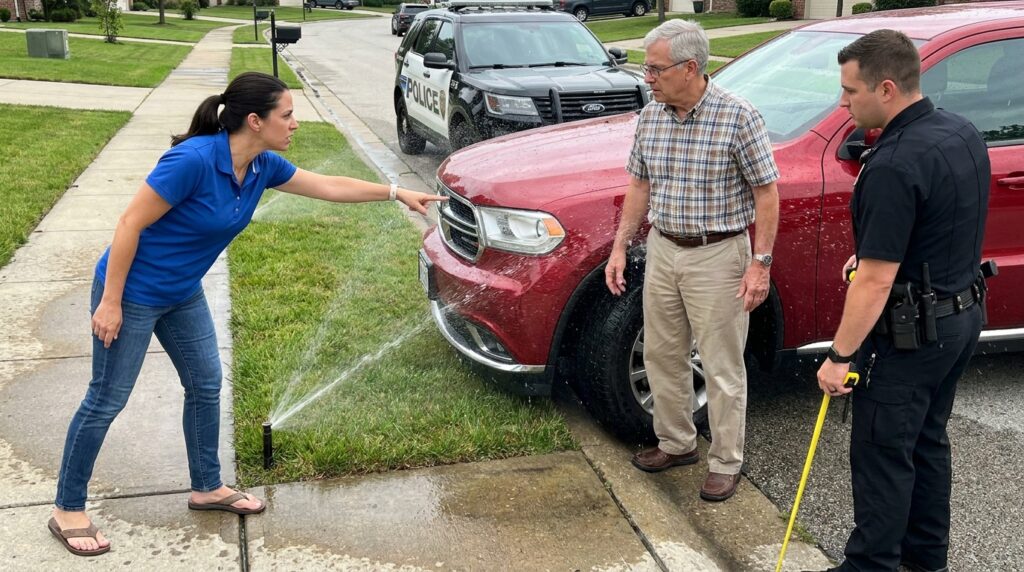
Arthur didn’t look up immediately. He kept his grip firm on the textured steering wheel of his red SUV, letting the engine idle with a low, heavy rumble that vibrated through the floorboards. Through the windshield, the world was a desaturated stretch of cracked American asphalt, baking under a humid July sky that made the horizon shimmer with heat. At the edge of his vision, the water came—a heavy, deliberate arc of high-pressure mist that slapped against his passenger-side door with a sound like throwing a handful of gravel.
He cut the ignition. The silence that followed was dense, heavy with the smell of wet earth, hot rubber, and the metallic tang of hard city water hitting sun-baked metal.
When he finally pushed the driver’s door open, the friction of the hinges groaned in the humid air. He swung his boots out onto the street, his soles finding the exact point where the dry pavement gave way to a dark, spreading stain of artificial runoff. Across the strip of vibrant green turf, she was already waiting.
The resident woman stood with her heels dug into the absolute edge of her lawn, her dark hair pulled back into a ponytail so tight it seemed to strain the skin around her eyes. She wore a blue polo shirt, crisp and uncreased, and her arms were crossed tightly over her chest like a padlock. Between her fingers, she clutched a sleek, black smartphone—her weapon of choice, always held at an angle that suggested a recording was either active or seconds away.
“This is the third time this week, Arthur,” she said, her voice dropping into a transactional, hard-edged register. She didn’t shout, but she stepped forward, her sandals stopping barely an inch from the muddy mud-line where her grass bled into the public concrete. “You’re deliberately blocking the pattern. The county guidelines are clear about uniform irrigation access.”
“It’s a public curb,” Arthur said. His voice was sparse, sanded down by thirty years of living on the same block. He adjusted his wire-rimmed glasses, his eyes tracking the silver arc of the sprinkler as it swung back toward his vehicle, the fine mist coating his front bumper in a glossy, wet sheen. “My house is three doors down, and there isn’t a square foot of dry asphalt left on the street.”
“Your parking issues aren’t my structural priority,” she snapped back, her thumb tapping the screen of her phone with a dull, rhythmic click. “Move the vehicle, or I let the city code enforcement handle the obstruction.”
Arthur didn’t back down, but as he reached down to close his door, his eyes caught something down in the dark gutter line—a tiny, deep fissure in the asphalt where the water was pooling unnaturally, disappearing down into a small, jagged hole beneath the curb edge that hadn’t been there yesterday.

CHAPTER 2: THE CRUNCH OF THE CURB
Arthur knelt. The heat from the dark asphalt came off the street in thick, dizzying waves, radiating straight through the worn denim of his jeans. Up close, the smell of the road was different—less about the humid summer air and more about the baking chemistry of old tar, sulfur, and the sour iron tang of hard city water that had dried and crusted over the concrete for seasons.
He didn’t look back up at her porch. He kept his attention down, his knuckles nearly brushing the dark, weaponized torrent of the sprinkler spray as it swept overhead, catching the back of his plaid shirt with a fine, freezing mist.
The fissure wasn’t just a crack. It was an intake.
The water from the high-powered oscillating head was hitting his SUV’s side panel, pooling in sheets down the crimson paint, and dumping straight into the gutter. But instead of running down the block toward the storm drain near the intersection, the flow was twisting. It formed a miniature, granular whirlpool, pulling loose grit and fragments of gray road stone down into a jagged, tooth-shaped gap right beneath the curb’s concrete apron. Arthur extended a thick, calloused finger, pressing it into the lip of the asphalt near the hole. The ground gave slightly—a soft, spongy hollow beneath a crust of sun-brittle aggregate.
“I told you to step away from the easement, Arthur.”
Her voice was closer now. The crunch of her sandals on the dry gravel edge of her lawn was sharp, rhythmic, and entirely devoid of hesitation. She had come down the three concrete steps of her walkway, her blue polo shirt vivid against the pale, over-fertilized green of her turf. The smartphone in her right hand was raised slightly, the dark lens pointing down toward the crown of his gray head like a barrel.
“You’re trespassing on a monitored perimeter,” she said. Her delivery was clipped, defensive, a calculated sequence of words designed to sound like a legal notice. “The county has strict codes regarding municipal property management. You’re tampering with the local water distribution.”
Arthur stood up slowly. His joints made a dry, popping sound that felt entirely in sync with the grit beneath his boots. He wiped his damp palm against the side of his khakis, leaving a dark, muddy streak across the fabric. He looked her dead in the eyes, his wire-rimmed glasses catching the glare of the high, white sun.
“The county didn’t pave this street for your private irrigation, Brenda,” he said, his voice flat, retaining the sparse, unyielding weight of a man who had watched three decades of neighbors move in and out of these identical floor plans. “And the water isn’t distributing. It’s sinking. You’ve got a void opening up right under your mailbox lane.”
A precise, microscopic flicker passed over Brenda’s face—a sudden freezing of the small muscles around her jaw before she pulled her lips back into a hard, defensive line. Her ponytail shifted as she tilted her head, her posture adjusting with the rigid, mechanical precision of her own sprinkler system.
“The drainage on this lot is fully certified,” she said, her thumb sliding down the side of her phone with an intentional, loud click that signaled a screen lock. “Any structural displacement out here is the direct result of your vehicle’s gross axle weight resting on the unreinforced curb edge. I’ve already submitted the formal notation to the board. If that tire is still touching the concrete when the patrol car routes through here, it’s an automatic municipal citation.”
“The curb is city property,” Arthur replied, his voice dropping into a lower, heavier register that didn’t rise to meet her defensive energy. He took one slow step toward the front bumper of his SUV, his body cutting off her phone’s view of the small, swallowing whirlpool in the gutter. “And a standard utility vehicle doesn’t displace six inches of road grade unless the earth underneath is already gone.”
Behind them, the low, steady hiss-click-click-hiss of the plastic sprinkler head reached the end of its arc. It paused for a single, mechanical micro-second, then reversed, throwing a solid sheet of cold city water straight across the narrow gap between them. The spray hit the hot hood of the SUV with a loud, spitting hiss, sending a cloud of fine white steam rising between Arthur and the resident woman.
Through the white mist, Arthur didn’t look at her angry, rigid expression. His eyes drifted past her shoulder, toward the pristine concrete foundation of her garage. There, half-hidden behind a heavily manicured boxwood shrub, a fresh, jagged line of dark gray sealant ran vertically up the brickwork—a thick, ugly scar where the house was quietly trying to tear itself away from the driveway.
Brenda noticed his gaze. Without a word, she stepped laterally, her wide silhouette completely blocking the shrubbery, her clipboard-like phone raised once more as the distant, metallic wail of a siren began to drift through the heavy, humid air from the main highway.
CHAPTER 3: THE CALL TO THE PERIMETER
The distant wail of the siren dropped an octave as the emergency vehicle cleared the county line highway and turned into the secondary development grid. The sound ground through the humid air, low and heavy, vibrating against the aluminum siding of the uniform two-story houses.
Brenda didn’t shift her position. Her silhouette remained wide, planted directly between Arthur’s line of sight and the vertical bead of dark gray sealant patching her garage brickwork. She adjusted the grip on her smartphone, her knuckles white against the black plastic frame, her thumb resting directly over the camera trigger. The hard, mechanical hiss of the sprinkler head completed another slow arc, dropping a fresh coat of hard, mineral-crusted water across the hood of Arthur’s red SUV.
“The log is open, Arthur,” she said. Her voice had gone exceptionally flat, matching the gray hue of the asphalt beneath her sandals. “I’ve uploaded the chronological sequence of your encroachment. The city doesn’t debate parking rights when an irrigation baseline is actively compromised by a vehicle’s tire load.”
Arthur didn’t pull his eyes away from the boxwood shrubbery where the patched foundation vanished into the parched earth. He reached into his pocket, his fingers tracking the cool, notched teeth of his house keys, feeling the grit of dry sand that seemed to inhabit every crease of his clothing on this block. He knew the structural layout of these homes; he’d helped pour the footings for the secondary phase across the street back when the soil was considered stable. The county had used uncompacted river silt as a sub-base, a cheap shortcut that left every driveway on the low side of the grade vulnerable to subsurface shifts.
“You’re using the non-emergency patrol to settle a boundary line you didn’t pay for, Brenda,” Arthur said. He stepped closer to his driver’s side door, his hand resting on the warm, water-slicked handle. The metal felt rough, scored by years of fine limestone sediment carried in the local water grid. “The municipal code gives three feet of clearance from the curb lip for utility access. My bumper isn’t within eight inches of your water lateral.”
“The lateral isn’t the primary asset,” she replied instantly, her posture tightening as the sound of the approaching cruiser grew distinct enough to locate two blocks north. “The neighborhood covenants require a continuous, uniform frontage. You’ve been notified three times by the board’s automated mailing system that your registration doesn’t align with the assigned street allocation for this sector.”
Arthur looked at the small, swallowing whirlpool at the edge of the concrete apron. The water was entering the fissure faster now, the surface tension breaking into a constant, hollow gurgle that was barely audible beneath the rhythmic clicking of the plastic sprinkler head. The soil beneath the concrete wasn’t just damp; it was losing its cohesion, washing out into whatever subterranean void was drawing it down.
“I didn’t get an automated notice,” Arthur muttered. His boots ground against a loose patch of loose aggregate near the wheel line. “I got a generic envelope with a hand-stamped county seal three days ago. No board header. No signature.”
Brenda’s eyes narrowed behind her wire-framed sunglasses, the lens reflecting two distorted, miniature versions of Arthur’s red SUV. She pulled her phone closer to her chest, her fingers covering the lower half of the device where a small, blue status light was flashing rhythmically.
“The delivery protocol is managed by the administrative tier,” she said, her delivery accelerating slightly as the white-and-black nose of the police cruiser finally rounded the corner of the cul-de-sac, its emergency lights turning the humid, sun-bleached air into a shifting strobe of red and blue. “If you have an exception to file, you do it at the district office, not by blocking my primary utility line with five thousand pounds of unrated steel.”
The patrol car slowed as it neared the curb, its tires producing a long, wet crunch as they rolled through the wide fan of water Brenda’s sprinkler was continuing to cast across the public road. The driver’s side window rolled down before the vehicle had even come to a complete stop, revealing the stocky silhouette of an officer whose dark hair was cropped short enough to expose the graying skin at his temples. The heavy nylon of his duty belt groaned against the vinyl seat as he shifted his weight, his eyes already tracking the wet boundary line between the resident woman’s lawn and Arthur’s front bumper.
Arthur stayed motionless by his vehicle door, his thumb hooked into the pocket of his khakis, waiting for the officer’s boots to hit the wet pavement. He could feel the small vibration of the idling cruiser through the soles of his shoes, but beneath that, there was a secondary, deeper hum—the faint, resonant thrum of hundreds of gallons of water rushing into the dark spaces beneath Brenda’s immaculate green grass.
CHAPTER 4: THE SPRINKLER CLASH
“Keep your hands where I can see them, sir, and step back from the driver’s side panel.”
The patrolman’s voice didn’t rise above the localized hiss of the sprinkler, but it carried the unyielding weight of an official directive. His boots hit the wet pavement with a thick, rubbery crunch, instantly soaking the lower leather of his uniform gear as he stepped into the path of the fine irrigation mist. The heavy nylon of his duty belt rasped against his utility vest, a sound Arthur recognized from decades of municipal personnel routing through the lower tracts of the development.
Arthur slowly withdrew his thumb from his pocket, raising his palms slightly but keeping his heels planted firmly near the edge of the red SUV’s front wheel line. “Afternoon, Officer. I’m just waiting for the water line to clear.”
“He’s obstructing an active utility layout, Officer,” Brenda interrupted, her sandals taking two rapid, aggressive strides down the turf until her front strap was touching the concrete curb apron. She held her smartphone up, the screen tilted down toward the officer’s badge line while that persistent blue status light continued its rhythmic, low-frequency pulse. “I filed the initial priority log ten minutes ago. The vehicle’s registration doesn’t match the designated sector allocation, and his tire load is currently causing localized structural displacement to the municipal drainage infrastructure.”
The officer didn’t look at Brenda’s phone. He stopped between the two of them, his stocky frame cutting off the direct line of sight between Arthur and the hidden foundation crack behind the boxwood shrub. His eyes, small and tightly pocketed behind sun-strained lids, went straight to the dark, swallowing vortex where the water was continuing to drain beneath the concrete lip.
“Your name is Arthur?” the officer asked, his attention remaining on the small whirlpool.
“Arthur Vance,” he replied, his voice flat, matching the gray aggregate of the road. “I live at forty-two ten down the block. This space has been a public curb easement since ninety-six. I’ve parked here every Tuesday for five years while the utility crews clear the lower culvert.”
“The easement parameters were systematically revised under the spring zoning review,” Brenda said, her delivery accelerating into a sharp, transactional clip. She shifted her smartphone to her left hand, her right hand reaching into the rear pocket of her jeans to pull out a folded piece of heavy, high-grade stock paper that had been creased into precise thirds. The paper lacked the official blue grid-lines of a standard city document, but it bore a heavy, dark municipal stamp near the top margin. “The sector board has reserved the immediate frontage for automated surface runoff stabilization. He was served with a certified notice of restriction three days ago.”
Arthur’s eyes traced the folded document in her hand. The title at the top, barely visible through the airborne water mist, didn’t read like a standard city citation. It was marked Application for Sovereign Easement Variance.
“Let me see the document, ma’am,” the officer said, extending a thick, short-fingered hand toward Brenda.
“It’s already logged in the district database,” she replied, her arm tightening against her side as she held the paper just out of his immediate reach, her thumb remaining firmly fixed over the lower sub-text where a signature line appeared completely blank. “The physical copy is for residential verification only. The point is the encroachment. Look at the water line. His vehicle is actively diverting the required flow rate away from the primary catchment basin.”
As she spoke, the oscillating sprinkler head reached the northern limit of its track. With a loud, pressurized pop-click, the plastic arm stalled, then began to cast a thick, unbroken fan of hard water directly across the officer’s shoulder and the SUV’s windshield. The fluid hit the safety glass with a heavy, drumming roar, masking the sound of the idling cruiser’s engine and sending a fresh stream of silt-laden gutter runoff directly toward the officer’s boots.
Arthur didn’t pull his eyes away from Brenda’s phone. As the water hit her arm, her screen flared to life, revealing a PDF document title that hadn’t been closed: Pet_ReZone_Drain_04_26. The date on the file string was current, but the county seal on the background image was missing its outer border line—the telltale mark of a digital draft, not an approved statute.
“Turn the irrigation valve off, ma’am,” the officer muttered, his head dipping slightly as a heavy drop of hard city water rolled down the bridge of his nose.
“The cycle is automated under section four of the covenant,” Brenda countered, her posture locking into a rigid, defensive block that completely obscured the boxwood shrub behind her. “If I interrupt the volume pressure now, the system’s internal alignment log resets, and the baseline variance becomes unverified for the court record.”
The officer’s hand moved slowly down toward the heavy leather snap of his duty utility case, his fingers brushing against the knurled metal edge of a tool casing. “I’m not asking about the covenant, ma’am. I’m telling you to shut down the water line so I can establish the physical clearance baseline on this asphalt.”
Arthur took one slow, deliberate step backward, his boot heel coming into direct contact with the red SUV’s front tire. The rubber felt warm, but the concrete directly beneath the tread gave a tiny, distinct crunch—a shifting of loose gravel that signaled the void beneath the road apron was expanding under the steady weight of the continuous water pressure.
CHAPTER 5: THE BLUE LIGHT CLOSES IN
The officer’s leather-bound boots took two slow, calculated strides into the heavy fan of the sprinkler spray, his uniform pants instantly darkening into a sodden, heavy wool as he positioned himself squarely within the contested line of sight. He didn’t reach for his sidearm, but his hand hovered with trained, transactional precision near the heavy composite clip of his utility case.
“Ma’am, I am instructing you a second time to turn off the valve at the main manifold,” the officer said. His voice was clipped, a dry municipal baritone that didn’t rise to meet Brenda’s defensive cadence. “The volume of runoff is creating a visible puddle depth inside the driving lane. That constitutes a traffic hazard under Section Nine.”
Brenda’s sandals didn’t move. She stood perched on her manicured lawn line, the wet soil beginning to ooze slightly over the thin white straps of her shoes as her weight shifted. Her phone was still raised, the blue indicator light blinking like an automated beacon against the gray backdrop of her garage door.
“The volume is calibrated to meet the baseline drainage index, Officer,” she said, her chin tilting upward with a sharp, mechanical tightness. Her voice carried the practiced, rhythmic tone of someone reciting a corporate ledger. “The documentation is right here. The application was stamped by the regional zoning coordinator on the fourteenth. If you interfere with the saturation cycle before the log is complete, the municipal data layer becomes unverified for the district hearing.”
Arthur watched the folded stock paper in her left hand. The paper was getting soft now, the edges curling under the persistent spray of the lawn sprinkler, the heavy black ink of the official-looking stamp beginning to run in thin, dark lines across the unprinted margins. He stepped closer to the hood of his red SUV, his hand resting on the hot, wet metal. He could feel a distinct vibration beneath his boots—not the steady purr of the idling cruiser, but a lower, hollower frequency that seemed to travel directly along the concrete line of the curb.
“Let me see that document, Brenda,” Arthur said. He didn’t reach for it, keeping his arms low and guarded at his sides, but his eyes stayed locked on the signature line. Through the blur of the falling mist, the line where the district surveyor’s approval should have been scratched remained a smooth, blank white.
“This is an internal residential notification, Arthur,” she snapped back, her thumb sliding down the glass screen of her phone to change the display layout. “You’re not a verified party to the variance. Your primary parcel is registered three hundred feet outside the immediate catchment boundary.”
The officer turned his stocky frame toward Arthur, his sun-strained eyes squinting through the wet haze. “Sir, I need you to step back toward the rear panel of your vehicle while I verify the curb clearance. If your front axle is resting within the city’s utility margin, we’re going to have to clear the road regardless of the document status.”
Arthur didn’t pull his boots back. Instead, he leaned down slightly, his fingers trailing the rough, mineral-crusted edge of the asphalt where it met the concrete apron. “Look at the tire line, Officer. I’m not over the margin. The asphalt itself is dropping. Every gallon she dumps out here is pulling the sub-base straight under her lawn.”
As if responding to the weight of his words, the automatic sprinkler head paused at the absolute peak of its southern arc. With a heavy, pressurized thud-clack, the plastic mechanism locked. A solid, uninterrupted stream of hard city water hit the front wheel well of the SUV, the heavy fluid driving straight into the crumbling crack in the gutter.
The sound wasn’t a splash anymore. It was a deep, gargling suction.
The officer took a half-step closer, his eyes dropping to the wet, dark line where the aggregate was turning into a loose, shifting silt. His mouth opened to issue a directive, but before the words could clear his lips, a sharp, metallic snap echoed from behind Brenda’s manicured boxwood shrubbery. The vertical bead of dark gray sealant patching her garage wall didn’t just split—it tore, a thin shower of dried red brick dust spraying out over the green turf as the house foundation gave a low, grinding groan against the shifting earth.
Brenda didn’t look back at the wall, but her smartphone jerked downward, the blue status light suddenly disappearing as her fingers squeezed the frame. Her face went entirely pale, the rigid muscles of her jaw locking into a tight, desperate line that had nothing to do with county parking guidelines.
“The cycle is automated,” she repeated, her voice dropping into a lower, harsher register that sounded frayed around the edges. “The board approved the saturation baseline. It’s on the server.”
“Shut it down, ma’am,” the officer said, his hand finally snapping the heavy leather retention strap off his utility case as he stepped out of the water lane. “Now.”
CHAPTER 6: THE SNAP OF THE STRAP
The snap of the heavy leather strap releasing on the officer’s utility case was a dull, transactional sound, but it stayed entirely clean above the high-pressure drone of the water line.
The patrolman stepped laterally, his uniform boots churning through the loose gravel that had begun to drift out of Brenda’s driveway apron and into the wash of the main road. His hand didn’t drop to his belt again; instead, he pointed a single, thick finger toward the small irrigation manifold hidden inside a dark green plastic housing near the edge of her porch steps.
“I’m not giving you an option for an administrative review this afternoon, ma’am,” he said, his voice flat, taking on the rigid rhythm of an official warning. “The structural displacement out here is no longer a civil easement issue. You’ve got active aggregate collapse hitting the driving lane. Step away from the phone and secure the valve.”
Brenda didn’t move toward the green box. Her sandals remained wedged into the softening sod line, the wet peat bubbling up around her soles in dark, mineral-heavy bubbles. She kept her phone angled upward, but her thumb was frozen over the top corner of the screen, her knuckles locked into a bloodless, grey shade that matched the weathered brick of her garage.
“The allocation is registered under the district’s drainage baseline,” she said, though her cadence had lost its flat, corporate certainty. Her chest rose and fell in short, sharp movements that strained the fabric of her blue polo shirt. “The structural integrity of this parcel was verified by the developer during the phase two rollout. If there’s an active void under this pavement, it’s a direct consequence of the municipal utility failing to concrete-seal the culvert line three doors down.”
Arthur didn’t answer her. He kept his attention focused on the split behind the boxwood.
The dark gray bead of sealant hadn’t just separated; it had uncoiled like an old wire. A slow, grinding friction was traveling beneath his own boots now, a dull skrr-skrr of fractured limestone bedding shifting three feet down beneath the asphalt crust. He knew that sound. It was the sound of river silt losing its friction under constant, pressurized saturation.
“It’s not the culvert, Brenda,” Arthur said, his voice low, retaining the unhurried weight of thirty years spent watching this soil settle. He reached down to the front bumper of his red SUV, his calloused palm catching the heavy, vibrating pulse of the water hitting the steel. “You’ve been running this zone four hours every night since May. You weren’t watering the sod. You were trying to fill the drop behind your service box before the county inspector routed through for the annual grade check.”
Brenda’s jaw tightened into a thin, white line, her ponytail twitching against her neck as she turned her head sharply toward the patrol car. The red and blue strobe of the light bar caught the sweat glistening along her jawline, turning the humid air between them into a rapid, pulsating mask.
“The documentation is on the server,” she whispered, her voice dropping out of its transactional register into something harsh and dry. “The application was submitted through the regional office. The board has no authority to revoke a stabilization variance once the physical application has been stamped by the coordinator.”
The officer didn’t wait for her to finish. He turned back to his cruiser, his hand reaching through the open window to unhook the heavy plastic microphone from the dashboard rack. His knuckles brushed against the knurled metal housing of his spotlight as he keyed the transmitter, his eyes staying fixed on the widening crack beneath the curb apron.
“Dispatch, this is Unit Four,” he muttered into the grill, his delivery clipped and devoid of drama. “Get the municipal water supervisor down to forty-two hundred block of Shady Pine Lane. We’ve got an active water main lateral failure or localized sub-grade washout under the roadway edge. Let them know they need to bring the steel-gauge line-testing pins.”
He dropped the mic back into the cradle with a dull, hollow thud that seemed to echo through the frame of the car. When he turned back around, he pulled a thick, steel-tipped yellow measuring tape from his secondary utility pouch, the metal housing scratched and oxidized from seasons of exposure to salt and road grime.
“Both of you stand clear of the front wheel well,” the officer directed, his boots splashing through three inches of mud-laden water as he approached the front tire of the red SUV. “I’m pinning the legal curb margin right now. If that tire is on public asphalt, this line goes off, and the city’s taking the valve out of the ground.”
Arthur stepped back two feet, his soles finding a dry, cracked ridge of asphalt further toward the crown of the road. He watched the metal tip of the tape drop toward the wet concrete lip, knowing the measurement wasn’t going to find what Brenda expected. The ground beneath the tape was already moving, a slow, silent displacement that was drawing the whole neighborhood’s common ground down into the dark.
CHAPTER 7: THE TAPE SNAP
The steel lip of the measuring tape bit into the wet aggregate with a sharp, metallic clink.
The officer didn’t look up to read Brenda’s expression. He dropped to one knee, his sodden uniform trousers pressing directly into the gray slurry accumulating in the gutter line. His thick fingers pinned the yellow spring-steel ribbon flush against the vertical concrete of the curb, pulling the casing back across the dark asphalt until the blade went rigid, stretching taut directly beneath the front bumper of Arthur’s red SUV.
“I need you to look right here, ma’am,” the patrolman said. His voice remained a flat, municipal monotone, the words dry and transactional beneath the relentless hiss of the irrigation line. “The municipal boundary doesn’t track with your lot stakes. The city’s easement extends exactly thirty-six inches from the inside edge of this concrete header.”
Brenda took one sharp step backward, her sandals sliding off the muddy turf and catching the rough edge of her concrete walkway. The phone in her right hand dipped, the blue status indicator dying out as she lowered her arm against her hip like a spent lever. Her face remained a pale, rigid mask under the humid daylight, the small muscles around her mouth twitching with a frantic, silent calculation.
“The calculation is erroneous, Officer,” she said, though her rhythm had slowed, the syllables losing their crisp, mechanical authority. “The original developer’s map established the drainage margin at the surveyor’s pin behind the fence line. If you’re measuring from the curb lip, you’re overriding an active application variance currently held by the district coordinator.”
Arthur didn’t pull his eyes away from the taut steel tape. The yellow paint was scratched, exposing patches of raw, gray steel that had rusted under seasons of use in the county’s drainage sectors. Through the fine spray of the sprinkler, he could see the precise red numbering on the blade. The black rubber tread of his front tire sat at twenty-eight inches—eight clear inches inside the public roadway easement.
“The tire is clear, Brenda,” Arthur said, his voice dropping into that quiet, heavy register that had carried him through thirty years of watching this block settle. He didn’t move his boots from the dry ridge of the asphalt crown. “It’s public property. It’s been public property since the county poured the footings.”
Brenda’s fingers tightened on the folded paper in her left hand, the damp stock tearing slightly as her thumb dug into the unverified signature line. “The paper was stamped, Arthur. The filing layer is active on the server. You can’t just park a five-thousand-pound unrated axle over an active sub-surface irrigation baseline without a formal district allocation.”
“The application isn’t an ordinance, ma’am,” the officer said. He let his thumb release the slide lock on the tape casing. With a sudden, high-velocity snap-clack, the steel blade retracted into the oxidized housing, the sound cutting clean through the humid drone of the street like a deadbolt falling into place. He stood up slowly, his joints making a dry, cracking pop that matched the loose aggregate beneath his boots. “An unsigned petition doesn’t give you the authority to operate a pressurized water line across a public driving lane. Right now, this irrigation head is actively undermining the public right-of-way.”
As if triggered by the retraction of the steel tape, a second sound came from behind the manicured boxwood shrubbery—a deep, resonant thud-hollow that vibrated straight through the floorboards of the idling patrol car. The vertical crack in Brenda’s brickwork didn’t just split further; it shifted laterally by half an inch, a steady trickle of granular foundation sand pouring out from behind the mortar line, washing straight down into the parched earth where her green grass met the concrete walkway.
Brenda didn’t look back at the groan of her house, but her shoulders dropped an inch, the rigid, forward-leaning posture that had held her at the edge of the sidewalk since noon finally giving way to a slight, defensive crouch. The neighborhood watchers on the surrounding porches didn’t speak, but two screen doors clicked shut down the block—the silent, local acknowledgment that the territorial claim had broken.
The officer adjusted the heavy nylon of his duty belt, his hand resting on the knurled metal frame of his heavy utility flashlight. “I’m going to stay right here until the water supervisor pins the lateral line, ma’am. You walk up that path and cut the valve off manually, or I’m going to cite the property for intentional obstruction of a municipal thoroughfare under code section twelve.”
Arthur stayed still against the flank of his SUV, his hand tracking the cool, mineral crust left by the water on his hood. He could feel the small, persistent suction from the gutter crack pulling the remaining surface runoff down into the dark, but the high-pressure spray across his windshield was already beginning to lose its volume, the arc dropping lower as Brenda turned her back to the street and began the long walk up her wet concrete steps.
CHAPTER 8: THE DRYING BOUNDARY
The final, sputtering gasp of the sprinkler head died out with a dry, hollow wheeze.
The persistent fan of high-pressure water collapsed into a weak, greasy trickle, dripping down the plastic arm and pooling inside the mud-rimmed turf housing. The sudden absence of the mechanical drone left a dense, suffocating quiet over the block, broken only by the rhythmic tick of Arthur’s cooling engine block and the slow, heavy splash of mud-laden runoff dropping into the deep gutter fissure.
Arthur didn’t move from his position near the dry ridge of the road crown. His boot soles felt completely locked to the gritty asphalt surface, tracking the faint, subterranean vibration that remained active beneath the concrete header. Up close, the street smelled exclusively of sun-baked lime crust, sulfur, and the raw, granular odor of uncompacted sub-base silt that had been washed completely clean by the continuous saturation.
Brenda stood on the top concrete tier of her walkway, her hand still resting on the iron handle of the main isolation valve housing. Her blue polo shirt was completely stained with wet peat around the hemline, her dark ponytail sagging against her neck as the rigid, structural certainty of her stance evaporated under the high afternoon sun. She didn’t look down at the street lane, nor did she look at the half-dozen neighbors who remained standing motionless on their respective porches, their silent attention fixed squarely on the wide, dark patch of shifting aggregate separating her property line from the road.
“The log will update at midnight, Arthur,” she whispered, her voice stripped of its crisp, administrative clip, leaving only a dry, rattling hiss that barely cleared her lips. “The sub-base records are certified. The county layer doesn’t overwrite a priority application variance just because a patrolman used a standard-issue tape measure.”
Arthur adjusted his glasses, his eyes drifting past her sagging silhouette toward the deep, jagged vertical split in her garage wall. The dark gray sealant had completely separated from the brickwork now, exposing a three-inch gap of raw, rotting mortar that showed the entire northwestern corner of the house was dropping into an unrecorded void.
“The county layer isn’t looking at your paperwork anymore, Brenda,” Arthur said, his voice flat, retaining the heavy, unyielding pragmatism of a man who knew exactly how much river silt it took to swallow a foundation footing. “They’re going to be looking at the structural survey map. The earth under your service lane isn’t holding. You didn’t file for a drainage basin variance to save the curb; you filed it because the whole front lot is dropping into the old creek bed, and you wanted the city to pay for the grout injection before the floorboards cracked clean through.”
A sharp, metallic ping echoed from beneath her driveway apron—the distinct sound of a cast-iron municipal water lateral snapping under the weight of the settling grade. A tiny, steady column of grey silt-water began to bubbled up through a fresh crack in her concrete walkway, turning the pristine green grass into a dark, marshy bog within seconds.
The patrolman stepped away from the front wheel well of the red SUV, his hand sliding the rusted yellow measuring tape back into his utility pouch with a clean, leathery slide. His boots left deep, dark tracks of grey mud across the asphalt as he approached the front hood of his cruiser, his eyes never leaving the widening fracture line in the concrete header.
“Ma’am,” the officer called out, his tone dropping into a cold, non-negotiable directive that offered no room for legal subtext or administrative delay. “Leave the main valve isolated. The municipal water crew is turning off the sector mainline at the highway junction in five minutes. Pack what you need for forty-eight hours and step clear of the porch perimeter. This lot is being yellow-tagged for active sub-grade subsidence before the utility rig arrives.”
Brenda’s phone slipped from her fingers, hitting the wet concrete step with a dull, plastic crack that shattered the glass face. The screen flickered once, the blue status indicator light dying out completely, leaving the empty zoning document locked beneath a web of dark, radiating fractures. She didn’t stoop to pick it up. She turned around slowly, her sandals dragging across the wet aggregate as she disappeared into the shadow of her doorway, her wide silhouette looking strangely small against the tilting frame of her house.
Arthur turned his back to the property line, his hand finding the warm, rough steel of his driver’s side handle. The pavement beneath his vehicle was dry now, the boundary line clearly marked by the gray crust of dried minerals where the water had been forced to stop. He didn’t look back at the watching porches as he pushed the heavy door shut, the solid, metallic latch sealing him inside the familiar rumble of his own machine while the common ground beneath the street settled into its final, unyielding shape.







