The Concrete Seam: A Modern Post-Western Tale of Asphalt, Iron Boundaries, and False Sovereigns
CHAPTER 1: THE MEASURE OF AN INCH
The metallic click of the steel-cased pen was the only sound inside the cab. Click. Release. Click. Outside, the morning air over the cul-de-sac was thick with the scent of cut fescue and damp asphalt, a clean, sterile midwestern peace that always felt hours away from rotting. Through the windshield, the yellow survey stake stood like an iron tooth driven into the edge of the sod. It was raw, unpainted wood wrapped in high-visibility vinyl, an explicit declaration of war anchored precisely where the concrete seam met the curb.
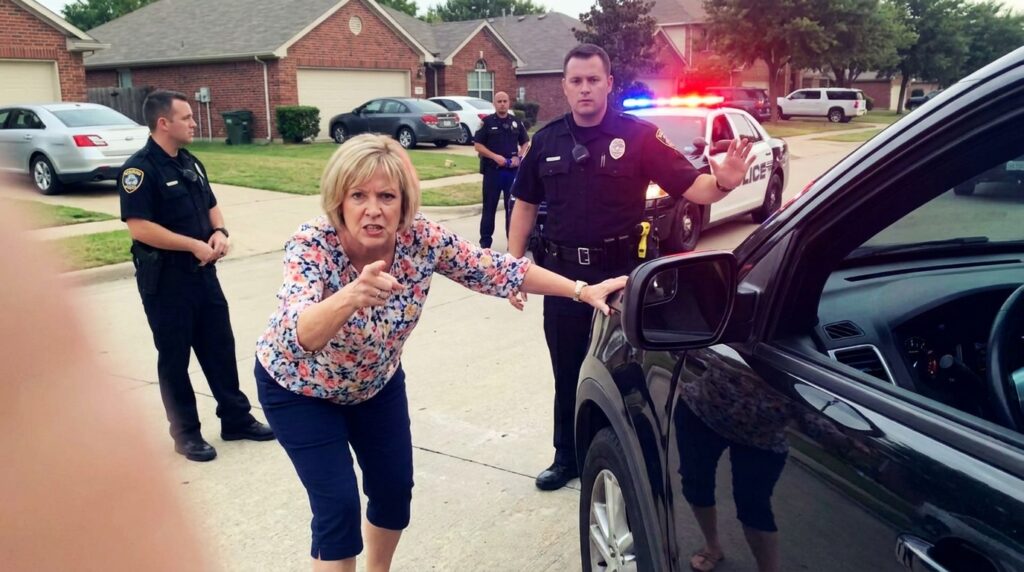
Evelyn was already at the mailbox line. She didn’t walk; she drifted with a heavy, deliberate momentum, her floral blouse catching the low sun like a warning flag. Her sandals made a rhythmic, scratching slap against the aggregate driveway. In her right hand, the plastic corner of a blue folder was clamped tight against her ribs—the fake notices, the arbitrary citations, the weeks of typed threats about easement violations and common-area overreach. She stopped exactly two inches from the yellow vinyl ribbon, her short blonde bob tossing as she leaned her chin forward to inspect the fresh stake. Her jaw looked like it had been carved out of dry river limestone.
Inside the dark truck, I kept my thumb pressed against the side of the metallic pen. The passenger seat was occupied by the heavy, laminated county deed folder, its brass fasteners scratched from three separate trips to the clerk’s records room. Every number was logged. Every square foot of the parcel had been verified by a state-certified surveyor whose iron pins were now buried under six inches of topsoil along her flowerbed. She didn’t know about the pins yet. She only knew that for eighteen months, her typed letters had gone unanswered, ignored by a resident who preferred the silence of a property line over the theater of an HOA grievance committee.
She turned her face toward the driver’s side glass, her sunglasses reflecting the dull gray of the truck’s door panels. She raised her phone—the white-cased weapon she used to document every oil stain, every tire that lingered an inch over the grass, every delivery truck that stayed five minutes too long at the curb. Her thumb hovered over the screen, her head tilting as she caught the small, red blinking light of the interior dashcam mounted behind the rearview mirror.
She didn’t back down. The entitlement was too deep in her ankles, bred from a decade of running the block like an uncommissioned sheriff. She took one step closer, her brown sandals crossing the first expansion joint of my concrete. The air in the cab grew instantly smaller, pressurized by the proximity of her shadow against the glass. She didn’t knock. She simply stood there, her fingers twitching against the blue folder, her chest rising under the floral print as she prepared the opening accusation. Through the glass, I could hear her breathing—shallow, dry, and perfectly convinced that the ground beneath her feet belonged to the association.
My finger stayed off the window switch. Let her step into the frame. Let the lenses capture the exact millisecond her sole left the public easement and found the private stone.

CHAPTER 2: THE TWISTED LINK
“He’s backed up to the curb, Evelyn! You want me to hook the front axle or the chassis?”
The voice cracked through the midday heat, thick with grease and tobacco. The flatbed tow truck sat idling at the lip of the cul-de-sac, its diesel engine emitting a low, rhythmic rattle that vibrated through the floorboards of my cab. The driver, a stocky man in an oil-stained neon vest, stood with his boots planted on the public asphalt, his hand resting on the hydraulic lever assembly of the flatbed. The steel cable hung slack from the winch, a heavy, rusted hook clinking against the diamond-plate steel deck.
Evelyn didn’t turn around to look at him. Her eyes stayed locked on my windshield, her reflection distorted by the dust clinging to the glass. She tapped her phone screen twice with a manicured nail—a sharp, plastic click that sounded like an insect hitting a window.
“The chassis,” Evelyn said, her voice dropping into that flat, administrative tone she used when she was citing a homeowner for an unapproved shade of porch paint. “It’s a persistent obstruction of a designated utility easement. The bylaws are clear, Bob. Hook it and pull it to the impound lot.”
I reached across the console, my fingers brushing the cold, textured vinyl of the laminated deed folder. The brass fasteners felt heavy, slightly rough where the plating had worn away from years in the dark cabinet. I pulled the folder into my lap, the pages of the 1994 tract map crinkling under my palm. There was a specific weight to reality—the exact density of paper, the iron-gall ink of county stamps, the physical presence of three-quarter-inch steel survey pins driven deep into the clay. Evelyn’s world was built on three-part carbon copies and neighborhood association minutes; mine was anchored in the geology of property markers.
The window rolled down with a dry, scraping groan, the internal gears gritting against the fine silt that blew off the development’s unfinished retention basin. The smell of hot diesel and sun-baked rubber rolled into the air-conditioned cabin.
“The winch cable isn’t long enough to clear the private property line, Bob,” I said, my voice leveled to match the low hum of the truck’s engine. I didn’t look at Evelyn. I looked past her bobbing blonde hair, straight at the tow driver whose hand was still hovering over the hydraulics. “If your iron crosses that yellow stake, you’re operating an unauthorized recovery on a private lot. The state licensing board has an administrative form for that. It costs about five grand on the first offense.”
Bob hesitated. His boots shifted on the asphalt, his eyes dropping to the yellow vinyl ribbon tied around the survey stake. The ribbon fluttered in the hot exhaust, a bright, synthetic slash against the dusty gray of the concrete seam. He knew the look of an official marker. He also knew the look of a lawsuit. He pulled his hand back from the lever, wiping his palm on his thigh. “She said it was a common area, man. I’m just executing the dispatch order.”
“The dispatch order is based on a falsified complaint,” I replied, opening the door.
The weight of the door frame was solid under my grip, the ungreased hinges giving off a sharp, metallic squeak as I pushed it into the gap between my vehicle and Evelyn’s hip. She didn’t move back until the steel edge was three inches from her floral blouse. Her jaw tightened further, the skin around her mouth turning the color of dry tallow. She held the blue folder up like a shield, the paper corners soft and frayed from her constant, nervous handling.
“It is a common area,” she hissed, her finger snapping down toward the base of the curb. “The utility easement extends six feet from the water meter. The association charter from 1992 explicitly gives the board the right to clear any vehicle obstructing structural access. You think because you hired some cut-rate surveyor to pound sticks into the dirt that you can rewrite the map of this development?”
I stepped out onto the concrete, my boots finding the grit. The heat of the sun-baked driveway radiated through my soles. I didn’t answer her. Instead, I walked past her shoulder, my shadow cutting across her Capris as I moved toward the drainage grate near the curb.
Something had been wedged into the iron slats—a small, dark object that didn’t belong to the street’s standard debris. I knelt down, the heat of the curb pressing through my jeans. It was an old, oil-stained brass shim, three inches long, stamped with a series of faded, non-sequential numbers that didn’t match the county code. It had been driven into the concrete seam right where the original curb had been cut and refaced years ago. When I touched it, the metal was burning hot, the surface pitted with rust and road salt.
“Evelyn,” I said, my fingers tracing the rough edge of the brass wedge. “Who poured the concrete for the cul-de-sac extension back in ninety-four?”
She froze. The phone in her hand tilted downward, the camera lens pointing blankly at her own brown sandals. For a fraction of a second, the limestone rigidity of her face cracked, revealing something old, dry, and carefully guarded behind her sunglasses. She pulled the blue folder closer to her chest, her knuckles turning white against the cardboard.
“That has nothing to do with your truck,” she said, her voice rising an octave, losing its cold, bureaucratic precision. “Bob, hook the axle. Now.”
But Bob wasn’t looking at her anymore. He was looking down the street, where the first rhythmic pulse of a crimson and blue light was beginning to paint the brick facades of the neighborhood.
CHAPTER 3: THE RUSTED APPARATUS
The flash of the first cruiser’s roof rack hit the vinyl siding of the house opposite us, transforming the sun-baked cul-de-sac into an arena of rhythmic, artificial indigo and crimson. The diesel rumble of Bob’s tow truck was eclipsed by the high-frequency click of a local municipal engine dropping into park. Doors slammed in sequence—two crisp, mechanical cracks that signaled the arrival of institutional gravity.
Evelyn didn’t move her boots from the concrete expansion joint, but her fingers adjusted their grip on the blue folder, tightening until the cheap plastic rings groaned. The limestone mask was back on her face, though a thin bead of sweat had begun to track through the powder on her temple, cutting a tiny, clean line down to her jaw.
“About time,” she muttered, her voice recovering its practiced sharpness as the lead officer cleared the bumper of her sedan. “Officer, this resident is actively obstructing a documented municipal utility access route. He’s placed unauthorized physical markers into the common-area turf and has threatened commercial recovery operators.”
The lead officer was tall, his black local uniform stiff with starch that had already dried crisp under the midday sun. His duty belt gave off a heavy, shifting leather creak as he stopped at the precise line where my aggregate driveway met the public street asphalt. His eyes didn’t look at Evelyn’s face; they dropped immediately to the yellow vinyl ribbon fluttering on the survey stake, then to the uncoupled flatbed hook dangling three feet from my front bumper.
“Ma’am,” the officer said, his voice flat, professional, and entirely drained of neighborhood politics. “We received a call regarding a hostile dispute over a vehicle blockage. Who is the registered property owner here?”
“I am,” I said. I stood by the open cabin door of my truck, my hand resting on the warm, scuffed steel of the door frame. “The deed is in the passenger seat. The state-certified survey markers were driven yesterday morning at eight o’clock. The vehicle is situated exactly fourteen inches inside the private boundary line.”
Evelyn stepped forward, her brown sandals grinding a stray piece of limestone gravel into the concrete with a dry, crunching screech. She thrust her phone toward the officer’s face, her short bob shaking with the sudden expenditure of her defensive energy. “The survey is invalid. The association charter signed in ninety-two reserves a six-foot easement from the primary water main for infrastructure maintenance. Look at the record. He’s blocking the county grid.”
The backup officer, a stocky man with a shaved head and a quiet, watchful stance, moved laterally along the curb line. He wasn’t looking at the phone screen. His boots brushed past the edge of Evelyn’s meticulously manicured lawn, his eyes scanning the low ground where her prize-winning hostas grew in dense, dark green clusters right against the property line. He stopped, his toe tapping a half-buried piece of iron.
“Evelyn,” I said, shifting my gaze from the lead officer to the blue folder in her hand. “The ninety-two charter you keep citing was superseded by the ninety-four extension when the developer put in the secondary drainage culvert. If this is a utility easement, where is the iron access cap?”
“It’s registered under the common plat,” she snapped, her knuckles turning a bloodless white against the plastic folder. “It doesn’t need to be visible to be legally binding.”
“Everything structural has an inspection footprint, ma’am,” the lead officer remarked, his hand resting casually but firmly on his utility belt. He turned his head slightly toward his partner. “Miller, you see a municipal cap over there?”
The backup officer bent down, his thick fingers parting the broad, waxy leaves of the hostas. The dry earth gave off a faint, dusty smell as he cleared a layer of decorative pine bark. There was a metallic scrape—the sound of a boot heel striking old, pitted iron. When he stood back up, his palms were covered in a fine, brick-colored rust dust.
“Got a domestic main cap down here,” Miller said, looking over his shoulder at the lead officer. “But it isn’t six feet from the curb. It’s nearly ten. And it looks like someone ran an unmapped iron sleeve from the lateral line straight under this driveway extension.”
The lead officer’s eyebrows narrowed, his gaze shifting back to Evelyn’s face. The blue and red lights continued their relentless, silent rotation, casting long, mechanical shadows across her floral blouse. The atmosphere in the cul-de-sac had changed; the weight of the dispute was shifting away from an unapproved vehicle parking violation and down into the rusted, hidden plumbing of the development itself.
I reached into the cab, my fingers wrapping around the edge of the laminated deed folder, pulling it into the glare of the noon sun. “The ninety-four amendment locked the utility corridor to the northern boundary, officer. If there’s an iron sleeve under this concrete, it was laid after the plat map was filed. And it wasn’t laid by the county.”
Evelyn’s phone dropped two inches, the screen reflecting the high, unblinking glare of the midday sky. Her mouth opened slightly, but no administrative rule came out. She looked at the tow driver, then at the rusted dust on Miller’s fingers, her fingers twitching against the frayed edge of her secret.
CHAPTER 4: THE CHROMIUM STROBE
“The county grid isn’t open to interpretation by patrolmen who can’t read an engineering legend!”
Evelyn’s voice cut through the steady, mechanical clicker-clicker of the cruiser’s flashers. She took two sharp steps away from her flowerbed, her brown sandals snapping against the curb’s concrete lip. Her right arm came down hard, the blue folder slicing a violent arc through the humid air as if she could physically beat back the rust-colored powder coating Miller’s fingertips.
The lead officer didn’t blink. The red strobes caught the polished silver of his badge, sending sharp, bleeding beams across the driveway’s aggregate surface. The leather of his duty belt gave off a dry, heavy creak as he shifted his weight, his solid stance remaining anchored exactly on the property seam.
“Ma’am,” the lead officer said, his tone dropping an octave into a cold, transactional rhythm that belonged to city intake desks rather than suburban cul-de-sacs. “The county code is very specific about unmapped infrastructure. If my partner is looking at a lateral extension that doesn’t clear the main plat, this call ceases to be an administrative tow request. It becomes an unauthorized worksite issue.”
“It’s a private improvement authorized under the ninety-two subdivision covenants,” Evelyn said, her words rushing out, her lips white and dry along the edges. She pulled her sunglasses down an inch, her eyes bloodshot and small in the glare of the noon light. She wasn’t looking at the officer; she was staring down into the darkness of my open cab door, where the laminated deed folder still lay flat across the gray vinyl passenger seat. “The resident knows exactly what’s under that slab. He’s been attempting to block infrastructure access since the frost broke.”
I stepped around the corner of my truck’s heavy steel tailgate, the friction of my boots on the gritty driveway concrete making a low, scraping sound. I held my phone out, the screen displaying a clean, high-resolution digital log of county building permits spanning from 1990 to the previous winter.
“There are no private improvement riders attached to this lot number, officer,” I said. My thumb scrolled through the scanned rows of ink-stamped ledger sheets. “The developer closed the final permit pool in October of ninety-four. If Evelyn’s board ran a sleeve under this concrete after that date, they did it without a county inspector signing off on the depth. They bypassed the trench regulations.”
Miller stayed on his knees near the hostas, his thick fingers working through the root systems with the blunt precision of a mechanic adjusting a valve. He used a small, flat-bladed tool from his pocket kit to strike the side of the exposed domestic main cap. The sound that came back up was hollow, a dead, ringing clink that indicated an empty cavity below the iron plate rather than a packed gravel bed.
“The collar’s fresh,” Miller called out, squinting up through the flashing blue light spill. He pointed with the tip of his tool toward the inner diameter of the drainage casing. “The iron is pitted on the outside, but look down the throat. Someone applied a high-zinc cold galvanizing spray to the threads within the last forty-eight hours. The overspray is still tacky on the silt line.”
The lead officer turned his full attention back to Evelyn. The limestone rigidity of her posture seemed to shrink slightly under the steady, alternate pulse of the roof rack. The neighborhood porches were silent now; three separate residents stood by their mailboxes down the lane, their profiles dark and motionless against the white vinyl fences. The cul-de-sac had become a closed system, its legal and physical boundaries tightening around her like a tightening winch.
“Evelyn,” the lead officer said, his voice level but unyielding as he stepped into her personal space, his shoulder line cutting off her view of the tow driver. “We need the structural variance log. Not the association newsletter. The actual engineering waiver with the municipal seal.”
“The records are at the management office,” she said, her fingers twitching against the cardboard backing of her folder, her defensive stance beginning to reveal the exhaustion of a long, calculated gamble. “They aren’t open on Mondays. The clerk is out until Wednesday morning.”
“Then the truck stays exactly where it’s parked,” I said, leaning my elbow against the bed rail of my truck, feeling the heat of the dark paint transfer through my sleeve. “And Bob takes his flatbed out of my driveway before his oil pan leaves a mark on the stone.”
Bob didn’t wait for Evelyn to give the word. He hit the hydraulic release valve on his deck with a loud, pneumatic hiss, the steel ramp sliding back into its road frame with a metallic clatter that shook the loose gravel near the curb. He climbed into his cab without looking back, his diesel exhaust leaving a greasy black cloud over the top of her prize-winning hostas.
The lead officer watched the tow truck pull away, then looked back at the fresh survey stakes driven into my sod. “Miller, pull the digital map for the ninety-four plat pool on the terminal screen. Let’s see what the county grid actually recorded before someone started spraying zinc down the throat of this drain.”
Evelyn didn’t move, but her sandals shifted slightly, her heels crossing back over the concrete expansion joint into the public gray of the street. The secret was still locked down in the dark under the slab, but the first seam had begun to open.
CHAPTER 5: THE CORE OF THE SEAM
“You can’t put yourself in my place, then judge me like that!”
Evelyn’s voice broke completely, losing its dry, corporate cadence and sharpening into something frantic, raw, and desperate. She didn’t stay on the public side of the concrete seam. Before Miller could look up from the terminal inside the cruiser, her brown sandals slammed across the private aggregate line, her body lunging toward the open dark frame of my driver’s side door.
Her shoulders pitched violently forward, her floral button blouse bunching at the collar as she thrust her weight into the narrow gap. Her left hand clamped onto the dusty black metal of the door frame, the knuckles turning the shade of old tallow under her manicured nails. With her right hand, she stabbed a rigid, trembling finger directly into the cab’s shadowed interior, cutting the space inches away from my chest. Her sunglasses slipped down her nose, revealing wide, bloodshot eyes fixed on the laminated deed folder sitting on the vinyl passenger seat.
“The board spent thirty thousand dollars securing that northern utility line!” she screamed, her breath hot and shallow against the interior air conditioning. “You don’t understand the liability. You don’t live with the pressure of keeping this entire development from falling below code. If that sleeve isn’t tied into your drainage lateral by Friday, the management company pulls our structural insurance!”
I didn’t move my thumb from the side of the steel pen. I sat anchored in the seat, my neck muscles tense, letting the dashcam capture the exact angle of her arm crossing the threshold. “Then you should have filed a legal variance in ninety-four, Evelyn. You don’t get to manufacture an emergency call because you buried an unauthorized easement under my lot.”
Before she could lean her torso further into the cab, the lead officer intercepted her. His tall, starch-stiff frame cut into the light, his heavy leather duty belt giving off a sharp, sequential creak as he planted his shoulder line directly into the narrow gap between Evelyn’s ribs and the door edge. He raised his right hand, a massive, unyielding palm-out block that physically terminated her forward momentum.
“Ma’am, step back, give us the vehicle,” the lead officer commanded. His voice wasn’t loud, but it carried the absolute, unyielding density of a municipal direct order.
Evelyn didn’t immediately retreat. Her jaw remained locked in its limestone grin, her fingers twitching against the black paint of the door frame as she tried to lean her head around the officer’s shoulder. “He’s recording me! He’s tracking the board’s security measures without authorization! Officer, look at the folder on the seat—he’s got the internal subdivision plats from the developer’s original pool!”
“Ma’am, I am not going to tell you again,” the lead officer said, his chest expanding against his black uniform pocket as he maintained his physical barrier, using his mass to steadily push her out of the driveway’s interior zone. “Remove your hand from the frame. Now.”
From the left midground, Miller closed the distance. His stocky posture was low, his palms ready near his duty belt as he stepped across the grass edge. He didn’t grab her wrist, but his forearms moved into a tight separation position, his shadow enveloping her navy capri pants. “Keep moving, ma’am, give the car space. Walk it back to the sidewalk line.”
The physical logic of the cul-de-sac had broken completely. Evelyn’s fingers finally slid off the hot steel door frame, leaving oily streaks on the fine dust. She stumbled backward two steps under the officers’ joint guidance, her sandals skidding through the loose limestone gravel at the edge of my concrete.
I reached down and picked up the laminated folder, the heavy paper edges cool against my palm. Through the windshield, the red and blue cruiser lights were still pulsing against the brick walls of her house, but the performance of her sovereignty was gone. Neighbors were stepping off their porches now, their phones held level at chest height as they documented the enforcer being cleared from the seam.
“Miller,” the lead officer called over his shoulder, his eyes never leaving Evelyn’s face as she retreated under guard. “What did the ninety-four terminal plat show for this lateral index?”
Miller didn’t answer immediately. He stood near the cruiser door, his stocky shoulders blocking the glare of the tactical screen, his face lit by the pale blue matrix of the county database. When he finally looked up, his face was flat, the professional detachment completely replaced by a strange, hard confusion.
“The lateral index matches his deed coordinates, boss,” Miller said, his voice carrying clearly across the quiet lawns. “But the grid reference points don’t link up with the street line. According to the county master file, the entire asphalt curve we’re standing on was logged four feet north of where the iron stakes are sitting.”
Evelyn stopped her retreat. Her floral blouse caught the exhaust of the idling unit, her hand dropping to her side as her blue folder slipped, its corners touching the dry dirt of her flowerbed. The decoy secret of her unauthorized utility easement had just been crushed by a deeper, more systemic error buried in the gravel beneath our boots.
CHAPTER 6: THE FORCED LATERAL
“Turn your shoulder away from the door frame, Evelyn. The lane is clear.”
The lead officer didn’t shout, but his boots made a distinct, heavy grating sound as he shifted his weight into the soft sod of her flowerbed. His uniform sleeve, dark and rigid with dried starch, remained a solid wall between Evelyn’s floral blouse and my open truck cab. The strobes overhead continued their relentless, hypnotic sweeps, bleeding indigo light across the aggregate stone like a liquid stain.
Miller didn’t take his hand off his utility belt. He stepped into the gap from the left, his stocky build leaning slightly into the lane of her retreat to ensure the separation remained absolute. His fingers brushed the heavy canvas of her blue folder, guiding her back toward the public curb with a cold, professional indifference that broke her remaining momentum.
“The grid reference points are locked on the county terminal, ma’am,” Miller said, his eyes scanning the horizon of neighboring roofs rather than her limestone expression. “We aren’t going to debate the administrative drift on this driveway lot. You need to clear the access seam now.”
Evelyn’s brown sandals skidded slightly on a patch of loose gravel at the edge of the asphalt. Her jaw remained tight, but her breathing had turned ragged, a shallow, whistling intake that rattled the plastic rings of her document folder. She looked down the suburban lane, where the silhouette of an unmarked municipal utility truck was already rounding the far corner of the cul-de-sac, its yellow light bar pulsing a slow, sluggish amber.
“The association hasn’t cleared the budget for a full resurvey,” she whispered, her voice dropping into a dry, defensive rasp that stripped her of her usual administrative clarity. “The developer’s surveyor died in ninety-eight. If the coordinate index is shifted, then every fence line from here to the county road is out of compliance.”
“That’s a civil matter for the title insurers, ma’am,” the lead officer replied, his palm remaining flat and level at chest height as he backed her another three feet onto her own grass. “Right now, my concern is the unauthorized utility work my partner noted in the drainage throat. We’re holding the perimeter until the district supervisor verifies the seal.”
I stepped completely down from the driver’s side threshold, the scuffed leather of my boots finding the grit of the concrete seam. I didn’t open the laminated deed folder; I held it beneath my forearm like an anchor, the cold weight of the brass fasteners pressing into my ribs. The active dashcam behind the glass continued its steady, crimson wink, logging the precise sequence of her displacement.
“Evelyn,” I said, leaning my hips against the truck’s heavy steel tailgate, watching her sandals settle into the mulch of her prize-winning hostas. “The private developer didn’t make an error in ninety-four. They used the old county stakes from the ninety-two pool because it saved them four hundred feet of trenching along the northern easement. You knew the line was soft when you ordered the zinc spray.”
She didn’t deny it. Her fingers simply twitched against the frayed cardboard edge of her folder, her short bob shaking as she tilted her head to avoid the glare of the cruiser’s roof rack. Her phone stayed lowered, its lens pointing uselessly at the dry sod, its power to bully or fine completely uncoupled from the physical space she had tried to govern.
Miller walked back toward the curb line, his heavy boots crunching through the ornamental bark. He bent down one more time near the drainage grate, his thick fingers tracing a small, faded mark that had been carved directly into the underside of the concrete lip—a crude, non-standard red chalk notch that matched the numbering on the brass shim I had found earlier.
“We got a secondary bypass marker down here,” Miller called up to the lead officer. He wiped a fresh smear of heavy, grease-filmed silt off his thumb onto his trousers. “The lateral connection isn’t even tied into the main sewer line. It’s an overflow discharge line that empties straight into the culvert under the resident’s lot. If this thing backed up during a frost, it would have flooded his foundation within twelve hours.”
The lead officer looked from the chalk notch back to Evelyn’s pale, tight mouth. The amber pulse of the arriving utility unit began to mingle with the crimson strobes, turning the dusty gray of the suburban afternoon into a muddy, vibrating orange. The performance of her neighborhood sovereignty hadn’t just collapsed; it had turned into an actionable code violation under the state’s environmental protection codes.
“Miller, get the camera out of the unit,” the lead officer instructed, his leather belt creaking as he turned his back on Evelyn entirely, sealing her out of the active scene. “We’re going to log every inch of this trench line before the county team drops their probes into the stone.”
Evelyn stood motionless on her lawn, her sandals buried in the damp mulch, her authority stripped away in full view of the silent porch watchers whose phones were still recording from the shade of their eaves. She had crossed the boundary looking for a violation, and the earth had opened up to show her own signature on the fraud.
CHAPTER 7: THE DRIFT OF THE TERMINAL LOG
“The coordinates don’t hold the curb line because the benchmark monument itself was moved in ninety-four.”
Miller’s voice came flat out of the cruiser’s interior window, accompanied by the dry, synthetic chime of a system timeout. He didn’t look up from the keyboard rack. His thick, grease-stained thumb hit the return key hard, sending a fresh cascade of alphanumeric strings across the terminal screen. The pale matrix glare caught the clean-shaven jaw of the lead officer, who stood perfectly motionless between Evelyn’s floral shoulder and my truck’s tail gate.
Evelyn didn’t speak. Her fingernails were dug into the cardboard backing of her blue folder, her knuckles the color of wet lime under the rotating indigo light bar. The arriving municipal truck had stopped ten yards back, its amber strobe casting long, sluggish shadows across her prize-winning hostas. The district utility supervisor remained behind his glass, his engine idling a low, greasy vibration into the asphalt lane.
“Officer,” I said, leaning my weight against the truck’s bed rail, the laminated deed folder remaining clamped tight beneath my forearm. “The surveyor’s pins I found under the sod aren’t out of compliance. They align precisely with the ninety-two iron pipe benchmarks. If the county terminal shows a four-foot drift, someone entered the plat shift manually without adjusting the regional grid.”
The lead officer turned his head slowly, his black uniform shirt crinkling where the starch had dried crisp under the noon sun. He reached down to his duty belt, his hand resting on the rugged casing of his digital radio interface. “Miller, pull the administrative signature for the ninety-four modification pool. Let’s see who certified the initial grid index before the pavement was poured.”
“The signature is internal, boss,” Miller called back, his stocky shoulders leaning closer to the terminal housing. “Logged under a corporate tax identifier matching the developer’s infrastructure liaison. But there’s an administrative rider attached to it. A non-disclosure variance filed by the subdivision committee.”
The silence that returned to the cul-de-sac was heavy, filled only with the dry hum of cooling engines and the distant, rhythmic slap of a porch fan ceiling unit down the lane. Evelyn’s short bob didn’t move. Her sunglasses remained tilted toward the gravel, her reflection caught in the polished chrome of the patrol car’s door handle.
“Evelyn,” the lead officer said, his tone dropping into that cold, procedural depth that belonged to a records court rather than a neighborhood boundary dispute. “The non-disclosure rider covers the infrastructure lines beneath this entire block. If the developer shifted the road grid north to clear the drainage ditch, every foundation line on this side of the court is sitting on land that belongs to the original agricultural tract.”
“The board didn’t execute the survey,” she whispered, her voice losing its remaining administrative sharpness, turning into a hollow rasp that barely cleared her dry lips. “We only managed the maintenance schedule. The management company told us the easement was grandfathered into the lot deed when the first phase closed.”
“The lot deed is clean,” I said, opening the laminated cover under my arm to display the ink-stamped tract map. The paper gave off a faint smell of stale cedar and old cabinet dust. “The survey pins are sitting exactly where the county surveyor set them before your board authorized the zinc-sprayed bypass line. You didn’t just hide an unmapped lateral, Evelyn. You used a false easement to cover up a four-foot structural drift that would void the title on your own house.”
The lead officer reached into his pocket and pulled out a yellow grease pencil, his fingers moving with the deliberate precision of a man logging physical evidence at an industrial site. He stepped over the aggregate seam onto her private sod, his boots crushing a patch of her manicured turf as he walked down to the drainage grate. He didn’t look at her phone or her folder; he knelt down, his eyes level with the rusted zinc throat of the pipe.
“Miller,” he said, his voice echoing slightly inside the concrete throat. “Call the code enforcement detail down here with a concrete core rig. We aren’t closing this call as a civil standoff. We have a non-permitted lateral bypass that’s discharging greywater into a private residential foundation lot.”
Evelyn’s hand finally dropped away from her blue folder. The cheap plastic binding cracked against the limestone gravel as it hit the ground, the pages of unapproved paint codes and lawn warnings spilling into the dry dust near her sandals. Her phone stayed lowered, its screen dark, its performative authority completely erased by the structural reality blinking on the cruiser terminal. The neighbors remained on their porches, their phone lenses capturing her silent retreat into the gray shade of her entryway.
CHAPTER 8: THE DRY GRAY RESOLUTION
The sound of the code enforcement unit’s air brakes was a loud, flat pneumatic hiss that rolled across the manicured sod of Evelyn’s yard. The yellow light bar on the secondary utility rig cut through the rhythmic crimson and blue flashes, overlapping them with a heavy, sickly amber pulse. The cul-de-sac felt entirely enclosed now, locked beneath a dome of high-voltage strobe light that bared every crack in the aggregate stone, every patch of dry clover, and every centimeter of the unyielding concrete seam.
Evelyn had not picked up her blue folder. The cheap plastic document pockets lay splayed across the limestone gravel at her feet, the loose white sheets of unapproved fence dimensions and trash-bin citations lifting slightly in the hot exhaust of the idling cruiser. Her brown sandals remained fixed in the decorative pine bark, her heels pressed flat against the stone rim of her flowerbed as if she could physically hold the original boundary of her sovereign lane.
The lead officer stood directly on the concrete expansion line, his tall, solid mass casting a long, mechanical shadow across her spilled papers. His leather duty belt gave off a dry, heavy creak as he detached his digital interface from his shoulder strap. He didn’t look down at the documents. His eyes remained fixed on the yellow survey stake driven five inches into the frost line, then shifted to the pale matrix screen inside his partner’s door panel.
“The district supervisor is setting the probes at the upper culvert, Miller,” the lead officer said, his tone carrying the cold, transactional weight of a city intake desk. “We’re logging the citation under the state environmental code for a non-permitted graywater discharge. Tell the county rig to hold the line until the core drill is set.”
Miller leaned out of the cruiser’s passenger door, his stocky shoulders blocking the glare of the terminal log. His palms were still coated with the fine, brick-colored rust dust from the buried main cap. He looked across the concrete gap at the white-cased phone that hung uselessly from Evelyn’s fingers, its lens pointing dead into the dirt.
“The supervisor checked the administrative ledger, boss,” Miller called out, his voice flat and unhurried across the quiet lawns. “The ninety-four modification rider wasn’t just soft. The developer’s liaison used the old ninety-two benchmarks because the county grid monument had been clipped by a grading tractor during the initial phase. The whole road curve is sitting four feet over the northern coordinate line. Every foundation on this side of the court is out of plat.”
The revelation settled into the dry air of the cul-de-sac like a physical weight. Evelyn’s short blonde bob didn’t move. Her jaw remained tight, but her limestone rigidity had shrunk into a defensive hunch, her shoulders pitched forward under her floral blouse as if she were trying to block the line of sight from the neighboring porches. Down the lane, three separate homeowners stood by their mailboxes, their profiles completely motionless, their phones held level at chest height to document the precise moment her performance collapsed.
I stepped away from my truck’s heavy steel tailgate, the scuffed leather of my boots making a low, grinding sound against the aggregate stone. I didn’t reach for the laminated deed folder beneath my arm; the fasteners were cold against my ribs, their purpose already served by the data blinking on the patrol car’s screen.
“This isn’t your neighborhood sandbox anymore, Evelyn,” I said, my voice leveled to match the low, greasy hum of the diesel engines. “The survey stakes are right where the town grid put them. The police can read the map. Your board didn’t spend thirty thousand dollars to clear a utility corridor; you spent it to hide the fact that your own garage is sitting four feet onto the agricultural tract.”
She didn’t lift her eyes to look at me. Her sunglasses had slipped to the bridge of her nose, her pupils small and tracking the slow rotation of the amber strobe on the utility truck’s roof. Her authority had been built on the unyielding compliance of carbon copies and arbitrary notices, a fragile grid of paper that had just been crushed by the iron reality beneath her lawn.
The lead officer reached down to his duty belt, pulling a heavy, ink-stamped municipal citation book from his rear pocket casing. The paper gave off a sharp, chemical snap as he tore the top carbon leaf from the binding. He didn’t offer it to her hand; he placed it flat on top of the blue plastic folder lying in the dirt by her sandal.
“Ma’am,” the officer said, his voice absolute and procedural. “This is a formal notice for an unpermitted lateral bypass and public mischief regarding a fraudulent emergency dispatch. Code enforcement will remain on site until the drainage collar is plugged with concrete. Keep your person on the residential lot.”
Evelyn didn’t reach down for the paper. She turned slowly, her sandals dragging a trail of dark mulch across her manicured turf as she retreated toward the gray shade of her entryway. Her fingers were still twitching against her sides, her white phone swinging by its lanyard like a dead pendulum. She didn’t look back at the flashing units, nor at the neighbors who remained on their lawns to watch the final uncoupling of her sovereignty.
I climbed back into the dark cab of my truck, the door frame solid and unyielding under my grip. The window rolled up with its familiar, dry, scraping groan, shutting out the scent of hot diesel and wet subsoil. Through the windshield, the yellow survey stake stood perfectly straight, its high-visibility vinyl ribbon catching the dying glare of the noon sun. The concrete seam was silent now, its limits locked, its boundary defended by nothing more than an inch of driven iron.