
The Line Where the Asphalt Cracks: A Narrative of Suburban Sovereignty and RUSTED TRUTH

CHAPTER 1: THE SCRAPING ON THE GLASS

The heat in the cul-de-sac didn’t rise; it sat. It pressed down on the gray asphalt until the tar smelled like hot oil, thick and chemical, clogging the back of the throat.

I didn’t use the key fob. I kept my hand in my pocket, fingers curling around the cold, notched edge of the house keys, watching the paper slide against the windshield. It was the third one this week. The edges were already curling from the moisture of the morning dew, now baked dry into a crisp, yellowing parchment that crackled under the wiper blade.

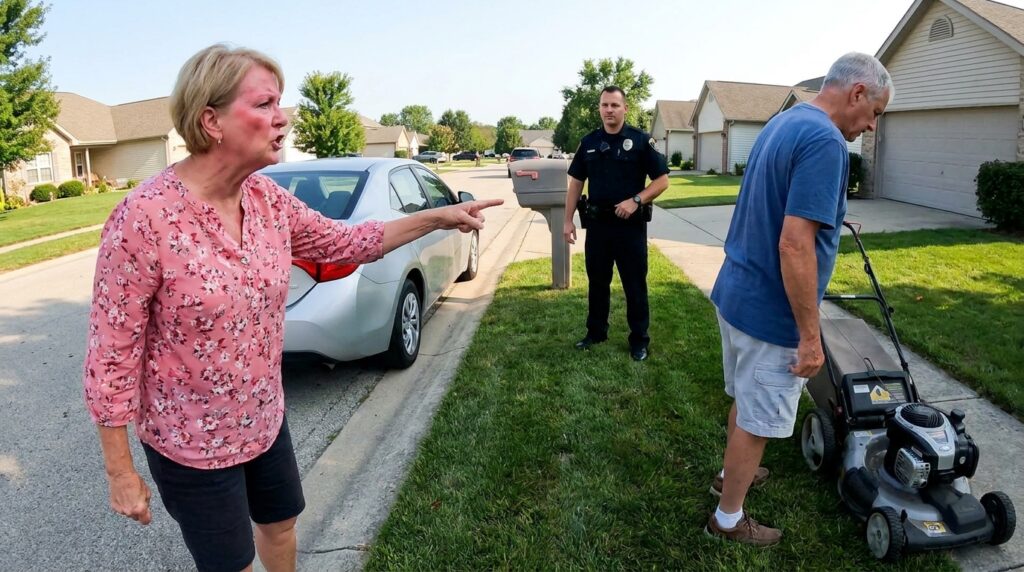
Across the line of bright, uniform fescue, the silence was heavy. The only sound was the low, rhythmic chugging of an old Briggs & Stratton engine near the adjacent garage—the neighbor, his head down, pushing a faded green deck mower through grass that didn’t need cutting. He didn’t look up when my boots hit the gravel at the edge of the asphalt. He didn’t look up when I reached across the silver hood of the sedan. He simply adjusted his grip on the foam-padded handle, his knuckles white against the blue shirt he wore every Tuesday.

The note wasn’t typed. It was written with a soft-lead pencil that had smudged where the writer’s palm had dragged across the page. Not a public lot. Park where you belong.

I turned the paper over. The back was blank, save for a faint oily residue from the wiper rubber.

“You’re tracking dirt onto the apron,” a voice called out.

The voice came from the shade of the porch, but the body followed it almost instantly, breaking into the glare of the two o’clock sun. She wore a pink floral blouse that looked stiff, like it had never been through a wash cycle without heavy starch, and dark shorts that stopped exactly two inches above her knees. She didn’t walk; she planted each foot as if she were driving a stake into the ground, her shoulders pulled back until the fabric across her chest strained. In her left hand, she held a blue plastic folder, its corner slightly cracked.

“It’s a public street,” I said. My voice felt dry, stripped of any fluid grace by the heat. I didn’t raise it. In this valley, a raised voice traveled three houses down before you could catch the echo.

“It’s my frontage,” she said, her pointer finger coming up in a single, jerky motion, targeting the space between my front tire and the concrete curb. “The code says clear access. The city doesn’t pay for your storage.”

Behind her, the mower engine sputtered, then leveled out again. The neighbor in the blue shirt had stopped moving. He was ten feet back from the driveway line, his hands resting on the vibration-deadening rubber of the machine, his gaze locked firmly onto the grass catcher. He was waiting for the turn. Everyone in the loop was waiting for the turn.

I tucked the creased note into my pocket, the graphite graying my thumb. “The city easement extends eight feet from the center line of the gutter. That includes three feet of your sod.”

Her mouth tightened, the small lines around her lips turning into deep, pale crevices. She shifted the blue folder to her hip, her fingers tapping against the plastic like a hammer clicking against an empty cylinder. “We’ll see what the precinct says about an obstruction.”


CHAPTER 2: THE BASELINE MEASURE

The county clerk’s basement smelled of zinc and damp cardboard, a subterranean chill that did nothing to wash away the memory of the cul-de-sac’s white heat. I pressed my palm flat against the green laminate counter, feeling the slight vibration of the HVAC system hum through my skin.

The woman behind the desk didn’t look up from her screen. Her fingers moved with a rhythmic, heavy clack across a yellowed keyboard, each stroke echoing off the steel filing cabinets lining the back wall. Between us lay the heavy leather-bound ledger for Sector 4, its spine split at the bottom where the white mesh binding peeked through like dried bone.

“These lines haven’t been updated since the ninety-two widening,” she said, her voice thin and flat, matching the gray light of the fluorescent tubes overhead. She spun a heavy brass magnifying loupe across the page, its glass catching the reflection of the grid lines beneath. “If you’re looking for the municipal right-of-way, it’s recorded under the old county surveyor’s easement, not the developer’s plat.”

I leaned over the ledger. The paper was thick, fibrous, and smelled of old ink that had set before I was born. My thumb traced the boundary line of Lot 14—her lot. On the original draft, the line was a crisp, ruled stroke of black India ink, but where it met the curb of the road, someone had scratched a faint pencil correction. It was a cross-hatched box, barely larger than a postage stamp, labeled Muni-Util-Vault-04.

“What’s the offset on that vault?” I asked.

“Six feet from the flowline of the concrete gutter,” she muttered, finally looking up. Her eyes were small, watery behind thick lenses. “But that was before the road was re-paved in two thousand eight. If they shifted the crown of the asphalt during the scrape, the vault might be sitting beneath the sod now. It happens when the developers skip the final survey.”

I took out my phone, comparing the screen’s high-resolution satellite imagery with the faded ink map. In the satellite photo, the frontage of Lot 14 looked perfectly uniform—a seamless carpet of dark green turf extending right to the gray lip of the asphalt. There was no vault cover visible. No iron plate. No concrete marker. There was only the manicured edge where her pink floral blouse had caught the glare of the afternoon sun.

A micro-mystery had traveled with her from the driveway. When she had shifted that cracked blue plastic folder against her hip, a loose sheet had slipped slightly out of alignment. It wasn’t a standard printout. It was a grid-paper sketch, hand-drawn in purple felt-tip ink, showing a series of small circles spaced precisely nine feet apart along the curb line. The numbers next to them weren’t city codes; they were handwritten measurements with arrows pointing back toward the foundation of her porch.

“If someone covered a utility access point,” I said, my finger resting on the pencil-marked box, “what’s the administrative penalty?”

The clerk let out a dry, rattling laugh that turned into a cough. “Penalty? The county doesn’t fine you for covering a box, son. They just send a crew out with jackhammers and a backhoe when the main line blows. They don’t look at the landscaping when they start digging. They just look at the map.”

She pulled the ledger toward her, closing it with a heavy thud that puffed a small cloud of silt into the air between us. The iron smell of the old binding hung in the space.

I thanked her, took my ligned notepad, and walked up the concrete stairs into the parking lot. The afternoon sun hit me like a physical blow, the heat rebounding off the hood of the sedan as I climbed inside. The steering wheel was hot enough to scorch bare skin, the black vinyl slick with oil.

I drove back toward the loop slowly, keeping the speed down to let the ancient air conditioner struggle against the cabin’s heat. The truck lanes of the county road were rutted, the tires groaning against the uneven asphalt where the heavy gravel haulers had deformed the surface during the spring thaw. Everything in this county was wearing out, shifting slightly under the weight of time, held together only by the inertia of old habits and unverified boundaries.

When I turned back into the subdivision, the stillness had returned, but it was a different kind of quiet now. The neighbor in the blue shirt was gone, his mower sitting on the concrete apron of his garage like a abandoned piece of artillery, the deck still caked with damp, clippings that were already turning brown and sweet in the humidity.

I parked the sedan in the exact same spot at the curb. The silver paint on the roof was hot enough to sizzle if a drop of water hit it. I stood on the asphalt, my shadow falling across the line where the public road met the gravel fringe of her yard.

I knelt down, pretending to check the pressure in my front tire, but my eyes were on the turf just beyond the concrete flowline. The fescue was dense, but about three inches into the sod, there was a subtle, linear dip in the earth—a slight depression that ran parallel to the road for twelve feet before disappearing beneath her manicured flowerbed. I reached out, my fingers sinking into the dry, stiff blades of grass until they struck something hard and cold just an inch below the surface.

It wasn’t rock. It was the rusted edge of an old iron plate, buried deliberately beneath a layer of shaved topsoil and sod.

Above me, the front door of Lot 14 creaked open. The screen door didn’t slam; it caught on its hydraulic piston, letting out a long, high-pitched hiss that sounded like a warning.

CHAPTER 3: THE ORANGE OBSTRUCTIONS

The hydraulic hiss of the screen door behind me didn’t register as a voice, but the sudden density of the afternoon air told me she was watching from the porch shade. I didn’t look up from the front tire. I kept my weight settled low, balanced on the balls of my work boots, letting my fingers trace the buried iron plate through the fescue before pulling my hand back. The grit under my fingernails was gray, dry, and mixed with the bitter scent of crushed root systems.

By the time I stood up and closed the driver-side door of the sedan, the street had changed again.

Three heavy, sun-bleached traffic cones had been placed in a tight, unyielding line directly in front of my bumper. They weren’t standard residential markers bought from a hardware store. These were industrial-grade, twenty-eight-inch high-visibility pylons made of heavy injection-molded PVC, their orange bases stained with dried mud and tar from some long-abandoned commercial worksite. They sat in the gravel gutter lane like a row of small, jagged teeth, completely choking off the approach to the curb.

I walked to the first cone. The plastic was hot to the touch, sticky with melted road film under the glare of the three o’clock sun. When I wrapped my fingers around the square base to lift it, the weight dragged against the gravel, releasing a small puff of white dust that smelled of pulverized limestone.

“Those are structural markers,” her voice carried down from the top step. She hadn’t moved into the open yard yet, keeping her frame tucked safely beneath the overhang of the roofline. The cracked blue plastic folder was locked under her arm, the cheap spine catching the sharp glare of the afternoon light. “The lane is restricted for utility maintenance. You park there, you’re obstructing a designated right-of-way.”

I didn’t answer right away. I turned the cone over in my hands, tilting the wide base toward the light. The interior wall of the pylon wasn’t smooth. Someone had used a mechanical grease pencil to scrape a series of letters and numbers inside the lip: PROPERTY OF UTILITY DISTRICT 4 – DO NOT REMOVE. But the ink was fresh. It lacked the fine network of cracks that decades of sun exposure give to grease paint. It had been written within the last forty-eight hours, the thick black wax still soft enough to smudge under the pressure of my thumb.

“District Four doesn’t use pylon markers for unexcavated vaults,” I said, setting the cone down on her side of the grass line. The rubber base hit the sod with a dull thud, flattening a patch of her prized fescue. “They use brass plaques driven into the concrete flowline. And they don’t write their inventory codes with an office pen.”

She stepped off the porch, her sandals crunching rhythmically against the dry gravel driveway. Her pink floral blouse caught the full force of the heat, the stiff fabric shaking slightly as her posture tightened. “I know the commissioners,” she said, her voice dropping into a flat, transactional hiss that didn’t rise above the drone of the distant highway. “I know how this loop is zoned. You think you can just bring your vehicle into a private residential grid and leave it wherever the asphalt is clear?”

Across the yard, near the shadows of the adjacent two-car garage, the neighbor in the blue shirt reappeared. He didn’t have his mower now. He was holding an old, notched garden spade, his boots stepping carefully along the edge of his own flowerbed as if he were looking for a place to dig. His chin was tucked low against his collar, his eyes shifting between the pylon in my hand and the locked front door of his own house. He was listening to the measurements. He knew what was buried three inches under the dirt line.

I moved to the second pylon, my boots grinding into the soft shoulder of the street lane. “The county records don’t show a private grid,” I said, keeping my fingers steady as I cleared the second obstacle, stacking it neatly inside the first. “They show a public right-of-way that was established before these foundations were poured. If you want these cones here, you’ll need an engineering permit signed by the board.”

“The board doesn’t need to sign anything for an emergency clearance,” she said, her pointing finger snapping out again, a rigid extension of her shoulder that trembled slightly from the exertion. She didn’t look at the stacked cones; she looked directly at the silver hood of my car, her face flushing a deep, mottled red under her styled blonde hair. “The line is hazardous. There’s an unstable structure under the turf. If your weight collapses that main, the county will hold you personally liable for every gallon.”

It was a functional counter-move, grounded in a specific kind of tactical bluff that usually worked on tenants or delivery drivers who couldn’t afford the time to check the maps. She was using the hidden iron plate—the very thing she had buried to extend her lawn—as a legal shield to prevent anyone else from claiming the spatial margin. She had built a false bottom into the property dispute, using a real utility vault to cover an illegal land grab.

I didn’t argue the point. I grabbed the final pylon by its tip, dragged it five feet across the gravel lane, and set the entire stacked pile right at the corner of her mailbox post. The wooden post was weathered, its gray cedar grain splitting down the middle where the moisture had warped the wood over twenty winters.

When the base of the cones hit the post, a small piece of paper fluttered out from a crevice behind the metal flag assembly. It was an old, faded compliance notice from the county development office, dated six years ago, its red lettering bleached into a pale, ghostly pink by the sun. The text was mostly unreadable, but the large stamp at the bottom was still clear enough to parse: APPLICATION INCOMPLETE – CHARTER PENDING RE-SUBMISSION.

I reached out to take it, but the sound of an engine turning the corner of the loop cut through the heavy air. It wasn’t a resident’s car. It was the low, steady rumble of a Ford Interceptor utility vehicle, its black-and-white panels covered in a fine layer of gray limestone dust from the county access road.

The cruiser didn’t activate its lights. It coasted along the curb lane, its heavy tires crunching over the loose gravel before coming to a stop six inches behind my rear bumper, its exhaust tailpipe puffing a warm, faint cloud of carbon into the midday glare.

Similar Posts

Leave a Reply

Your email address will not be published. Required fields are marked *






