
The Weight of the Iron Stake: A Novel of Modern Suburban Sovereignty and Rusted Truths
CHAPTER 1: THE DAMP RADICAL
The rot always smelled worse when the sun hit the cedar. It wasn’t the clean, sharp scent of fresh lumber, but the heavy, sour reek of wood that had spent five years drinking stagnant groundwater.
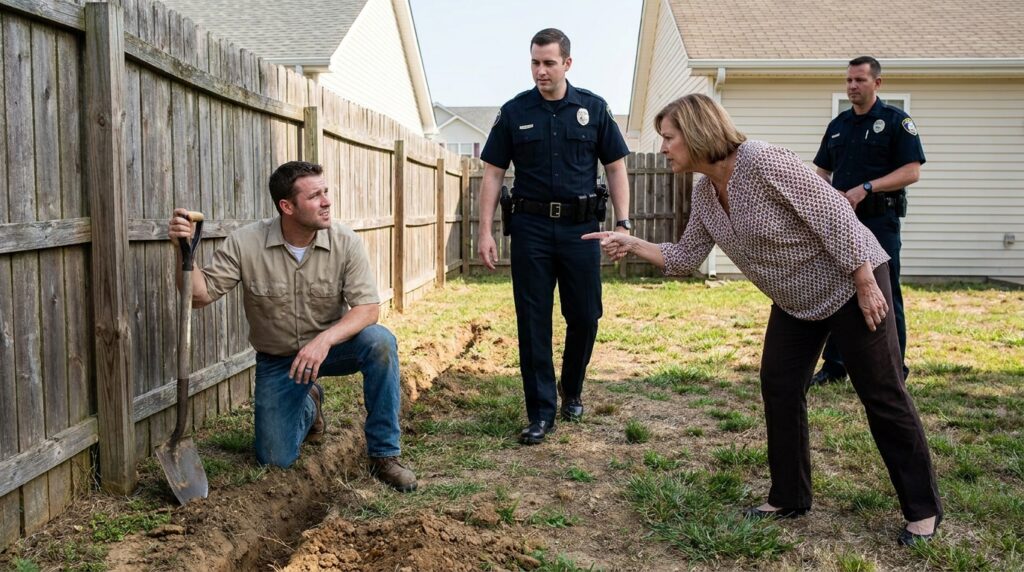
Arthur knelt in the high fescue, his thumb pressing into the gray grain of the bottom rail. The wood gave way under his nail like wet cardboard. A dark trickle of moisture squeezed out, staining his skin. Beyond the fence, the neighbor’s yard rose at a steady, deliberate three-degree tilt, a manicured slope designed to shed its excess storms directly into his foundation.
He didn’t look up when the back door of the ranch house next door clicked open. He didn’t need to. He knew the rhythm of her footsteps—the sharp, heels-first strike on the concrete patio, the brief pause to adjust the sunglasses, the slow, territorial march down the property line.
“Arthur.”
He kept his thumb pressed against the soft wood, counting three heartbeats before he stood. His knees made a dry, popping sound in the silence. He wiped his hands on his denim thighs, the fabric stiff with grease and dried topsoil.
“The fence is dropping another inch,” Arthur said. He kept his tone flat, empty of the heat that had spent the last three months building behind his teeth. “The posts are waterlogged from the runoff.”
Mrs. Gable didn’t look at the rot. She looked at the pair of surveyor’s stakes he had driven into the earth the previous afternoon—clean, raw pine topped with cheap neon-orange plastic caps that caught the glare of the noon sun. Her oversized tortoiseshell sunglasses masked her eyes, but the hard line of her jaw was set. She held a blue plastic folder against her chest like an unyielding shield.
“Those stakes are a violation of the aesthetic code, Arthur,” she said. Her voice had the thin, polished edge of someone who had spent twenty years reading bylaws to people who just wanted to be left alone. “We don’t allow unpainted markers visible from the road. And your drainage plan wasn’t cleared through the architectural committee.”
“I don’t need the committee for my own dirt, Eleanor.” Arthur reached down, his fingers closing around the cold ash handle of his square-point shovel. The metal blade was nicked along the edge from a buried limestone ledge he’d hit last November, but it was heavy. Balanced. “The surveyor ran the transit from the county pin. The line isn’t where we thought it was.”
Eleanor stepped closer, her sandals crunching against the dry clover at the boundary line. A faint, chemical trace of laundry detergent and expensive sunscreen drifted across the gap between them. She pointed a manicured finger toward the fence, her diamond rings catching the light with a dull, white flash.
“The line is exactly where it has been since 1994,” she said. Her voice dropped an octave, steadying itself on decades of unchallenged occupancy. “My husband poured that concrete post-footing himself. If you dig within three feet of that wood, you’re interfering with an established easement. I’ve already sent the digital notice to the precinct.”
Arthur looked down at the spade. The tip was black with old loam. He could feel the vibration of the neighborhood—the distant whine of a lawnmower three streets over, the low hum of a transformer on the utility pole—but here, along the eighteen inches of dead grass between their properties, the air felt thick and dry as flour.
He didn’t argue. He didn’t point out the city water permit clipped to his clipboard on the porch steps. Instead, he drove the blade of the shovel into the earth with the clean, heavy weight of his boot, the iron edge cutting through the top layer of sod with a low, wet shhhk.
When he pulled the handle back, the soil groaned, parting to reveal a pale, tangled network of roots and something else—a scrap of old, yellowed caution tape buried six inches deep, wrapped around a piece of fractured, dark iron that didn’t belong to any surveyor he had hired.

CHAPTER 2: THE ANATOMY OF A TRESPASS
The iron fragment didn’t want to leave the clay. Arthur kept his boot jammed onto the shoulder of the spade, his weight leaning forward until the ash handle creaked under the strain. Beneath the top layer of scorched fescue, the earth was hard as brick, packed tight by thirty years of residential settling and the rhythmic, daily vibrations of Eleanor Gable’s industrial-sized pool pump across the line.
With a dull, scraping groan, the spade dislodged the metallic chunk. It flipped over into the fresh trench, a jagged, semicircular crescent covered in red flaking rust and wet mud. The scrap of yellow caution tape attached to it was brittle, tearing into flakes between Arthur’s dirty fingers. It wasn’t standard utility marking. The font was tight, blocky, and old—the kind of marking municipal crews used before the county consolidated its records in the late seventies.
“You’re destroying the structural grade,” Eleanor said, her voice dropping from the property edge like an anvil. She hadn’t moved an inch back toward her patio. Her shadow, elongated by the early afternoon sun, stretched directly across the shallow ditch, cutting right over Arthur’s boots. “That iron is part of the original drainage foundation. If you pull that out, you’re responsible for the collapse of the northern retaining slope.”
Arthur didn’t answer. He picked up the heavy iron piece, the weight of it surprisingly dense for its size. The rust came off on his palm in a gritty, orange smear that smelled sharply of stagnant water and deep-earth decay. It was a section of a five-inch cast-iron pipe, the rim sheared off cleanly by a mechanical force that had happened decades ago. Beneath it, inside the dark pocket where the iron had rested, the soil wasn’t dry clay. It was black, slimy muck, smelling faintly of sulfur and laundry detergent.
He looked at the orange surveyor’s stake three feet away. The pine was dry and clean. The transit line didn’t lie; the county pin was absolute. But this pipe was running parallel to the fence, fully eighteen inches inside his legal boundary, and it was actively leaking.
“The grade is already gone, Eleanor,” Arthur said. He tossed the iron piece onto his side of the grass with a heavy, hollow thud. He didn’t look at her sunglasses; he kept his eyes on the wet pocket of earth. “This line is discharging into my lawn. It’s been doing it long enough to rot the cedar from the bottom up.”
“That’s an existing easement by prescription,” she countered instantly. She took half a step forward, her leather sandals stopping exactly where the clover met the fresh dirt ridge. She held the blue plastic folder tighter against her chest, her knuckles turning the same chalky white as the trim on her house. “My property has held open and notorious use of that drainage line since before you signed your deed. You touch that line, and it’s a civil tort. I have the injunction template ready to file.”
Arthur stood up straight, using the shovel as a crutch to ease the ache in his lower back. He wiped the sweat from his forehead with his forearm, leaving a dark streak of soil across his brow. He didn’t know about prescriptive easements, but he knew the weight of his mortgage, and he knew the city building code folder sitting on his porch stairs had an official, raised silver seal on the cover.
He could see her calculation in the way her jaw remained clamped shut between sentences. She wasn’t just angry about a visual blemish on her perfect perimeter; she was defending the pipe. Her house sat higher on the ridge, its pristine white vinyl siding reflecting the harsh sun like a mirror, but somewhere beneath that manicured lawn, her gray-water system was taking a shortcut through his dirt.
“The county pin says this is Lot 4,” Arthur said, his voice dropping into the quiet, rhythmic tone of a man who worked with tools. “Lot 4 doesn’t have an easement listed on the title report. I checked before I started digging.”
“Title companies miss unrecorded historical infrastructure all the time,” Eleanor said, her chin tilting up. “My husband was on the zoning board when this plat was laid out. We know exactly where the authority sits, Arthur. You’re playing with things you don’t understand.”
He noticed then a slight discrepancy in the fence line itself. Three yards down, where the old cedar posts met a massive, knotty oak tree, the wood didn’t follow a straight line. It dipped slightly inward toward his house, an intentional curve that looked like it had been built to dodge something buried beneath the roots.
Before he could drive the shovel back into the clay to trace the pipe further, the low, distinct crunch of tires on the gravel driveway at the front of the house broke the backyard silence. A low, electronic chirp echoed between the houses—the short, professional squawk of a municipal radio.
Eleanor’s shoulders dropped just a fraction of an inch, a subtle relaxation of her defensive posture that felt entirely victory-coded. “That will be the local precinct,” she said, her finger pointing back toward the side gate. “I told them you were altering the municipal runoff line without a supervisor present.”
Arthur didn’t drop the shovel. He kept his fingers locked around the ash handle, his boots planted firmly in the fresh trench as the heavy side gate clicked open and the shadow of two local officers fell across the dry grass.
CHAPTER 3: THE STRATAGEM OF THE PORCH
“Keep your hands right where they are on that handle, sir,” the first officer said.
The weight of his boots on the lawn was heavy, the crunch of dry clover signaling a deliberate, measured approach. He didn’t unholster his sidearm, but his right hand rested naturally against the stiff cordura nylon of his utility belt. The second officer remained three paces back, his eyes tracking the fence line, mapping the geometry of the dispute with a cold, professional squint.
Arthur didn’t let go of the ash wood. He felt the cold iron of the spade deep under the clay, a physical anchor pinning him to Lot 4. “I’m on my own property, Officer,” he said, his voice dropping into a low register that sounded like stone grinding against stone. “The county markers are right by your left heel.”
The responding officer—his badge reading Miller—didn’t look down at the bright orange cap immediately. He looked at Eleanor Gable. She had already shifted her stance, her forward lean softening into the practiced vulnerability of a citizen seeking protection. The blue folder was tucked under her elbow now, and she held a single sheets of crisp, white paper out toward the uniform.
“He’s digging up the infrastructure, Officer Miller,” Eleanor said, her tone smooth, stripped of the raw heat she had used seconds ago. “I’ve issued three separate administrative warnings regarding the shared drainage easement. He’s deliberately violating the neighborhood covenants to divert municipal water into my foundation.”
Miller took the paper, the dry cellulose crinkling under his thumb. Arthur watched the officer’s eyes track the typed lines—the formal headers, the dense, pseudolegal jargon Eleanor had spent the last three weeks pasting onto Arthur’s screen door with industrial tape.
“Arthur, is it?” Miller asked, turning his gaze back to the trench. The local uniform didn’t have a county patch, just the clean, silver insignia of the precinct. “You got a permit for this excavation?”
“On the porch steps,” Arthur said. “Blue folder. City engineering stamp is on the first page.”
The backup officer moved toward the porch, his heavy boots making the wooden steps groan as he retrieved the file. Arthur didn’t track his movement; he kept his eyes on Miller, watching the way the officer’s gaze flicked between Eleanor’s typed notice and the dark, wet hole at the bottom of the ditch where the sheared iron pipe was still weeping grey water.
The air between them felt thin, choked by the smell of the damp cedar rot and the dry, metallic tang of the rusted crescent Arthur had tossed onto the grass. Eleanor stood perfectly still, her large sunglasses masking whatever calculation was happening behind her eyes, but her fingers were tapping a silent, rapid rhythm against the blue plastic under her arm.
“Officer,” Arthur said, his hand tightening on the shovel until the wood grain bit into his calluses. “Take a look at the orientation of that cast-iron line. It doesn’t run toward the street storm drain. It angles backward, straight from her downspouts into my perimeter.”
Miller knelt, his uniform trousers taut against his knees as he leaned over the fresh edge of the trench. He didn’t mind the mud. He reached down, his gloved finger tracing the rough, flaking rim of the old conduit. When he pulled his hand back, the tip of his glove was coated in the same soapy, sulfur-smelling sludge Arthur had unearthed five minutes ago.
“This isn’t a county main,” Miller muttered, looking up at Eleanor. “This looks like a private gray-water tie-in.”
“It’s an established historical runoff path,” Eleanor corrected instantly, her voice rising slightly, losing a fraction of its administrative polish. “It was built into the plat when the subdivision was cleared in the seventies. My husband’s signatures are on the original covenant filings.”
The backup officer returned from the porch, holding Arthur’s blue folder open. He didn’t speak; he simply held it out so Miller could see the red ink of the city engineer’s layout. The map inside didn’t show an easement. It showed a clean, unencumbered boundary line, a straight black ink stroke that sliced directly through the center of the old wood fence and gave Arthur three more inches of dirt than he currently possessed.
Arthur watched Miller’s face settle into the hard, pragmatic mask of a beat cop who had seen fifty variations of the same backyard cold war. The officer stood up, brushing a fleck of dry clay from his knee, his eyes locking onto Eleanor’s folder.
“Mrs. Gable,” Miller said, his voice dropping the polite deference. “We need to look at your original deed registration. Because right now, this city permit says your drainage system is sitting eighteen inches deep inside this man’s lot.”
Eleanor didn’t flinch. She pulled her shoulders back, her jaw locking as she gripped the blue folder until the plastic bent. “The city didn’t audit the historical charters, Officer. If he keeps digging that trench, he’s going to unearth the structural footings for my entire secondary garage lane. And I assure you, nobody wants to see what happens when that shifts.”
Arthur felt a sudden, cold weight drop into his stomach. He looked past her, toward the massive brick-and-timber garage lane that sat at the high point of her slope. The structure was old, its foundation laid long before he bought Lot 4. He had always assumed the building stopped right at the edge of the cedar fence. But looking at the curve of the old oak tree and the angle of the weeping iron pipe, he realized the concrete slab under her garage didn’t stop at the boundary line at all. It was buried deep under his grass.
CHAPTER 4: THE ANATOMY OF A COLLAPSE
The steel spade didn’t bounce; it hit with a dead, heavy thunk that traveled up the hickory shaft and jarred Arthur’s elbows. It was the distinct sound of tempered metal striking forty-year-old structural stone.
Arthur dropped to one knee in the fresh mud of the ditch, ignoring the wet clay that soaked instantly through his denim. He scraped back a thick wedge of dark, sulfurous topsoil with his bare fingers, his nails tearing against the rough aggregate beneath. There, twelve inches below the surface and clear across the transit line, lay a massive, poured-concrete footing. It wasn’t an isolated post pad. It was a continuous, monolithic gray shelf, rough-formed and reinforced with corroded iron rebar that extended laterally out from beneath Eleanor Gable’s secondary garage wall.
“Step back from the trench, sir,” Officer Miller barked, his boots pivoting in the clover as he leaned over the property line. His hand didn’t drop to his holster, but his fingers twitched near the clip of his secondary tactical light. “Arthur, don’t clear any more of that structural mass until we establish what it’s carrying.”
“It’s carrying her wall,” Arthur said. His voice was hoarse, his lungs catching on the damp, alkaline tang of old cement dust and rotting cedar. He forced his fingers under the cold edge of the concrete shelf, feeling the absolute solidity of the encroachment. “Look at the pour marks, Officer. This isn’t a county pipe easement. The entire sub-base of her building is sitting on Lot 4.”
Eleanor didn’t move an inch away from her gravel path, but her shadow tightened. Her sunglasses caught the dull flash of the backup officer’s radio clip. She didn’t shout; her voice retained that polished, transactional weight that had kept the neighborhood compliant for three decades.
“The structural footings were stabilized during the 1978 zoning override, Officer Miller,” she said, her fingers curling around the blue folder until the plastic gave a short, sharp snap. “The architectural layout was preserved under a grandfather clause. If Arthur disrupts the earth beneath that retaining shelf, the lateral load of the masonry wall will shift toward his foundation. That’s an engineered liability.”
“There’s no clause on the deed registry, Eleanor,” Arthur muttered, his jaw locked as he stood up, using the shovel to lift his weight out of the trench. His shirt was gray with silt, the fabric stiffening across his shoulder blades. “A private building cannot sit eighteen inches across a residential pin line without a recorded variance. The city clerk would have flagged it during the permit audit.”
Miller looked down at the exposed gray stone, then back at Arthur’s blue city folder. The official silver seal on the permit was clean, its embossed borders sharp under the noon glare. The line on the plat map was a mathematically perfect vector; it didn’t curve to accommodate an over-poured slab.
“The map doesn’t show an override, Mrs. Gable,” Miller said, his boots sliding slightly on the damp grass as he moved down the fence line to inspect the angle of the garage wall. He tapped the heel of his boot against the base of the wood fence where the cedar posts were bowing under the pressure of the rising hill. “And this grade is moving. The dirt’s pushing the timber out of the ground.”
“The dirt is moving because he’s digging an illegal moat,” Eleanor shot back, her tone sharp, losing its administrative veneer completely. She cut her hand toward the backup officer. “Call the city inspector out here. Now. He’s undermining a permanent structure.”
The backup officer didn’t pull his phone. He stood at center-depth, his face expressionless under his brimmed cap, his eyes tracking a thin, zigzag fracture that ran from the exposed footing up through the first three courses of brick on Eleanor’s garage.
Arthur saw it too. The line was fresh—the interior of the crack was white and dry, free of the moss and dirt that lined the older masonry seams. His shovel hadn’t caused it; the slow, decades-long rot of the cedar fence and the unchecked discharge of the buried gray-water pipe had softened the clay under the slab until the heavy wall began to hinge on its own weight.
He took two steps along his side of the trench, his boots sinking into the black muck where the pipe was still weeping its soapy discharge. He drove the spade down once more, not to dig, but to clear a section of the old cedar fence post that had snapped off at the ground level. As the wood fell away, it revealed a second marker—a flat, bronze disk set into a square of cracked concrete, buried beneath the roots of the old oak tree.
It wasn’t a surveyor’s pin. It was an old county benchmark from 1974, and the top of the bronze disk was stamped with a single, clear warning phrase that had been struck through with a cold chisel.
Arthur reached down to touch the cold bronze, but before his hand could clear the remaining silt, a low, grinding sound vibrated through the earth beneath his feet. A tiny shower of red brick dust fell from the garage wall, settling like dried blood across the fresh gray dirt of his trench.
CHAPTER 5: THE PRECINCT AND THE PERIMETER
The grinding sound didn’t repeat, but the silence that followed was worse. A single, gray chunk of masonry mortar detached from the joint above the exposed footing, hitting the rusted cast-iron pipe below with a dry, sharp clink.
Officer Miller took two fast steps back from the trench line, his heavy service boots tearing into the clover. “Nobody touches anything,” he commanded, his voice dropping its conversational tone entirely, replaced by the flat authority of a scene commander. “Arthur, get out of the ditch. Move over to the patio lane. Now.”
Arthur didn’t pull his boots out of the muck immediately. He stayed low for three more seconds, his fingers remaining locked onto the cold, corroded edge of the 1974 county benchmark disk. The chiseled line across the bronze surface wasn’t fresh; the groove was packed tight with decades of fine, gray silt and fossilized oak root casings. Someone had intentionally defaced the marker before the subdivision’s topsoil had even been graded.
He climbed out onto the grass, the heavy clay sucking at his heels until his knees strained. His tan shirt was damp and dark across the ribs, stiffened by the sulfurous gray water that continued to leak from Eleanor’s private gray-water line.
“This whole corner is unstable, Miller,” Arthur said, wiping his palms on his jeans. The grease from the bronze disk left two metallic streaks on his thighs. “The footing is resting on expanding clay. When that pipe leaks, the ground liquefies. She isn’t just sitting over my line—she’s sliding down it.”
Eleanor Gable hadn’t moved back, but her posture had gone rigid. The blue folder was pressed so hard against her patterned blouse that the plastic corners left sharp white dimples in the fabric. Her oversized sunglasses glinted under the sun, hiding her eyes, but the thin muscles along her neck were twitching.
“The structural integrity of my property is protected under the municipal stabilization act of 1976,” she stated, though the polish in her delivery had begun to crack around the vowels. Her voice was too high, too fast. “If your unapproved digging causes a shift in the load-bearing timber, the city’s insurance pool is liable for the full replacement cost. I have the board minutes from the original development phase right here.”
She shoved the sheets of white paper toward the backup officer, but he didn’t reach for them. He was already on his radio, his shoulder mic crackling with static that cut through the hot backyard air like dry brush catching fire.
“Precinct 4, this is Delta-Two,” the backup officer muttered, his eyes never leaving the zigzag crack in Eleanor’s brickwork. “We have a civil property dispute at 414 Oak, escalating to structural compromise. Notify building code enforcement. We need a structural inspector with a transit out here within the hour. The secondary residential structure is showing active foundation failure.”
“It is not a failure!” Eleanor snapped, her sandals skittering on the loose gravel of her walkway as she took a full step toward the trench. “It’s a minor settling seam. It’s been there for twelve years!”
“It wasn’t white inside twelve minutes ago, ma’am,” Miller said, his boots planted firmly on Arthur’s side of the boundary stake. He reached into his pocket and pulled out a heavy steel tape measure, its yellow ribbon clicking sharply as he extended it from the orange surveyor’s pin directly to the face of the encroaching concrete shelf. “Eighteen inches clear over the line. No grandfather clause covers an active trespass of structural concrete, Mrs. Gable. Not without a registered easement deed signed by the current parcel holder.”
Arthur watched the numbers on the yellow tape. The steel ribbon vibrated slightly in the hot air. He wasn’t thinking about the litigation or the insurance; he was looking at the way the old cedar fence bowed out toward his kitchen window. The weight of her entire double-car garage was leaning against his property, held back by nothing more than six inches of rotted cedar posts and thirty years of silent overreach.
He moved toward his porch steps, his fingers tracking the edge of his blue city permit folder. The documents inside were clean, verified by the county registrar three weeks ago. But as he flipped past the current plat map to the historical abstract page, his thumb caught on a small, purple ink stamp from 1974 that had been partially obscured by a newer staple.
It read: Subject to unrecorded municipal charter restrictions – Volume 3, Page 89.
The words matched the blocky, old-style font stamped on the defaced bronze disk under the oak tree. The decoy was her claim of a zoning override—she had used the fake HOA notices and the old bylaws to keep him from looking down into the clay. The real secret wasn’t just the buried gutters or the leaking pipe. It was the charter itself. The entire block had been laid out on a flawed grid, and Eleanor’s husband hadn’t just over-poured a footing; he had built her legacy on land that belonged to the county’s public right-of-way.
Before Arthur could point out the purple stamp, a high-pitched, metallic snap echoed from beneath the garage floorboards. The wood fence shuddered, its top rail splitting cleanly down the middle with a sound like a pistol shot.
CHAPTER 6: THE RECKONING OF LOT FOUR
The sound of the cedar rail splitting wasn’t a damp groan; it was the dry, violent crack of ancient wood giving up its tension all at once. The white splinters of the fence rail sprayed across the ditch, peppering the stagnant water in the trench with tiny wooden needles.
Arthur didn’t jump back. He dropped the blue folder onto the dry clover, his boots instinctively widening their stance on the edge of the slope. Before the echo of the break could leave the narrow lane between the houses, the weight of the hill shifted. It was an incremental, silent subsidence—a three-inch drop that dragged the bottom rail of the fence into the fresh muck. Across the line, the lower course of brick on Eleanor Gable’s garage wall bulged outward, a handful of crumbling gray mortar dust puffing from the zigzag fissure like a dying breath.
“Miller!” the backup officer shouted, his arm extending to latch onto the iron latch of the side gate as the ground vibrated under his boots. “Get her off that walkway! The whole retaining line is pivoting!”
Officer Miller didn’t wait to argue. His thick leather gloves closed around Eleanor’s forearm, his weight leaning backward to pull her off the gravel path just as the second course of brickwork sheared cleanly away from the foundation. The blue plastic folder slipped from Eleanor’s grip, its crisp white pages scattering across the damp grass, their typed threats and bold administrative warnings instantly stained by the gray silt drifting up from the trench.
“Let go of me!” Eleanor’s voice was high, a thin, jagged rasp that lacked any of her practiced bureaucratic control. Her large tortoiseshell sunglasses flew from her face as she stumbled, hitting the grass with a heavy, ungraceful thud. Without the dark plastic lenses, her eyes looked small, pale, and entirely undone by the sudden collapse of her perimeter. “My husband… the variance… it’s on the record!”
Arthur stepped down into the settling dirt, his boots sinking past the ankles into the cold, saturated clay. He didn’t look at her. He didn’t need to see the panic to know the math had run out. He drove his spade straight down between the shifted concrete footing and the newly exposed bronze benchmark disk under the oak tree. The steel spade struck something flat and non-yielding—not stone, but a heavy, galvanized iron plate that had been driven vertically into the soil four decades ago to hide the original corner stake.
“It’s not a variance, Eleanor,” Arthur said, his words coming out slow, balanced by the rhythmic, heavy thump of his heart against his ribs. He leaned his full weight onto the shovel handle, using the leverage to pry the rusted iron plate back until the wet earth groaned and released its hold. “Your husband didn’t grandfather this wall. He hit the county right-of-way marker in seventy-four, and instead of moving the slab back four inches, he buried the benchmark and ran his drainage straight into my dirt to wash away the evidence.”
Miller stood over the edge of the ditch, his breath coming in short, ragged bursts through his teeth as he looked down into the pit. The yellow steel tape measure was still gripped in his hand, its tip coated in the gritty brick dust that continued to settle over the mud.
“Arthur,” Miller muttered, his fingers tracing the line of the exposed bronze disk where the chiseled strike-through was now completely visible under the noon glare. “That’s a regional survey node. If that building is sitting on a county benchmark grid line…”
“It means her garage isn’t just an encroachment on my lot,” Arthur said, his thumb brushing a thick layer of wet loam off the old abstract page he had pulled from his own file. He pointed directly to the purple ink stamp from 1974—the unrecorded municipal charter entry that Eleanor had spent thirty years hiding behind fake HOA notices and empty legal noise. “It means the entire northern wall of her house is sitting inside the unrecorded public easement strip. The county owns the four inches under her foundation.”
The silence that followed was total, broken only by the thin, persistent trickle of gray water leaking from the severed iron pipe.
Eleanor remained on the grass, her hands dug into the dry clover as she stared at the white white shards of her split fence. Her patterned blouse was smeared with dark backyard loam, and her short styled hair was grayed by the fine mortar dust that had drifted over the boundary. She looked at the backup officer, who was already back on his radio, his voice dropping into the flat, transactional tone of an official logging a code violation that couldn’t be settled with a signature or a warning.
“Delta-Two to dispatch,” the backup officer said, his boots crunching against the split timber as he stepped across the line. “Cancel the standard code car. Notify the county surveyor’s office and the district engineer. We have a structural failure involving an intentional obstruction of a regional grid point at 414 Oak. The encroaching structure is going to require an immediate condemnation order for the secondary perimeter.”
Eleanor didn’t speak. Her mouth opened, her jaw working silently as she looked from the split wood to the clean, straight edge of Arthur’s shovel blade. The manufactured authority that had governed the block since 1994 had evaporated in the space of six inches of dug clay.
Arthur pulled his spade out of the mud, the cold iron dripping with the thick, gray topsoil of Lot 4. He didn’t look for an apology. He didn’t look for a retreat. He simply planted the blade of the shovel three inches inside his own side of the orange surveyor’s stake, his boot pressing down on the iron shoulder until the metal was set firm.
“The line stays exactly where it is,” Arthur said.
The wind caught the loose sheets of Eleanor’s folder, rolling them down the slope until they caught against the sharp splinters of the broken fence, the typed rules finally turning gray under the shadow of the rotting cedar.







