
The Weight of the Fence: A Story of Suburban Sovereignty, Rusted Steel, and the Exact Boundaries of Home

CHAPTER 1: THE FRICTION OF THE EDGE

The sharp, metallic snap of the starter cord against the plastic housing of the green push mower always vibrated straight through Arthur’s arthritic wrists before the engine finally caught. He spat a fleck of dry tobacco into the parched, yellowing turf at his boots and adjusted his grip on the black rubber handle. The afternoon sun beat down on his bare shoulders, drawing out a thin film of sweat that mixed with the fine, dry dust rising from the yard. He only had this last twelve-inch strip of rye grass left—the narrow lane running parallel to the weather-faded cedar fence that marked the eastern edge of his world. He pushed the machine forward, the rusted steel blades chewing through the stalks with a heavy, uneven drone.

Then a shadow cut through the glare.

“Shut it down, Arthur! Turn it off right now!”

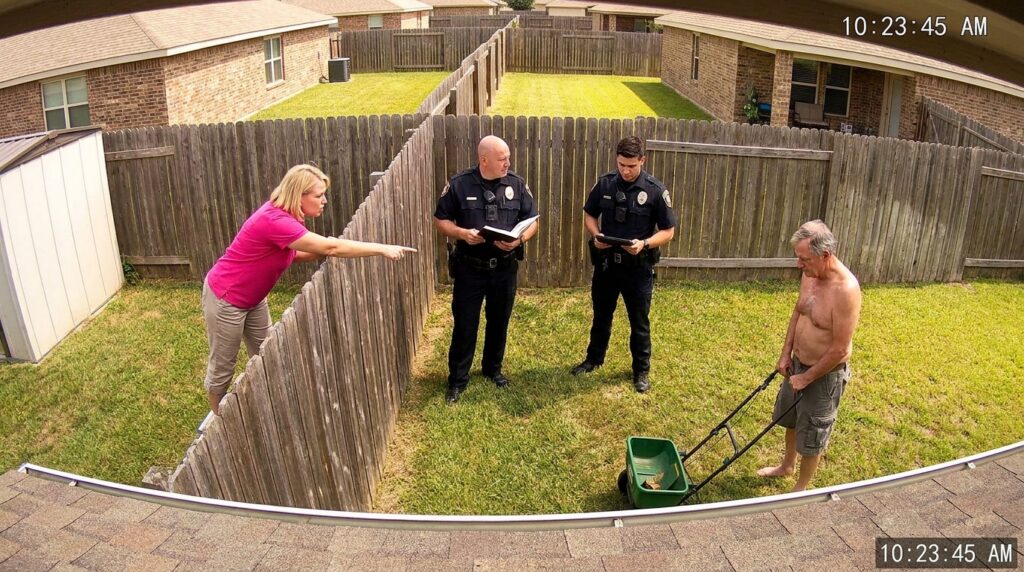
The voice was thin, piercing, and entirely devoid of neighborly grace. Arthur didn’t drop his hands from the frame immediately. He let the mower idle for a three-second count, watching the hot pink fabric of Shannon’s polo shirt flash against the graying cedar slats. She was leaning so far over the top rail that the wood groaned under her weight, her arms extended like a highway barrier. Her blonde hair was pulled back tight, her large dark sunglasses propped up on her skull like a second set of sightless eyes. In her left hand, she clutched a sleek, black-cased smartphone, its lens aimed squarely at his chest.

Arthur squeezed the kill switch. The engine sputtered, gasped, and died with a heavy, metallic sigh that left the backyard suddenly exposed to the low, distant hum of the interstate.

“Afternoon, Shannon,” Arthur said. His voice was low, gravelly from a lifetime of breathing workshop dust, and deliberately slow. He didn’t step away from the mower. He kept his work shoes—caked with old clippings and stained with engine oil—planted right where they were.

“Don’t ‘afternoon’ me,” she snapped, her knuckles turning white where she gripped the top of the fence. “Look at your left wheel, Arthur. Look at it. It’s three inches over the property line. You’re tracking your weeds into my layout, and you’re doing it on purpose.”

Arthur looked down. The rubber wheel of his old Sears craftsman was resting in a shallow depression in the dirt, right where the grass gave way to the sparse clover. He knew every square inch of this dirt. He’d buried two dogs near the oak tree twenty years ago, long before the developer leveled the orchard to put up Shannon’s pristine colonial. He knew the fence was the boundary. It had been the boundary when her house was just a blueprint.

“The fence is the line, Shannon,” he said, keeping his tone level, transactional. “Been the line since ninety-eight.”

“The fence is a structural error,” she said, her voice dropping into a tight, bureaucratic register that signaled weeks of calculated malice. “The builder offset it to clear the utility box. My lot extends twenty-four inches past these panels. I told you last month I was filing the grievance, and you chose to ignore it. Now you’re actively encroaching on an active dispute.”

She didn’t blink behind the glare of the afternoon light. She was calculating, watching his face for a sign of anger, a raised voice, anything she could log into her database. Arthur merely shifted his weight, feeling the dry heat radiating from the cedar boards. He noticed a fresh, deep scrape on the bottom rail of the fence on her side—a clean, white gouge in the wood that hadn’t been there yesterday morning, right near the base where a heavy iron pry bar might have been jammed under the post to test its depth.

Before he could speak, the distinct, low-frequency rumble of a municipal engine drifted down the asphalt of the cul-de-sac. The blue-and-white cruiser turned into the driveway, its tires crunching heavily over the loose gravel.


CHAPTER 2: THE MEASURE OF FRICTION

The white driver’s side door of the Ford Explorer bore the matte-black emblem of the county sheriff, the paint around the door handle pitted with small, rusty flecks from winter road salt. The engine didn’t die immediately; it remained idling with a heavy, mechanical vibration that rattled the loose gravel beneath its exhaust pipe. Arthur didn’t move his boots from the dry thatch. He watched the front tire of the cruiser compress the fringe of his lawn, the heavy rubber treading down the dandelion heads with a dry, crunching finality.

Before the officer’s boots even hit the dust, Shannon’s phone cleared the top rail of the cedar fence again. The plastic casing of her device was scratched along the edges, worn down from being slipped in and out of her pocket during her daily perimeter checks.

“Look at the timestamp, Officer,” Shannon called out, her voice rising above the low rumble of the cruiser’s block. She wasn’t looking at Arthur anymore; her focus had shifted entirely to the vehicle. She swiped her thumb across the glass screen with a frantic, rhythmic intensity, her manicured nail clicking against the surface like a beetle trapped in a jar. “I have June fourteenth logged at 08:00. I have July first logged at 14:30. Every single time he brings this old machine out, the left wheel track crosses the property line by at least ninety millimeters. It is a persistent, documented trespass.”

Arthur let his hands drop slowly from the mower’s rubber grip, though he stayed close to the chassis. The metal of the deck was hot, smelling of old grease and scorched grass clippings. He looked at Shannon’s phone screen from across the five-foot divide. Even in the shifting glare of the afternoon sun, he could see the grid lines she had digitally overlaid onto the photographs—bright red, computerized vectors cutting through the natural, uneven spread of his clover. She had a folder open, its title typed in clean, cold capital letters: LOT 42 – ENCROACHMENTS.

“Let’s take a breath before we start measuring the grass, ma’am,” Officer Vance said. His boots made a rhythmic, heavy scratching sound against the gravel as he rounded the hood of the utility vehicle. He was a broad man, his utility belt creaking with the weight of iron cuffs, a Glock, and the heavy plastic housing of his body camera. His dark uniform shirt showed salt rings under the arms from a long shift in the July heat, and his bald head caught the direct white light of the sky. Behind him came the younger one, Miller, holding a ruggedized tablet with a thick rubber bumper, his thumb hovering over the stylus slot.

Shannon straightened her spine, her hot pink polo stretching taut over her shoulders as she gestured down at the turf. “I am not measuring grass, Officer Vance. I am protecting my deeded boundary. This man has been told repeatedly that his routine maintenance constitutes a civil violation. I have the county subdivision plat pulled up right here.”

She thrust the phone forward, almost pressing the glass against Officer Vance’s chest. Arthur watched the interaction with the quiet patience of a man who had spent forty years working lathe chucks and rusted pipe joints. You didn’t force a rusted bolt; you applied oil, you felt the resistance, and you waited for the metal to tell you where the stress was.

Arthur looked down at the bottom rail of the cedar fence again. The white gouge he had noticed earlier was deeper than he’d realized. It wasn’t just a scratch from a lawn tool; the wood fibers were torn upward, and right beneath the wound in the wood, a tiny pile of fresh, orange-red iron flakes rested on a flat stone. It was rust from a heavy iron tool—not his mower, which was painted green, and not Shannon’s aluminum gardening trowels. It was the specific, heavy flake that came off old forged iron when it was forced against stone or wood.

“Arthur,” Vance said, turning his stocky frame toward the mower. The officer didn’t look angry; he looked tired, his eyes squinting against the glare rising from the dry earth. “She says you’re cutting into her dirt. What do you say?”

“I say the fence went up when the posts were set in ninety-eight, Officer,” Arthur replied. He reached into his cargo shorts and pulled out a faded red handkerchief, wiping the gray dust from his palms. “The old owner, Higgins, and I dug the holes ourselves. We used a standard string line from the iron pin at the curb. I’ve been running this Sears craftsman down this exact same line for twenty-six years. Never had a complaint until the colonial next door got sold last spring.”

“The previous owner’s casual negligence doesn’t alter my title insurance,” Shannon countered sharply. Her voice had a hard, metallic ring that seemed to cut right through the humid air. She tapped a specific image on her screen, zooming into a close-up of Arthur’s left rear tire. “Look at the tread compression, Officer Miller. Look at the tablet. You can see his tire is resting on the root system of my perennial rye. That is my side of the line, regardless of where the wood panels sit.”

Miller didn’t look up from his screen, his stylus making a faint, plastic clicking sound as he logged her statement. The neighborhood was dead silent now; the usual Saturday sounds of power washers and tricycles had vanished, replaced by the heavy, watchful presence of three pairs of eyes fixed on a twelve-inch strip of dry dirt.

Arthur took a slow step backward, his work shoes kicking up a small cloud of grey dust that settled onto the rusted deck of the mower. His shoulder brushed against the corner of his old corrugated tin tool shed—a structure that had stood in the shade of the oak tree since the days when this entire development was nothing but gravel pits and scrub pine. As his weight pressed against the metal siding, the old structure gave a long, hollow groan, the rusty screws holding the corner panel together groaning under the strain.

Shannon’s eyes darted instantly to the sound, her smartphone lens tilting downward toward the foundation of the shed. A cold, triumphant smile twitched at the corner of her mouth, her thumb freezing mid-scroll over her digital records.

“In fact, Officer,” Shannon said, her voice dropping into a low, predatory whisper that made Arthur’s grip tighten on his red handkerchief, “while you’re pulling the official municipal map, we need to talk about what’s sitting inside that old tin shed of his. Because I didn’t just take pictures of the lawn.”

CHAPTER 3: THE PERIMETER DATABASE

The corrugated tin panel behind Arthur’s shoulder vibrated with a faint, hollow rattle as the wind from the highway died down. Shannon’s smartphone didn’t drop; she held it at a precise forty-five-degree angle, her thumb twitching over a new subfolder on her interface. The glare from the screen caught the tight, clean lines of her jawline as she glared over the cedar posts.

“I have the county building compliance portal open right here, Officer Vance,” she said, her fingernail clicking with an intense, mechanical cadence against the glass pane. “Section 404, Paragraph B. Clear as day. Detached auxiliary structures must maintain a minimum forty-eight-inch setback from the primary residential plat boundary. Look at that tin wall. It’s sitting exactly nine inches from the cedar framework. He’s housing hazardous materials—two-cycle engine fuel, petroleum distillates, rusted iron scrap—right against my line of sight.”

Arthur let out a slow, controlled breath through his nose, his thumb rubbing the rough, calloused edge of his red pocket handkerchief. The heat coming off the metal siding of the shed was heavy, carrying the stale, greasy scent of forty-year-old machine oil and damp burlap.

“That shed’s been anchored to those concrete blocks since Jimmy Carter was in office, Shannon,” Arthur said, his voice flat, retaining the slow, rhythmic cadence of a retired machinist who refused to be hurried. “The concrete was poured before your house was even a tractor tire track in the mud. Higgins and I checked the easement clearings before we set the anchor bolts.”

“Higgins is dead, Arthur,” she countered instantly, her voice dropping into that razor-sharp, bureaucratic register that had turned the last three months into an endless series of certified letters and code-enforcement notices. “And his unrecorded handshake agreements don’t transfer through a modern title registration. The law doesn’t recognize old neighborly understandings; it recognizes the deeded survey grid. Officer Miller, look at the satellite overlay on your screen. You can see the roof protrusion cuts right through the municipal clear zone.”

Officer Vance shifted his weight, his heavy leather utility belt letting out a long, dry groan as the iron links of his handcuffs pressed against his side holster. He didn’t look at the phone Shannon was thrusting through the slats. His eyes stayed on the ground, scanning the small pile of fresh, orange-red iron flakes Arthur had noticed earlier at the base of the fence rail. With the toe of his heavy, dust-coated work boot, Vance nudged a patch of clover aside, revealing a shallow, fresh indentation in the dry dirt directly beneath the fence—the exact shape of an industrial pry bar’s heel.

“Ma’am,” Vance said, his voice dropping into a low, gravelly drone that had defused a thousand domestic line disputes across the county. “We’re out here because you reported an active criminal trespass regarding a lawn mower wheel. Now we’re talking about the permanent footings of an auxiliary structure that’s older than my department seniority. This isn’t a criminal matter. This is a civil boundary dispute, and my office doesn’t enforce municipal zoning setbacks on a Saturday afternoon.”

“It becomes a criminal matter when there’s intentional non-compliance and property damage,” Shannon said, her fingers swiping aggressively across her screen to pull up a fresh sequence of high-resolution images. “Look at this file from July fourth. Three weeks ago. I captured him coming out from behind that tin panel with a hand tool. He was clearing the brush on my side of the cedar posts. That’s destruction of natural perimeter landscaping. I have thirty-four separate entries of him performing unauthorized physical adjustments within the utility easement.”

Arthur looked at the screen she was tilting toward the officer. The photograph was clear—taken from a high wide angle, down from the eaves of her house. It was the exact perspective of a fixed security lens. But what caught his eye wasn’t his own reflection in the image; it was the reflection in the smartphone’s glass. In the bright white glare of the afternoon sky, he could see the digital tablet in Officer Miller’s hands. Miller wasn’t just logging Shannon’s words; he was cross-referencing her digital files with the county’s live geographic information system map.

The rookie officer stopped tapping, his stylus remaining frozen over the blue-hued interface. He looked up, his young, clean-shaven face clouding with a sudden, quiet uncertainty as he caught Vance’s eye.

“Sir,” Miller said, his voice quiet, dropping below the heavy thrum of the midday heat. “I’m looking at the historical property layer on the registry. There’s a note attached to the 1998 fence permit for this address. It’s an approved variance. It looks like the original survey line wasn’t standard. There’s an unindexed variance document from the county court clerk filed under the previous owner’s estate.”

Shannon’s hand froze mid-air, her finger remaining pressed against her phone screen. Her posture didn’t soften; it became more rigid, her shoulders squaring under the hot pink cotton of her polo shirt until the seams looked ready to snap. “That’s impossible. I completed a full title search before closing. My title company certified that the lot was unencumbered by prior variances.”

“Title companies miss old county clerk paper filings all the time, ma’am, especially if they were logged before the county digitized the grid in 2004,” Vance said, his stocky frame turning away from the fence line toward the cruiser. He reached into his pocket and pulled out a heavy set of keys, the iron rings clinking together with a dull, administrative finality. “Miller, pull the original deed image from the microfiche index on the system. Let’s see what Higgins actually signed away before he sold the lot.”

Arthur stood perfectly still, his calloused palms resting on the hot green paint of his mower handle. He knew exactly what was inside that tin shed. In the far back corner, beneath a stack of rusted oil cans and a dry-rotted canvas tarp, sat Higgins’s old metal filing locker. And inside that locker was a yellowed piece of carbon paper, signed in ink that had turned the color of dried blood thirty years ago. He had forgotten it even existed until the sound of Miller’s tablet brought the past back into the dry afternoon air.

Shannon didn’t step back from the fence. Her eyes narrowed into tiny, hostile slits as she watched Officer Miller tap the screen, her grip tightening on her phone until the plastic frame began to creak against her palm. She wasn’t just angry; she was calculating her next administrative move.

“Even if there’s an old variance,” Shannon whispered, her voice carrying a cold, rhythmic venom that rattled through the quiet yard, “it doesn’t account for what’s buried under the foundation stone of that shed, Arthur. And I think the city inspector is going to find that very interesting when he opens the ground on Monday morning.”

CHAPTER 4: THE MEASURED ANCHOR

The dry heat seemed to drop another ten pounds of pressure onto the yard as Officer Vance reached into the rear window of the cruiser. His large, salt-ringed shoulder blade brushed against the door frame, producing a sharp, metallic ping from the car’s radio antenna. When he turned back toward the property line, he wasn’t carrying a light citation pad. He had a heavy, leather-bound volume wedged under his short elbow—the official municipal code book for the county, its canvas spine stained with greasy thumbprints from years of courthouse basement storage.

“Miller,” Vance called out, his gravelly voice flat as he stepped directly onto the parched grass strip between the yards. “Get the tape out of the gear well. The thirty-meter steel one, not the nylon.”

Arthur didn’t move. He kept his palms resting on the plastic-capped kill switch of the Sears craftsman, his thumb feeling the grit embedded in the rubber grip. The green paint on the deck was hot enough to warp water, sending up a faint, sharp reek of scorched weed juice and old internal gear oil. He watched the younger officer, Miller, yank a heavy orange spool from the back utility trunk. The steel tape let out a high, metallic shriek as Miller pulled the lead ring free, the thin blade of metal flashing silver against the yellowed thatch of the lawn.

“We don’t need a manual measure, Officer,” Shannon said. She didn’t step back from the cedar slats. Her smartphone was held flat at chest height now, her thumb hovering over the screen like a mortar fuse. “The digital GIS survey layer is calibrated to the state plane coordinate system within two centimeters. The variance Miller mentioned is an unindexed artifact. It has no legal standing against a modern deed warranty.”

Vance didn’t answer her. He let the heavy book drop onto the flat top of a cedar post with a hollow, wooden thud that sent a small puff of grey dust into the air. He flipped the pages with his thick thumb, the heavy linen paper making a dry, scraping sound like old leaves being swept across concrete.

“Section Twelve, Paragraph Four,” Vance muttered, his finger tracing a line of small, dense print. “Regarding established boundary markers and continuous maintenance. Ma’am, you bought this lot sixteen months ago from a relocation company out of Charlotte. Is that right?”

“Sixteen months and three days,” Shannon replied, her posture freezing into a rigid, defensive angle under the hot pink polo shirt. “And my title insurance clear-search was certified up to the closing hour. Prior occupancy doesn’t create a prescriptive easement in this subdivision. The covenants are explicit.”

“Covenants don’t override a court clerk’s indexed estate settlement from ninety-eight,” Vance said, his eyes still fixed on the dense text of the volume. He didn’t look up at her. He pointed his left hand toward the base of Arthur’s tin tool shed, where the concrete footer stones were buried deep in the crabgrass. “Miller, hook the zero-ring to the iron corner pin at the curb line. Let’s run the line straight back down the fence rail.”

Arthur watched the young officer drop to one knee near the asphalt edge, his utility belt clicking against the curb stone as he secured the tape’s brass hook to the old rusted surveyor’s spike driven into the road grade. The steel line pulled taut, humming a low, vibrating note as it sliced through the wild clover along the boundary. It sat exactly three inches to the left of Arthur’s mower wheels—not on Shannon’s side, but directly on the line of the old cedar posts.

“Hold it right there,” Vance commanded. He leaned his stocky frame over the book, his bald head glistening with a fresh bead of sweat that dropped straight down onto the open page. He reached out with a blunt finger and touched the bottom rail of the fence—right where the deep white gouge was torn into the wood, right where the fresh orange-red iron rust sat on the stone. “Ma’am, look down here.”

Shannon tilted her head, her dark sunglasses slipping an inch down her nose, revealing her eyes for the first time. They were wide, pale blue, and hyper-focused, the pupils tiny pins under the white midday glare. “I am looking at a damaged fence rail. It’s another example of his careless equipment operation.”

“This isn’t mower damage,” Vance said, his voice dropping into that quiet, transactional drone that carried the weight of thirty years of civil boundary arbitration. “A spinning blade doesn’t scoop wood upward from the grass line. And it doesn’t leave forged iron slag behind. Someone took a five-foot digging bar to the base of this corner post within the last forty-eight hours. They were trying to lift the alignment shoe out of the subsoil.”

Arthur turned his gaze slowly toward the foundation of his tin shed. He knew what was buried under that foundation corner. When he and Higgins had set the shed in seventy-nine, they hadn’t just poured concrete blocks. They had driven a four-foot piece of rusted railroad track deep into the earth to act as a deadman anchor for the old fence line. If someone had jammed a pry bar down there trying to find the legal lot pin, they wouldn’t have found an official county marker. They would have hit forty pounds of solid, scale-rusted steel that didn’t belong on any modern subdivision map.

Shannon’s mouth tightened until her lips were nothing but a thin, bloodless line across her face. Her thumb stopped swiping. She slowly lowered the smartphone to her side, the digital screen going dark as the shadow of the cedar post fell across the lens.

“The county survey map is wrong, Officer,” she said. Her voice didn’t rise; it grew quieter, dropping into a cold, flat cadence that made Officer Miller look up from his steel tape with a sudden, sharp attention. “The entire section line for this block was shifted three inches to the east during the ninety-four road expansion. If you use the curb spike, you’re measuring from a corrupted baseline. And Arthur knows it.”

Arthur caught the look in her eye—the same look he’d seen in old foremen back at the machine shop when a micrometer calibration came back bad from the lab. She wasn’t guessing anymore. She had already dug into the old grid records. She knew about the shift.

“Miller,” Vance said, his hand remaining steady on the open code book. “What’s the digital readout on that microfiche overlay?”

The young officer tapped his screen twice, his stylus making a small, hollow click against the glass. He didn’t look at Shannon, and he didn’t look at Arthur. His eyes stayed on the blue vector lines cutting across his screen. “The court clerk file from ninety-eight isn’t just a variance, sir. It’s a recorded boundary settlement. Higgins paid the county clerk sixty dollars to lock the fence coordinates after the road crew moved the curb. According to this text, the legal lot line isn’t the coordinate grid. It’s the physical wood structure.”

CHAPTER 5: THE COLLAPSE OF THE BOUNDARY VECTORS

The word structure seemed to hang in the humid air like the thick smell of upcoming grease smoke from a bad bearing. Officer Miller didn’t shift his gaze from his tablet; the blue glare reflected off his sunglasses, fracturing into clean, technological shards against his uniform collar. The steel measuring tape stretched across the clover let out a low, vibrant whine as the tension from the spool increased, cutting a razor-thin line through the dry dandelions.

“Let me look at that,” Shannon said. She didn’t shout. Her voice had dropped into a flat, dangerously quiet drone that Arthur had heard only once before—when the commercial utility crew had tried to trim the low-hanging oak limbs near her concrete driveway. She unlatched the cedar gate with a single, aggressive jerk of her wrist, her khaki capris brushing against the rough splinters as she stepped straight into the neutral dirt of the grass strip. “The 1998 settlement was executed before the county integrated the satellite coordinates. It lacks a valid geographic anchor. You cannot invalidate a modern property deed with an unindexed piece of dead microfiche.”

Officer Vance didn’t yield the ground. His stocky, dark-clothed frame remained planted directly between the green push mower and the open pages of the ordinance book. He slowly closed the heavy leather volume, the thick linen sheets snapping together with a sound like a small pistol shot in the quiet neighborhood.

“Ma’am,” Vance said, his voice retaining that heavy, transactional rasp that carried the absolute finality of a county magistrate. “The code is explicit under Chapter Nine, Section Two. A physical barrier, when accompanied by a recorded, court-clerk-certified variance and maintained continuously for a period exceeding twenty-five years, establishes the absolute legal boundary regardless of subsequent subdivision grid shifts. The curb spike doesn’t matter anymore. Your title company missed the baseline adjustment because they only searched back through the 2004 digital migration. But the dirt remembers.”

Arthur watched Shannon’s hand drop to her side. The smartphone was still clutched in her white-knuckled fingers, its glass screen reflecting the parched, yellowed earth beneath her work shoes. Her fingernails were pressed so hard into the plastic casing that the cheap composite material let out a faint, structural groan. For twelve months, she had built her authority on the absolute precision of her digital maps, tracking Arthur’s tire tracks down to the millimeter, convinced that the weight of the city bureaucracy would grind his old tin shed into the dirt.

Now, the very book she had called to the scene was pinning her to the fence line.

“This is an administrative failure,” she whispered, her chest tightening beneath the hot pink cotton of her polo shirt. Her chin rose, her eyes scanning the windows of the neighboring houses—the silent porch watchers who had spent the last hour tracking the flashing blue lights of the cruiser through their blinds. “The county clerk’s office will have a record of the original pre-expansion baseline. I’m calling the zoning director directly. This line is shifted. The whole block is shifted.”

“The whole block is shifted, Shannon,” Arthur said softly. He finally took his hands off the mower handle, his boots making a dry, crunching sound as he stepped closer to the cedar divider. He reached down and touched the base rail, his fingers running over the rough, silvered grain of the wood right where the heavy iron pry bar had gouged the fibers. “That’s what you didn’t see when you were looking at your satellite maps. When the road crew put the cul-de-sac in back in ninety-four, they moved the entire asphalt arc three inches to the east to clear the county water main. If you move my fence, you have to move the fence on Lot Forty-Three, and Lot Forty-Four, and the concrete garage footings at the end of the lane. You’re trying to pull a single thread out of a finished coat.”

Shannon didn’t answer him. Her eyes darted toward Officer Miller, who was already reeling the steel measuring tape back into its orange housing. The thin blade of metal clattered against the dry earth, dragging a small track of orange-red iron dust from the base of the shed panel with it. The micro-mystery of her late-night digging was exposed; she hadn’t been looking for her property line. She had been trying to find the old iron monument spike to prove the road expansion error before the police arrived, and her pry bar had hit forty pounds of unyielding, forgotten railroad steel instead.

“We’re clearing the scene, ma’am,” Officer Vance said, his hand resting on the latch of his cruiser door with an administrative finality that signaled the end of the Saturday intervention. “The report will reflect that the neighbor was operating within an established, court-settled variance. If you want to challenge the 1998 text, you’ll have to file a formal petition with the county circuit court. Until then, the fence stands exactly where it sits. Keep your tools and your cameras on your side of the cedar.”

Shannon stood perfectly rigid on the dry grass strip, her figure framed by the clean, sharp angles of her pristine colonial house. Her performative authority had cracked down the center, leaving her exposed to the very neighborhood she had tried to regulate. She didn’t look at Arthur, and she didn’t look at the officers. She turned back toward her gate, her movements stiff, her shoulders locked under the hot afternoon sun as the cruiser’s engine roared back to life, spitting a fine spray of gray gravel against the bottom rail of the fence.

Arthur watched her go, then turned back to the Sears craftsman. His hands were steady as he reached for the starter cord again, the old engine waiting for the next pull in the heavy, dry dust.

CHAPTER 6: THE RETREAT FROM THE PARCHED STRIP

The gray gravel dust kicked up by the cruiser’s rear tires hung in the hot air like the smoke from a dead engine, settling slowly onto the yellowed grass stems between the properties. Arthur didn’t reach for the rubber starter pull immediately. He stood motionless in his oil-stained work shoes, watching the back of Shannon’s hot pink polo shirt recede toward her kitchen porch. Her gate didn’t just swing closed; she latched it with a sudden, metallic click that vibrated down the entire length of the cedar panels.

Through the glass of her double-paned sliding door, her silhouette remained rigid, a dark vertical shape against the sterile white kitchen tile inside. She didn’t drop the smartphone. Even from fifty feet away, Arthur could see the faint blue glow of the screen illuminating her face as she stood behind the reflective tint of the windowpane, her thumb already working the glass with a slow, defensive deliberation.

Arthur walked back to the edge of his corrugated tin tool shed, his boots leaves crushing the dry clover with a crisp, hollow crackle. The metal of the siding was baking under the three o’clock glare, the old zinc coating emitting a faint, metallic odor that smelled of hot machinery and long-settled grit. He knelt down in the shade of the low oak limbs, his arthritic knees popping under the weight of his frame. Right at the corner footing where the cedar post met the earth, he reached his hand into the loose, dry soil.

His fingers brushed against the iron deadman anchor he and Higgins had buried thirty-four years ago. The surface of the old railroad track was rough, covered in thick plates of dark brown oxidation that flaked off under his fingernails like dry slate. But right next to the iron flank, the dirt was loose, cleared out by a tool that didn’t belong to his workshop. He reached down further, his knuckles striking something small and hard wedged between the rusted metal and the foundation stone.

He pulled it out. It was a broken corner of hardened black tool steel—the flat, chiseled tip of an industrial breaker bar, snapped off clean by the sheer weight of the unyielding railroad iron beneath. The edge of the steel fracture was bright silver, completely unweathered, showing that the tool had broken only hours before Shannon made her call to the station.

She hadn’t just been checking the digital overlays from her desktop. She had been down here in the dark, using her own hands and forty pounds of forged steel to locate the original property marker spike, desperate to prove her coordinate map correct before the county surveyors could arrive with their physical transits. She had hit the deadman instead, her tool shattering against the forgotten industrial iron Arthur had driven into the subsoil before her house was even an architect’s sketch.

“Arthur.”

The voice came from the gravel driveway behind him. It was Miller, the junior officer. He hadn’t gotten back into the cruiser with Vance; he had stayed behind near the utility box, his dark uniform cap pushed back an inch on his forehead to let the dry air hit his skin. He was carrying a small bundle of orange surveyor flags under his stocky arm, the thin wire stems clinking together with a light, metallic ring as he walked down the grass strip.

“Vance wants me to drop these markers before the city office closes out the log,” Miller said, his boots tracking a fresh line of gray dust across the parched clover. He stopped three feet short of the cedar post, looking down at the broken steel tip resting in Arthur’s palm. “He says if we don’t set the physical anchors right now, she’ll be back out here with a private contractor before the morning shift starts.”

Arthur rose slowly, wiping his stained hands on his cargo shorts. “She knows about the ninety-four shift, doesn’t she?”

Miller didn’t answer right away. He dropped to one knee, his utility belt letting out a dry leather creak as he pushed the first orange flag into the hard, sun-baked clay right against the cedar post line. The wire stem vibrated as it met the resistance of the earth.

“She’s got the whole block mapped, Arthur,” Miller muttered, his eyes remaining fixed on the ground as he cleared a patch of dry thistle. “The GIS layer she pulled from the relocation company wasn’t just a standard title print. It was a preliminary re-platting map from the state highway office. They’ve been looking at widening the cul-de-sac radius for the new drainage line next spring. If she moves this fence three inches west, her kitchen deck clears the city utility setback by exactly two centimeters. If the fence stays where it is, her insurance company hits her with a non-compliance penalty the second the city inspector signs the work order on Monday.”

Arthur looked back at the house across the fence. The blue glow behind the glass pane had vanished, replaced by the dark, dead reflection of the afternoon sky. The real pressure wasn’t about his mower tracks or Higgins’s old handshake agreements. She was running a calculation against a municipal clock, trying to push her legal boundary onto his grass before the city’s civil engineering team arrived to lock the block’s infrastructure into place. Her precision wasn’t an obsession; it was a shield against a massive financial liability she had inherited from the Charlotte firm.

“The wire’s hitting something hard down here,” Miller said, his thumb forcing the second flag stem into the dirt near the tin corner of the shed. The metal rod bent with a sharp, springy click as it struck the buried railroad iron. “It feels like solid plate.”

“That’s forty pounds of steel that doesn’t move, son,” Arthur said softly, his voice matching the heavy, flat hum of the July heat. He looked down at the orange plastic flag fluttering against the gray cedar slats. “And it’s been holding this dirt together longer than she’s been alive.”

Miller pulled his hand back, his fingers coated in the same dark, orange-red iron flakes that had been scraped off the fence rail. He stood up, looking at the long row of cedar panels that divided the yards, their vertical edges showing the true, uneven warp of thirty years of exposure to the weather. The line was locked, but the air between the houses remained thick, heavy with the silent, unresolved weight of a neighborhood grid that had been built on an unrecorded human error.

CHAPTER 7: THE SETTING OF THE SURVEY ANCHORS

The wire stem of the third orange flag vibrated with a long, microscopic rattle as Officer Miller drove his heel into the top loop, burying the metal guide deep into the cracked clay. The thin rod didn’t slide smoothly; it scraped hard against the buried shoulder of the 1979 railroad track, sending a dry, hollow echo through the dirt beneath Arthur’s work boots.

Arthur reached down and lifted the heavy iron sledgehammer from the threshold of his corrugated tin shed. The hickory handle was dark, greased by decades of his own palm sweat, the forged steel head showing a deep, cross-hatched pattern of scars from striking frozen pipe joints and industrial lathe anchors. The metal was burning hot from sitting in the afternoon sun, the heat radiating straight into the dry skin of his fingers as he wrapped his hand around the throat of the tool.

“Step back an inch, son,” Arthur said. His voice was steady, retaining that slow, deliberate register of a man who measured his life by thousands of an inch rather than digital coordinates.

He swung the sledge in a short, vertical arc. The heavy iron head struck the top of the permanent steel surveyor’s spike Miller had set into the sod. The impact was a loud, flat clank that cut right through the mid-afternoon hum of the highway, dropping a clean, ringing silence over the neighboring yards. The steel rod sank three inches into the hardpan. Arthur didn’t pause. He swung again, his shoulders rising and falling in an unbroken, rhythmic motion that felt exactly like the mechanical stroking of the heavy shaper machines he used to run at the plant.

Clank.

With every blow, the orange flag fluttered against the weathered gray slats of the fence. Across the boundary, behind the dark, heat-reflective tint of the sliding glass door, Shannon’s silhouette didn’t move. She remained standing by her white kitchen island, her phone held level at her waist, watching the steel pins go down into the earth one by one. The calculations she had spent sixteen months constructing—the digital vectors, the satellite overlays, the clean, automated lines of her deed warranty—were being driven straight into the clay by eight pounds of unyielding iron.

Arthur felt the vibration travel up through the hickory handle, into his wrists, and settle deep into his shoulder joints. It was the specific, dead resistance of the earth when it refused to give any more ground. This wasn’t just about a fence anymore. The final pin was down, and as it locked into the subsoil, it anchored something much larger than a twelve-inch strip of rye grass. The 1994 road expansion error was permanently buried under this turf; the three-inch shift that had displaced the entire block’s legal foundation was now a fixed, unmovable reality, protected by a sixty-dollar county clerk variance document signed before Shannon’s colonial house had even been dug out of the mud.

He rested the head of the sledgehammer on the ground, his chest rising and falling in slow, controlled breaths. A fine film of grey dust had settled over his bare shoulders, turning the sweat into a dry, chalky paste that smelled of iron scale and baked silt.

Officer Miller wiped his brow with the back of his dark uniform sleeve, his ruggedized digital tablet already tucked into its side holster. He looked at the row of orange flags sitting flush against the cedar rail, their straight, uniform line cutting a clean boundary down the length of the properties. The plastic markers didn’t waver in the dead air.

“That’s the limit, Arthur,” Miller said softly, his voice dropping below the distant rattle of the highway traffic. “The report is logged. The coordinate system won’t change this line again.”

Arthur didn’t answer. He looked at his old green Sears craftsman mower, resting quiet in the grass strip, its rubber tires dusted with the grey earth they had spent twenty-six years maintaining. He reached down, picked up the broken tip of the black breaker bar Shannon had left behind in the dirt, and tossed it into the rusted scrap bin near his tool shed door. The metal hit the bottom of the tin barrel with a short, heavy clatter that signaled the end of the long day’s labor.

He turned his back on the white colonial next door, grabbed the starter cord of the mower, and gave it one final, smooth pull. The old engine caught instantly, its heavy, mechanical drone filling the backyard with the familiar, predictable song of a home that had finally found its true measure.

Similar Posts

Leave a Reply

Your email address will not be published. Required fields are marked *






