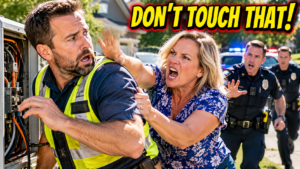
The Weight of the Line and the Fractured Concrete of a Cul-de-Sac Suburb
CHAPTER 1: THE SPLIT VALVE
The spade struck cracked gray aggregate with a wet, heavy thud. Leo didn’t look up from the trench. He didn’t need to see the sun to know it was baking the skin off his shoulder blades; the smell of iron-heavy mud and heated American asphalt told the story well enough. Somewhere down beneath the property seam, where his driveway met Brenda’s meticulously manicured sod, water was hissing through a fresh fissure. It was a rhythmic, malicious sound—a steady theft of pressure that had already turned his lower lawn into a sponge.
He reached down, his fingers sinking into the cold silt of the cul-de-sac’s underbelly, his palm closing around the slick curve of a three-quarter-inch main line. The break wasn’t clean. It wasn’t the natural decay of old plastic or the shifting of frost-heaved earth. His thumb traced a jagged, sharp ridge where the plastic met the brass stem of the shut-off valve. The metal was scraped raw, scarred by the heavy teeth of a pipe wrench that didn’t belong to him.
“You’re outside the utility easement, Leo.”
The voice was thin, sharp, and perfectly timed to the scrape of his trowel against the stone. Brenda stood exactly three inches behind the yellow property stake. Her white sneakers were spotless, planted firmly on her side of the invisible line that divided their lives. In her left hand, she held a hard plastic clipboard, its metal clamp pinning a thick stack of neon-orange notices. Her hair was pulled back into a knot so tight it seemed to pull the skin around her eyes into a permanent squint.
Leo didn’t rise. He kept his weight on his heels, his shirtless chest glistening with a mixture of sweat and ditch water. “The line ruptured inside my meter box, Brenda. It’s my fix.”
“The water is pooled on shared asphalt,” she said, her index finger tapping the edge of her clipboard with the precise, mechanical rhythm of a clock. “The bylaws are clear about industrial maintenance in residential view corridors. You have four hours before the county citation team processes the digital report I sent at dawn.”
Leo wiped his forehead with the back of his forearm, leaving a smear of gray silt across his brow. He looked at the yellow flag sticking out of the grass—a marker he hadn’t placed. Then his gaze drifted past her pristine sneakers to the small, brass utility box near her hydrangeas. The iron lid was slightly askew, a single blade of crushed grass trapped beneath the rim where someone had forced it open in the dark.
A shadow moved across the street. Old man Miller had stopped his riding mower at the edge of his turf, his engine idling down to a low, guttural cough as he leaned over the steering wheel to watch. Further down, two women on their afternoon walk slowed their pace, their eyes locked on the shirtless man in the mud and the woman with the orange papers.
“I didn’t open that valve box last night,” Leo said quietly, his voice staying low, transactional, and flat.
Brenda’s posture didn’t soften. Instead, she stepped forward, her shadow falling directly across his hands as they rested on the cold tool box. “The code doesn’t care who touches the pipe, Leo. It only cares who owns the mess.”
Beneath the wet soil, his fingers tightened around a rusted crescent wrench. He felt the cold weight of the iron, the hard reality of the boundary line beneath his knees, and the sudden, sharp realization that the pressure gauge on his porch had dropped to zero exactly twenty minutes after Brenda’s back porch light had cycled off the night before.

CHAPTER 2: THE TOOL MARKS
The crescent wrench didn’t slide onto the brass nut; it bit into it, cold iron grinding against soft, wet metal. Leo kept his chest low, the abrasive edge of the driveway concrete scraping against his ribs every time he leaned into the trench. The water didn’t stop. It pooled around his knuckles, thick with a fine, red clay silt that tasted of rust and stale iron. Brenda’s shadow remained pinned to the gray aggregate, a dark, geometric shape that felt as heavy as the midsummer heat pressing down on the back of his neck.
“You’re tracking that slurry onto the public curb,” she said. Her voice didn’t have the volume of a shout, but it carried across the narrow asphalt street with a strange, flat resonance. “The neighborhood infrastructure committee has a strict zero-tolerance policy for runoff. If that silt hits the storm drain, it’s an automatic environmental assessment fee.”
Leo didn’t answer. He didn’t want to give her the satisfaction of a verbal slip, not while Miller’s lawn mower was still idling down the block like an old dog waiting for a fight. Instead, he wedged the edge of his thumb into the narrow gap between the pipe sleeve and the main valve core. The plastic casing had split longitudinally—a clean, violent fracture that ran three inches down the seam.
But it wasn’t the split that caught his eye.
When he turned the small, battery-powered work light toward the bottom of the trench, the beam illuminated the underside of the brass valve housing. The metal wasn’t corroded. It was scored. Three distinct, parallel grooves had been gouged into the hexagonal neck of the fitting. They weren’t the random scratches of a shifting stone or a frost-heave; they were the clean, deep impressions left by a heavy pair of locking pliers with hardened steel teeth. Someone had clamped onto the main shut-off valve with enough leverage to twist the internal seal until the back-pressure sheared the underlying PVC right at the thread.
He felt a cold drip of sweat slide down his temple, cutting a clean track through the gray mud on his cheek. He didn’t look up, but his grip on the wrench tightened until his knuckles went pale beneath the grease. “This valve didn’t freeze, Brenda,” he said, his voice dropping into the quiet, rhythmic cadence of a man checking a measurement. “Someone put an eight-inch jaw on the stem and turned it until the collar snapped.”
The rhythmic tapping of her finger against the clipboard stopped instantly.
For four seconds, the only sound in the cul-de-sac was the steady, low hiss of the escaping water and the faint, hot wind rattling the dry leaves of the maples at the corner. Leo watched her shadow. The silhouette of the clipboard tilted slightly, its sharp corner dipping toward the lawn as if her wrist had momentarily lost its rigidity.
“The equipment on your side of the meter is your liability,” she replied, her tone shifting from the dry recitation of rules to something sharper, narrower. “Defective plumbing isn’t an excuse to turn the cul-de-sac into an open trench project. The county marshal’s office already has the documentation. I’ve signed the formal complaint myself.”
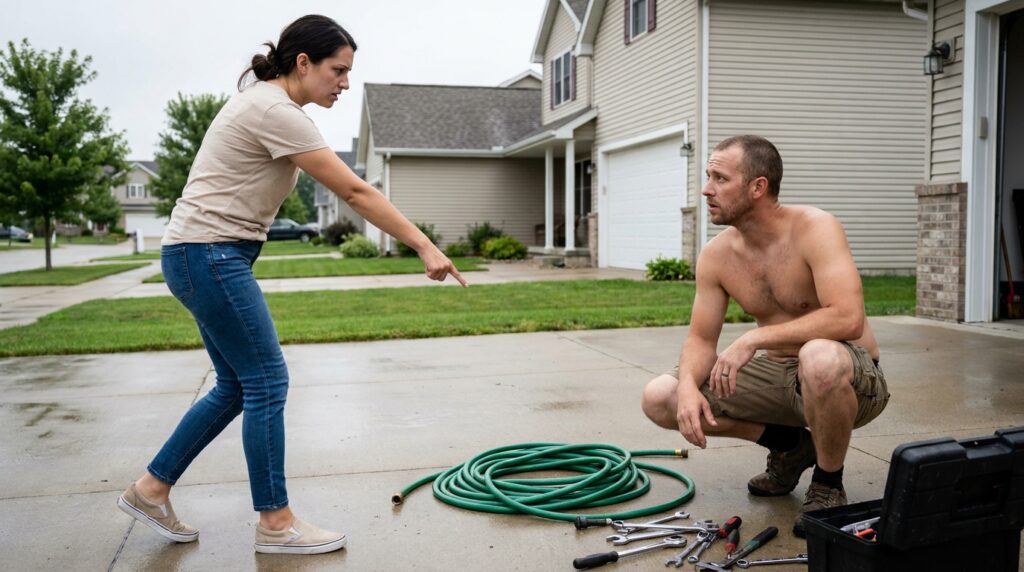
Leo slowly pulled his arms out of the mud, the wet clay suctioning against his skin before letting go with a dull pop. He sat back on his heels, his shirtless torso streaked with gray silt and the dark orange oil of rusted fittings. He didn’t look at Brenda. He looked down at the tool zone between them—the scattered coupling sleeves, the yellow plastic toolbox with its rusted hinges, and the coiled green hose that lay like a dead snake on the wet concrete.
Right at the edge of his tool box, half-buried under a damp rag, lay a yellow carbon copy of a city citation. He hadn’t noticed it when he first dragged the box out of the garage. He reached down, his wet fingers leaving dark, translucent smudges across the paper as he lifted it. The letterhead didn’t belong to the city building inspector. It was a standard, pre-printed HOA notice form, but the lines at the bottom weren’t filled out with the typical fine amounts. Instead, there was a typed amendment under the section labeled Immediate Corrective Actions.
Failure to clear the common easement area within twenty-four hours will result in an immediate lien filing under Section 4-B, pending emergency property receivership.
Leo’s thumb rubbed against the bottom edge of the paper, where the ink was slightly blurred from the humidity. There were three lines for witness verification. The names Miller, Vance, and Grover were written out in a stiff, identical script that didn’t match the signature style of any man on this street. The letters were narrow, slanting sharply to the right, the ink a dark purple ballpoint that looked exactly like the pen Brenda currently had clipped to the pocket of her jeans.
He tucked the paper into the back pocket of his shorts, the damp carbon sticking to his skin. He didn’t mention the names. He didn’t mention the teeth marks on the brass hex. The sun was leaning into the western sky now, the light turning a dull, sulfurous yellow that cast long, distorted shadows across the asphalt.
“The county marshal doesn’t enforce neighborhood association liens, Brenda,” Leo said, his eyes finally lifting to meet her sunglasses. The lenses were dark, completely flat mirrors that reflected nothing but the gray concrete and his own mud-streaked face.
Brenda didn’t flinch. She adjusted her grip on the clipboard, her knuckles white against the black plastic. “They enforce the peace, Leo. And right now, you’re the only thing breaking it.”
Behind her, at the far corner of the driveway boundary, the small, black dome of Leo’s doorbell camera sat nestled under the porch eave. A tiny, blue indicator light flickered twice inside the casing, its silent lens recording the precise angle of her stance and the tight, defensive tremor in her left hand as she stepped half an inch closer to the wet dirt.
CHAPTER 3: THE AMBUSH AT THE BOUNDARY
The heat coming off the concrete driveway didn’t rise in waves anymore; it sat like a physical weight against Leo’s shoulders as he shifted his stance. The mud on his cargo shorts had baked into a stiff, gray crust that cracked whenever he moved his legs. Beneath him, the pooling water continued its slow, steady spread, cutting a dark, jagged path across the light aggregate toward the street seam. He could hear the sound of a heavy diesel engine shifting gears three blocks away—the county municipal fleet was active, and Brenda knew the schedule down to the minute.
She took half a step forward. Her clean white sneakers crossed the expansion joint, her sole pressing flat against a patch of damp concrete that lay indisputably on Leo’s side of the survey marker. The movement was calculated, a deliberate test of physical leverage designed to narrow the distance between her clipboard and his face. Her arm extended, a stiff index finger pointing sharply downward into the wet trench where the sheared PVC pipe lay exposed to the glare.
“You do not get to stand here and pretend this is easy,” she said. Her voice cut clean through the heavy, humid air of the cul-de-sac. She didn’t drop her gaze; she kept her eyes fixed behind the dark circles of her sunglasses, forcing her forward posture directly into the anchor zone of his work area. “The association rules exist to maintain structural consistency. Look at this drainage. Look at the mud you’ve dragged into the view corridor. You’re intentionally letting it run into the common easement to avoid paying a commercial haul-away fee.”
Leo pushed up from his crouch, his knees making a dry, cracking sound as he straightened to his full height in the right-midground. His hands lifted instinctively—wet with gray clay, palms facing outward in a blunt, defensive gesture that held the space between his bare chest and her extended arm. The wrench in his right pocket clicked against a coupling sleeve as he stood ground.
“I am fixing it right now, stop acting like I do not care!” He didn’t shout, but his voice carried the hard, flat friction of someone who had spent four hours on his knees in the dirt. He pointed toward the yellow city utility flag sticking out of the turf ten feet away. “The main valve was twisted from the outside, Brenda. I’m resetting the collar because if I don’t, the line stays dry all the way down to the corner house. This isn’t a landscape project. It’s an emergency repair.”
Brenda didn’t pull her hand back. Her finger remained fixed on the scattered pile of tools—the pipe wrenches, the yellow plastic toolbox with its rusted latch, and the heavy green hose that glistened with a fine sheen of dirty water. Her mouth narrowed into a hard, pale line, her chin tilting upward to maximize the angle of her clipboard.
“Then show me you actually care about this,” she snapped, her words hitting him with a rapid, venomous precision. She tapped the neon-orange papers clamped to the plastic board. “Show me the registered contractor signature. Show me the municipal ground-disturbance authorization code. You don’t have one, Leo. You’re digging in a common easement without an structural engineer’s sign-off, and the neighborhood isn’t going to absorb the depreciation on our home values just because you want to handle your own utility connections with a box of rusted garage tools.”
Behind her on the asphalt, the two women who had been walking their dogs stopped completely. They stood near the edge of Miller’s lawn, their shadows stretching long and thin across the street as they watched the confrontation. Miller himself had cut the ignition on his riding mower. He sat atop the high-backed vinyl seat, his grease-stained cap tilted back as he watched the two figures squared off across the open trench. The cul-de-sac had become a stage, the silence between the houses growing so thick that the faint, wet drip of the broken pipe sounded like a hammer striking stone.
Leo felt the damp paper of the forged violation notice inside his back pocket—the one with the identical purple ink and the three forged signatures of the very men currently watching him from across the lawns. He could feel the trap closing around his ankles, the legal and social weight of the street being brought down on his property line based on a document written by a single hand.
Brenda leaned in another inch, the metal corner of her clipboard almost touching the dirty skin of his forearm. “The county truck turns onto this block in twenty minutes, Leo. When they get here, this trench gets backfilled with gravel by an enforcement crew, and the bill goes directly to your property tax assessment. Unless you want to clear these tools right now and let the professional service team handle the foreclosure protocol.”
Leo’s eyes didn’t look at the clipboard. They tracked a tiny smudge of dark purple ink on the side of Brenda’s left thumb—a small, distinct stain that matched the exact hue of the witness signatures hidden in his pocket.
CHAPTER 4: THE THREAT OF THE TOW TRUCK
“If these tools are not inside your garage doors by the time that hydraulic brake down the street cycles, I am authorizing the immediate physical clearance of this entire driveway,” Brenda said. Her thumb moved over the top of her clipboard, her voice tight, dry, and sharp. She didn’t drop her arm. Her extended index finger pointed straight past his shoulder toward the open garage behind him, where an array of older, oil-stained machinery sat in the shadows. “The county code team doesn’t debate with non-compliant owners, Leo. They fine, they clear, and they attach the cost directly to the title.”
Leo stood ground, his boots grinding into the gritty stone dust that had settled over the wet concrete seam. The heat was a living force now, an invisible anvil pressing down on his bare shoulders. He looked down at his yellow toolbox, his fingers twitching toward the heavy handle. “The only thing getting attached today is a new coupling sleeve to my main line, Brenda. The city survey markers give me five feet of clearance from this expansion joint for emergency utility maintenance. You can call whoever you want, but they aren’t backfilling an open repair line while the water is still running.”
“That isn’t your utility line anymore,” she fired back, her sunglasses reflecting the bright, desaturated glare of the afternoon sun. She stepped forward again, her clean white sneaker landing directly in a pool of gray silt that oozed across the property seam. “The amendment passed by the board last month reclassified the entire driveway corridor as common residential turf. Your property line ends at the porch foundation. Every square inch of this concrete belongs to the association’s maintenance scope, and you are currently destroying common equity.”
She tilted the clipboard, bringing it up within six inches of his chest. The white paper caught the direct light, blinding him for a split second with its raw reflection.
“Sign the acknowledgment form,” she snapped. “Or the county sheriff’s deputy coming behind the tow truck will treat this as a criminal obstruction of public works.”
Leo felt a rhythmic, cold pulse behind his temples. His left hand slowly reached into his back pocket, his fingertips brushing against the damp carbon copy of the citation he had pulled from the box earlier—the one with the signatures of Miller, Vance, and Grover written out in that tight, narrow, purple script. He didn’t pull it out. Not yet. He looked down at the mud-streaked concrete between them, where the green garden hose lay coiled like a heavy, dead snake.
“Let me see the petition, Brenda,” Leo said. His voice was low, flat, and transactional. It lacked the heat of a shout, but it possessed the heavy weight of iron. “The one you used to get the emergency lien filed. If the street signed off on taking my driveway, I want to see the ink.”
Brenda’s shoulder flared, her posture rigid as an iron stake. “The records are proprietary property of the association management board. You don’t have the status to review them until the hearing next month.”
“Then you’re bluffing,” Leo said. He took half a step forward, his shadow fully engulfing her white sneakers.
The physical movement was small, but it broke her rhythm. Brenda’s heel caught on the raised lip of the concrete aggregate behind her. Her weight shifted rapidly, her balance breaking as her arms jerked upward to keep from falling into the wet ditch. The heavy plastic clipboard slipped from her wet hand, striking the iron corner of his tool box with a sharp, echoing clatter before landing flat in the muddy pool at the edge of the trench.
The papers exploded outward from the metal clamp. The clean white sheets soaked up the gray silt instantly, the water turning the margins translucent.
Brenda made a short, breathy sound—a small gasp of panic that broke through her rigid demeanor—and dropped down to grab the mess. But Leo was already lower. His hand slammed onto a thick manila folder before her fingers could touch the paper. He didn’t pull it away; he simply pinned it against the wet stone with the flat of his palm, his skin leaving an unyielding print of dark silt across the cover.
Right beneath his thumb, sticking out from the side of the board’s official letterhead, was a narrow, pink slip of paper that didn’t belong to the neighborhood association files. It was an official pre-foreclosure notice from the county registrar, stamped with a bright red ink seal dated three days prior. The name on the primary debtor line wasn’t his. It was Brenda Vance.
Leo’s eyes locked onto the document, his internal calculations shifting instantly as the physical evidence of her desperation lay exposed in the mud between them. At the top of the street, the deep, guttural rumble of a heavy diesel engine brake finally sounded, its loud thwack-thwack-thwack bouncing off the brick garage fronts as a large orange city service truck slowed its pace, turning its massive tires directly into the cul-de-sac.
CHAPTER 5: THE SURVEY MAP AND THE CAMERA REVEAL
The orange municipal truck didn’t just stop; it settled into the curb with a massive hiss of air brakes that rattled the metal latches on Leo’s toolbox. The smell of unburned diesel fuel rolled across the grass, thick and oily, mixing with the sharp tang of the wet clay between his boots. From the cab, a city inspector in a high-visibility vest rolled down the window, looking out at the half-naked man in the mud and the rigid woman frozen over a puddle of translucent documents.
Leo didn’t look at the truck. He stayed low, his fingers pinned flat against the manila folder that had spilled from Brenda’s clipboard. Under the gray slime of the runoff, the pink county pre-foreclosure notice practically glowed in the white glare of the sun.
“Get your hands off those files,” Brenda whispered. Her voice had lost its flat, mechanical authority. It was thin now, frayed at the edges like old hemp rope under tension. She didn’t reach down to pull the folder away; her fingers merely hovered over the silt, trembling slightly against the backdrop of her spotless white sneakers. “Those are administrative board records. You’re tampering with proprietary legal property.”
“This isn’t an association file, Brenda,” Leo said. He slowly lifted his hand, picking up the wet, stained notice along with the typed petition sheet underneath it. The ink on the signatures—the ones for Miller, Vance, and Grover—was running slightly in the ditch water, bleeding a distinct, vivid shade of violet across the pulp. He straightened to his full height, turning his back to the arriving truck so his shadow completely boxed her in. “The county registrar doesn’t send foreclosure notices to the HOA. They send them to the owner of record. Your name is the only one on the debt line.”
Behind them, the passenger door of the city truck swung open. The heavy boots of a code enforcement deputy struck the asphalt with a dull thud. Down the sidewalk, Miller began walking toward the property seam, his hands stuffed into the pockets of his grease-stained jeans, his brow furrowed as he caught sight of the mess. The two women with the dogs followed three paces behind, their phones held low against their hips but their eyes locked on the driveway.
Brenda’s posture snapped back into rigidity, her shoulders pulling back as she tried to command the space by sheer proximity. Her sunglasses hid her eyes, but the muscles around her jaw were tight enough to turn the skin white. “My personal finances don’t change the structural violation in this ditch, Leo. You’re digging without an authorized civil layout. Inspector!” she called out, her voice rising to reach the approaching official. “This resident has breached the common main and is discharging polluted runoff onto public property. I have the signed neighbor petition right here.”
“No, you don’t,” Leo said. He didn’t raise his voice to compete with hers. He simply reached over to his yellow toolbox, lifted the plastic lid, and pulled out a long, heavy cylinder of laminated paper alongside his smartphone.
He unrolled the sheet right across the hood of Brenda’s parked sedan, the thick, heavy plastic snapping open with a loud crack that made her flinch. It was the official municipal easement survey map, stamped with the blue embossed seal of the city planning department.
“The line is right here, inspector,” Leo called out, his voice level and flat as he pointed to the grid matrix. “The five-foot emergency maintenance exemption covers this entire concrete seam. And as for the petition—” He turned toward Miller, who had just reached the edge of the lawn. “Hey, Tom. Did you sign an emergency lien authorization to put my house into receivership this morning?”
Miller stopped. His eyes went from Leo’s mud-covered chest to the wet paper in Leo’s hand, then down to Brenda’s sneakers. “I haven’t signed anything since the tax assessment in January. What the hell are you talking about?”
“She used your name,” Leo said, turning the running purple ink toward the old man. “Same handwriting. Same purple pen she’s got in her pocket right now. She needed an immediate foreclosure auction on this block to draw attention away from the bank clearing her own title next Tuesday.”
Brenda took a rapid step back, her heel hitting the edge of her own green sod. “This is a fabrication. He’s manipulating the markers—”
“I’m not manipulating the camera,” Leo interrupted. He didn’t look at her; he looked at the code enforcement deputy who had just reached the edge of the trench. With a single swipe of his thumb, Leo unlocked his phone and held the screen out into the bright afternoon light.
The video was clear, recorded in the sharp, stark contrast of infrared night vision. The time-stamp at the top read 02:14 AM. The lens showed the quiet driveway, the shadows of the maples, and a distinct, recognizable figure with dark hair tied back tightly creeping across the concrete seam. The figure carried an eight-inch pair of locking pliers. She had knelt down by Leo’s main valve box, wedged the metal jaws around the brass hex stem, and thrown her entire weight against the metal handle until the underlying PVC collar gave way with a violent spray of white water in the dark.
The sidewalk crowd went completely silent. The only sound left was the low, rhythmic idle of the diesel truck and the heavy, ragged breathing of Brenda as she stared at the glowing screen, her hand slipping into her pocket to hide the purple pen.
CHAPTER 6: THE GROUND RECLAIMED
The silence that followed the night-vision footage didn’t crack; it widened. The code enforcement deputy leaned in closer to Leo’s phone, his heavy leather utility belt creaking against the door of the city truck as he stared at the glowing pixels. On the screen, the loop restarted, the infrared shape of Brenda kneeling in the dark to wrench the brass stem until the pipe collar tore open.
The deputy looked up from the screen, his gaze moving past Leo’s dirt-streaked shoulder to lock squarely onto the spot where Brenda stood. His boots made a sharp, grinding sound on the gravelly aggregate as he turned his full frame toward her. “Ma’am,” he said, his voice flat, official, and devoid of the bureaucratic patience he had arrived with. “Step away from the resident’s property line. Keep your hands where I can see them.”
Brenda didn’t look at the deputy. She was looking at Miller. The old man had taken three slow steps across the grass, his face hardening into a grim, deeply lined mask as he stared down at the wet, purple-inked forgery pinned under Leo’s tool box.
“You signed my name to a civil lien, Brenda?” Miller asked. His voice wasn’t loud, but it had the rough, abrasive scrape of a dry piston. He reached down and yanked the translucent sheet out of the mud, the wet paper tearing slightly along the margin. “My wife and I have lived on this cul-de-sac for forty years. We don’t use court filings to handle a busted water valve, and we damn sure don’t let our neighbors steal our signatures to cover their own bank notices.”
“Tom, listen to me,” she began, her hand lifting instinctively toward her sunglasses, her fingers trembling against the black plastic frame. Her voice was too high, a thin, desperate rattle that vanished into the hot diesel exhaust of the idling truck. “The property values are dropping. Look at his driveway. Look at the aggregate. If the county lists his parcel as non-compliant, the whole block loses leverage before the quarter ends. I was trying to stabilize the residential footprint.”
“The only thing you were trying to stabilize was your own timeline,” Leo said. He stepped between her and his trench, his bare chest glistening with grease and dried gray silt. He reached down into his pocket, pulled out a heavy brass coupling sleeve, and set it down onto the concrete with a hard, metallic clank that marked the physical end of the argument. “The city surveyor stamped this line three years ago. Every inch of this repair is within the code. The code enforcement team isn’t here to tow my box, Brenda. They’re here because you filed a fraudulent report to manufacture an emergency asset seizure before the bank could put your own house up on the courthouse steps next week.”
The deputy pulled a thick, coarse-grained citation pad from his rear pocket, the cardboard backing snapping open with a dry slap. “Ma’am, I need you to show me a valid photo ID right now, and you need to remain on your side of the expansion joint while I contact the county registrar’s field office. We have an intentional destruction of municipal utility infrastructure under Section 8-A, and the signature forgery will be handled by the sheriff’s unit moving onto the block.”
Brenda looked around the circle. The two women from down the street had raised their phones fully now, the dark lenses of their cameras tracking her every step as she began to back away. Her clean white sneakers were ruined, covered in a thick, gray coating of the very slurry she had claimed was destroying the neighborhood aesthetic. Her shadow, once straight and rigid across Leo’s driveway, was now short, broken, and pinned beneath her heels as she retreated onto her own dying turf.
She didn’t speak another word. She turned her back to the street, her shoulders hunched as she marched up her driveway, her screen door slamming shut behind her with a tinny, hollow ring that echoed across the cul-de-sac.
Leo didn’t watch her go. He turned back to the trench, his breath coming in slow, measured counts that tasted of iron sediment and the bitter oil of rusted iron tools. The afternoon sun was leaning hard into the western tree line now, throwing long, desaturated bars of orange light across the gray concrete. The water had stopped its rapid hiss, dying down to a slow, manageable drip as the main pressure seal began to hold against the new brass sleeve.
The deputy walked over to the edge of the pit, his pen clicking twice as he noted the blue planning seal on Leo’s laminated survey map. “You’ve got two hours to finish the backfill before the sun goes down, son,” the officer said, his tone shifting into the rough, practical vocabulary of the trades. “The city won’t charge you for the runoff. Just make sure the gravel is tamped level with the public curb.”
“It’ll be level,” Leo said.
He knelt back down on the abrasive concrete, his skin scraping against the stone as he reached into the silt one last time to tighten the primary iron collar. The street was quiet again. Old man Miller walked back to his mower, his heavy hand giving Leo a single, brief nod of acknowledgement before kicking the engine back into gear. Leo took the heavy pipe wrench, clamped its hardened steel teeth around the hexagonal core of the new valve, and turned it until the seal locked home with an unyielding, metallic click. The ground beneath his knees was muddy, raw, and broken—but it was entirely his own.