
The Iron Stakes of Deadlines and the Unyielding Ground of the Cul-de-Sac

CHAPTER 1: THE RESISTANCE OF THE CLAY

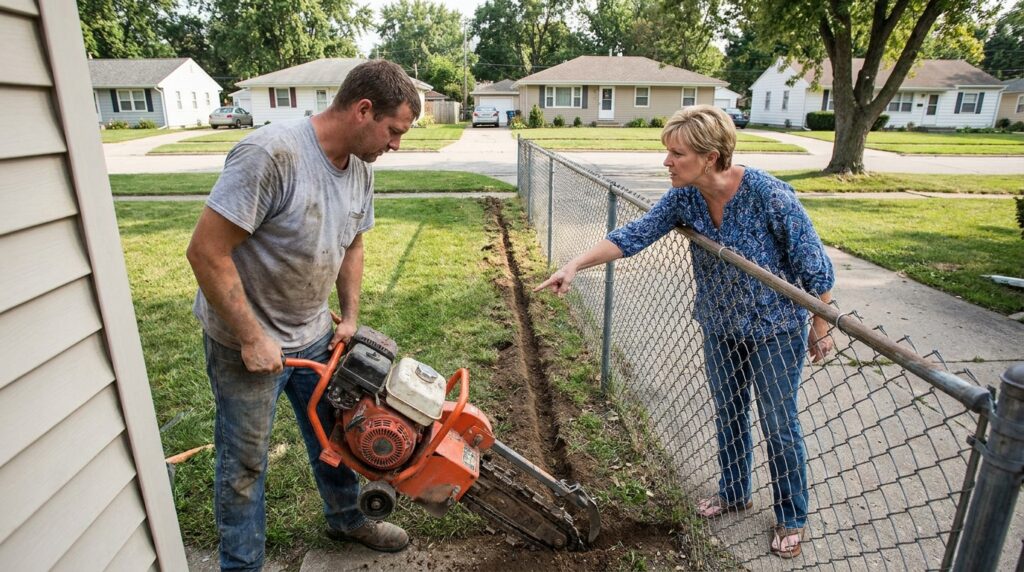
The dirt didn’t care about neighborhood bylaws. Two inches down beneath the bright green sod that the homeowner had watered to a deceptive, velvet softness, the ground turned to the gray, packed clay of the Piedmont. It was old seabed stuff, compressed by half a century of heavy construction equipment and baking under the early morning heat until it had the density of unworked limestone. Mark adjusted his grip on the twin rubber handles of the trenching machine, leaning his weight forward until the heavy steel teeth of the boom bit into the crust, spitting out small, dry clods that rattled against the chain-link fence like birdshot.

His left wrist was already doing that rhythmic, dull throbbing—the old souvenir from an unpinned fracture back in his framing days. He ignored it, focusing instead on the narrow string line he’d staked out at 5:30 AM while the streetlights were still flickering out. The sky to the west was a bruised, heavy purple, the clouds moving with the quiet velocity of a system that would dump three inches of water onto these roofs by tomorrow night. If the trench wasn’t cut, leveled, and backfilled with clean gravel before those clouds opened, his client’s basement would become a four-foot deep cistern.

Through the vibrating haze of the engine’s exhaust, he saw the blinds twitch in the colonial-style house next door.

He didn’t look up. He didn’t need to. In this line of work, you learned to sense the exact moment a property owner or a self-appointed block captain stepped into their kitchen to watch you. You could feel the weight of their attention across the fence line long before they ever set foot on the grass. Mark kept his boots planted in the loose soil, his eyes fixed on the exact spot where the cutting chain disappeared into the earth, tracking the thin silver wire of the fence that separated two different kinds of certainty.

A silver watch caught the morning sun from the side porch next door. It was followed by the crisp, sharp slap of a plastic clipboard settling against a forearm.

Mark adjusted the choke, keeping the revs high, the machine groaning as it struck an old tree root hidden beneath the boundary line. He could see the apprentice, a twenty-year-old kid named Leo, stalling out near the tool trailer on the street, his hands frozen on the handles of a wheelbarrow as the shadow of the loud blue patterned blouse moved down the sidewalk with deliberate, measured steps. The neighborhood authority had arrived, and she wasn’t carrying a cup of coffee. She was carrying a stopwatch.

Mark didn’t throttle down. He kept the boom moving forward, a steady, unyielding inch at a time, letting the high-pitched shriek of steel hitting packed earth fill the space between them.

Near the base of his boot, half-buried under a fresh hill of gray clay, something small and metallic gleamed—a heavy brass casing from an old plumbing transition that shouldn’t have been within six feet of the surface. He tapped the machine’s carriage with his toe, shifting the angle slightly, his mind already calculating the risk of an unmapped line while the woman reached the fence.


CHAPTER 2: THE CLAIMS ON THE MARGIN

“Shut it down. Shut it down right now or I’m calling code enforcement to impound the rig.”

Brenda’s voice didn’t carry the erratic pitch of someone losing her temper; it had the cold, rhythmic precision of a state inspector checking a manifest. She stood exactly three inches back from the rusty chain-link mesh, her polished white tennis shoes perfectly clean against the cracked concrete of the sidewalk. Her oversized silver watch gleamed under the graying sky as she hoisted the heavy plastic clipboard against her ribs like armor.

Mark didn’t lift his hands from the rubber grips. The trenching machine gave a low, iron rattle as the teeth ground against another pocket of packed gray clay, sending a spray of fine, metallic dust over the toes of his work boots. He adjusted his stance, using his thigh to anchor the frame against the torque. Through the exhaust-warmed air, the smell of unburned diesel and pulverized shale was thick enough to taste.

“I’m talking to you, sir,” she said, her voice dropping an octave to cut beneath the high-frequency whine of the small engine. “This is a non-permitted disturbance of a Class II common easement. I have the master plat right here. You’re already looking at a twenty-five hundred dollar variance fine for the homeowner, and your operator’s license goes into the county registry by noon.”

Leo, the kid, had stopped completely now. He was leaning against the wheelbarrow forty feet back near the curb, his face pale under his dusty ball cap, staring at the clipboard in Brenda’s hands as if it were a warrant. That was the problem with the younger ones—they still believed the paperwork had teeth just because it was printed on heavy cardstock. They didn’t understand that on a property line, the only thing that held weight was the iron in the ground and the permit in the truck.

Mark slowly eased the throttle lever back, notch by notch, until the screaming engine dropped into a heavy, wet idle. The sudden drop in volume made the entire cul-de-sac feel artificially quiet, the silence punctuated only by the distant, rhythmic thrumming in his broken left wrist.

“Morning, ma’am,” Mark said. His voice was dry, raspy from the dirt. He didn’t clear his throat. He kept his boots planted in the trench, looking at her through the square gaps in the wire fence. From this low angle, her silhouette was framed against the neat, identical gables of the houses across the street—a row of perfect, vinyl-sided boxes that all shared the same five shades of beige.

“It’s not morning for your client anymore,” Brenda said, her finger tapping the top edge of her aluminum form sheet. “I warned him three weeks ago when he put the deposit down for this work. The HOA board has an exclusive landscape restriction on this entire northern boundary strip. You’re cutting straight through a protected root zone for the legacy hedges.”

Mark looked down at the trench between his boots. The chain had just exposed the top curve of that old brass plumbing transition he’d spotted a minute ago. It wasn’t standard residential stuff. The nut was oxidized to a deep, dark green, the crusty corrosion showing the distinct, squared ridges of a commercial high-pressure valve that had been abandoned long before these houses were framed in the nineties. It was dry, but the soil around it was packed with coarse river gravel—the kind utility companies used to bed in large-diameter mains.

“The hedges are six feet back on your side of the wire, ma’am,” Mark said, his tone perfectly flat, empty of any defensive edge. He reached into his back pocket, his calloused fingers tracing the stiff, folded corner of the city-stamped drainage permit. He didn’t pull it out yet. In a boundary fight, you didn’t show your hole card while the other side was still trying to bluff with a clipboard. “We’re running eight inches inside the client’s deeded line. The chain hasn’t touched a root over two inches.”

“The deeded line doesn’t matter when an overlapping covenant is active, Mr… Mark, is it?” She didn’t wait for him to confirm. She adjusted her sunglasses, her gaze scanning the length of the machine’s steel boom, tracking the fresh pile of clay like an auditor counting a deficit. “The covenant states that any modification to the grade within ten feet of the fence requires a two-thirds majority signature from the architectural review committee. You don’t have it. I checked the portal before the sun came up.”

She stepped closer, her floral blouse brushing against the wire fence with a faint, synthetic rustle. Her eyes were hidden behind the dark, polarized lenses, but Mark could see the tight, white line of her jaw. She was calculating the cost of the equipment sitting in the yard—the trailer, the truck, the fuel cells. She knew the margins for an independent contractor were thin enough that a three-day delay could break the quarterly insurance premium.

“Leo,” Mark called out without turning his head. “Get the laser level out of the cab. Check the drop on the secondary culvert by the road entry.”

The kid didn’t move for a second, his eyes still darting between Mark and Brenda’s clipboard.

“Now, Leo,” Mark repeated, his voice dropping into that low, heavy register he used when a cable was about to snap under load.

The apprentice jumped, dropping the wheelbarrow handles with a sharp clang that echoed down the blacktop, and scrambled toward the tool boxes on the side of the F-250.

Brenda watched the kid run, her mouth curling into the briefest hint of a professional smile. She turned her attention back down to Mark, her posture squaring as she took a half-step to the right, blocking his direct line of sight to the lower street drain. “You’re wasting his time, and you’re wasting your fuel. I’ve already sent the digital notice to the township inspector’s office. If that chain rotates one more time before the official car pulls up, I’m filing a formal visual nuisance report with the sheriff’s dispatcher.”

Mark looked at the brass valve between his feet again. The gravel bedding underneath it didn’t run toward the street; it angled back, deep under the fence line, straight toward the foundation of Brenda’s garage. He knelt down slowly, the dry clay popping beneath his knees, and ran his gloved hand over the crusty metal. There was a faint, cold draft coming through the gravel pack—the distinct smell of stagnant water and old lime mortar.

“The township won’t red-tag a safety excavation, ma’am,” Mark said quietly, his hand staying on the valve. “Not with three inches of rain coming down from the ridge by dawn.”

“It’s an unpermitted ditch, Mark. The city doesn’t override a private covenant for a puddle.” Brenda tilted her clipboard up, her pen poised above the line. “Now, do you turn it off, or do I call the county code desk while I’m standing right here in front of your truck?”

Mark stood up, wiping the gray dust from his gloves onto his jeans. He looked past her shoulder, down toward the corner of the lot where the concrete curb met the drainage intake. Something about the way the grass was dying along that specific curb line didn’t fit the slope of the hill. It was dry, yellowed, and completely dead—not from a lack of water, but from something else entirely.

CHAPTER 3: THE WARNING SHOT

The drive belt didn’t snap; it went soft under the load, smoking against the drive pulley with a sharp, synthetic stench that cut through the raw odor of the dirt. Mark caught the slip instantly, his boots shifting in the loose clay as he cut the primary drive and let the trenching machine sink to a dead stop. A heavy quiet collapsed over the lot again, save for the faint, steady rattle of a dry bearing somewhere deep inside the housing.

“Leo, the three-quarter box wrench,” Mark said. He didn’t look up from the access panel. He dropped to one knee on the packed earth, his bare fingers sweeping away a crusty layer of soil from the tensioner bolt. The metal was hot enough to leave a white smudge of dry skin on his thumb. “And bring the rag from the tailgate.”

No answer came from the truck. Mark leaned his weight against the frame of the ditch witch, his left wrist pulsing with that dull, rhythmic ache as he turned his head toward the street. Leo wasn’t at the toolboxes. The kid was standing near the front bumper of the F-250, his face shadowed by his cap, staring at a thick piece of white cardstock that had been slammed under the passenger-side wiper blade.

Brenda was already thirty yards down the sidewalk, her blue patterned blouse a bright, artificial speck against the uniform brick facades of the cul-de-sac. She didn’t look back. She walked with a stiff, calculated posture, the clipboard clamped tightly beneath her elbow like an official ledger.

Mark stood up slowly, the dry clay popping on his jeans as he crossed the yard. The turf felt spongy under his boots, a clear sign that the water table beneath the sod was already rising ahead of the storm system. He reached the truck, taking the cardstock from Leo’s hesitant fingers without a word.

The paper was thick, textured, and bore the embossed gold seal of the Oakridge Heights Homeowners Association. The ink was fresh, the bold typewriter font giving it the look of a municipal summons. It was a formal Cease-and-Desist order, citing three separate violations of the neighborhood civil code: unauthorized commercial equipment deployment, environmental disturbance of a common easement, and failure to present a physical hardcopy of the sub-divisional variance registry. At the bottom, a neat, blue-ink signature marked Brenda’s full name alongside a stamped assessment fee of twelve hundred dollars, payable within forty-eight hours to clear the property title.

“She said they’re bringing the county tow truck for the trailer,” Leo muttered, his voice dropping into that quiet, panicked rhythm of a kid who had never seen an asset seizure. He wiped his palms on his work vest, his eyes tracking the dark clouds rolling over the ridge to the west. “She said if we’re still on the sod when the code enforcement car gets here, they’re labeling the truck as an abandoned hazard.”

Mark rolled the heavy cardstock between his thumb and forefinger, feeling the cheap varnish on the gold seal flake off under his callouses. He looked at the white plastic caps on the client’s chain-link fence posts right next to the truck. On the top curve of the nearest cap, a clean, square patch of white adhesive residue remained—the kind left behind when a county surveyor’s tape is peeled away too quickly. It was completely free of dust, which meant whatever had been stuck there had been removed within the last twenty-four hours.

“The truck stays where it is,” Mark said. He tossed the notice onto the dashboard through the open window, his voice completely flat. “Get the box wrench. The tensioner’s slipping because the shale is packing into the guard.”

“Mark, the paper has a notary stamp,” Leo insisted, his hand staying on the edge of the truck bed. “My uncle had his rig impounded down in the valley for an unpermitted grading job. Took three weeks and four grand to get the registration cleared. We can’t afford to lose the lift on this truck if the court locks it.”

Mark turned his back to the street, his eyes scanning the client’s property line down toward the low corner where the chain-link met the road entry. The grass there wasn’t just dead; it had that brittle, chemically burned texture that happened when stale water sat stagnant under a hot sun for too long. He walked back to the machine, his boots sinking an inch into the soft clay by the boom.

The contractor logic in his head was already mapping the elevations. The street drain was clear—he’d checked the grate himself before unloading the trailer. Yet the side yard was acting like a bowl, holding liquid that should have dropped six feet through the natural slope of the hill. He looked across the wire fence into Brenda’s yard. Her lawn was immaculate, a deep, emerald green that looked entirely detached from the gray clay beneath it, bordered by a dense, five-foot wall of dark green Leyland cypress trees that ran parallel to his trench.

The cypress needles near the base of the fence were dry, dusted with a fine, white powder that smelled faintly of cured lime and dry cement mix. Mark knelt back down by the open casing of the ditch witch, his fingers finding the tensioner bolt. He didn’t use the wrench when Leo finally brought it over; he used the weight of his palm to force the bracket back into place, feeling the iron grind against the grit inside the slot until the belt went taut again.

“She’s not calling the county tow, Leo,” Mark said quietly, his voice cutting through the distant, low rumble of thunder from the ridge. He tightened the nut with three short, precise strokes of the wrench. “The county doesn’t pull a licensed commercial rig off a private driveway without a sheriff’s signature on a civil injunction. She knows that.”

“Then why’s she standing by her driveway with her phone out?” Leo asked, nodding toward the house next door.

Through the gaps in the cypress line, Brenda was visible on her side porch, her phone pressed to her ear, her sunglasses pushed up onto her short blonde hair. Her eyes were locked directly onto Mark’s position, her lips moving in a rapid, transactional rhythm. She wasn’t looking at the truck or the trailer; she was watching the exact spot where the steel boom of the trenching machine sat suspended over the gray clay, waiting for the iron to rotate again.

Mark wiped his grease-stained hands on his jeans, his gaze drifting back to the white adhesive mark on the fence cap. The line was exactly straight. He could feel the first cold drop of rain hit the back of his neck—a single, heavy drop that smelled of ozone and wet stone. The deadline wasn’t forty-eight hours anymore. It was two.

CHAPTER 4: THE ANCHOR INCIDENT

The pull-start cord tore out of Mark’s hand with a vicious, metallic snap, the two-hundred-cc engine catching instantly. A plume of pale blue exhaust rattled loose from the manifold, settling over the wet sod as the steel teeth of the cutting boom began their rhythmic, grinding rotation once more. The vibration traveled up through the welded steel frame, striking his palms and settling deep into the fractured bone of his left wrist. He didn’t flinch. He leaned his thighs into the rubber-padded rear guard, setting his heavy work boots against the rising lip of clay, and locked the hydraulic drive into forward.

A shadow broke the gray light over his left shoulder.

Brenda didn’t yell this time; the roar of the machine at full operational revs swallowed anything short of a siren. Instead, her silhouette lunged directly into the narrow gap between the Leyland cypress branches. Her white tennis shoes skidded across the muddy margin of the sidewalk, her knuckles turning bone-white as her fingers clamped onto the galvanized zinc wire of the chain-link fence.

Before Mark could drop the throttle to neutral, Brenda’s right arm thrust straight through the open diamond pattern of the wire mesh.

Her hand, manicured fingers stiffened into a rigid blade, extended five inches into the client’s air space, pointing directly down at the moving steel chain where it chewed into the rock-packed mud. The sleeve of her blue patterned blouse caught on a jagged, rusted twist of the top rail tie wire, the fabric tearing with a high, thin screech that was lost beneath the engine’s whine. She didn’t pull back. She leaned her upper body hard against the fence, her face pressed so tightly into the wire that the metal grid distorted her cheek into a pale, angular mask.

“Turn it off!” Her mouth moved with exaggerated, violent emphasis behind the wire, the words barely tracing through the high-frequency mechanical scream. “You don’t cross this line! Shut it down!”

Mark’s hands remained clamped on the handles like iron clamps. His knuckles were gray with shale dust, his fingers wrapped so tightly that the blood had left his nails. If he let go of the safety dead-man switch now, the emergency brake would lock the chain instantly, but the sudden momentum shift would tip the six-hundred-pound rig sideways, straight onto her extended arm. If he backed up, the rear counterweight would crush the client’s buried water meter box behind his heel.

He held the line. He kept his feet planted in the slick clay, his weight thrown backward to balance the machine’s drift, his eyes locked onto the exact half-inch of clearance between the spinning steel teeth and the tip of her index finger. The wind coming off the ridge was colder now, carrying the metallic tang of heavy rain that was already misting against the hot iron of the engine block, sending up tiny curls of white steam.

Leo was screaming from the street line, his voice a faint, useless squeak over the roar. “Mark! Mark, stop! She’s through the fence!”

Mark didn’t drop his gaze to meet her hidden eyes behind the dark lenses. He calculated the distance. Three inches of soil remained before the boom cleared the old brass transition valve. He eased his right thumb downward onto the governor lever, pulling the engine back from its screaming maximum down to a low, guttural chug that made the whole chassis shudder. The noise dropped just enough for the sound of the wind and the rustle of the cypress branches to return to the yard.

He lifted his head then, slowly, his neck muscles corded like cable. His dusty gray t-shirt was damp from the mist, clinging to his shoulders. He looked directly at her hand—at the three inches of bare skin exposed between her watch band and the sharp, rusted point of the torn tie wire that was hovering less than a hand-span from his machine’s primary guide bar.

“I hear you,” Mark said. His voice was flat, low, and carried the heavy, unhurried cadence of a man who spent his life working around things that could take a limb before a man could blink. He didn’t move his fingers from the rubber grips. “I’m finishing this first.”

“You are trespassing on an association buffer,” Brenda hissed through the wire, her breath fogging the metallic surface of the fence. Her clipboard was jammed against the steel post behind her back, her shoulder straining as she tried to maintain her lean into his workspace. “The code enforcement officer is at the entrance of the development. I told them you were operating an unsafe site without secondary safety barriers. Look at this! You’re within six inches of my hand!”

“Your hand is on my side of the wire, ma’am,” Mark said. He didn’t raise his voice. He didn’t lean away. He kept his chest exactly twelve inches from her face, using his body as a physical wall between her and the machinery. “And you’re hanging on a rusted tie rail that belongs to this lot. If you move your elbow to the left, that wire’s going to take the skin off your wrist.”

Brenda’s fingers twitched against the mesh, but she didn’t pull her arm back out of the gap. Her gaze dropped to the brass valve uncovered at the bottom of the cut. Her expression shifted—not into fear, but into a sharp, defensive calculation that Mark recognized instantly. It was the look a superintendent gave when they realized an investigator had just uncovered the wrong set of footer specs under the gravel.

“That’s an old irrigation header,” she said quickly, her voice rising to cut through the idle of the engine. “It’s been out of service for twenty years. It has nothing to do with your drainage problem. You’re digging up dead infrastructure to avoid the fact that you don’t have a valid HOA registry number.”

Mark didn’t look down at the valve. He didn’t need to. His finger tapped the hydraulic release lever on the left handle, dropping the boom another two inches into the clay. The machine groaned as the chain caught a pocket of wet river stone underneath the valve body, spitting out a single, heavy chunk of grey limestone that rolled across Brenda’s pristine white tennis shoe on the other side of the wire.

“Leo,” Mark called out over his shoulder, his eyes never leaving Brenda’s face. “Get the digital camera from the glove box. Take a close-up of this cap on the fence post right here. Get the adhesive trace under the light.”

Brenda’s arm went rigid against the wire mesh, her jaw tightening until the tendons in her throat stood out like wire rope.

CHAPTER 5: THE COLD HARD FORCES

The air brakes on the dump truck didn’t just hiss; they popped with a sharp, pneumatic crack that sent the birds out of the Leyland cypress line. Down at the mouth of the driveway, the backfill delivery driver—a massive, bearded guy in a stained high-visibility vest—slammed his gears into reverse, his dual wheels biting hard into the asphalt curb. The six tons of washed limestone gravel in the bed shifted with a low, metallic roar like a minor landslide, the weight causing the truck’s leaf springs to groan against the chassis.

Then came the second sound: the high-velocity whine of a precision-tuned engine, followed by the dry, synthetic scrape of an iron bumper grinding over concrete.

Brenda’s luxury German SUV had cut across the cul-de-sac at forty miles an hour, its front wheels mounting the low curb strip directly in front of the dump truck’s massive steel bumper. She didn’t park; she jammed the vehicle into park right across the narrow throat of the driveway entrance, her low, wide chassis pinning the supply rig against the telephone pole on the margin. The vehicle sat there idling with a low, high-end purr, completely blocking the only access route to the side yard.

Mark slowly stood up from the handles of the trenching machine, his boots slick with the gray clay. The rain was coming down in a steady, cold drizzle now, the mist collecting on the hot exhaust shield of the ditch witch and popping off in tiny, gray bubbles. The cold water ran down his neck, soaking through the collar of his t-shirt, but his left wrist had stopped throbbing. It had gone cold, numb—the precise warning sign that he had pushed his structural frame past its daily tolerance.

“Hey! You can’t dump that here!” Brenda’s car door flew open, the interior chime giving off a polite, digital pulse that sounded absurdly out of place against the low rumble of the diesel engine. She stepped straight into the rain, her white tennis shoes instantly slurring into the muddy overflow along the sidewalk edge. She didn’t have her clipboard this time; she had her phone held out like a meter, the screen glowing through the wet air. “This road is rated for under five tons. You’re cracking the structural concrete of the sub-divisional apron. I’ve already flagged the license plate with the municipal office!”

The dump truck driver didn’t get out of his cab. He rolled down the heavy glass window, his elbow—thick as an oak log and covered in faded grease-gun tattoos—settling over the wet iron door sill. He looked down at the luxury SUV wedged six inches beneath his tire line, then shifted his gaze up the yard toward Mark.

“Mark!” the driver yelled over the diesel clatter. “You want me to drop this in the street? Because this lady’s fixing to get her roof peeled off if I clear my tailgate.”

“Keep it in the bed, Gary,” Mark called back. His voice was completely empty of irritation, carrying only the hard, factual calculation of a man who knew exactly how many minutes of labor remained before the storm overtopped the culvert. He didn’t look at Brenda. He walked down the grade toward the driveway, his boots leaving deep, ribbed impressions in the clay.

Leo was already backing away toward the rear of the F-250, his face entirely blank with the realization that the job had stalled out six yards short of the tie-in point. “Mark, the township code car just turned onto the main boulevard. I saw the amber light through the trees. They’re going to lock us out before we can lay the pipe.”

Mark reached the bottom of the yard, his eyes scanning the narrow gravel apron where Brenda’s SUV sat idling. Right under her rear tire line, where the concrete curb met the drainage intake grate, the water was already three inches deep. It wasn’t moving. It was bubbling up, thick with that same white, chalky slurry he’d noticed earlier under the cypress branches.

He didn’t speak to Brenda. He knelt down on the wet blacktop right next to her front wheel well, his bare hand dropping into the cold water to trace the iron rim of the street drain. The metal was clean, but six inches down into the throat of the pipe, the natural dark curve of the stone block was gone. It had been replaced by a smooth, light-gray wall—the distinctive, hard-packed surface of a concrete patch mix that had been poured directly down the throat of the intake and left to cure under the silt.

The decoy was clear. Brenda wasn’t trying to enforce an HOA landscape rule; she was trying to hide the fact that during her own garage renovation two months ago, her contractors had dumped three bags of residual masonry wash straight down the storm easement to avoid a commercial disposal fee. The plug had turned the client’s side yard into a structural retention pond, and the first full bucket from Mark’s trenching machine was about to expose the blockage to the city inspector.

“You’re looking at the wrong line, Mark,” Brenda said, her voice dropping into that tight, performative hiss as she stepped closer, her phone still recording his hands in the water. She was standing so close he could smell the expensive leather cleaner from her car seats through the wet diesel smoke. “The county code is very clear about unpermitted excavation on common infrastructure. When that officer gets out of his car, he’s not looking at my curb. He’s looking at your lack of an engineering registry stamp.”

Mark didn’t pull his hand out of the drain. He looked up at her from his knee, his face gray with clay dust, his eyes completely steady beneath the dripping brim of his hat. He could see the small, rhythmic twitch in the corner of her left eye behind her glasses—the same muscle failure that hit a foreman when they knew the structural load test was coming back red.

“The county doesn’t stamp a private drainage line, ma’am,” Mark said quietly, his voice cutting clean beneath her phone’s microphone range. He stood up slowly, the wet gravel grinding under his boots as he faced her down across the low hood of her car. “But they do check the outflow on a municipal culvert. And right now, your rear axle is sitting on six cubic yards of unrecorded flow diversion.”

Down the block, the low, mechanical whine of an approaching township vehicle drifted through the wet air, its amber roof lights casting long, rhythmic strobes of yellow across the perfect, identical facades of the boxes across the street.

CHAPTER 6: THE BLUE LIGHTS

“Nobody dumps, nobody moves the equipment. Keep your hands off the rig until I see the staging log.”

The township code enforcement officer didn’t use a loudspeaker, but his voice carried the hard, flat weight of county ordinances. His white cruiser came to a skidding stop against the curb line, its amber and blue roof bars casting long, rhythmic slashes of neon across the wet vinyl siding of the houses. The passenger door swung open with a dry metallic click, and a middle-aged deputy in a dark state slicker stepped into the drizzle, his boots crunching heavily into the wet river gravel at the edge of the driveway.

Brenda moved instantly, her white tennis shoes splashing through the muddy overflow as she crossed the gap between her SUV’s rear bumper and the cruiser’s fender. Her clipboard was leveled like a shield, her fingers tracking a line of red ink on her form sheet.

“Officer, thank God you’re here,” Brenda said, her voice dropping into that rhythmic, urgent cadence she used for administrative review. “I called the desk forty minutes ago. This operator has been running a commercial ditcher inside a Class II drainage buffer since dawn. He’s already compromised the root systems of the protective boundary foliage, and now he’s attempting an unauthorized discharge of unclassified backfill onto a public thoroughfare.”

The code officer, a thick-set man named Miller with an official township badge pinned to his nylon vest, didn’t look at her paperwork. He walked past her toward the front bumper of the dump truck, his eyes scanning the narrow throat of the driveway where the six tons of limestone gravel remained suspended in the bed. His clipboard remained under his arm, his hands tucked securely into his vest pockets against the cold mist.

“Mark,” Miller said, nodding once toward the trenching machine sitting idle in the side yard. “You got a township cut permit for this run? The desk said they had a report of an active gas-line disturbance.”

Mark didn’t step back from the curb. He stood his ground by the idling dump truck tire, his bare hands slick with gray clay dust, the rain dripping steadily from the stiff brim of his work hat. “Morning, Miller. No gas here. We’re working a standard residential subsurface French drain to clear a six-inch reverse grade ponding issue. The permit’s taped to the inside glass of the F-250 cabin. Stamped by county engineering last Tuesday.”

“It’s a fraudulent variance,” Brenda cut in, her voice tightening as she stepped between them, her sunglasses catching the flashing blue strobe from the cruiser. “The Oakridge Heights master covenant explicitly states that any infrastructure alteration within ten feet of the physical boundary fence line is subject to an architectural review board clearance. This contractor has zero association authorization. I have the signed stop-work injunction right here.”

Mark slowly turned his head, his gaze settling on the white post caps of the client’s fence. Leo was standing near the truck bed, completely frozen, his fingers clamped around the handle of a shovel as if he expected the deputy to reach for his belt. Mark reached into his back pocket, pulling out a small, steel wire brush he used for clearing threads, and walked five paces back up the slope toward the exposed brass transition valve at the bottom of the cut.

“Miller,” Mark called out, his voice perfectly level over the low diesel clank of the idling dump truck. “Bring your line flashlight down here for a second.”

The code officer hesitated, his boots shifting in the slick grass, before he walked across the property line, ignoring Brenda’s extended clipboard. He stood over the narrow trench, the beam of his heavy maglight cutting through the gray mist to illuminate the green-crusted brass transition valve between Mark’s boots.

Mark knelt down in the wet clay, the moisture soaking instantly through the knees of his jeans. He didn’t look up at Brenda, who had frozen on the sidewalk side of the wire fence, her fingers clamping tightly into the galvanized grid. He used the wire brush with three short, precise strokes across the neck of the valve casing, clearing away thirty years of lime buildup and oxidized copper scale until a clean, stamped series of characters emerged from the metal.

It wasn’t a standard irrigation code. It was a three-letter municipal designation: W.B.D., followed by a four-digit state utility marker.

“That’s a Water Basin District designation, Miller,” Mark said quietly, his finger tracing the stamped letters. “Look at the bedding gravel under the flange. It doesn’t run flat toward the street line. It drops twelve inches through an old four-inch overflow sleeve that leads straight into the main culvert throat underneath the sidewalk.”

Miller knelt down beside him, his nylon slicker rustling loudly as he adjusted the focus of the beam. He stared at the stamp, then shifted the light three inches to the left, where the edge of the limestone block inside the drain throat showed that clean, light-gray wall of cured masonry wash. His mouth thinned into a hard, professional line that Mark had seen on city inspectors a hundred times before.

“This isn’t an irrigation header,” Miller muttered, his voice dropping into that dry register reserved for structural code violations. He stood up slowly, the light from his maglight tracking the line of Brenda’s Leyland cypress trees where they ran parallel to the trench. “The county hasn’t run a basin line through here since the old farm tract was split in ninety-four.”

“It’s an abandoned easement, officer,” Brenda said quickly, her posture shifting as she took a half-step back toward the open door of her SUV, her phone finally lowering from its recording angle. “The association took over the main maintenance of this buffer zone when the third phase of the development was recorded. The contractor is trying to complicate a simple landscape code violation to avoid his fines.”

Mark stood up, wiping his muddy hands onto a dry rag from his belt. He looked past her shoulder toward the lower corner of the lot where the water was already rising over the top of her white tennis shoes. The decoy secret was crumbling right into the mud, but beneath the gray clay and the concrete wash inside the pipe, the actual grade lines of the plat were beginning to tell a completely different story.

“The association didn’t record the phase three buffer over a pre-existing county main, ma’am,” Mark said, his voice carrying the finality of an old survey stake. “Because the county doesn’t cede structural drainage to a private board. Miller, check the master plat folder in your trunk. Look at the ninety-four water main bypass route before you sign that red tag.”

The deputy by the cruiser shifted his weight, his eyes tracking the amber lights as they flashed against the dark sky, while Miller turned back toward his vehicle with a slow, deliberate stride that meant the paperwork was about to get very heavy for someone on the block.

CHAPTER 7: THE UNEARTHING

The flat of Mark’s spade struck something unyielding three inches below the mulch line, giving off a sharp, metallic ring that vibrated straight through his wet work gloves. He didn’t drop the shovel. Shifting his weight forward, he used the edge of his boot heel to shave away a final layer of slimy, decaying leaf mold. A dark, hexagonal head of rusted iron emerged from the gray clay, its surface scored with a deep cross-hatched pattern—the unmistakable profile of a county-certified survey pin driven into the bedrock thirty winters ago.

“Miller, right here,” Mark said. His voice was rough, choked with the damp chill of the rising wind. He didn’t clear his throat. He remained on one knee in the muck, his fingers wiping the slick grit from the face of the metal cap until a small, stamped seal—the county engineer’s crest—became visible through the oxidation.

The code officer stepped into the open trench, the heavy rubber soles of his boots suctioning into the clay with a loud, wet pop. He dragged his line flashlight across the pit, the white beam bouncing off the zinc links of the fence and tracking straight down into the hole. Miller didn’t look at the clipboard Brenda was still holding against her chest like a heavy shield. He reached down into his leather binder, pulling out a large, three-fold blueprint map that was already soft and dark at the margins from the driving rain.

“Hold the light, Leo,” Miller muttered over his shoulder.

The kid dropped his shovel and scrambled down, his hands shaking slightly as he grabbed the plastic casing of the maglight. The yellow strobe from the cruiser’s roof bars washed over the wet vellum paper, turning the blue ink lines into a cross-hatch of sharp shadows that shifted with every pulse of the lamp.

“The ninety-four layout shows the original right-of-way line running exactly four feet west of the modern curb,” Miller said, his index finger tracing a series of double-line perforations that scored the center of the sheet. He stopped at a small, ink-drawn circle labeled Bypass Cap 12. He leaned his head lower into the rain, his eyes squinting through the mist at the iron head Mark had just exposed. “It’s a main water artery buffer. Mark’s right. The boundary isn’t where your fence sits, ma’am.”

Brenda didn’t move from her position on the concrete sidewalk. Her floral blouse was soaked through now, clinging to her arms in dark, irregular patches, and the water rolling off her short blonde hair was leaving gray streaks down her high-end sunglasses. She clutched the aluminum form sheet tighter, her knuckles turning the color of chalk.

“That map is thirty years old, Miller,” she said, her voice dropping into that rapid, transactional register that lacked any room for debate. “The county turned over full civil maintenance of this gesamte section to the developer when the second phase was accepted into the municipal registry. We’ve been paying the landscape assessment on this strip since ninety-eight. If you let this man run that chain across that line, you’re exposing the township to a major liability claim for private property damage.”

“The county didn’t turn over an active water artery buffer, Brenda,” Miller said quietly, his voice carrying the flat finality of an official ledger. He reached down and took the steel wire brush from Mark’s belt, running it once across the side of the survey post until the clean, unweathered silver of galvanized iron appeared beneath the crust. “Look at the stamp. Water Basin District. This isn’t neighborhood common ground. It never was. The association has been assessing fees on a public utility lane for twenty-eight years.”

A sudden hush settled over the lot, heavier than the rain. Down at the corner of the curb, two homeowners who had been watching from behind their screen doors stepped out onto their porches, their phones lowered slightly as they stared at the white cruiser’s flashing lights. The delivery truck driver, Gary, leaned farther out of his cab, his huge tattooed arm resting on the door sill as he watched Miller look up from the pit.

Mark stood up slowly, the gray clay popping on his jeans as he straightened his spine. His left wrist had gone entirely numb now, the cold rain washing the shale dust from his fingers in long, dark streaks that dripped onto the handles of the ditch witch. He looked at Brenda across the wire mesh. She wasn’t looking at him anymore; her eyes were fixed on the master plat sheet in Miller’s hand, her mouth a thin, rigid line behind the wet frames of her glasses.

“The lines don’t change just because you don’t like where they land, ma’am,” Mark said, his voice level and dry as he stepped back toward the controls of his machine.

Brenda’s fingers twitched against the clipboard, the metal corner scraping against her watch with a sharp, high-pitched click. She looked down the block toward the houses—the row of perfect beige boxes with their identical lawns—then shifted her gaze back to the exposed iron pin in the dirt between Mark’s boots. The decoy was dead in the clay, but as Miller reached for his official citation book, the rain began to fall faster, filling the narrow trench with three inches of dark, swirling water that began to lap against the foundation of her own garage.

CHAPTER 8: THE BASELINE SHIFT

The high-pressure hydraulic lines on Gary’s dump truck shrieked as the steel lift cylinders extended, forcing the massive bed upward into the gray mist. Six tons of washed three-quarter limestone gravel hit the tail gate with a deafening, metallic crash that rattled the windowpanes of the identical colonial houses down the block. The rock slid in a single, heavy torrent, pouring straight into the driveway apron with a sound like a small mountain collapsing onto the blacktop.

Miller didn’t raise his hand to stop it. The code enforcement officer stood by his cruiser’s fender, his pen scratching three firm, carbon-copied strokes across a bright orange citation pad before tearing the top sheet away with a sharp slap of the paper.

“Ma’am,” Miller said, his voice easily cutting through the hiss of the rain as he stepped toward the side porch. He didn’t look at the luxury SUV that still sat blocking the curb. He jammed the orange ticket straight under the driver’s side wiper blade of Brenda’s vehicle, right over the glass. “This is a formal municipal order for immediate easement clearance. You have sixty minutes to remove this vehicle and initiate the remediation protocol for an unrecorded alteration of a county drainage culvert. If that intake isn’t cleared of the masonry wash by noon tomorrow, the county water district takes over the site at your expense.”

Brenda didn’t reach for the paper. Her hands remained frozen at her sides, her fingers hooked rigidly into the strap of her leather shoulder bag. Her clipboard lay on the wet sidewalk behind her heel, its aluminum clip reflecting the steady, rhythmic blue strobes from the cruiser’s roof bars. Through the wet, streaked lenses of her sunglasses, she stared at the blueprint map still pinned beneath Miller’s thumb—the ancient county plat that had completely erased her authority from the dirt.

“This is an association sector, Miller,” she whispered. Her voice was thin now, stripped of its bureaucratic cadence, barely holding against the cold wind coming off the ridge. “We’ve maintained the grading for twenty years. The town can’t just declare an unrecorded bypass without a formal board hearing.”

“The county doesn’t hold hearings for an active storm main, ma’am,” Miller said, turning his back to her and nodding once toward Mark. “The lines are where the state drove the iron. Everything else is just landscaping.”

Mark didn’t wait for the rest of the conversation. He hit the primary drive lever on the ditch witch, the two-hundred-cc engine screaming back to maximum operational revs as the cutting boom sank five inches deeper into the wet clay. The vibration hit his calloused palms like a solid blow, traveling straight up his arms to find the dull, cold throb in his broken left wrist. He leaned his thighs back into the frame, his grease-stained boots sliding an inch in the muck before he stabilized his stance, tracking the exact line of the string toward the tie-in point.

The machine chewed through the remaining yards of shale with a relentless, mechanical rhythm, spitting out a uniform hill of gray dirt that rose parallel to the zinc fence. Behind him, Leo had finally found his pace. The kid was moving with the rhythmic focus of a real operator now, his shovel swinging in short, precise arcs as he scooped the fresh limestone backfill into the throat of the cut, bedding the four-inch perforated pipe before the rising water could float the line.

Across the fence, through the narrow gaps in the Leyland cypress line, the neighbors were starting to lower their porch awnings. The screen doors were clicking shut one by one down the cul-de-sac. The spectacle was over. The performative power of the clipboard had dissolved into the clay, leaving only the hard, structural reality of the grade and the water that was already beginning to drop, inch by inch, through the newly cleared channel Mark had driven through the yard.

By the time the final run cleared the road entry, the sky to the west had turned a deep, solid charcoal, the first heavy sheeting sheets of the storm system sweeping across the roofs of the subdivision. Mark cut the throttle, letting the machine drop into a wet, low idle before shutting the ignition off completely. The silence that followed was heavy, clean, broken only by the steady, rushing gurgle of four hundred gallons of storm runoff draining out of the client’s lot and dropping through the open sleeve of the municipal main.

He stood in the center of the yard, his gray t-shirt completely soaked, his work boots caked with six pounds of packed gray clay. He reached down and picked up his steel wire brush from the grass, tucking it back into his belt loop before looking over at the fence line one last time.

Brenda was gone. Her luxury SUV had been moved back into her garage, the heavy insulated door shut tight against the weather, leaving only the fresh, dark tire marks where the vehicle had skidded across the muddy margin of the sidewalk. The orange ticket was gone from the glass, but the small, rusted iron survey pin remained exposed at the base of the post, its stamped county seal clean and silver under the gray light of the rain.

Mark wiped the wet grit from his face with the back of his sleeve, his eyes tracking the steady flow of the water as it ran true through the limestone bed.

Similar Posts

Leave a Reply

Your email address will not be published. Required fields are marked *






