
The Unforgiving Geometry of a Standard Sixty-Foot Suburban Lot Line
CHAPTER 1: THE FRICTION OF THE LINE
“Drop the wire,” Miller said, his voice flat enough to match the heat rising off the sun-baked asphalt of the driveway edge.
The laborer on the third rung of the fiberglass ladder didn’t drop it. He froze, a pair of heavy-duty insulated side-cutters clamped down on a thick, black coaxial trunk line that belonged exclusively to the primary feed of Lot 42. Sweat had tracked pale lines through the gray stone dust coating the man’s safety vest. He looked past Miller’s shoulder toward the adjacent lawn, seeking the woman who had signed his work order.
The gray wooden privacy fence between the two properties smelled of dried pine resin and old iron nails under the three-payout August sun. The metallic latch on the utility box was already gone, sheared off with a cold chisel that lay in the dead grass at the base of the ladder.
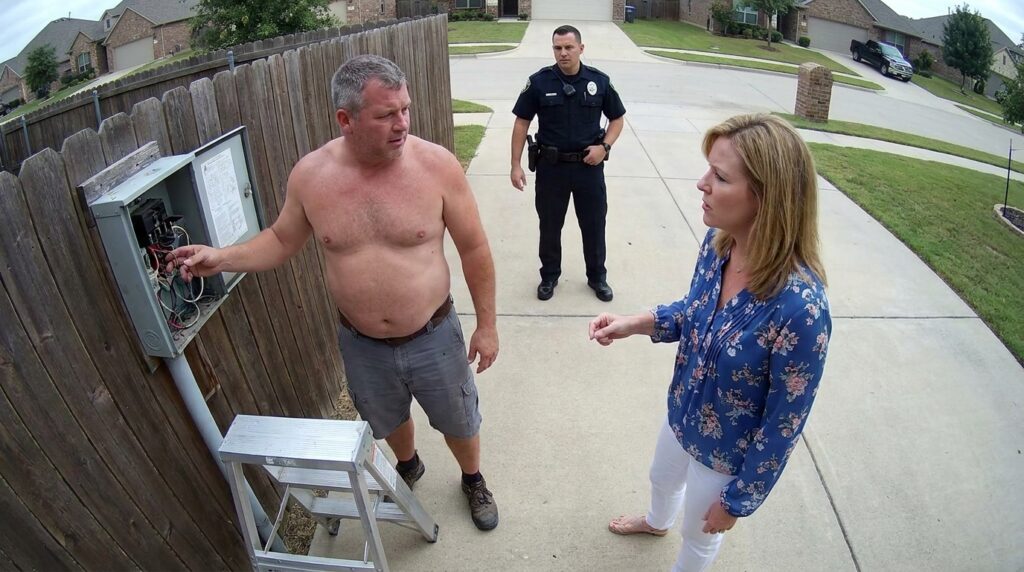
“He doesn’t have a say in this, Tommy,” Elena Vance said, stepping off the manicured flagstones of her walkway. Her white pants were pristine, a sharp, artificial contrast against the parched yellow turf of the easement strip. She adjusted her oversized sunglasses, her fingers twitching near the screen of her phone. “The utility company gave verbal clearance for the bypass three days ago. It’s a matter of community safety. That box is an unsecured eyesore.”
Miller didn’t turn his head to look at her. He kept his eyes locked on the contractor’s white knuckles. He could feel the dry grit of concrete dust on his own shirtless chest, his skin hot and tightening from four hours of replacing his own rotted porch joists. His gray shorts were stained with timber oil. In his right hand, he held his phone, the screen dark but the glass slick against his palm.
“There is no verbal clearance for a main trunk line,” Miller said to the worker. “You snip that feed, and you’re disabling code-enforced emergency infrastructure for three houses on this junction. I didn’t see a municipal permit pulled on the county registry this morning.”
The worker looked at the opened panel, where three different color-coded cables had already been pulled from their plastic retention clips. A small brass locking tag—the kind the county water and power authority used to seal commercial access ports—hung from the lower hinge, severed cleanly by a bolt cutter. It was a fresh break; the exposed metal at the fracture point was still bright and unoxidized.
“She told me it was a private auxiliary line for the retaining wall,” the worker muttered, his boots shifting on the fiberglass rung. The ladder creaked against the fence post, the sound of dry wood yielding to heavy weight.
“It’s a common-use easement,” Elena snapped, her voice rising an octave as she crossed the invisible line where the green sod met Miller’s unwatered dirt. She held a heavy leather folder under her left arm, the gold initials on the corner catching the glare. “And your porch project is two feet over the structural allowance anyway, Miller. I’ve already filed the formal code complaint. If you don’t let him complete the stabilization, I’m calling the county enforcement unit directly.”
Miller took a slow breath through his nose, smelling the hot copper of the exposed box and the distinct, bitter scent of crushed wild mint under Elena’s leather flats. He reached down into his pocket, his fingers brushing against a cold, metallic object—a spare iron survey stake he’d unearthed near his foundation an hour ago. There was a discrepancy in the ground here, one that went deeper than a handful of diverted wires.
“Go ahead,” Miller said, stepping back three inches to clear the worker’s descent path. “Make the call.”

CHAPTER 2: THE FORGED VARIANCE
The mechanical chime of a phone connecting to an outgoing line cut through the heavy, stagnant afternoon air. Elena didn’t wait for the ring. She held the speaker close to her chin, her knuckles white against the screen, her eyes fixed on the open metal box where the colorful copper nerves of Lot 42 remained exposed.
“Yes, county dispatch,” Elena said, her voice dropping into a rapid, practiced cadence that sounded rehearsed. “I need an officer at 1412 Sycamore Lane immediately. I have an unshirted, aggressive individual trespassing on my utility easement. He’s actively obstructing a contracted technician and creating a hostile environment.”
Miller didn’t move. He stood on the dry turf, the coarse, sun-baked blades scraping against the edges of his work boots. He watched her. In his chest, the heavy, rhythmic thud of his pulse remained steady, calibrated by twenty years of structural demolition and land assessment. He knew the parameters of this grid. He knew every square inch of the concrete footprint beneath his feet.
“He’s acting erratically,” Elena continued into the microphone, her heels grinding into the boundary line, turning the yellowed grass into dust. “The technician is up on a ladder and feels unsafe descending. Please hurry.”
She ended the call with a sharp tap of her thumb. The silence that followed was dense, thick with the smell of hot asphalt and the faint, bitter scent of ozone leaking from the unsealed terminal block. The worker on the fiberglass ladder lowered his side-cutters, his arms trembling slightly from the strain of holding the position. He looked down at Miller, then at Elena, his tool belt clinking like small chains as he shifted his weight.
“Look, lady,” the worker muttered, his voice cracking through the humidity. “If there’s a dispute about the plat lines, I need to see the physical verification. My boss doesn’t clear us for civil interference.”
“The verification is right here,” Elena said sharply. She unclasped the heavy leather folder beneath her arm. The brass zipper gave a dry, scratchy rasp as she pulled it back. From the interior pocket, she extracted a single sheet of blue-tinted security paper. The edges were clean, crisp, entirely unweathered by the dust of a real job site. “This is an official municipal utility variance, signed by the district zoning board chair last Tuesday. It grants direct easement authorization to reroute the auxiliary feeds for the common boundary.”
She held it out, not to Miller, but toward the worker on the ladder, using the paper like a shield to re-establish her perimeter.
Miller took two steps forward. The movement was deliberate, his work boots sinking slightly into the soft, uncompacted dirt near the fence line where Elena’s landscape crew had dumped topsoil two months ago. He didn’t reach for the paper. Instead, his gaze caught the lower right corner of the document—the embossed seal of the county clerk. The gold foil was flat, lacking the distinct physical indentation left by a heavy mechanical press. It looked like a high-density laser print, an imitation designed to satisfy a casual glance from fifty feet away.
“Let me see that,” Miller said, his voice dropping an octave, carrying the dry, rasping weight of a man who spent his days checking concrete batch tickets.
Elena pulled the folder back against her chest, her sunglasses sliding slightly down the bridge of her nose. “You don’t have the authority to audit municipal filings, Miller. The county handles the records. You can argue with the deputy when he arrives.”
“That signature block at the bottom,” Miller said, his eyes narrowing as he traced the ink lines from three feet away. “Old man Garrison retired from the zoning board in January. His nephew took over the seat before the spring thaw. Why is Garrison’s name on a document dated last Tuesday?”
A subtle, micro-second freeze passed through Elena’s shoulders. Her fingers tightened around the leather binding, the material groaning under the sudden pressure of her grip. She didn’t look down at the blue paper. Instead, she stepped back across the line, her heels finding the firm, irrigated concrete of her own walkway.
“It’s an administrative continuation,” she said, though the speed of her delivery had faltered, the rhythm breaking into jagged, defensive syllables. “The paperwork was filed during his tenure. It’s completely binding.”
“The water authority doesn’t hold utility variances for seven months without entering them into the digital portal,” Miller said. He reached into his pocket, his thumb catching the edge of his phone. “I checked the subdivision index before I started my porch. Every active variance on Sycamore Lane has a twelve-digit tracking barcode on the margin. Yours doesn’t have the stamp.”
The contractor on the ladder looked between them, his face darkening as the implications settled. He slowly unhooked his safety lanyard from the fence rail, his tools clattering against his thighs as he prepared to step down. “If this isn’t an approved county ticket, I’m pulling my gear. I’m not getting cited for illegal infrastructure tampering because you two have a backyard war.”
“Stay on that ladder, Tommy,” Elena commanded, her voice turning brittle. “The police are already en route. We will settle the legal definition of this property right here.”
Far down the block, past the uniform rows of split-level ranches and identical mailboxes, the faint, rising wail of a siren began to bleed through the heavy summer air. Miller didn’t look toward the sound. He looked down at the earth beneath the ladder, where the yellowed turf met the gray wood of his fence. There was a secret buried under that parched soil, something far more permanent than a forged signature on a blue slip of paper, and the siren meant the clock had just started ticking.
CHAPTER 3: THE ARRIVAL ZONE
The crown of the asphalt curb didn’t just meet the tires; it deflected them with a harsh, metallic scrape as the white-and-black Interceptor settled into the gravel edge of Miller’s driveway. The lightbar didn’t wail anymore, but the strobes kept pulsing—sharp, rhythmic cuts of red and blue that turned the blistering heat haze into a fragmented lens.
The door pane groaned as the deputy threw his weight against it. Officer Harris was a solid man whose uniform shirt was already dark with sweat beneath the rigid ballistic panels of his vest. His leather utility belt gave a rhythmic, heavy creak—handcuffs against chemical spray, the heavy polymer frame of his sidearm clicking against its retention holster—as he stepped onto the parched grass. He didn’t look at Elena first. He looked at Miller’s bare torso, then down at the grease-stained shorts, his boots tracking straight down the visual line of the confrontation.
“Step away from the box and calm down now,” Harris said, his voice flat, carry-over gravel from a long shift on the interstate grid. He didn’t drop his hand to his belt, but his forearm rested naturally across the high-ride holster, his fingers curved into a loose, ready anchor.
Miller took one slow step back, his boots finding the harder, sun-cracked dirt of his own property line. He kept his palms open, fingers spaced widely apart, pointing toward the ground. He didn’t speak. He knew the protocol of an opening intervention; the first person to yell was usually the one the county paperwork classified as the primary disruptor.
“Officer, thank goodness,” Elena said, her flat shoes clicking with sudden velocity against the concrete walk as she moved behind the deputy’s right shoulder, establishing the classic alignment of the reporting party. Her hand was up, pointing past Harris’s badge straight at Miller’s chest. “He’s been shouting at my contractor, threatening him while he’s on the ladder, and attempting to physically block access to the neighborhood infrastructure. I have the municipal clearance right here, and he refuses to comply with the district code.”
Harris didn’t take the blue security paper she thrust toward his face. He kept his eyes on Miller, his head tilted slightly to account for the glare coming off the Interceptor’s hood. “Sir, is this your lot?”
“It is,” Miller said. His voice was steady, filtered through dry throat and the smell of exhaust fumes cooking on the hot grass. “Lot 42. The fence is mine. The utility panel is mounted to my structural posts.”
“He’s lying about the easement boundaries,” Elena cut in, her blue floral top rustling as she shifted her stance, trying to look around the officer’s shoulder to maintain eye contact with Miller. “The entire drainage and auxiliary lane belongs to the development association’s common grid. We are simply rerouting a secondary line to ensure the lower retaining wall doesn’t saturate during the fall rains. He’s deliberately delaying code-enforced maintenance.”
The worker on the ladder had finally cleared the bottom rung. He dropped his side-cutters into a canvas pouch with a dull, heavy clink, his eyes tracking the deputy’s movements with professional caution. He reached for a blue rag in his back pocket, wiping his palms down without looking up. “I’m just the hand here, Officer. She called the shop, gave us the ticket number, and said the homeowner was cleared. I don’t have a dog in the dirt line.”
Harris adjusted his duty belt with a quick, upward bump of his hips. He turned his head three inches toward Elena, his sunglasses reflecting her white pants and the blue folder clutched against her side. “Ma’am, did you state on the recorded line that there was an active physical threat?”
“He told my man to drop the tools or there’d be an infrastructure violation,” Elena said, her chin rising as she adjusted her posture, performing an entitlement that had worked in three different HOA disputes across the subdivision this season. “In this county, intentional interference with a contracted utility technician constitutes a Class B misdemeanor under the public safety code. I know the ordinance.”
Miller watched the deputy’s eyes behind the tinted lenses. Harris wasn’t looking at the blue paper yet; he was looking at the severed brass locking tag hanging from the lower hinge of the electrical box. The metal was too clean, the scrape marks on the green powder-coated steel too fresh.
“You pull a tool to get into that box?” Harris asked the worker.
“The lady gave me the key code,” the contractor muttered, his face turning an uneasy shade of mottled red under his dusty ball cap. “Or… she said the latch was already cleared by the inspector. I just used the wedge to lift the seal.”
“There is no inspector code for a manual bolt cut,” Miller said to the officer. He didn’t raise his arm; he simply tilted his phone forward, the screen waking up to display a black-and-white grid of the county plat index. “Officer, I suggest you take a look at the timestamped registry before we discuss who’s interfering with public infrastructure. Because what’s inside that leather folder isn’t an administrative continuation. It’s an outdated form with a deceased board member’s signature block.”
Elena’s hand twitched, her fingers slipping across the smooth grain of the leather binder. The low-frequency rattle of the cruiser’s loose catalytic converter vibrated through the parched soil, a steady, irritating hum that seemed to tighten the air between them. Harris shifted his weight, his boots crunching on the loose stone as he reached out his left hand toward Elena’s folder.
“Let me see the blue slip, ma’am,” Harris said, his tone dropping the initial urgency, settling into the heavy, procedural drag of a man who realized he had been dragged into a civil boundary trap on a ninety-five-degree afternoon. “Let’s see what the county actually signed off on.”
CHAPTER 4: THE STRATEGIC RETREAT
Miller’s thumb left a dark smudge across the tempered glass of his screen as he swiped down, initializing the localized playback loop from the overhead optical housing beneath his garage eave. The digital timeline buffered for half a second, the progress bar a thin, gray vein ticking under the harsh midday sun.
“Alright, I’m stepping back,” Miller said, his boots grinding into the parched dirt as he cleared a five-foot radius around Officer Harris’s utility belt. His hands stayed extended at hip height, fingers wide, empty, and dry.
Elena pulled her leather folder tighter against her blue floral top, the stiff grain of the material letting out a faint creak against her ribs. She took a step toward Harris, her white pants coming within inches of the unsealed box. “Officer, he’s trying to stall. The contractor needs to finish that junction re-route before the county inspectors close the Friday log. If Miller continues to obstruct this project, I intend to press full civil damages for construction delay.”
Harris didn’t take the folder. He kept his attention locked on Miller’s wide, open palms, then glanced down at the black-and-white grid lines of the plat survey currently glowing on the smartphone screen. The deputy’s jaw worked slowly, chewing through the silence and the sharp, chemical odor of raw engine exhaust from the idling patrol car behind them.
“Sir,” Harris said, his hand dropping away from the polymer grip of his sidearm but remaining anchored near his pocket. “What am I looking at on this screen?”
“This is the cloud ledger for Lot 42, logged into the county geographic information system four hours ago,” Miller said. He held the screen steady, despite the glare bouncing off the hood of the black Interceptor. “Look at the four-frame sequence from 0900 this morning. That’s five hours before your dispatch logged the call.”
The contractor shifted his weight from boot to boot, the tools in his heavy leather belt clinking like structural chains against his thighs. He peered over Harris’s shoulder, his sun-chapped face wrinkling as he squinted into the high-intensity display. “Hey… that’s my truck.”
On the screen, a crisp, 1080p stream showed the gray wooden fence line in real time, then skipped backward to the morning hours. The video played. Elena Vance was clearly visible standing at the base of the fence rail, her arm extended as she handed a folded blue slip of security paper to a different man—the contractor’s field foreman. The audio track on the omnidirectional microphone gave a sharp, metallic pop before her voice came through Miller’s speaker, clear despite the distance.
“The homeowner isn’t here on weekends,” the recorded version of Elena said, her digital image pointing directly at the brass security lock on the utility hub. “Just cut the seal. The board cleared the administrative continuation. We need the auxiliary feed tied into my line before he finishes his porch inspection.”
The actual Elena on the driveway froze. Her sunglasses slipped down the bridge of her nose as her fingers slipped across the brass corners of her binder. The speed of her breath tripped, her chest rising sharply under the bright pattern of her blouse.
“That’s a private recording,” she said, her voice thinning into a brittle, defensive register. “Officer, he has cameras oriented toward my active property line. That’s a direct violation of neighborhood privacy covenants. That footage is completely inadmissible.”
“It’s oriented downward at my own utility panel, Elena,” Miller said, his voice flat, matching the unyielding heat rising off the sandstone dust beneath his boots. “And it shows you instructing a commercial crew to cut a county-administered security tag on a main trunk feed. That’s a federal utility infraction, not an HOA dispute.”
Harris leaned in closer, his dark uniform shirt absorbing the ambient glare as his eyes followed the timestamp on the screen. The footage continued to loop, showing the contractor’s worker pulling the first blue wire from the internal bus bar. Then Harris’s gaze dropped down to the paper Elena was still attempting to press against his midsection.
The blue slip lacked the distinctive, three-dimensional indentation of a heavy mechanical press. Under the direct, unshaded sunlight, the gold seal at the bottom didn’t catch the light like metallic foil; it diffuse-reflected like high-density toner from an office printer. The ink on old man Garrison’s signature block had a faint, glossy sheen—the mark of a low-grade thermal transfer copy, not a live-ink signature from a municipal desk.
“Ma’am,” Harris said, his tone dropping into the cold, flat register of an officer who realized he had been dispatched under a fraudulent emergency flag. He didn’t take the folder. Instead, he unclipped a heavy steel flashlight from his utility belt, using the blunt metallic end to point toward the bottom of the blue sheet. “This signature block belongs to an officer who hasn’t been active since the winter cycle. Why did you tell dispatch this man was threatening you when you were actively directing an unpermitted bypass on his fence line?”
“The variance was approved,” Elena stammered, her heels clicking backward on the walkway as she tried to change her alignment, her white pants catching a smear of dark grease from the ladder frame. “It’s an administrative adjustment. The development has an easement privilege for utility maintenance.”
“The easement privilege requires a twelve-digit validation code entered into the public portal forty-eight hours before ground is broken,” Miller said, taking a slow step forward, his boots crossing back over the dry turf. “And your crew didn’t just open the box. Look at what your guy dug up right under the ladder rail before the officer got here.”
Miller pointed with the edge of his boot toward a fresh, shallow trench where the contractor’s shovel had peeled back three inches of dry sod. Nestled in the sandstone dust, where the gray wood of the fence post entered the earth, was a glint of dark, gray powder-coated wire shielding—and right next to it, a jagged piece of rusted iron that had been completely severed by a motorized trenching blade.
Harris frowned, stepping into the interaction lane between Miller and Elena. He knelt down, his utility belt clattering against his thighs as he adjusted his sunglasses to peer into the narrow gap in the turf. His hand went to his pocket, pulling out a pair of disposable nitrile gloves with a dry, latex snap.
“What did you hit down there?” Harris asked the contractor.
The worker looked at his boots, his hands dropping to his sides. “I told her we hit something solid when we were leveling the turf for the drainage pipe. She told me it was just an old irrigation pipe and to cut right through it.”
Miller watched the deputy’s fingers trace the edge of the severed iron object. It wasn’t an irrigation line. It was thick, solid, and square-headed—the top of an original county surveyor’s monument pin that had been driven into the subsoil thirty years ago when the development grid was first laid out. The metal was dark with rust, but the fresh cut from the blade was bright, silver, and unforgiving.
“Officer,” Miller said, his gaze shifting from the buried pin straight to Elena’s pale face. “That pin doesn’t mark the edge of her lot. That pin marks the original boundary of my parcel from 1996. And her entire retaining wall is sitting three feet on my side of the line.”
CHAPTER 5: THE UNCOVERED GEOMETRY
“Clear the grass,” Harris said. The flat, unyielding snap of his nitrile gloves broke the heavy drone of the afternoon heat. He didn’t look up at Elena. His focus remained pinned to the narrow, jagged trench where the motorized spade had chewed through thirty years of compacted subsoil.
Miller knelt down on the sun-baked dirt, his bare knees sinking into the dry sandstone grit at the margin of his driveway. He didn’t look for a trowel. Using his bare fingers, he scraped back the remaining loose earth from the iron cylinder. The metal was coarse, scaled with thick, dark layers of rust that flaked off under his fingernails like dried scabs. It was cold despite the blistering air, a heavy plug of solid municipal iron driven straight through the shale layer beneath the development grid.
“Ma’am, step back onto your flagstones,” Harris instructed, his arm extending without his eyes leaving the iron head. His fingers gestured toward the line, establishing a definitive five-foot buffer zone between Elena’s white trousers and the newly exposed landmark.
Elena didn’t move immediately. Her leather folder slipped lower under her arm, the gold initials slanting as her shoulder dropped. Her sunglasses had slid past the bridge of her nose, exposing wide, bloodshot eyes that shifted rapidly from Harris’s badge to the digital plat map still glowing on Miller’s phone. “Officer, that’s an outdated marker. The neighborhood infrastructure was legally re-platted when the eastern retaining wall was completed in 2012. The association board holds the master variance.”
“The board doesn’t override the county surveyor’s primary datum,” Miller said, his voice flat, dry with the dust of the hole. He used the blunt edge of the spare iron stake from his pocket to scrape across the flattened crown of the buried pin. The flaking scale came away, revealing a small, cross-hatched indentation at the absolute center of the iron core. Beside the cross, three numbers were stamped deep into the metal: 4-2-A.
Harris squinted down, pulling a small silver scribe from his uniform pocket to clear the remaining dirt from the alphanumeric stamp. His jaw tightened as the numbers became readable under the high glare of the sun. He reached for his radio microphone, his thumb hitting the side switch with a dull, static click.
“Dispatch, this is Delta-Four,” Harris said, his chest expanding against the rigid fabric of his ballistic vest. “Run a verification on a physical monument datum at 1412 Sycamore Lane. Code is Four-Two-Alpha. Confirm the primary north-west iron pin location for Lot 42.”
The radio spit back a sequence of rapid digital chirps before a flat, synthesized voice broke the channel. “Delta-Four, registry shows Four-Two-Alpha is the permanent boundary anchor for Lot 42, registered 1996. Landmark is protected under code section sixty-two. Any unpermitted alteration or structural concealment is an actionable class-one infraction.”
The contractor took three deliberate steps away from his step ladder, his work belt clattering against his thighs with a heavy, final sound. He pulled his ball cap off his head, using his sleeve to wipe a line of dark grease from his forehead. “That’s it. I’m out. Tommy, grab the load straps. We’re striking the rig.”
“You haven’t finished the tie-in,” Elena said, her voice rising into an unnatural, sharp whistle as she turned on the worker. Her fingers clutched the blue paper so tightly the gold-printed seal began to wrinkle and split across the margin. “You have a signed, legally binding contract with my landscaping firm. If you walk off this site before the bypass is secured, I’ll have your structural license audited before the weekend closes.”
“The contract is null if you ordered me to cut across a protected county datum on a false ticket, lady,” the contractor spit back. He reached down, grabbing the handle of his motorized trencher with both hands, his knuckles white against the black rubber grips. “You told me the fence line was the boundary. You didn’t say the fence was sitting three feet inside this man’s legal parcel.”
Harris stood up slowly, his duty belt shifting with a heavy, mechanical creak as he adjusted his posture to face Elena directly. The procedural drag was completely gone from his tone now, replaced by the cold, precise weight of a county deputy executing an on-site correction.
“Ma’am,” Harris said, pointing the tip of his silver scribe toward the blue slip of paper in her hand. “The document you presented to me features an obsolete seal and a signature block from a official who has been out of office for seven months. Furthermore, the physical evidence at this worksite confirms that your backyard retaining wall and the secondary drainage line are currently encroaching three feet onto Lot 42.”
Elena’s mouth opened, then clicked shut without a sound. The white pants she had worn like a shield of administrative authority were now dusted with gray sandstone grit from the contractor’s tires. She looked toward the street, where two neighboring porch-watchers had stepped past their mailboxes, their phones raised to capture the red-and-blue strobes pulsing against her front windows.
“This is an internal neighborhood adjustment,” she whispered, her confidence completely collapsing into the small space between her heels and the concrete walk. “It’s a matter of aesthetics. The box is an eyesore.”
“The box is on his deeded property,” Harris said. He reached toward his utility belt, unclipping a heavy, bound citation book from behind his holster. The sound of the stiff cardboard backing hitting the metal steering ring of his clipboard was loud in the stagnant air. “And you used a fraudulent emergency call to bring an active unit to this location while your crew was destroying a protected land marker. Stand right there.”
Miller didn’t stand up immediately. He remained on one knee beside the iron pin, his hand resting on the cold, rusted cap of the boundary line. He could hear the sound of the contractor’s ladder being dropped into the bed of the truck with a sharp, echoing bang, but his eyes were fixed on the deep, structural crack that had begun to split the edge of Elena’s flagstone walk where it crossed his land. The geometry was fixed, the line was clear, and the true cost of the overreach was finally about to be tallied.
CHAPTER 6: THE FINAL LINE
The sharp, metallic snap of Officer Harris’s clipboard frame echoed down the driveway asphalt like a small caliber round. He didn’t look at the neighbors who had migrated from their porches to the curb edge, their phone lenses glinting like tiny glass beads under the harsh afternoon glare.
With a slow, deliberate stroke of his ballpoint pen, the deputy tore the top carbon copy from his pad. The paper was thin, gray-tinted, and its perforated edge rasped dryly against the aluminum backing board. He held it out into the hot space between his uniform vest and Elena Vance’s limp hand.
“This is a formal citation for unlawful interference with a public safety emergency line under code section forty-four,” Harris said, his voice flat, dropped entirely into a low, procedural drone that brooked no debate. “Along with a secondary summons for civil trespass and intentional damage to a designated municipal landmark. The court date is stamped at the margin. Sign the lower ledger block.”
Elena didn’t look at the paper. Her sunglasses had slipped completely down her nose, catching on her lip before she pushed them back with a hand that rattled against the leather grain of her folder. The blue sheet with the fake gold toner seal was folded double now, stuffed into the pocket of her white trousers like an old grocery receipt.
“Officer,” she whispered, her chin dropping toward her collarbone as the bright pattern of her floral top seemed to lose its artificial color in the raw heat. “This is an administrative misunderstanding. The landscaping company was supposed to confirm the easement offsets before the trenching unit arrived. I didn’t direct the blade.”
“You handed the operator the blue form, ma’am,” Harris said, his fingers clicking the pen into its pocket with a final, mechanical snap. “The camera stream we verified matches the log. Your name is on the service ticket. If you refuse to sign the notification block, I’ll be required to take custody of your person for non-compliant transport.”
Behind Harris, the contractor’s heavy diesel engine turned over with a deep, shuddering roar. The truck bed vibrated, sending a cloud of blue oil smoke across the yellowed grass of the boundary line as the worker slammed the tailgate shut. The safety chains clinked against the bumper—dull, heavy thuds of iron on steel—as the vehicle began to back out of the driveway, its tires crunching heavily over the loose stone shoulder. The worker didn’t look back at the fence line; his team was already pulling their administrative file from the company ledger to avoid a county-level license suspension.
Miller stood up from the turf, his bare chest damp with grease-streaked sweat, his fingers caked with the dark rust scaling from the surveyor’s iron monument pin. He didn’t follow the deputy to the curb. He walked back to his porch ladder, where his original pile of pressure-treated lumber lay stacked across the joist frames. The wood smelled of clean cedar and zinc oxide under the blinding sun.
“Miller,” Elena said, her voice jagged enough to make the neighbors lower their devices by a fraction of an inch as she took two paces back toward the lot line. Her fingers clutched the corner of her stone walk where the concrete was already buckling under the pressure of her wall. “The entire eastern segment of the subdivision wall is built on this alignment. If you enforce the three-foot setback, the structural integrity of the upper tier collapses. It will ruin the property value for the entire block.”
Miller picked up his old framing hammer from the top plate of the porch joist. The steel head was cold, scratched with gray zinc lines from a hundred driven spikes. He turned it over in his hand, feeling the balance of the hickory handle against his calloused palm. He looked down at the iron cylinder still exposed in the shallow trench—the unyielding, forty-pound anchor of 4-2-A that had been driven through the shale before any of these houses had names.
“You can call whoever you want, Elena,” Miller said, his voice flat enough to match the unforgiving grid of the plat map. “But you can’t rewrite the county surveyor’s pins. If the wall collapses, I suggest you call the masonry firm that put it on my dirt.”
Harris walked back toward his Interceptor, his heavy leather duty belt giving one last, drawn-out creak before he opened the driver’s door. The strobes were still cutting red-and-blue slivers through the white heat haze on the street, but the siren stayed dead. He looked at Miller once over the roof of the cruiser, gave a single, brief nod of professional acknowledgment, and slid behind the glass.
The neighborhood crowd began to break apart, their heels scraping quietly on the dry asphalt as they drifted back toward their own air-conditioned living rooms. The show was over, the parameters were locked, and the true geometry of the lot was settled. Miller adjusted his grip on the hammer, stepped onto the first rung of his own ladder, and drove the first structural nail straight into the clean timber of his porch.







