
The Absolute Gravity of a Uniform Broken by the Cold Weight of Real Authority
CHAPTER 1: THE THRESHOLD OF IMPACT
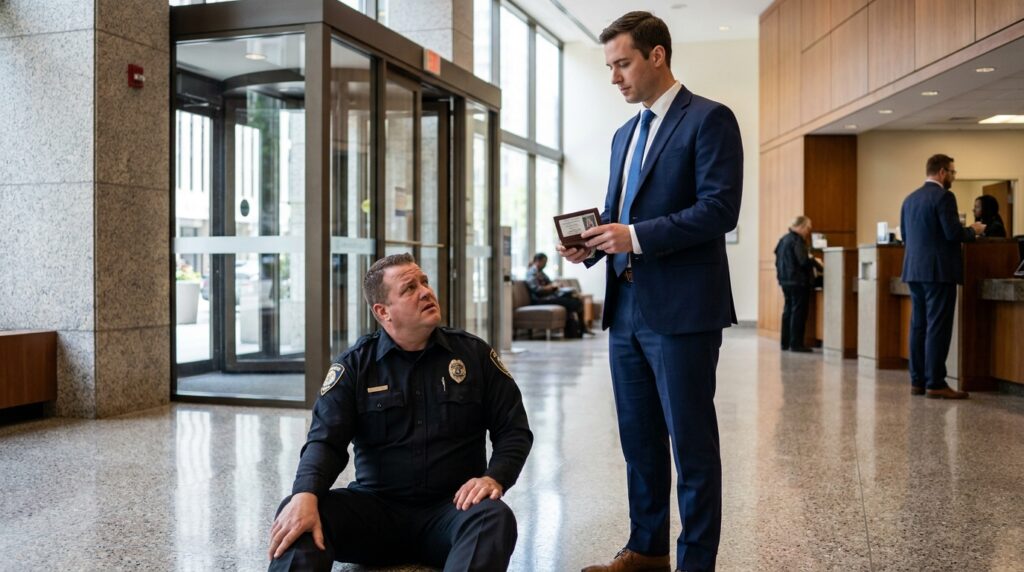
The leather-bound credential wallet sat exactly three inches inside the left breast pocket of John Vance’s navy suit jacket, resting against the slow, unhurried rhythm of his ribcage. The grand lobby of the private bank smelled of expensive climate control, floor wax, and the faint, ozone tang of high-volume server stacks humming behind brushed steel panels. To his right, three corporate clients paused near a teller window, their voices muffled by the sheer height of the sound-dampening glass. Everything about the space was designed to project absolute security, yet Vance only noticed the structural flaws: the wide turning radius required by the security stanchions, the blind spot beneath the mezzanine balcony, and the heavy, forward-leaning gait of the stocky security guard crossing the polished white marble toward him.
“Sir, stop right there, I need to verify your identification first,” the guard barked. The man’s voice was too loud for the acoustics of the room, intentionally pitched to draw the eyes of the staff. He was mid-40s, his dark hair cropped close enough to show a pale scalp, his palms slick against the stiff nylon of his duty belt. He didn’t look at Vance’s eyes; he looked at the lack of a corporate badge on the lapel of the suit. He saw a visitor who hadn’t asked for permission.
Vance stopped. His boots remained flat against the stone, his weight centered, his hands dropping naturally to his sides where the silver military signet ring caught a sharp glint of neon from the overhead fixtures. He did not pull his hands away or raise them in defense. He simply watched the guard’s right shoulder drop—the classic tell of a civilian about to use physical leverage to compensate for a lack of real tactical position.
“I am here on an official recovery matter,” Vance said. His voice was low, flat, and stripped of the defensive inflection people usually offered to an angry uniform.
The guard didn’t listen. The need to maintain control before an affluent audience overrode the man’s professional training. He closed the remaining two feet of distance, his thick fingers flaring as he lunged forward, reaching aggressively for Vance’s lapel to shove him back toward the glass entry doors.
The contact lasted less than half a second. Vance didn’t strike. He didn’t drop his shoulder into a tackle. As the guard’s hand closed on the navy fabric, Vance caught the man’s right wrist with his left hand, compressing the nerve cluster below the thumb while stepping back at a precise forty-five-degree angle. It was a single, fluid redirect of mass and momentum. The guard’s own forward rush carried him past his center of gravity, his boots slipping on the highly polished marble. With a brief, controlled twist of the wrist, Vance guided the stocky frame downward, letting the physics of the fall do the work.
The impact was a hollow, heavy thud that shook the stanchions. The guard landed flat on his back, his heavy plastic holster clattering against the stone, his breath escaping in a sharp, involuntary gasp.
The entire lobby went dead silent. The teller with the deposit slips froze. The corporate clients backed away by two deliberate steps, their phones remaining low but their eyes locked on the floor.
Vance remained standing. His suit jacket hadn’t even unbuttoned. He reached into his left breast pocket, slid his fingers around the cold leather of his credential wallet, and brought it out in a single, unhurried motion. He opened it, holding it chest-high, letting the heavy gold federal investigator shield and the distinct red-bordered military clearance cards lock into the fallen guard’s line of sight.
The guard’s eyes widened, the flushed red of anger draining from his face within three shallow breaths. He stared at the gold seal, then up at the gray, unblinking focus in Vance’s eyes. The hand that had just reached out to assault a visitor began to tremble against the cold marble floor.
“I’m sorry,” the guard whispered, his voice cracking under the weight of the room’s absolute silence. “I… I made the wrong call.”
Vance did not offer a hand to help him up. He kept the badge steady, his gaze shifting past the broken authority on the floor toward the heavy mahogany doors of the executive suite, where the handle was just beginning to turn.

CHAPTER 2: THE RECOLLECTION OF WEIGHT
The heavy mahogany door of the executive suite didn’t just swing open; it unsealed with a precise, clinical hiss of rubber gaskets separating from high-tensile brass frames. A man in his late fifties stepped into the threshold, his silver hair neatly parted to match the sharp crease of his charcoal pinstripe trousers. This was Arthur Pendelton, the branch director. His hands were clean, the nails buffed to a translucent sheen, but his right index finger was twitching against the seam of his pocket—a micro-movement Vance registered before the man even cleared the shadow of the doorframe. Pendelton looked down at the security guard still gathering his breath on the cold stone, then up at the gold federal investigator shield held steady in Vance’s left hand.
“There is no need for further demonstrations, Investigator,” Pendelton said. His tone was smooth, polished by decades of calming high-net-worth clients, yet it lacked the natural resonance of an innocent man. It was the calculated pitch of an executive managing a structural collapse. “The bank fully respects the boundaries of a federal warrant. Please, step into the office. Let us remove this unfortunate misunderstanding from the public floor.”
“The misunderstanding is already resolved,” Vance replied, his voice flat, retaining the cold, even cadence of a man who measured environments by their tactical exits. He slid the credential wallet back into his suit jacket, his silver signet ring catching the low-voltage track lighting above the door. “What remains is the execution of the order. I require the physical ledger files for the logistics accounts under the 2024 tactical vehicle procurement block.”
Pendelton’s eyes didn’t widen, but the skin around his jaw tightened by a fraction of a millimeter. “Of course. The vault records are kept in accordance with federal compliance. If you will follow me.”
Vance stepped over the threshold, his leather soles making no sound against the thick, low-pile wool rug that replaced the marble floor inside the executive corridor. The transition from the public lobby to the private suite shifted the sensory profile of the building. The air here was thicker, carrying the scent of old paper, leather oil, and the dry, metallic heat of computer cooling fans running at capacity. The walls were lined with dark wood paneling, its sharp, geometric edges casting deep shadows under the recessed spotlights.
As they walked down the narrow hall toward the secure elevator, Vance adjusted his spacing. He remained exactly one pace behind Pendelton’s right shoulder—close enough to intercept a sudden movement, distant enough to maintain a clear line of sight on the director’s hands.
“We pride ourselves on our discretion, Mr. Vance,” Pendelton murmured, not turning his head. “When the Department of Defense routes funds through our private ledger system, we treat those accounts with the same sanctity as our sovereign wealth portfolios. Mistakes by our floor security are… rare. The guard was merely on edge due to recent network anomalies.”
“A security guard doesn’t lunge at a federal badge because of a network anomaly,” Vance said, his eyes tracking a brass override key left dangling in the secondary lock of a maintenance panel they passed. The key was stamped with a non-standard military parts number—a six-digit identifier that shouldn’t exist inside a commercial financial institution. The anomaly wasn’t digital; it was physical. “He lunged because he was told to look for someone who didn’t belong to the corporate register. Someone looking into the procurement trail.”
Pendelton paused at the elevator gate, pressing a thumb against the biometric scanner. The glass plate flashed green, and the heavy bronze doors slid apart with a low, mechanical groan. “You are an investigator of finance, sir. I advise you to stick to the arithmetic. The architecture of security is a delicate machine.”
“Arithmetic is just a sequence of actions with names attached,” Vance said as they stepped into the elevator cabin. The space was small, paneled in mirrored chrome that reflected the sharp lines of Vance’s navy suit against Pendelton’s stiff charcoal silhouette. “And right now, three billion dollars in hardware signatures have disappeared between the staging yard in Norfolk and this branch. That isn’t a delicate machine. That’s a breach.”
The elevator descended into the sub-basement with a heavy, hydraulic drop that Vance felt in the small of his back. When the doors opened, the temperature fell by five degrees. The air smelled of concrete dust and oxidized iron. This was the vault level—a fortress of reinforced concrete blocks held together by steel reinforcing bars three inches thick.
Pendelton led the way toward a massive circular vault door, its gear-driven locking bolts polished until they looked like silver teeth. A junior compliance officer was already waiting by the control desk, her fingers hovering over a terminal keyboard, her face pale under the harsh fluorescent tubes.
“The investigator has a valid warrant for the logistics ledger,” Pendelton told the clerk, his voice regaining its smooth, authoritative weight. “Load the local archive for the 2024 procurement blocks. Only the physical verification logs.”
Vance didn’t look at the screen. He looked at the base of the terminal. A small, black encryption drive was plugged into the secondary diagnostic port, its tiny blue LED light blinking in a rapid, erratic rhythm that indicated a massive data transfer was currently underway. The drive’s housing bore the same six-digit military part stamp as the key upstairs.
Vance reached out, his hand moving with the same silent, fluid precision he had used against the guard on the floor, and clamped his fingers around the plastic drive before the compliance officer could cover it with her hand.
“Leave it,” Vance said, his voice dropping into a register that made the clerk instantly pull her fingers away from the terminal. He didn’t pull the drive out yet; he held it in place, his thumb resting against its warm plastic casing, his eyes locked on Pendelton’s suddenly frozen profile. “Let’s see what the arithmetic looks like before your server finishes cleaning itself.”
CHAPTER 3: THE LOCKED ARCHIVE
The small plastic drive felt uncomfortably warm against the flat of Vance’s thumb. Underneath his palm, the terminal’s cooling fan picked up speed, its high-pitched whine bouncing off the reinforced concrete walls of the sub-basement. The junior compliance officer did not pull away entirely; she remained frozen, her shoulders locked, her eyes wide as she stared at the heavy silver signet ring pressed flat against the brushed aluminum casing of her keyboard.
“The transfer is encrypted,” Arthur Pendelton said from behind Vance’s shoulder. The branch director’s voice had dropped its polished, executive layer. The smooth, rhythmic delivery he had used in the lobby was replaced by a dry, tight rasp. “It is an automated ledger synchronization. Standard end-of-day protocol for institutional liquidity. Removing it manually will trigger a local network freeze.”
“Good,” Vance said. He did not look back. His eyes remained locked on the terminal screen, where rows of hex codes were flickering in neat, vertical columns. “A freeze keeps the signatures exactly where they are. Let’s look at the destination blocks.”
Vance didn’t pull the drive out. Instead, he gripped the outer edge of the terminal casing with his right hand, using his body weight to block the clerk’s access to the hard kill-switch beneath the desk riser. His left hand moved down the row of keys with mechanical precision, inputting an override string he had memorized three winters ago in a windowless command container outside of Stuttgart. The command prompt bypassed the bank’s local graphic interface, stripping the terminal down to its raw binary roots.
The text on the monitor shifted from standard corporate branding to a stark, unformatted system log. The top-level directory didn’t bear the name of the bank or the Department of Defense logistics branch. It was marked by a single, six-digit alphanumeric string: 99-X-404.
The clerk let out a shallow, jagged breath. “I don’t have clearance for that block. The system… it wasn’t supposed to reveal those directories.”
“You don’t have clearance because the account doesn’t belong to the commercial ledger,” Vance said, his voice level, carrying the heavy, rhythmic weight of an interrogation room. “But someone has been using your terminal to authorize the terminal routing tokens. Look at the date stamps on the manual override inputs.”
Pendelton stepped forward, the sharp edge of his leather dress shoes clicking loudly against the concrete floor. He reached out toward the console, his movements frantic but calculated, his fingers aiming for the primary power terminal on the wall panel. Vance shifted his weight by three inches, his shoulder presenting a solid, immovable barrier of navy wool that intercepted the director’s path before the older man could close the distance. There was no blow, no overt show of violence—just a cold, physical calculation of space that left Pendelton standing inches from Vance’s chest, his breathing ragged.
“Investigator,” Pendelton whispered, his eyes dark under the glare of the bare fluorescent tubes. “You are overstepping the boundaries of your warrant. The accounts you are pulling to the surface are covered by non-disclosure agreements signed at the cabinet level. If you disrupt the sync, the financial liability will rest on your agency.”
“My agency is the one that signed the warrant, Arthur,” Vance said, his gray eyes turning slowly to meet the director’s gaze. “And right now, the warrant says I collect every scrap of iron that has a falsified signature on it. Look at the ledger’s manual logbook.”
Vance reached past the clerk, his hand gripping the heavy, leather-bound binder that sat in the slot beside the terminal tower. This was the physical backup—the mandatory paper anchor required by federal banking laws for vault access. He flipped the pages back to the third week of April, his thumb catching the serrated edges of the heavy cream paper.
The entries were written in a stiff, architectural hand. The name A. Pendelton was stamped beside forty-two separate transfers of heavy equipment parts from the Norfolk logistics yards. But below each stamp was a handwritten confirmation initial—a tiny, stylized double-loop that Vance recognized with a physical jolt that settled in the small of his back.
It wasn’t Pendelton’s signature. It belonged to Colonel Marcus Vance. His father. A man whose name had been stripped from the active service rosters six years ago after a transport plane went down over the North Sea with an empty cargo hold.
“Who brought this log down to the vault?” Vance asked. The words were quiet, but they cut through the hum of the server stacks like a cold blade.
The clerk looked from Vance to Pendelton, her lips parting but no sound coming out. The director’s face had gone completely gray, the pinstriped lines of his suit looking suddenly too large for his shrinking posture.
Before Pendelton could answer, the heavy steel security door behind them groaned. The main magnetic lock didn’t release with the usual pneumatic click; instead, a loud, continuous alarm tone began to pulse from the overhead speaker panels, and the primary lights flickered once before dying completely, leaving the vault submerged in the sharp, amber glow of the emergency backup cells.
The terminal screen went black. The warm plastic drive in Vance’s hand ceased its rapid blinking, its tiny blue light dying as the local grid cut power to the terminal ports.
Vance didn’t move toward the door. He stepped back into the shadow of the structural concrete pillar, his right hand dropping naturally to the lower edge of his suit jacket where his fingers could feel the cold, cross-hatched grip of his compact service weapon. He was no longer in a bank. The physical parameters of the room had changed in a single heartbeat from a corporate audit into a live trap.
“The server room,” Vance said, his voice cutting through the rising wail of the siren. “Someone just pulled the primary breaker from the inside.”
CHAPTER 4: THE BREACH IN THE CIRCUIT
The amber glow of the emergency cells bled across the concrete pillar, sharpening the edges of the iron rebar columns. The siren didn’t fade; it died with a violent electronic pop as the primary fiber trunk line behind the terminal rack was cleanly severed. Vance stood perfectly still, his back pressed into the hard, right-angle corner of the structural column, his thumb resting over the serrated safety toggle of his weapon. In the narrow gap between his shoulder and the concrete, he watched Arthur Pendelton. The director hadn’t run. He had fallen backward against the primary vault door, his charcoal trousers smudging with gray graphite grease from the exposed gear teeth, his palms flat against the cold steel plate.
“This wasn’t supposed to happen,” Pendelton muttered. His eyes were wide, tracking the dark space above the server rack where a thin, acrid ribbon of white smoke began to curl from the ventilation duct. “The protocol locks the floor. It doesn’t drop the trunk line. The compliance network is independent.”
“It was independent until someone mapped a local gateway to the maintenance panels,” Vance said. His voice was a thin, dry sliver that barely cleared the rumble of the building’s emergency air extractors. He didn’t check his phone; the shielding on this level was twelve inches of lead-lined concrete. He looked at the clerk. She was crouched under the desk riser, her hands clamped over her ears, her breath hitching in a predictable, three-second cycle of panic. “Get out from under the console. Move to the rear fire vestibule. Now.”
The clerk didn’t look at him. She looked at Pendelton, but the director was staring down the darkened corridor that led to the secure elevator. The elevator doors were locked open by three inches, a jagged gap of rusted iron where the pneumatic safety blocks had fired to jam the carriage between levels.
A sharp, metallic click echoed down the hall—the unmistakable sound of a steel-jacketed slide stripping a round from a high-capacity magazine.
Vance didn’t look down his sights yet. He calculated the geometry of the hallway. The distance from the elevator shaft to the vault threshold was exactly twenty-two feet. The walls were unpainted concrete, offering zero ballistic protection against standard tactical rounds but giving a clear, hard surface for ricochets. The floor was slick with condensation from the failing cooling pumps.
“Arthur,” Vance said, his gaze fixed on the shadow expanding past the elevator frame. “The drive I just pulled has a six-digit asset tag. That code belongs to an unlisted logistics cell inside the procurement division. My division. Who gave you the synchronization tokens?”
Pendelton’s jaw worked, his teeth clicking together once before he could lock his mouth shut. “I told you. It was handled through a blind clearinghouse. The signatures… the signatures came through the secure military router. We don’t verify the operational commands if the treasury keys match.”
“The keys matched because the initial authorizations were pulled from an active service file,” Vance said, his fingers tightening on the cross-hatched grip of his weapon as the first physical silhouette cleared the lift gate. The figure was broad, wearing a gray tactical jacket with no markings, no badges, and no face—only the dark, non-reflective nylon of a low-profile respirator mask. “They used Marcus Vance’s name because his security profile was archived but never deleted from the network root. They weren’t hiding from an audit. They were waiting for one.”
The man in the gray jacket didn’t shout a warning. He didn’t demand the return of the black drive. He raised a short-barreled automatic carbine, the cold steel muzzle tracking across the vault space with the smooth, robotic sweep of a professional clearer.
Vance fired twice through the narrow gap in the pillar.
The copper-jacketed rounds struck the concrete floor six inches ahead of the intruder’s lead boot, exploding the stone into a spray of white dust and jagged quartz chips. The man didn’t drop; he shifted his weight with a clean, low-profile pivot, his weapon barking three times in a rapid, rhythmic burst that chewed into the side of Vance’s concrete pillar. The impact sent a shockwave through the stone that vibrated directly into Vance’s shoulder blade, filling the air with the dry, chalky taste of pulverized mortar.
Vance stepped back into the deeper shadow of the vault interior, his left hand reaching down to grab Pendelton by the collar of his pinstripe suit. He dragged the director behind the primary door frame just as a second burst of fire shattered the glass casing of the vault terminal, showering the clerk’s empty chair in a storm of green-tinged crystal shards.
“They aren’t here for the ledger, Arthur,” Vance said, his breath steady, his voice dropping below the register of the gunfire as he jammed Pendelton against the cold bronze rivets of the inner lock assembly. “They’re here to close the branch. Permanent settlement.”
“The records… the physical copies are in the secure chest behind the distribution rack,” Pendelton gasped, his fingers digging into the wool of Vance’s sleeves. His corporate armor had completely failed him; he was just an old man realizing that his high-net-worth clients had turned his bank into a shooting box. “The manual logs have the routing destinations. The phantom sites. If they destroy the local server, there is no backup. The money just… disappears back into the department’s dark budget.”
Vance didn’t answer. He looked at his weapon’s chamber. Four rounds remained in the primary clip. He had two secondary magazines inside his suit jacket, but the weight of the situation wasn’t a matter of ammunition. It was an failure of context. The physical decoy—the idea that the branch manager was running a rogue siphoning ring to grease his own corporate pockets—had just been blown apart by three tactical rounds of specialized military-grade ammunition that shouldn’t exist on American soil.
The intruder wasn’t a criminal asset hired by a corrupt bank director. He was a clean-up specialist using the exact same operational protocols Vance had drafted for the division five years ago.
A soft, electronic chirp came from the tactical radio clip inside the intruder’s jacket, the frequency bleeding through the concrete walls with a high-powered repeater signal. Vance caught the automated voice prompt before the speaker could adjust his headset.
“Target identified,” the radio crackled, the tone flat and familiar. “Inquire if investigator Vance has secured the ledger before termination.”
Vance froze against the steel door. The voice on the speaker wasn’t a stranger’s. It was Director Miller. His commander. The man who had personally signed Vance’s field warrant three days ago in Washington.
CHAPTER 5: THE CORE LEDGER DELIBERATION
The flat, compressed frequency of Director Miller’s voice hung in the three-inch gap between the heavy steel vault door and Vance’s ear. It didn’t waver. It held the precise, analytical drone that had mapped out Vance’s tactical career for seven years. The gray tactical jacket twenty feet down the corridor stopped its lateral sweep, the short barrel of the carbine lowering by two degrees as the operator waited for the confirmation signal.
Vance didn’t look at Arthur Pendelton. He didn’t need to. He could hear the rapid, shallow scratching of the director’s fingernails against the exposed bronze teeth of the door mechanism. Every calculation Vance had built since entering the financial district lobby had just undergone a violent paradigm shift. The warrant wasn’t an audit. It was a tracer element. They hadn’t sent him to find the siphoned billions; they had used his name, his face, and his specific family signature history to pull the local archives out of the commercial bank’s network before the server was burned to the ground.
“Miller,” Vance said, his voice dropping below the steady, pneumatic hum of the air extractors, speaking directly into the dead air space of the corridor. He didn’t use an encryption key; he knew the high-powered repeater unit on the shooter’s collar would catch the acoustic vibration. “The sync is frozen. The local drive has forty-two direct authorizations under Marcus Vance’s personal identifier. You didn’t archive his profile six years ago. You cloned it.”
The radio speaker gave a single, dry pop. The voice that returned didn’t contain anger. It held the cold, transactional weight of an executive closing an unmonitored lane.
“The Marcus Vance file was a sovereign asset, John,” Miller’s voice crackled through the static. “A domestic clearinghouse requires a structural buffer that doesn’t terminate at a political desk. If the local ledger is in your jacket, step away from the bank director. The cleanup team has a secondary directive for the server frames.”
“The ledger stays with the warrant,” Vance said. His left hand moved down to the small of his back, his fingers closing around the cold, textured butt of his secondary magazine. He didn’t have the volume of fire to clear the hallway, but he had the geometric advantage of the vault entry. “And the bank director stays with the logbook.”
The man in the gray jacket didn’t wait for a closing remark. He pivoted on his left heel, his weapon rising in a smooth, mechanical arc that brought the muzzle inline with the edge of the steel plate.
Vance didn’t try to exchange rounds. He dropped his weight by six inches, his right shoulder driving into Pendelton’s ribs, forcing the older man down onto the cold, grease-slick concrete as a four-round burst of armor-piercing ammunition stitched a vertical line of jagged silver craters across the outer face of the vault door. The copper jackets disintegrated against the hardened alloy, showering their hair in a dry, metallic sleet of hot filings and pulverized lead.
The bank clerk screamed once from the rear fire vestibule—a short, desperate sound that was instantly swallowed by the heavy, rolling roar of the server racks exploding in the adjacent room. The secondary team had fired their thermite charges. Through the ventilation grate above the console, a thick, greasy wave of black plastic smoke poured into the room, cutting the amber emergency light down to a hazy, three-foot horizon.
“The distribution rack,” Pendelton gasped, his hand clawing at the navy fabric of Vance’s sleeve, his face smeared with black carbon soot and gray hydraulic fluid. “The secure chest behind the terminal. It’s… it’s an analog wire backup. It doesn’t connect to the main trunk line. If you don’t clear the lock now, the thermite will drop through the ceiling grid.”
Vance pulled himself along the base of the steel door, his knees scraping the cold stone. The smoke was dropping fast, filling his throat with the bitter, chemical taste of burning circuit boards. He reached the shattered remains of the desk riser, his right hand searching through the glass shards until his fingers hit the cold, ridged edge of the heavy aluminum document chest. The chest was locked with a mechanical, five-digit combination dial—no biometric scanners, no digital handshakes.
He didn’t look at the dial. He didn’t have the light. He turned the wheel by touch, his fingers tracking the sharp, serrated clicks of the internal tumblers. 0-4-0-4. The terminal directory suffix he had pulled from the raw system log three minutes ago.
The heavy latch released with a solid, metallic snap. Inside, wrapped in anti-static plastic, lay the physical ledger pages—the manual transfer slips bearing the stylized double-loop initials of his father. Beneath the paper stack sat a small, military-grade diagnostic tablet, its screen dark but its brushed steel casing engraved with the internal seal of the federal investigative division.
Vance slid the documents and the tablet inside his suit jacket, pinning them against his ribs with his left arm. The physical decoy had vanished completely. This wasn’t a bank fraud case; it was a domestic operation conducted by his own command structure, using a private branch to clean billions in unmonitored defense allocations while using a dead officer’s signature as a firewall. And he had just stepped right into the middle of the purge line.
“Arthur,” Vance said, his voice dropping into the quiet, lethal register of a field commander. He gripped the director’s collar, pulling the shaking executive toward the low-profile ventilation shaft behind the battery rack. “The elevator is dead. The hallway is covered. This duct leads directly to the subterranean utility lines under the financial district. Move.”
The gray-jacketed shooter cleared the threshold, his boots crunching on the glass shards, but Vance didn’t look back to check the distance. He slid into the dark, narrow square of the utility trunk, his navy suit tearing against the sharp, galvanized steel edges of the frame as the first thermal grenade detonated behind them, converting the vault into a silent, white-hot furnace.
CHAPTER 6: THE SUBTERRANEAN EXIT
The galvanized steel framing of the utility duct bit cleanly through the shoulder seam of Vance’s navy wool jacket, leaving a thin, burning scratch across his skin. He didn’t drop his pace. The air inside the four-foot conduit was thick with the stagnant, copper tang of ancient water pipes and the heavy sulfur smell of city drainage. Behind them, the muffled, low-frequency thud of the vault’s thermite core collapsing sent a wave of compressed, hot air washing over his boots. The fire didn’t catch, but the sudden absence of the terminal’s siren left a heavy, ringing void in his eardrums.
Arthur Pendelton was crawling ahead of him, his pinstriped trousers ruined, his knees scraping heavily across the raw concrete rivets of the tunnel floor. The director’s breath came in ragged, wet rattles. The corporate mask had been entirely dissolved, replaced by the primitive mechanics of survival.
“The main line,” Pendelton wheezed, his fingers slipping into a pool of icy water. “It opens into… it opens into the steam tunnel grid under Fourth Street. There’s an access hatch to the delivery sub-basement of the federal building.”
“Keep moving,” Vance said. His left arm remained clamped against his lower ribs, pinning the aluminum document case and the dark diagnostic tablet securely against his body. His right hand held his weapon at a low ready position, his eyes scanning the dark, geometric shadows where the conduit crossed secondary pipe lines.
The physical decoy was dead. The idea that this branch was merely a corrupted asset-clearing house run by an ambitious banker had been incinerated alongside the terminal desk. As they cleared the mouth of the conduit and dropped onto the rusted iron catwalk of the main utility line, Vance pulled the diagnostic tablet from beneath his jacket.
He didn’t stop walking. He tapped the primary power toggle with his thumb, his fingers tracking the sharp, metallic edges of the chassis. The screen flickered to life, its low-power LCD casting a pale, cold blue hue across his face.
The system didn’t boot into a bank interface. It bypassed the corporate firewall entirely, displaying a static, administrative connection log that was hardcoded to the primary server in Washington. The terminal signatures weren’t clever fakes. The digital handshakes that had authorized the siphoning of billions over the last six fiscal years had been originated from the desktop terminal of Director Miller.
The Marcus Vance profile wasn’t an oversight. It was an intentional ghost. They had used his father’s dormant clearance to shield the domestic pipeline from congressional oversight, creating a phantom ledger that could be closed with a single cleanup command whenever an investigator got too close. Miller hadn’t given Vance a field warrant to solve a crime; he had given him a key to pull the final data packet into the open before the evidence was vaporized.
“He knew I’d look at the manual logs,” Vance murmured. His boots clicked softly against the iron slats of the catwalk. “He needed the physical verification tokens extracted before the thermite hit the floor.”
“Investigator,” Pendelton said, stopping at the base of an iron ladder that ascended into a dark vertical shaft. “The tokens… if you turn them over to the bureau, they’ll bury it. They have to. The clearinghouse funds three separate unlisted divisions. It’s what keeps the domestic net running.”
“The warrant was signed by a federal judge, Arthur,” Vance said, his gray eyes locking onto the director’s trembling frame. He slid the tablet back into his coat, the cold weight of the metal settling against his ribs like a structural anchor. “The judge wasn’t part of the circuit.”
“The judge only saw the arithmetic you showed him,” a voice dropped from the top of the ladder.
Vance didn’t look up. He pivoted on his heel, his weapon rising in a smooth, mechanical sweep that locked onto the dark opening above.
Director Miller sat on the concrete lip of the access hatch, twenty feet above the catwalk. He wasn’t wearing a tactical mask. He was in his standard civilian overcoat, his silver hair catching the amber glow of the municipal streetlights bleeding down through the street-level grate. Beside his boot, two gray-jacketed operators held their carbines pointed down into the shaft, their positions perfectly blocking the exit.
“You always had a clean line of movement, John,” Miller said, his voice flat, carrying the same dry, institutional authority that had directed Vance’s career since his father’s plane went down. “You found the manual log within four minutes of entry. That’s why we used your name for the recovery profile. The bank wouldn’t have opened the analog safe-deposit box for anyone else.”
“You cloned his signature before the crash,” Vance said. His voice was level, stripping the space of any emotional resonance. His fingers were rock steady against the trigger guard. “The North Sea operation wasn’t an interception. It was the setup for the ledger.”
“A ghost doesn’t leave a paper trail that can be subpoenaed,” Miller replied, his eyes dark under the shadow of the street grate. “The money built the capabilities you used in Stuttgart, John. It paid for the armor you’re wearing right now. Turn over the diagnostic tablet and the manual slips. The branch manager can stay in the system. The record will show a local electrical failure.”
Vance looked at the iron ladder, then at Pendelton, who had dropped to his knees against the rusted railing. The tactical geometry was clear. He was outpaced, outgunned, and cornered in a concrete vein deep beneath the city’s surface. A standard field officer would have looked for a negotiation point.
But John Vance wasn’t an auditor. He was an operative who measured survival by the destruction of the adversary’s position.
“The tablet isn’t transmitting to the local router, Miller,” Vance said, his voice dropping into a cold, transactional register that made the operators above tighten their grip on their forends. “Before I dropped into the utility line, I synced the raw ledger files to the secondary federal court compliance network using the bank’s emergency override key. The judge is reading the signatures right now.”
Miller’s face didn’t shift, but his right hand dropped into his pocket—a tell Vance knew too well. “The court won’t authorize the release, John. It violates national security directives.”
“The court already authorized the warrant,” Vance said. He stepped back by one pace, his boots anchoring into the iron slats. “And the warrant doesn’t have a national security clause. Next time, look at the eyes, Miller. Not the suit.”
With his left hand, Vance pulled the gold federal shield from his pocket and threw it flat onto the wet concrete floor of the shaft. It landed with a sharp, metallic ring that cut through the low rumble of the street traffic above.
He didn’t wait for the shooters to adjust their alignment. Vance grabbed Pendelton by the shoulder, driving both of them backward off the catwalk into the dark, roaring current of the secondary bypass overflow canal five feet below, his weapon firing three times into the overhead lighting cluster to plunge the shaft into absolute, unguided darkness as the concrete above exploded under a hail of blind tactical fire.







