
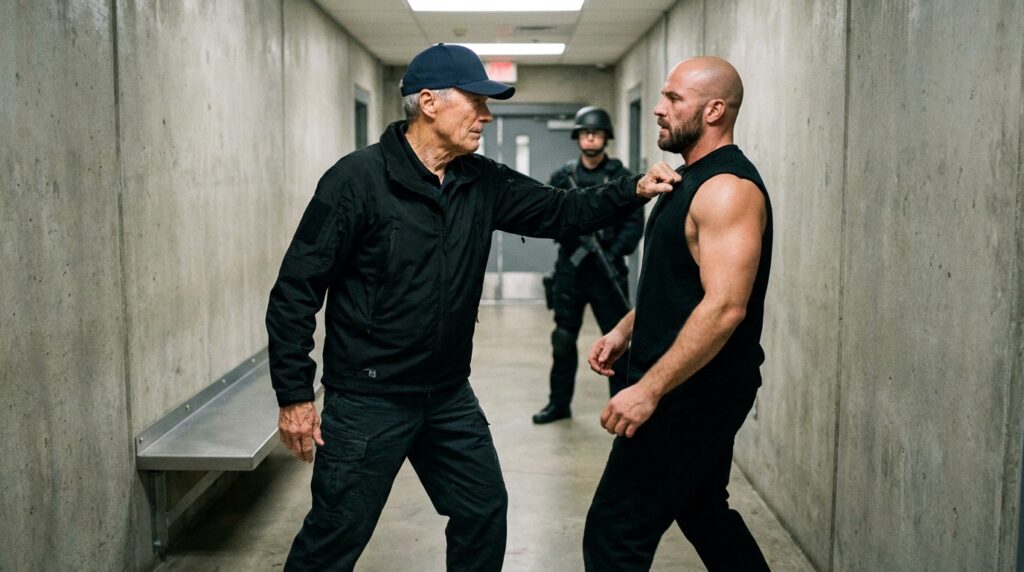
Legacy Code 1986: The Veteran’s Final Stand to Expose the Forgotten Truth of Seventh Bureau

CHAPTER 1: THE LIQUIDATION OF STATUS

The automated security turnstile at the perimeter of Sector 4 did not recognize ink on paper. It gave a short, high-frequency click, its red optical eye blinking twice against the laminated surface of the retirement credential.

Move along, sir, the intake clerk said. He didn’t look up from his dual monitors. His fingers kept a steady, syncopated rhythm against a mechanical keyboard. The system doesn’t pull legacy codes from before the migration. If the barcode doesn’t register green, you aren’t on the log.

The veteran did not pull his hand back. He held the card perfectly level between two thick, scarred fingers. His knuckles were slightly enlarged, the skin across the joints shiny and pale like old parchment. Beneath the low brim of his faded navy service cap, his eyes remained fixed on the small gap between the clerk’s shoulder and the reinforced partition glass.

I am on the log, the veteran said. His voice had the texture of coarse sand shifting under water—low, dry, and lacking the frantic inflection of the younger men who hurried through the turnstiles behind him. Check the hard-copy ledger under the gray desk. Sector Commander Miller signed the cross-clearance at dawn.

The clerk paused. The mechanical clacking stopped for three full seconds. A cool breeze from the overhead HVAC vent smelled faintly of ozone and old dust, rustling the edge of the veteran’s clean, unbranded black tactical shirt. The clerk slowly turned his head, his eyes traveling up from the dead plastic card, past the rigid alignment of the veteran’s shoulder, to the faded gold lettering on the cap.

Miller retired three years ago, old man, the clerk murmured, his tone shifting into the flat, metric delivery of a system that had already forgotten its creators. This is a private logistics tier now. Everything runs on the new contract. If you don’t have a live token, you’re an obstruction. Step left. Let the operators through.

A sudden shift in air pressure announced the arrival of the modern tier. From the security corridor behind the veteran, the scent of expensive synthetic oil and sweat cut through the ozone. A large shadow fell across the Formica counter, dark and wide enough to block out the harsh fluorescent glare of the intake ceiling.

A heavy hand, thick-veined and covered in black ink that crawled down from a sleeveless shirt, dropped onto the edge of the turnstile gate. The metal groaned slightly under the deliberate application of weight.

You’re holding up the lane, grandpa, a voice boomed from above the veteran’s left shoulder. It was deep, wet with the casual arrogance of a man who measured his authority by the circumference of his biceps. The contractor stood six feet four, his bald head gleaming under the lights, his thick beard neatly trimmed to match the sharp lines of his tactical trousers. Some of us have a clock running on live transit. Move your boots or get moved.

The veteran didn’t flinch. He didn’t shift his heels. His boots—well-oiled leather with steel eyelets—remained perfectly parallel, rooted six inches from the base of the turnstile. He slowly let his card slide back into his palm, his thumb feeling the slight indentation where his old rank had once been stamped into the plastic.

The clerk looked at the contractor, a subtle nod of recognition passing between them. The digital world understood big men with commercial badges.

The veteran slowly turned his head, just enough to look at the contractor’s exposed forearms. He didn’t look at the giant’s face. He looked at the stance—the weight distributed entirely on the forward toes, the hips loose, the balance arrogant but unrefined. It was the posture of a man who had never fought anyone who knew how to use the earth beneath their feet.

The lane belongs to the clearance, the veteran said softly.

The contractor let out a short, dry laugh that didn’t reach his eyes. He stepped in closer, his chest crowding the old man’s shoulder, his breath smelling of stale coffee. He reached out to grab the veteran’s arm.

Then look at the name on the door, old man. Your clearance died before I was born.

As the contractor’s fingers made contact with the dark fabric of his sleeve, the veteran felt a familiar vibration—a precise, mechanical hum from the wall behind the intake desk. It wasn’t the HVAC. It was the specific, rhythmic sequence of a manual override lock being punched into the secure corridor gate from the inside. Someone was coming through from the high-security cells, using a code that shouldn’t have existed on the clerk’s terminal.


CHAPTER 2: THE BREACHING POINT

The thumb of the contractor’s glove was rough, the synthetic fabric worn down to a fraying weave that scraped against the veteran’s shoulder. It was a pressure designed to make a lesser man lean away, to create a tilt in the spine that signaled submission before the first ounce of true force was even applied.

The veteran didn’t tilt. He allowed his shoulder to absorb the initial contact, treating the giant’s hand like a mechanical failure in a piece of heavy machinery—something to be calculated, timed, and then cleared from the gears. Beneath his boots, the vibration of the manual override lock inside the wall casing went cold. A single, heavy metallic thud resonated through the concrete flooring, a sound that only someone who had spent decades waiting behind closed bulkheads would isolate from the generic hum of the facility’s air scrubbers.

The override code hadn’t been an automated pulse. It had been typed manually, with a uneven, three-beat pause between the fourth and fifth digits. Tap-tap-tap-tap… tap-tap. The specific cadence belonged to a field manual procedure that had been decommissioned in the late eighties, an operational shorthand used by the old Seventh Bureau to signal an emergency extract under fire.

“The name on the door is private asset logistics,” the contractor muttered, his face lowering until the shadow of his heavy jaw completely eclipsed the light on the veteran’s cap. His fingers tightened, gathering the black fabric of the uniform into a bunch. “That means the rules are whatever we write on the manifest. Now back your heels out of my lane before I show you how we handle surplus property.”

“The card doesn’t have a name,” the veteran said. His chin remained level, his gaze fixed on the small, rusted screw head anchoring the clerk’s computer terminal to the desk. “It has an index number. If you knew how to read a three-digit suffix, you’d be standing three feet further back.”

The clerk behind the glass stopped moving completely. His hand stayed hovering over his mouse, his eyes darting toward the security feed monitor at the edge of his desk. The terminal screen flickered once, a line of legacy code—green text against a dead black background—bleeding through the modern Windows interface for less than half a second before being suppressed by the network’s firewall.

“I don’t read paper,” the contractor growled. He shifted his weight, his rear heel lifting slightly off the concrete as he prepared to drive his shoulder forward to clear the lane by force. “I clear blockages.”

The veteran didn’t wait for the mass to descend. He let his breath out in a short, silent exhalation, dropping his center of gravity by a fraction of an inch as his left boot pivoted inward. The movement was tiny, almost invisible beneath the stiff denim of his trousers, but it locked his skeletal frame directly into the floor’s expansion seam.

Before the contractor’s arm could extend into a full shove, the inner security door at the far end of the processing lane clicked. The latch didn’t open, but the pressure inside the corridor shifted. A small wisp of cold air, smelling faintly of old sulfur and wet iron, escaped from beneath the door frame.

“You’re using an unauthorized keyway,” the veteran said, his voice dropping into that gravelly, immovable register that didn’t require volume to carry.

The contractor didn’t register the words. His forward momentum was already locked in. His massive forearm came up, thick with tattooed vines that twisted around old scar tissue, intending to use his elbow as a wedge to force the older man against the bolted iron bench lining the wall.

The veteran’s right hand moved. It wasn’t a strike; it was a small, circular rotation of the wrist that caught the contractor’s thumb at the joint, utilizing the leverage of the giant’s own grip to twist the alignment of his wrist by five degrees. The friction of the synthetic glove fabric against his skin made a dry, snapping sound.

The contractor’s eyes widened slightly, not from pain, but from the sudden, inexplicable loss of leverage. His balance, which had been calculated to crush an old man’s frame against a hard surface, found nothing but an oiled hinge that absorbed the impact and redirected it downward into the concrete.

“Watch the line,” the guard in the midground called out. His voice was tight, his gloved hand moving down toward the retention strap of his holstered sidearm. He hadn’t stepped forward yet, but his boots shuffled back, trying to clear his own line of sight in the narrow hallway. “Keep your distance from the desk.”

The clerk didn’t answer. He was staring at his terminal, where a small icon—a three-pointed star inside a broken circle, the old seal of the logistics branch—had just begun to spin in the bottom right corner of the taskbar.

The veteran held the contractor’s wrist fixed in space for one heartbeat, his thumb pressed against the small radial bone just above the glove line. He could feel the giant’s pulse—fast, heavy, driven by an adrenaline spike that hadn’t expected an obstruction.

“The three-digit suffix,” the veteran whispered, his eyes finally lifting to meet the contractor’s stare beneath the brim of his navy cap. “It means the man who holds this card doesn’t leave a trail for your company to buy.”

The inner door at the end of the hall gave a second, louder pop, and the heavy iron panel began to swing inward into the dark.

CHAPTER 3: THE NARROW LANE

The concrete hallway stretched forty feet between the intake counter and the reinforced inner threshold, a desaturated tube of industrial gray that smelled of curing lime and old iron. The air didn’t circulate well here; it pooled in the corners, leaving a thin film of fine grit on the raw metal fittings.

The contractor didn’t let go immediately. His fingers slid off the veteran’s sleeve with a dry, scraping sound, leaving small, crumpled lines in the heavy cotton fabric. He looked down at his own hand, his knuckles white, his thumb twitching slightly from the microscopic leverage the older man had used to neutralize his stance. The arrogance in his posture hadn’t disappeared, but it had grown rigid—the fluid, sweeping confidence of a massive man replaced by the hard, defensive framing of a brawler who realized he had just stepped onto uneven ice.

“You’re tracking dirt into a clean transit,” the contractor said. His voice was lower now, lacking the performative boom he had used for the clerk’s benefit. He adjusted the strap of his nylon gear bag, the metal carabiners clinking against each other like dull coins. “The old brigade left their trash everywhere. They forgot to clean out the system when they closed the books.”

The veteran didn’t offer a retort. He simply adjusted his cap, pulling the salt-stained brim a fraction lower to shield his eyes from the direct glare of the fluorescent tubes. He turned his back to the intake counter and began a slow, rhythmic walk down the center of the corridor. His boots made no sound on the grit-dusted floor—an old habit of distributing weight through the outer edges of the sole, keeping the knees slightly bent to absorb the natural imperfections of the concrete.

Behind him, the armed guard didn’t move from his station. The young man’s helmeted head swung slowly, tracking the veteran’s progression with a silent, neutral curiosity. In these lower tiers, the private operators were supposed to handle their own friction, but the guard’s hand remained unlatched from his security holster. He had seen the way the old man had rotated his wrist—an motion so compact it didn’t register on the overhead low-resolution cameras, but one that had stopped two hundred and forty pounds of muscle with less than two inches of displacement.

Five paces down the lane, a single iron bench was bolted directly into the wall. It was a crude piece of utility furniture, its surface pitted with rust spots where the gray primer had flaked away over thirty years of institutional use. Beneath the seat, a small, circular ventilation brass grille hummed with the vibration of a localized cooling fan. The sound was wrong; it had a rhythmic, scraping stutter that suggested an unaligned axle—or an aftermarket recording device tapped directly into the facility’s low-voltage power rail.

The veteran stopped at the edge of the bench. He didn’t sit. He stood with his hip three inches from the iron frame, his left hand resting lightly on the cold metal surface. His fingers automatically found a deep gouge in the iron—three small notches carved into the underside of the seat, an old field marker indicating a dead-drop location used during the facility’s construction when it was still under the jurisdiction of the Department of the Army.

“There’s nothing for you down this line,” the contractor’s voice came from fifteen feet behind. The heavy, deliberate thud of his tactical boots began again, closing the distance with a slow, measured momentum. He wasn’t rushing now; he was stalking, his broad shoulders filling the narrow margins of the hallway, casting a long, irregular shadow that crept up the concrete wall toward the veteran’s feet. “The files you’re looking for were shredded before your pension cleared, old man. We own the storage arrays now.”

The veteran looked down at the rusted bench. The fine dust on the iron surface was vibrating in sync with the stuttering cooling fan beneath. He could read the frequency through the skin of his palm—it wasn’t an unaligned axle. It was an encrypted data pulse, a local wireless handoff masking itself as mechanical noise, broadcasting a legacy handshake protocol to any old-model receiver within three meters. His retirement credential, still tucked inside his palm, grew slightly warm against his skin as its internal copper coil picked up the induction field.

“The storage belongs to the structure,” the veteran said to the wall. His reflection in the polished concrete was a dark, narrow line, almost indistinguishable from the shadows between the structural pillars. “The company only rents the power.”

“We bought the structure,” the contractor countered, his boots stopping five feet away. The air between them grew thick again, warm with the smell of the contractor’s synthetic gear and the sharp, acidic tang of his frustration. He didn’t reach out this time. He simply used his bulk to crowd the veteran against the bench, his chest inches from the old man’s shoulder line, blocking the path toward the inner gate. “And we don’t like ghosts hanging around the hardware.”

The veteran remained perfectly still, his eyes tracking the red light of a security sensor mounted above the inner door. The light was green three seconds ago. Now it was a solid, unblinking crimson, indicating that someone in the central control room had manually isolated this specific corridor from the rest of the processing floor. The automated safety systems were offline. Whatever happened in this lane would stay in the lane until the log was manually cleared.

The contractor took another half-step forward, his large, bearded jaw tightening as he prepared to use his physical mass to force the veteran into the rusted metal of the bench.

CHAPTER 4: THE FOREARM CHECK

The contractor’s mass rolled forward like a shifted load in an unbraked bed. His left shoulder dropped, his jaw tight beneath his beard, committing his entire centerline to a blunt, crowding push that would pin the older man against the bolted structure of the bench. It was a movement built on thousands of hours of gym-floor metrics and low-tier corridor enforcement—heavy, predictable, and entirely dependent on the assumption that an elderly spine would fold under a direct application of weight.

The veteran didn’t retreat. His left boot didn’t slide an inch across the fine grit of the concrete floor. Instead, he stepped directly into the path of the advance, choosing the exact millisecond before the contractor’s forward foot could plant and lock its leverage.

The movement was an exercise in perfect skeletal mechanics. Raising his right arm in a compact, vertical arc, the veteran kept his elbow tucked tightly against his ribs, aligning the dense, thick radius bone of his forearm with the exact center of his own sternum. He didn’t swing. He didn’t strike. He simply set his mass—rooting his rear heel into the floor’s expansion joint and letting the kinetic energy of the contractor’s two hundred and forty pounds collide with an immovable, perfectly braced pillar of old bone and locked joints.

The impact was loud, a dull, hollow thwack that sounded like a heavy sack of grain dropping onto a timber floor. The air was instantly driven from the contractor’s lungs in a short, wet gasp.

The giant’s forward momentum didn’t just stop; it reversed. Because the veteran had anchored his frame into the structural core of the room, the entire force of the contractor’s rush bounced off the forearm check and traveled backward through his own collarbone. The massive younger man recoiled in pure, unadulterated surprise, his boots scraping wildly against the concrete as his hips tilted backward. He took one heavy, clumsy, controlled step in reverse just to keep his balance, his arms flailing slightly before his heels caught the floor and stabilized his frame.

The narrow corridor became completely silent, save for the scraping sound of tactical rubber soles trying to find purchase on the gritty floor.

The veteran didn’t follow up. He remained exactly where he had planted himself, his forearm still raised in a textbook defensive guard, his lean frame balanced and ready for the next transition. His face beneath the low brim of his navy service cap showed no flush of heat, no tremor of exertion. His pulse, steady and cold, barely registered the collision. Through his boots, the low-frequency vibration of the cooling fan beneath the bench continued its stuttering broadcast, but now a secondary inductive field seemed to click inside the adjacent wall panel, acknowledging the massive kinetic disruption in the corridor.

The contractor stood five feet back, his chest heaving as he forced air back into his bruised lungs. His thick hands were open, the fingers twitching with a mixture of shock and instinctive anger. The skin above his beard had gone a mottled, pale gray where the impact had rattled his breastbone. He looked down at the center of his black sleeveless shirt, where a faint, white line of fine concrete dust from the veteran’s sleeve had been printed directly over his tattoos.

“You…” the contractor started, but his voice broke on the intake, the gravel of his own throat matching the dry air of the facility. He shifted his weight to his rear leg, but this time his posture was hollow—the center of his gravity had been pushed too far back, and his heels were heavy against the floorboards.

The armed guard in the midground hadn’t moved a muscle, but his entire position had changed. His body was leaned back away from the interaction lane, his chin tucked into the collar of his tactical vest as his visor tracked the old man’s steady posture. He had seen riots in the yard and high-value transits go sideways with blades, but he had never seen a human frame stop a charging operator without moving an inch from its marks. His hand, which had been resting on his sidearm’s retention clip, slowly dropped away, his fingers curling into a loose, respectful fist against his thigh.

The veteran slowly lowered his arm, his wrist rotating with that same silent, mechanical precision. He didn’t look at the guard, nor did he look at the clerk behind the partition glass. His eyes remained locked on the contractor’s pupils, tracking the rapid, erratic movement of the giant’s irises as the younger man tried to calculate how an asset with seventy-eight years of wear on his joints had just hit him with the weight of an iron bulkhead.

“The lane,” the veteran said, his low, gravelly voice cutting through the ozone-scented air like a cold blade through grease, “is closed to commercial traffic.”

CHAPTER 5: THE SECTOR ISOLATION

The armed guard did not raise his rifle, but his shadow remained fixed against the salt-scrawled concrete wall like an oily stain. Through the narrow slit of his dark visor, his eyes were wide, their focus locked completely on the veteran’s rooted stance. He had been trained to look for weapon signatures—the tells of a hidden blade, the kinetic twitch of a hand dipping toward a waistband—but there was no policy manual in the modern tier for an old man who weaponized his own skeletal mass without shifting his heels.

The air in the detention lane grew significantly colder as the HVAC system completed its cycle, pushing a dry, sulfurous draft through the ceiling vents that rustled the edges of the contractor’s torn sleeve. The low hum of the local ventilation fan beneath the rusted iron bench altered its rhythm, the steady tap-tap-tap-tap of the data sequence suddenly sharpening into a high-frequency whistle.

On the side of the guard’s helmet, a small operational transceiver blinked into life. A tiny, amber alphanumeric sequence—E-6_MIGRATION_BLOCK—scrolled across his small external ear-display. It was an institutional override command, one that didn’t come from the regional dispatch desk but from an independent terminal embedded deep within the facility’s structural foundation.

“Stand down, 84,” the veteran said. His voice didn’t rise above the mechanical whine of the wall vent, yet it carried an unnatural density that seemed to vibrate the loose iron filings collected in the corners of the bench. He used the guard’s old-tier internal sector index, a numerical designation that had been wiped from the facility’s database during the commercial transition five years ago. “The desk clerk has already isolated the loop. If you break leather now, you’re logging a tactical incident on an unmonitored line.”

The guard’s fingers hovered two inches above his weapon’s retention strap. His boot soles made a tiny, dry crunching sound against the concrete grit as he shifted his weight back toward the partition wall. He wasn’t looking at the veteran as a civilian obstruction anymore; he was reading the posture of a sovereign protector—a man who had held these specific corridors when the concrete was still wet and the names on the walls were stamped in brass rather than printed on vinyl stickers.

“Who initiated the lockout?” the guard asked, his voice muffled by the plastic filter of his respirator. He didn’t look back toward the intake counter, where the clerk was now sitting perfectly motionless, his hands flat against the laminate surface as if he were trying to disconnect his body from the interface. “The grid is showing black from the primary hub.”

“The lock was pulled forty years ago,” the veteran murmured. He slowly closed his right hand, his scarred knuckles locking down over the old retirement credential. “The system is just catching up to the ledger.”

The contractor finally straightened his spine, his breath coming in jagged, wheezing rattles that smelled of copper and dry coffee. His left arm hung slightly loose, the shoulder dropped three inches below its natural line where the force of the forearm check had compressed the subscapular nerve. The arrogance had left his face, replaced by a dark, metallic malice that narrowed his eyes until they were small slits beneath his hairless brow.

“You’re an unregistered asset in a restricted hub,” the contractor spat, his boots dragging slightly as he tried to re-establish a balanced tripod stance against the corridor floor. He reached down with his good hand, his fingers gripping the heavy nylon strap of his gear bag with white-knuckled intensity. “This contract has an indemnity clause for administrative cleanups. The guard doesn’t have the clearance to pull you out once the main gate drops.”

“The main gate isn’t dropping for you,” the veteran said. He turned his face toward the inner doorway, his steady, unblinking gaze tracking a tiny rust line that ran from the upper hinge pin down into the electronic strike plate.

A heavy, metallic thud echoed from the deep archive vaults beyond the threshold—the sound of a multi-ton hydraulic valve seating itself into a dead-lock position. The data transmission through the bench grille ceased instantly, the receiver in the veteran’s palm turning cold as the localized inductive field dissolved into static. The decoy secret had been cleared from the line; the legacy files weren’t in the storage arrays at all. The contractor’s team hadn’t been deleting history—they had been setting a physical trap inside the high-security cells, waiting for the old man to use his legacy token so they could locate the remaining hard-copy journals before the vault was permanently welded shut.

The veteran realized his error not by what he saw, but by the specific failure of the sound. The hydraulic valve hadn’t closed to secure the area; it had closed to trap him in the narrow lane between the turnstile and the iron gate. The agency’s old-model keyways had been completely subverted from within, turned into a mechanical containment cell by the very people who had hired the contractor to crowd him out.

“We knew you’d check the frequency under the bench,” the contractor whispered, a slow, ugly grin breaking through his beard as he let his gear bag slide off his shoulder to the floor with a dull, heavy clatter. “The old man always looks for his old marks.”

CHAPTER 6: THE FRAGILE RETREAT

The nylon gear bag hit the floor with a heavy, wet thud, the brass slide fasteners scraping against the fine concrete grit. As the canvas slouched sideways, it exposed a faded stencil on the reinforced waterproof base—a set of inverted chevrons framing an obsolete warehouse code that didn’t belong to any private commercial outfit. It was an old log-mark from the logistics depot at Fort Meade, the exact center that handles deep-archive transfers for defunct shadow operations.

The contractor took three steps backward, his heavy boots making a distinct, dragging scratch across the floor’s expansion joint. He didn’t rise to his full height; his shoulders remained rolled forward, his chin tucked into his collarbone to protect his bruised ribs from a secondary check. The malice in his eyes had taken on a structural coldness, a tactical calculation that replaced his initial brute confidence. He knew the corridor was sealed from the central grid. He knew the log was dark.

“The line is dead, old man,” the contractor spat, his right hand slipping inside the open flap of his vest to adjust the strap of a compact, matte-black pneumatic breaching tool. “Your legacy token just flagged your coordinates to every live terminal in the sector. You thought you were pulling old logs out of the bench grille, but you just signed the inventory release for everything left in the vault.”

The veteran didn’t follow the hand. His gaze remained fixed on the lower lip of the heavy inner security door, where a thin layer of grease had oozed from the hydraulic pistons under the sudden high-pressure lock sequence. Through his soles, the rhythmic stutter of the cooling fan didn’t return, but the structural silence of the building had deepened—the absolute, dead pressure of a concrete tomb wrapped in reinforced steel.

He had calculated the margin of error forty years ago, but he hadn’t accounted for the continuity of the paperwork. The company hadn’t deleted the records; they had simply changed the name on the ledger, keeping the old treason alive beneath three layers of corporate indemnity.

“You’re tracking an expired index,” the veteran said. His voice was low, sand-dry, completely unhurried by the sound of the locking valves. He reached up with his left hand, his thick fingers touching the salt-crusted brim of his navy service cap, tilting it just enough to scan the dark angle where the wall met the ceiling. “The men who wrote that manifest didn’t use network storage. They used ink.”

The guard in the midground took a full pace back, his boots finding the relative safety of the partition glass wall. He looked down at his own wrist-terminal, where the alphanumeric override code had gone completely solid, freezing the screen into a single line of machine code that didn’t respond to his keypad overrides. His visor tracked the contractor’s hand inside the vest, then shifted back to the old man’s immovable shoulders. He wasn’t part of the contract cleanup; he was just a standard base asset who had suddenly realized he was standing inside a live strike window.

“This isn’t over yet,” the contractor said, his teeth showing white through his dark beard as he continued his slow, rhythmic retreat toward the intake turnstile. His weight was distributed evenly on his toes now, his knees loose, ready to sprint or drop the moment the outer perimeter barrier cycled. “You’re an old gatekeeper with an empty ring, grandpa. The commander owns the keys to the archive now.”

“It was over the moment you stepped into my lane,” the veteran whispered.

He didn’t advance on the contractor. Instead, he dropped his center of gravity by a fraction of an inch, his right heel catching the lip of the bolted iron bench. With a single, heavy backward kick that carried the absolute mass of his aligned posture, he struck the base of the bench’s iron support leg. The metal groaned—not from a fracture, but from the sudden shearing force applied to the rusted anchor bolts beneath the concrete surface.

The bench shifted two inches, the iron grille beneath the seat tearing free from its housing with a sharp, electric pop that sent a shower of orange sparks across the grit-dusted floor. The local cooling fan died with a wet whined, its blades striking the bent metal shroud inside the wall casing.

Deep within the floorboards, the counter-vibration of the secondary inductive field broke. The terminal screen behind the partition glass didn’t just flicker; it went completely black, the green legacy code dissolving into a line of static before the auxiliary batteries could kick in. The contractor stopped his retreat, his boots skidding on the concrete as the overhead fluorescent lights died, plunging the narrow detention lane into the absolute, desaturated gray of the emergency backup strips.

Through the dim, crimson light of the safety lamps, the heavy hydraulic arm of the inner security gate began to groan again, its primary fluid pressure failing as the veteran’s physical disruption shorted out the local isolation loop. The door didn’t slam shut; it began to swing outward, very slowly, heavy iron grinding against the raw concrete sill.

CHAPTER 7: THE RECKONING OF THE LEDGER

The heavy iron panel of the inner security gate did not swing smoothly. It ground its lower edge against the uneven, grit-streaked concrete floor, tearing a long, raw scoring mark through the gray industrial sealant. The emergency backup lighting cast a desaturated, crimson wash across the lane, turning the smoke from the shorted-out bench grille into drifting ribbons of dark ink.

The contractor froze five feet from the turnstile, his heels skidding slightly before his posture went rigid. His good arm dropped down to his flank, his thick fingers uncurling from the frame of the pneumatic breaching tool. The malice that had sharpened his features during the blackout vanished, replaced by a sudden, hard architectural calculation as a pair of polished leather riding boots stepped over the grinding threshold from the dark archive cells beyond.

The boots were flawless—lacking the fine coating of concrete dust that fouled every other surface in Sector 4. Moving upward, the dark wool trousers carried a sharp, military crease that terminated at the waist of a tailored service coat. It wasn’t the uniform of a private contractor or a standard base tier guard.

The man who entered the lane was sixty years old, his silver hair cropped close to a skull that looked as if it had been carved from the same cold granite as the facility’s foundations. On his right hand, resting loosely against the brass hilt of a ceremonial sidearm, he wore a pristine silver signet ring engraved with a three-pronged star inside a notched family crest—the private standard of General Vance, the operational director who had signed the liquidation orders for the old Seventh Bureau in the autumn of 1986.

The veteran did not adjust his stance. He remained rooted by the sheared base of the iron bench, his left hand still pressed against the rusted metal surface, his thumb over the small carved notches. He looked up, his unblinking gaze passing over the commander’s polished brass buttons until it settled squarely on the signet ring.

The weight of forty years of institutional dust seemed to settle into the narrow hallway. The logic was no longer a matter of barcodes or network tokens; the lineage of the betrayal had a face, and it had inherited the keys to the archive from the man who had written the original cross-clearance logs.

The commander stopped three paces from the veteran. His leather soles made a sharp, clean click on the grit, a sound that carried the absolute weight of a sovereign authority that didn’t need to borrow its power from a commercial manifest. He looked down at the faded navy service cap, tracking the salt-stained lines along the brim with an expression that carried no anger—only a cold, historical recognition.

The armed guard in the midground didn’t wait for a command. The small amber string on his helmet display had vanished, replaced by a universal security lock indicator. His entire body snapped straight, his heels coming together with a sharp, metallic ring against the concrete floorboards as his chin tucked into a rigid, unquestioning posture of absolute deference.

The contractor tried to step forward, his jaw working as he pointed a thick, tattooed finger toward the broken grille beneath the bench. “Commander, the asset sabotaged the local interface loop. He’s carrying an unregistered legacy token. We were moving to isolate—”

The commander did not turn his head. He didn’t lift his eyes from the veteran’s weathered face. He raised his right hand—the one bearing the signet ring—by two inches, a single, compact gesture that cut the contractor’s explanation off in the middle of a syllable. The silence that followed was heavy with the smell of ionized battery fluid and the cold, stagnant draft from the lower vaults.

“Leave the corridor,” the commander said. His voice was smooth, polished by decades of high-level administrative briefing, lacking the gravel or the friction of the men who did the physical labor in the lanes. “Your logistics team has completed its manifest. The remaining arrays are now under direct departmental custody.”

“The array isn’t clear,” the contractor muttered, though his boots were already shifting backward toward the automated turnstiles, his weight leaning away from the desk where the clerk remained perfectly still behind the glass partition. “The file logs are still cycling.”

“The logs are where they belong,” the commander murmured.

He turned fully toward the veteran. Slowly, with a deliberate, rhythmic precision that belonged to an era before the migration to digital tokens, the commander raised his right arm. His elbow tucked against his ribs, his hand flattening into a straight, rigid line even with the temple of his silver brow. He snapped a formal, full-dress salute—a gesture of absolute institutional deference rendered to a man who officially didn’t exist on any live roster in the United States.

The contractor’s mouth dropped slightly, his boots freezing on the turnstile plate as he witnessed the entire hierarchy of the facility reorder itself around the old man’s navy cap. The guard remained frozen in his stance, his visor tracking the signet ring as it held the salute in the crimson glare of the emergency lamps.

The veteran didn’t return the salute. He slowly pulled his hand away from the rusted bench, his fingers cold from the iron. He let his arms hang loosely at his sides, his athletic frame perfectly centered, an old gatekeeper who had finally located the deep-archive line he had spent half a lifetime tracking through the gray.

“The ledger is still open, Vance,” the veteran said softly, his gravelly voice cutting through the mechanical hum of the failing hydraulic gate.

The commander dropped his hand, his silver ring catching the last red pulse of the security sensor. “Then we had better go down into the vault and finish the entries.”

CHAPTER 8: THE LOWER TIER

The subterranean elevator didn’t use cables. It dropped via a heavy hydraulic piston that groaned deep within the bedrock, a slow, shuddering descent that smelled of scorched packing grease and wet sulfur. With every ten feet of depth, the temperature in the shaft plummeted, the dry, filtered air of the processing lanes replaced by a damp, primordial chill that condensed into fine beads of moisture along the iron ribs of the cage.

Commander Vance stood perfectly still in the center of the lift, his polished riding boots planted six inches apart. He hadn’t removed his hands from behind his back since the cage door had rattled shut, his silver signet ring casting a small, dull reflection against the wet iron grating.

“The sub-levels weren’t included in the commercial appraisal,” Vance said. His voice was flat, devoid of the administrative warmth he had used in the corridor above. It bounced off the raw rock walls of the shaft with a heavy, hollow resonance. “The contractors think the grid ends at the storage arrays. They don’t have the clearance to know that the foundation goes down another three tiers.”

The veteran didn’t answer. He stood by the gate, his left hand hooked into the cold iron mesh of the outer screen. His fingers could feel the rhythmic, rhythmic thudding of the hydraulic fluid passing through the lines—a heavy, four-beat pulse that indicated the pump system was running on legacy DC generators from the early cold war era. Beneath the low brim of his navy cap, his eyes tracked the passing strata of the shaft: first the poured concrete of the modern facility, then the rough-cut timbers of the old ordnance depot, and finally the black, unlined shale of the deep archive tier.

The elevator gave a final, massive jolt, its floor settling three inches below the sill of the lower platform with a wet, metallic splash.

The outer gate didn’t slide open automatically. The veteran reached down, his scarred fingers catching the heavy, rusted iron latch handle. It took thirty pounds of levered mass to break the corrosion lock, the metal shrieking in protest before the gate finally swung back against the rock face.

A single corridor stretched ahead, less than six feet wide, carved directly out of the stone. The lighting here didn’t use fluorescent tubes or emergency LED strips; it consisted of old, wire-caged incandescent bulbs spaced twenty feet apart, their filaments glowing a dim, smoky orange that barely reached the floorboards. The air was thick, heavy with the odor of unwashed canvas and decaying paper, a specific institutional stench that only accumulates when records are left to rot in the dark for half a century.

“Vault 3 is at the end of the drift,” Vance murmured, his boots making a sharp, hollow tack-tack on the damp cedar planks that served as a walkway over the drainage trench. “The manual combinations were never updated after the transition. My father kept the logbooks in his private office at the academy until he died.”

The veteran stepped onto the cedar planks, his heels instantly finding the center of the wood to avoid the wet mud oozing from the trench lines. He didn’t look back at the commander. He was calculating the distance—forty yards to the threshold, two separate blind spots where the rock face jutted out to support the ceiling timbers, and no secondary exit if the contractor’s cell above managed to drop a bypass charge down the elevator shaft.

At the midground of the drift, a massive iron wheel-lock was bolted into the face of a heavy steel bulkhead. The surface of the door was pitted with black oxidation, but around the rim of the locking wheel, three faint, white chalk-marks had been scribbled into the iron—an old field confirmation code from the winter of 1985, indicating that the contents had been verified and sealed under an operational blackout order.

The veteran stopped three inches from the wheel. His hand hovered over the iron spokes, his skin instantly registering the intense, penetrating cold radiating from the other side of the bulkhead.

“The combination isn’t a number,” the veteran whispered, his voice sand-dry in the damp air.

Vance stepped up behind his shoulder, the silver signet ring catching the orange glow of the nearest bulb. “No. It’s an internal index name. The name of the team we left behind in the delta.”

Before the veteran’s hand could touch the iron spoke, a low, wet vibration shuddered through the rock ceiling above them—the distinct, high-frequency thud of a commercial linear breaching charge firing on the processing floor three hundred feet up. The contractor’s cell had just bypassed the clerk’s terminal, and they were clearing the elevator shaft by force.

CHAPTER 9: THE CHALKED BULKHEAD

The black shale ceiling didn’t collapse, but it bled. A fine, continuous curtain of razor-sharp stone flakes and dry powder hissed down between the timber lagging, coating the veteran’s navy cap in a gray layer of fine grit. The second concussive thud from the elevator shaft was deeper—the iron counterweights of the lift cage caroming off the rock guides three hundred feet above as the private operators dropped their secondary transit lines.

The veteran’s right hand clamped onto the frozen spoke of the heavy locking wheel. The rusted iron surface tore at the callus on his palm, the cold metal drawing out the residual warmth of his skin within seconds. He didn’t pull back. He set his left heel into the slick edge of the cedar plank, shifting the center of his mass forward until his sternum was less than three inches from the chalked perimeter lines.

“The letters,” the veteran said. His teeth ground against the fine shale dust filling his mouth. His voice remained flat, a low-frequency rumble that matched the mechanical labor of the shaft. “They shifted the cipher order in eighty-six. If you turn it on the standard numerical alignment, the internal shear pins will snap.”

Commander Vance stood two paces behind him, his tailored coat already grayed by the downpour of stone dust. His hand remained flat against the brass hilt of his sidearm, the silver signet ring catching the dim, smoking orange glare of the nearest bulb as the wiring harness along the rock wall began to spit blue sparks. “The entry name was OBSIDIAN. Seven letters. My father logged it on the final day of the liquidation.”

“Your father was an administrative clerk who never stripped a mechanical lock under fire,” the veteran muttered.

He didn’t spin the wheel. He threw his weight against the iron rim in a sequence of short, sharp, two-inch pulses, using the kinetic shock of his aligned skeletal frame to break the thirty-year accumulation of oxide inside the gear casing. Crack. Crack. With the third pulse, a thick clump of dried grease, black as pitch and smelling of old iron filings, squeezed out from behind the central spindle plate.

Behind them, the elevator shaft gave a hollow, screaming whistle as a high-speed steel cable began to unspool through the dark, its friction generating a smell of burning wire that cut through the sulfurous draft. The contractors were down to the secondary bulkhead. They weren’t checking manifests anymore; they were utilizing high-velocity tactical gear designed to clear an unmonitored lane in less than ninety seconds.

The veteran’s fingers moved across the iron spokes, tracking the small, irregular gaps between the internal tumblers as they clicked behind the casing. One. Four. Three. He didn’t look at the chalk-marks. He was listening to the unaligned axle inside the lock box, matching the internal resistance of the brass pins to the old field manual procedure he had used before the agency deleted the Seventh Bureau from the index.

“The cipher wasn’t an operational code,” the veteran whispered, his thumb catching a deep notch in the rim. “It was a clearance release. He didn’t lock this door to preserve the logs, Vance. He locked it to keep the air scrubbers from clearing the lower tier after the valve went cold.”

The commander didn’t break his stance, but his jaw line grew rigid beneath his cropped hair. His eyes narrowed as a secondary vibration—lighter, faster, the rhythmic patter of high-tensile tactical boots hitting the floor of the elevator platform—echoed down the narrow stone drift. “The contract cleanup requires the physical retrieval of the original paper manifest. If they drop an incendiary block into the tier, the ledger is gone regardless of who holds the keyway.”

“They aren’t here for the manifest,” the veteran said.

With a final, bone-deep shove that forced his shoulder blade against the iron bulkhead, he threw the wheel past its last resistance point. The internal latch didn’t pop; it gave a heavy, wet thunk as forty pounds of oiled iron dropped down inside the door frame. The heavy steel door shifted outward by an inch, a blast of compressed, stagnant air—freezing cold and smelling of forty years of dry lime and rotting canvas—hitting the veteran directly in the face, blowing the gray dust from his cap.

The door was open, but the space beyond was pitch black, a dead void that didn’t catch a single glimmer of the orange lights in the drift. The absolute final reality of the vault remained locked behind that darkness, while behind them, the first tactical beam from a contractor’s weapon-light cut through the smoke of the elevator shaft, painting a bright, trembling white circle on the concrete wall forty yards out.

The private asset had reached the lane, his boots dropping into the mud of the drainage trench with a heavy, wet splash.

CHAPTER 10: THE FINAL ENTRY

The iron door groaned on its bottom lip, unseating decades of compressed shale dust as it gave way to the freezing dark of Vault 3. Behind them, the narrow stone drift erupted into a jagged pattern of bouncing white beam lights. The contractor’s tactical boots hit the mud of the drainage trench with a rhythmic, heavy slap, the sloshing water transmitting a dull vibration right through the cedar floor planks into the veteran’s heels.

“In,” the veteran said.

He didn’t use an administrative tone. It was a short, dry click of the jaw that carried the precise operational authority of a team leader who had lived through three separate extractions under live mortar fire. He gripped Commander Vance’s tailored wool shoulder with his left hand, his thick fingers digging into the fabric to redirect the taller man’s mass sideways through the narrowing gap of the unhinged bulkhead.

They dropped into a square room lined entirely with old zinc shelving. The air was dead, perfectly dry, and thick with the smell of moldering wood pulp and long-evaporated petroleum oil. The orange light from the drift barely penetrated three feet past the threshold, casting the long, skeletal shadows of the shelves across rows of gray canvas ledger binders that sat like forgotten grave markers in the dark.

A bright, trembling circle of white light sliced into the room from the corridor, catching the rusted edge of the iron wheel lock.

“The secondary case,” Vance whispered. His breath came in short, white pluming clouds that dissolved against the cold zinc frames. He didn’t pull his sidearm. His hand stayed flat against his coat, his silver signet ring striking the metal column of the nearest shelf with a dull, hollow click. “The center ledger on the third rail. That’s the 1986 operational release log.”

The veteran moved without answering, his hand sliding along the cold, rusted shelf edges by pure memory of the standard Seventh Bureau filing protocols. His fingers brushed past row after row of textured canvas until they hit a binding that was stiff, thick, and bound with twin steel rivets that had gone orange with corrosion. He pulled it from the rail, the dry paper inside rustling with a sound like dead leaves scraping across gravel.

The beam from the contractor’s weapon-light hit the open doorway full-force, reflecting off the zinc plates with a blinding glare that illuminated the first page of the binder.

The veteran didn’t read the typewritten columns. His eyes dropped instantly to the bottom margin—the authorization block where the sector supervisor’s validation stamp was supposed to sit. The ink was old, a purple administrative dye that had faded into a pale violet over forty years of isolation. But beneath the official liquidation stamp, there was a manual ink entry, written in a tight, precise, backward-slanted longhand that used the old-style departmental ledger ink.

It wasn’t a clearance authorization. It was a logistical liquidation order that listed the exact coordinates of the delta ambush, followed by a list of serial numbers for the unit’s equipment that had already been pre-assigned to a private salvage firm three weeks before the team ever crossed the border.

The signature at the bottom read Vance, Director Seventh Bureau. But the initials preceding the name weren’t those of the commander’s father. They were the commander’s own early career index codes—J.V. 402.

The veteran’s thumb stayed level on the faded purple line. The small silver signet ring on the commander’s finger didn’t belong to a dead father; it was the exact seal that had been pressed into the wax on the ledger’s binding cords forty years ago. The decoy secret had broken completely in his hands. The commander hadn’t brought him down into this hole to help him uncover an old institutional betrayal. He had brought him here because the legacy token in the veteran’s hand was the only key that could physically open the old-style zinc vault, allowing the final living record of the liquidation to be exposed to the live network so the company’s automated firewall could scrub the raw entry forever.

Behind them, the shadow of the bald contractor filled the doorway, his chest heaving under his sleeveless black shirt, the muzzle of his pneumatic breaching tool rising toward the veteran’s shoulder line.

“The file is live on the network now, sir,” the contractor said, his voice echoing off the zinc plates with a wet, raspy rattle. He didn’t look at the veteran. His eyes were fixed on the silver ring on Vance’s hand. “The system just confirmed the delete sequence from the primary hub. The lane is clear.”

The commander slowly lowered his hand, his granite chin lifting as he looked down at the veteran beneath the brim of the navy cap. The air in the room remained freezing, dead, and entirely without a lane of retreat.

CHAPTER 11: THE SHEARING FORCE

The contractor’s finger was already contracting against the knurled steel trigger bar of the pneumatic tool when the veteran’s center of gravity dropped. There was no theatrical wind-up, no shift in his shoulders to signal a kinetic transition. Operating on the absolute, instinctual economy of forty years of close-quarters tactical training, the veteran treated the heavy canvas ledger not as data, but as a five-pound block of dense cellulose and copper-reinforced binding rivets.

With a short, explosive pivot of his rear heel, the veteran drove the steel-bound corner of the binder upward in a compact, rising diagonal arc.

The trajectory was precise. The heavy edge of the ledger caught the contractor directly beneath his bearded jaw line, the shearing force of the impact snapping his teeth together with a wet, cracking sound. The kinetic energy didn’t just stop his breathing; it rattled his cervical vertebrae, throwing his head back against the low steel lintel of the vault door frame with a dull, metallic clang.

The pneumatic tool fired into the floorboards, its high-pressure steel bolt ripping through the cedar planks and into the wet shale mud below with a deafening shree-thump.

Before the contractor could drop his weight to stabilize his tripod stance, the veteran stepped inside the giant’s personal space, his right boot pinning the contractor’s trailing heel into the drainage trench. Using his left forearm—the same dense radius bone that had stopped the rush in the upper corridor—the veteran drove a short, level check directly into the lateral seam of the contractor’s left knee joint.

It was a matter of pure lever mechanics against unbraced ligaments. The joint didn’t bend; it gave way sideways with a loud, wet pop that sounded like green timber splitting under an axe. The giant went down into the mud of the drift with a choked, bubbling scream, his massive arms flailing against the zinc shelving units as three rows of empty gray canister cases came down around him in a clattering avalanche.

The veteran didn’t watch him hit the floor. His eyes were already tracking the silver signet ring on Commander Vance’s right hand.

The commander had already cleared the leather retention strap of his sidearm. The brass hilt of his weapon was visible, but his thumb had frozen over the hammer—not from a lack of tactical speed, but from the sudden, high-voltage crackle that had just erupted from his own wrist-terminal. The silver ring was vibrating against his knuckle, its hidden induction coil throwing off a faint scent of burning insulation as the shorted-out vault loop above sent a rogue power spike down the lift shaft.

“The deletion didn’t clear the buffer, Vance,” the veteran said. His breath was perfectly level, a low, rhythmic rattle in his chest that didn’t show the slightest spike of adrenaline. He held the blood-smeared ledger by its copper spine, his fingers perfectly relaxed against the canvas. “The old-style zinc rooms don’t connect to the satellite link. You built the firewall, but you forgot that the ground lines down here are still hooked into the Army’s copper telegraph lines.”

The commander looked down at his own hand, where the silver ring had grown hot enough to scorch the wool of his tailored sleeve. The crimson glare of the emergency backup lamps made his granite face look as if it had been dipped in old oil.

“The company will drop the shaft, Miller,” Vance whispered, using the veteran’s operational surname for the first time since they had entered the lower tier. He didn’t pull the weapon any further; his weight was leaning back toward the dark space behind the shelf rails. “They won’t let an unindexed ledger leave the perimeter. You’re an eighty-year-old ghost sitting on a dead fuse.”

“The fuse was lit in eighty-six,” the veteran murmured. He took one slow, deliberate step toward the door wheel, his leather soles crunching through the fine stone dust. “I’ve just been waiting for you to walk into the lane to snip the wire.”

CHAPTER 12: THE INDUCTION SPIKE

The silver signet ring didn’t just heat up; it failed structurally. A tiny, high-frequency pop hissed from beneath the notched family crest as the internal lithium-lead cell fractured, venting a thin ribbon of toxic, gray battery smoke that curled around Commander Vance’s blistered knuckle. The smell of scorched flesh and melted epoxy instantly filled the cold, static-charged pocket of air between them.

Vance didn’t scream, but his fingers opened involuntarily, his grip slipping from the brass backstrap of his sidearm. The weapon remained half-drawn, its steel muzzle catching on the stiff leather edge of the holster as the high-voltage surge from the shorted vault lines crackled along the wool of his sleeve. His eyes narrowed, his granite jaw tightening as he tracked the slow, horizontal rotation of the veteran’s shoulders.

“The terminal loop is locked from the top, Miller,” Vance growled, his boots shuffling two inches into the damp shale dust to brace his alignment against the frame. “The team outside isn’t checking individual log lines anymore. They’re running a thermal purge through the primary conduit arrays. In sixty seconds, the temperature in this casing drops to zero, or it goes to four hundred degrees.”

The veteran didn’t look down at the burning ring. He kept his heels locked into the floor’s expansion joint, his center of gravity distributed entirely through his skeletal structure to absorb the impending weight shift. His left hand remained clamped on the cold edge of Vault 3’s heavy iron wheel lock, his thumb feeling the irregular spacing of the internal steel tumblers as they vibrated against the central spindle.

“The company uses commercial line logic,” the veteran said. His voice was low, sand-dry, completely unhurried by the blue sparks beginning to cascade down the rock wall behind the shelves. “They think a system only records what it prints on a screen. They forgot that forty years of copper wiring doesn’t delete just because you throw an electronic switch from the regional desk.”

He didn’t pull his hand back. With a single, heavy contraction of his latissimus muscles, he threw his body mass against the iron spokes of the wheel. The rusted mechanism didn’t slide; it gave a sharp, metallic ping as the internal shear pins—the ones he had carefully preserved during the first breach—snapped under the weight of his perfectly aligned skeleton.

The massive iron door shifted an additional three inches outward, the heavy edge of the lockbox catching the contractor’s broken knee as the giant lay groaning in the mud of the drainage trench. The younger man let out a short, wet rattle, his fingers clawing uselessly at the raw concrete sill as the shadow of the door began to block out the white beam lights from the elevator drift.

“The vault doesn’t have an external release once the main axle drops,” Vance said, his hand finally abandoning the sidearm as his fingers curled into a defensive fist against his flank. “You’re sealing the ledger inside a dead box.”

“The ledger stays where the signature was written,” the veteran murmured.

He didn’t look back toward the elevator shaft, where the high-tensile steel cables were now whistling with the friction of a dozen descending operators. His thumb caught the last notch on the rim of the wheel, his muscles locking the spindle into a permanent terminal alignment that would freeze the internal gears inside their housings forever. Through the crimson glare of the backup lamps, the heavy hydraulic arm above the door began its final, unlubricated plunge, its cold grease odor thick in the narrow lane.

CHAPTER 13: THE VERTICAL HORIZON

The iron bulkhead of Vault 3 closed with the dull, absolute authority of a hydraulic guillotine sealing an empty trench. The six-inch steel face seated itself into the stone sill with a massive, window-rattling thud that cut off the contractor’s jagged breathing and the hum of the shorted-out signet transceiver in the space of a single microsecond. The narrow corridor fell into an unnatural, vacuum-like silence, save for the sudden, rhythmic dripping of condensation from the upper timber lagging.

The veteran didn’t pause to register the containment. He immediately tucked the thick, copper-riveted ledger under his left arm, his ribs clamping down to lock the canvas binder against his black uniform shirt. His right hand reached out into the dark of the adjacent recess, his scarred fingers instantly making contact with the cold, oxidized steel of the secondary utility ladder.

The iron rungs were narrow, pitted with deep pockets of rust that left a rough, metallic orange residue across his palms. Every six inches, the steel bars were stamped with a small, embossed anchor symbol—the mark of the old civil defense construction branch that had abandoned the drift during the previous migration.

Using the absolute minimum expenditure of mass, the veteran began his ascent. He didn’t look up into the vertical blackness of the exhaust shaft. His boots—the heavy leather soles flat and horizontal—tracked the rungs by feel, keeping his center of gravity close to the iron vertical rail to prevent his frame from swinging out into the void. Beneath him, the floor of the drift began to shudder again, the tactical team’s high-speed transit cables screaming as the primary winches above were overridden by the command room’s thermal purge sequence.

A thick, acrid draft began to rise from the lower drainage trench, carrying the smell of scorched wire, boiled grease, and the fine shale dust that had been baked dry by the electric arc. The space inside the shaft was tightening, the air pressure dropping rapidly as the automated ventilation dampers above closed to isolate the lower sub-levels from the main facility’s intake system.

The veteran’s muscles didn’t fail him. The seventy-eight years of wear on his skeletal frame were calculated out of the movement—his knees tracking in a straight, mechanical line, his elbows tucked against his flanks, his spine held straight to distribute the weight of the ledger across his pelvic core. It was the rhythm of a man who had climbed out of forgotten bunkers before the modern contractors had learned to lace their own boots.

Ten meters up, a small, square hatchway jutted out from the shale face, its heavy iron plate held in place by a single, counter-weighted manual latch bar. The metal was covered in a thick layer of industrial soot that had dried into a fine crust.

The veteran reached up with his right hand, his fingers hooking around the latch mechanism. It didn’t yield to a simple pull. He had to pivot his entire chest against the vertical rail, using the physical mass of his hip to drive the lever upward through thirty years of dried oil and grit. Clack. The latch broke its seal, a thin line of cool, neutral fluorescent light from the Sector 4 administrative corridor cutting through the dark of the shaft like a silver wire.

He pulled himself through the narrow aperture, his black uniform scraping against the iron frame as he tumbled onto the polished linoleum floor of the utility closet behind the main briefing room. The hatch slammed shut behind his heels under its own gravity, the latch dropping back into the slot with a short, metallic ring.

The veteran slowly stood up, his hand automatically checking the position of his navy service cap, pulling the salt-stained brim low over his eyes to shield them from the sudden glare of the upper tier. He adjusted the ledger under his shirt, the canvas cold against his ribs.

The administrative corridor outside the closet was completely empty, the white walls clean, desaturated, and silent. The primary grid above had returned to its automated log, completely unaware that forty yards below, the lane had been permanently sealed.

CHAPTER 14: THE SILENT TRANSIT

The linoleum floor of the utility closet gave way to the textured rubber matting of the main exit lane with a short, soft click of the veteran’s heel. The administrative wing of Sector 4 had transitioned back to its baseline metric; the automated overhead lamps hummed at sixty hertz, casting a flat, unblinking glare across the white acoustic ceiling tiles.

The veteran walked with his shoulders square, his arms hanging loosely at his flanks to mask the five-pound block of canvas and copper rivets pressing against his left ribs. Beneath the low brim of his navy service cap, his eyes didn’t swing toward the security monitors. He kept his gaze locked on the lower edge of the glass partition at the primary exit gate, thirty yards out.

The intake clerk who had rejected his legacy card an hour earlier was gone, replaced by a younger woman with the same company patch sewn onto her gray nylon polo shirt. She didn’t look up from her screen as his boots approached the turnstile. Her fingers maintained a swift, unbroken cadence on a touchscreen terminal, clearing the routine transit logs for the mid-tier shifts.

“Credential,” she murmured, her hand reaching out toward the scanner plate without her eyes leaving the data columns.

The veteran didn’t present the laminated retirement card. He reached into his pocket and pulled out a standard, three-dollar private carrier token—a blank piece of blue plastic he had picked up from the terminal kiosk before dawn. He let it drop onto the optical glass with a short, heavy snap.

The scanner gave a flat, mechanical chime. The green LED bar at the base of the turnstile gate flickered twice, its internal database processing the token as an unindexed courier delivery from the local logistics pool. The electronic latch opened with a dull clunk that sounded exactly like the hydraulic gate three hundred feet below, though the sound here carried no structural weight.

“Have a good afternoon, sir,” she said to the glass.

The veteran passed through the stainless steel arms, his black tactical uniform catching a small drift of cool, damp air from the open exterior vestibule ahead. The smell of the facility—the dry ozone, the curing lime, and the grease from the elevator shaft—dissolved within two paces, replaced by the heavy, metallic scent of city rain falling on hot asphalt.

Outside, the gray afternoon had turned into a steady, desaturated downpour that blurred the lines of the perimeter fence lines. The security towers at the outer fence looked like dark concrete needles against the low cloud cover, their searchlight housings locked into a fixed, inward-facing tracking angle. They weren’t looking for a lone operator walking toward the public transit line; their systems were programmed to flag multi-vehicle movements inside the high-value transport lanes.

He didn’t quicken his pace. He maintained the same unhurried, heel-to-toe stride through the slick puddles, his leather boots breaking the surface tension of the water without a splash. Behind him, the glass doors of the intake terminal slid closed, sealing the silence of the corridor behind three inches of reinforced polymer.

At the edge of the access road, a rusty blue steel mailbox stood beneath a dead telephone pole, its surface pitted with orange scale that flaked off in the downpour. The veteran stopped for less than three seconds, his hand sliding beneath his shirt to verify the position of the binder. The copper rivets were cold against his skin, but the canvas had stayed dry.

Through the gray curtain of rain, the rhythmic, high-frequency whistle of a distant facility siren began to crawl down from the upper roofs of Sector 4. The command team had finally processed the dead log on Vault 3, but the lane out to the highway was already open.

CHAPTER 15: THE MANUAL DESCENT

The corrugated iron door of the storage unit gave a dry, rhythmic rattling sound as the wind drove the cold rain against its rusted horizontal seams. Inside, the space was small, less than eight feet square, smelling heavily of ancient hydraulic fluid, damp canvas, and the sharp, oily tang of a kerosene heater whistling on the concrete slab. A single thirty-watt bulb hung from a frayed cloth-covered wire, its yellowish filament casting long, jagged shadows across the unpainted brick walls.

The veteran sat on an overturned wooden crate, his knees bent parallel, his boots firmly rooted into the oily grit of the floor. He had laid a clean legacy cipher book flat on a rusted steel workbench—its pages thick, raw-edged, and bound with coarse hemp twine that rasped against his scarred thumbs as he opened the binding. To its left lay the five-pound canvas binder from Vault 3, its copper rivets leaving tiny gray oxide marks on the clean workspace.

He didn’t use a digital terminal. He pulled a short, thick carpenter’s pencil from his pocket, his thumb checking the flat, beveled graphite lead before he made the first entry.

The work was purely manual, an exercise in physical muscle memory that age had not softened. His left hand held the original ledger open, his thumb anchored against the pale violet ink of the validation blocks, while his right hand transcribed the alpha-numeric strings into the cipher columns. Every single character had to be drawn with precise displacement—a single slip of the graphite would render the legacy decryption matrix useless when the code was run through the old-style manual grids.

J.V. 402… 1986-10-14… DELTA-SIX-CLEARANCE.

The graphite scratched across the rough paper with a dry, rhythmic hiss that matched the steady patter of the downpour against the iron roof. Through his soles, the veteran could feel the low, irregular vibration of the access road two hundred yards out—the heavy, rhythmic thrumming of low-profile commercial tires moving through the standing puddles at a sustained speed that didn’t match the local utility traffic. Vance’s external field teams were already tracking the perimeter, sector by sector, using their mobile arrays to scan for the low-frequency inductive spike his legacy token had left behind when he pulled the ledger from the rail.

At the back of the workbench, a small, gray lead-acid battery box sat inside an unbolted metal locker. A tiny, brass-capped toggle switch on the side of the housing was flipped down, its manual terminal connection held in place by an old-style wing nut that had gone dark with corrosion. It was a localized radio-frequency trap, a passive receiver that would buzz with an audible hum if any live directional terminal crossed the narrow electronic line he had set across the access lane before dawn.

“The log line doesn’t lie, Vance,” the veteran whispered to the paper. His gravelly voice was low, sand-dry, completely unhurried by the growing hum from the battery locker.

The pencil didn’t tremble. He completed the sixteenth line of the transcription, his thumb moving down to the final column where the commander’s original signature sat beneath the purple liquidation stamp. The paper grain was rough, absorbing the dark graphite until the names of the dead team looked as if they had been carved directly into the wood pulp. The absolute reality of the betrayal was no longer locked behind three layers of corporate indemnity; it was an active record again, written in carbon and grease on a surface that couldn’t be scrubbed by an external network command.

The passive receiver inside the locker gave a sudden, sharp click, the brass toggle switch vibrating as a high-tensile tracking array swept past the perimeter fence. The company’s search window was closing down to the hundred-yard mark, the regular interval of the tires slowing to a cautious, tactical crawl as they located the blue mailbox at the intersection.

The veteran slowly closed the canvas binder, the copper rivets making a dull clatter against the steel table. He didn’t rise from the crate. He held his position, his eyes fixed on the lower edge of the iron door, listening to the heavy, deliberate crunch of tactical boots stepping off the asphalt into the mud of the storage driveway.

CHAPTER 16: THE BREADCRUMB LINE

The rusted corrugated door didn’t screech when the veteran exited; he had oiled the side channels with clean gun grease before the downpour started. He stepped directly out into the freezing curtain of rain, his black tactical uniform absorbing the wetness until the fabric clung to his lean, athletic frame like a secondary skin. The smell of the kerosene heater vanished instantly, replaced by the vast, flat odor of wet earth and ancient iron flaking away in the ditches.

He didn’t run. He maintained his steady, rhythmic heel-to-toe stride through the pooling water, tracking the narrow shadow between the backs of the storage containers and the unlined rock face of the ridge line.

Ten paces down the gravel lane, a figure stood tucked into a recessed drainage alcove. It was an old man, near eighty himself, wearing a frayed canvas field jacket with a grease-smeared wool collar pulled up to his jaw. His hands were buried deep in his pockets, but his shoulders carried that same rigid, unmistakable skeletal alignment—the silent signature of the old Seventh Bureau’s logistics cadre.

“The line is hot, Miller,” the contact murmured. His voice was a thin, dry wheeze that barely carried over the steady drumming of the rain on the iron roofs. He didn’t look at the veteran’s face; his eyes remained fixed on the access road behind the fence line. “The company’s vanguard team just dropped their tracking rigs at the mailbox. They aren’t looking for a document; they’re running a live signal-hunt on the copper lines.”

The veteran stopped two feet away, his chest inches from the old man’s shoulder. “The cipher is done. The names are on the wood pulp.”

The contact slowly pulled his right hand from his pocket, his skin pale and slick with rain. Between his thick, enlarged knuckles, he held a small, cold brass cylinder no larger than a shotgun shell. The surface was deeply notched with an irregular, mechanical pattern that matched the old manual telegraph keys used by the regional command centers before the migration to digital infrastructure.

“This is the terminal anchor,” the contact said, his fingers sliding the heavy cylinder into the veteran’s open palm. “The ridge array is still hooked into the copper trunk line. If you seat this into the primary keyway at the station, it forces a hard-wire interrupt through the central repository. The automated firewalls can’t touch the stream once the physical brass locks the circuit.”

The veteran’s fingers closed over the cylinder, the metal instantly freezing against his calloused skin. He could feel the specific weight of the brass—the density of a physical tool built to survive an era of total liquidation. Through the gray blur of the downpour, a sudden pair of high-intensity white halogen beams swept across the top of the storage alley, painting a trembling, silver line along the rock face three feet above their caps.

The vanguard vehicle had cleared the gate. The tire friction against the wet gravel was loud now, a low, continuous growl that was accompanied by the rhythmic clinking of heavy tactical gear shifting inside an uninsulated bed.

The veteran didn’t look back at the light. He tucked the brass cylinder into the small pocket at the base of his sleeve, his thumb verifying the position of the canvas binder beneath his shirt. The lane toward the ridge was steep, unpaved, and entirely exposed to the tracking arrays, but the ledger was no longer an unindexed anomaly. It was a live signal waiting for a keyway.

“Get to the tree line,” the veteran whispered.

The contact didn’t answer with words. He simply took a single, controlled step backward into the dark shadow of the alcove, his frame dissolving into the desaturated gray of the stone wall as the vanguard’s primary searchlight swept over the empty gravel where they had just been standing.

CHAPTER 17: THE IRON GRID

The high-intensity halogen beam didn’t just illuminate the storage alley; it sliced the desaturated gray of the downpour into jagged, blinding geometric panes. The vanguard vehicle—a modified heavy chassis with its commercial markings crudely sprayed over with dark primer—nosed into the gravel lane, its tires churning up a wet spray of cold mud and iron filings that rattled against the corrugated iron walls of the lockers.

The veteran didn’t dodge the light. He dropped his mass by two inches, his boots remaining perfectly parallel as he slid into the narrow, eighteen-inch gap between two adjacent steel storage containers. The corrugated iron was cold against his shoulder blades, its rusted surface scraping through the wet cotton of his tactical shirt with a sharp, metallic hiss.

He held the five-pound canvas binder tightly against his left ribs, his right hand slipping down into his sleeve to verify the cold, heavy cylinder key resting in his pocket. Through the thin metal walls of the containers, he could track the vehicle’s engine vibration—a rhythmic, high-torque rumble that indicated the operators were moving at a slow, probing crawl, relying entirely on their roof-mounted passive tracking array to locate the inductive signature of his legacy token.

“Hold the lane at the intersection,” a voice called out from the vehicle’s uninsulated bed. It was sharp, transactional, and lacked the bureaucratic weight of the facility above. “The signal spiked near unit forty-two. He’s on foot, and he’s carrying the original hard-copy manifest.”

The truck stopped ten yards from the veteran’s gap. Its hot radiator hissed in the freezing rain, sending a cloud of greasy, oil-scented steam billowing into the narrow alleyway. On the front bumper, a large, heavy steel storage rack loaded with spare industrial batteries and cable drums sat unbolted, its iron frame vibrating violently against the truck’s chassis.

The veteran didn’t wait for the doors to open. He slipped out of the gap with a single, compact movement, his boots making no sound on the wet gravel as he stepped into the blind spot directly behind the vehicle’s front fender. His lean, athletic frame was balanced, his weight distributed through his outer soles as his right hand found the rusted support pillar of the heavy steel rack.

The anchor pins holding the storage rack to the frame were already orange with corrosion, worn thin by years of industrial service in the damp sub-levels.

Setting his left heel into the floor of the drainage trench, the veteran delivered a short, explosive forearm check to the lateral support bar of the rack. He didn’t swing his fist; he used the absolute mass of his perfectly aligned skeletal structure to transmit a single, concentrated shock wave through the rusted iron. Snap. The left anchor bolt sheared off with a sharp, high-velocity crack that sounded like a small caliber round firing into the mud.

The heavy steel rack tilted instantly, its three-hundred-pound load of lead-acid batteries shifting sideways and crashing directly into the truck’s lower engine block and front axle with a massive, crushing thud. A jagged shower of blue electrical sparks erupted from the severed battery cables, lighting up the rain-slick gravel with a brilliant, momentary glare before the vehicle’s primary alternator died with a wet, grinding shriek.

The roof-mounted passive tracking array went dark, its internal gyroscope spinning down to a dead stop within seconds. The lane behind the vehicle was plunged back into the desaturated crimson glare of the storage unit’s emergency safety lamps.

The operator in the bed let out a choked curse, his tactical boots scraping against the metal floorboards as he tried to clear his weapon strap from the side rail. But the veteran was already moving away, his leather soles crunching rhythmically through the mud as he headed toward the base of the shale ridge trail, leaving the disabled vanguard vehicle blocking the only access road into the grid.

CHAPTER 18: THE HIGH RUNGS

The ascent up the shale trail was an exercise in raw friction against a collapsing gradient. The rain didn’t fall clean on the ridge; it mixed with the loose surface soot and the fine slate dust, turning the narrow footpath into a slick, desaturated gray film that slid beneath the veteran’s boots like old machinery grease. Every three paces required a conscious calculation of his bone structure—locking his forward knee, keeping his gravity low, and using the lateral edges of his leather soles to carve out stable pockets in the crumbling stone before the mass of his frame could slide into the drainage gully below.

He held the five-pound ledger bound tightly against his ribs, his left arm pressing the stiff canvas into his side uniform seam to protect the wood pulp from the continuous, sulfur-scented downpour. His right hand reached out toward the brush lines, his fingers wrapping around the exposed roots of dead scrub oaks that clung to the shale face. The wood was cold, wet, and brittle, the bark peeling away in rough, dark curls that left a black residue under his fingernails.

Behind him, down in the dark grid of the storage alleys, a second tactical beam cut through the mist. The operators from the vanguard vehicle had abandoned their disabled transport chassis. The heavy, syncopated crunch of their high-tensile boots began to ascend the lower ridge line—a swift, aggressive cadence that indicated they were utilizing modern climbing crampons to bypass the slickness of the trail.

“He’s heading toward the old relay array,” a voice echoed through the cold, wet air from eighty yards down the slope. The tone was tight, short, and carried the specific, breathy wheeze of an operator moving at maximum output under a heavy load. “The ground link is still showing resistance at the base terminal. Get the thermite block ready to drop on the exterior box if the threshold pops.”

The veteran didn’t increase his speed. He knew the capacity of his lungs down to the last milliliter of volume, keeping his respiration to a steady, four-beat count that didn’t let the freezing air shock his throat. He used the trail’s blind curves to mask his outline, his black uniform blending into the wet, desaturated stone face like a long shadow.

Four yards from the upper shelf, the trail narrowed to a single rock ledge where the shale had sheared away entirely during the winter migrations, leaving nothing but a series of hand-cut iron rungs driven directly into the bedrock. The metal pins were orange with deep scale rust, their surfaces pitted and rough like old files. A small, faint stencil marker—U.S.A.D. 1974—was stamped into the anchor collar of the lowest bar, a silent record of the infrastructure that had been deleted from the facility’s modern network schematics.

The veteran gripped the first rung, his calloused palm instantly registering the penetrating, mineral chill of the bedrock. He pulled his body up by pure skeletal alignment, his elbows tucked against his ribs to distribute the load through his core muscles rather than his joints. The rusted iron groaned inside the stone sockets, throwing off small flakes of dark primer that fell into the rain-slick mud below.

Through his boots, he could track the geometric tread patterns left by his pursuers on the lower path—the sharp, digging click of their modern gear cutting through the slate layers. They were narrowing the gap, their weapon lights now painting long, trembling white cones across the underside of the rock shelf where he hung.

He reached the top of the shelf with a single, compact movement of his hips, his boots finding the level concrete pad of the transmitter station’s outer perimeter. The pad was cracked, its seams filled with wild moss that had gone black under the sulfur rain. Ahead, less than twenty paces through the mist, the low, windowless concrete bunker of the relay station sat beneath a rusted steel antenna tower, its heavy iron hatch door slightly ajar, venting a thin, dry draft of old battery acid and cold copper into the storm.

The lane across the concrete pad was completely exposed, a flat, desaturated gray zone where every drop of rain bounced off the stone like iron filings. The veteran didn’t hesitate; he kept his cap low and driven forward, his fingers tightening over the cold brass cylinder key inside his sleeve as the first tactical beam from the ridge line path hit the edge of the building’s concrete corner.

CHAPTER 19: THE COPPER LATENCY

The iron hatch door of the relay bunker slammed shut against its rusted frame with a blunt, concussive crash that sheared the remaining scale from the latch assembly. Inside, the air was instantly still, compressed, and heavy with the ancient, sulfurous stench of dried battery paste and long-dead rotary transformers. The freezing downpour outside became a distant, muffled drumming against the four-foot-thick concrete walls, a white noise backdrop to the intense, localized static crackling through the abandoned infrastructure.

The veteran didn’t pause to draw a breath. He slid across the gritty floor, his boots tracking the straight line of an old copper grounding bar bolted into the slab. He hit the primary terminal console with his knees braced, his left hand pinning the original canvas ledger from Vault 3 onto the raw iron vanity plate. His right hand reached out into the dark recess of the interface bay, his fingers automatically locating the heavy, cold brass keyway that had been disconnected from the facility’s active network logs for forty years.

The brass cylinder key inside his sleeve dropped into his palm, its notched mechanical profile sliding into the receptacle with a sharp, heavy clack that required thirty pounds of rotational torque to seat.

Before his thumb could lock the lever down, a beam of high-intensity white light exploded through the shattered observation slit of the hatch door. The vanguard leader—a tall operator whose dark tactical vest was torn and grayed by the shale trail—stepped over the threshold, the muzzle of his carbine tracking a straight horizontal line toward the veteran’s navy cap. His breath came in ragged, burning gasps that smelled of hot synthetic oil and tactical exhaustion.

“Drop the mechanical arm, Miller,” the operator growled, his boots sliding into a rigid, tripod bracing stance on the wet linoleum. The weapon-light didn’t shake, its beam reflecting off the zinc plates of the terminal console with a blinding glare that illuminated the rough graphite lines of the transcribed cipher book. “The command hub just initialized the line-purge. If you close that circuit manually, you’re throwing a raw voltage loop directly into a dead grid. The whole rack will explode before the buffer registers the names.”

The veteran kept his heels locked into the floor’s expansion joint, his skeletal frame perfectly aligned to absorb the expected impact friction. He didn’t look at the muzzle. Beneath the low brim of his cap, his unblinking eyes were fixed on the heavy, cast-brass blade-switch mounted at the base of the rotary housing—an old-model manual interrupt that had gone green with verdigris.

“The grid isn’t dead,” the veteran said. His voice was a low, sand-dry gravel that didn’t carry a hint of the storm’s frantic pitch. “The company only turned off the display screens. The copper is still in the stone.”

“The files are already gone from the primary arrays,” the operator countered, his finger tightening against the knurled steel trigger bar as his rear heel dug into the grit for leverage. “The commander deleted the index logs while you were in the elevator drift. You’re fighting for paper that doesn’t have an institutional home anymore.”

“The paper has a signature,” the veteran whispered.

With a single, explosive expansion of his shoulder joints, he threw his entire body mass downward against the handle of the brass blade-switch. The copper contacts didn’t slide smoothly; they ground through forty years of dried enamel and oxide with a sharp, high-voltage crack that sent a jagged sheet of blue sparks cascading across the zinc console.

The operator fired. The high-velocity round tore through the top of the canvas ledger, scattering fragments of old wood pulp and copper rivets into the air like dark snow, but the mechanical circuit had already locked.

The building didn’t flash with digital warnings. Instead, deep beneath the concrete slab, a heavy, rhythmic thwack-thwack-thwack began to echo through the stone walls—the manual telegraph selectors at the regional repository registering a raw, un-interceptable DC pulse from the copper trunk line. The silver signet ring’s code, the commander’s original signature, and the true log of the delta ambush weren’t being uploaded to a network buffer; they were being stamped directly into the permanent mechanical ticker reels at the central department by a physical line connection that couldn’t be scrubbed by an external command.

The terminal console gave a final, massive static discharge, its internal coils melting into a solid lump of smoking resin that smelled of old labor and vindication. The white weapon-light from the carbine flickered once and died as the localized power loop collapsed, plunging the concrete bunker into the absolute, desaturated gray of the afternoon mist crawling through the door frame.

The vanguard leader slowly lowered his weapon, his boots dragging through the fine stone dust as the rhythmic thumping of the repository receivers below grew distant and final, confirming that the ledger had reached the ledger. The veteran remained standing by the dead console, his hand still resting on the locked brass lever, an old lane keeper who had finally completed the final entry on the manifest.

CHAPTER 20: THE SEIZURE ORDER

The heavy iron door frame of the relay station didn’t whistle when the veteran stepped through; the wind had dropped, leaving the high ridge line wrapped in a thick, stagnant blanket of desaturated mountain mist. The sulfur rain had thinned to a cold, vertical drizzle that flattened the gray dust along the brim of his navy service cap, turning the fine concrete sediment on his uniform into a dull, streak-marked glaze.

Behind him in the bunker, the vanguard leader remained perfectly motionless by the dead terminal. He hadn’t raised his carbine again. The mechanical thumping from the lower conduit lines had ceased entirely, but the absolute finality of the circuit lock remained etched into the cold iron housing of the console.

The veteran walked down the concrete pad with his heels low, his boots making a faint, wet crunching sound as he cleared the wild moss lines. Under his left arm, the canvas binder from Vault 3 was frayed, its copper rivets loose and its top edge torn open where the operator’s round had sheared through the wood pulp columns. He didn’t check the pages. The graphite transcription was no longer his custody; it was currently scrolling through a mechanical ticker forty miles east, printing onto hard-copy paper that carried the legal weight of an unalterable federal entry.

From the access road at the base of the ridge, the low, synchronized hum of heavy diesel engines began to climb through the fog. It wasn’t the erratic, high-torque rattle of the contractor’s primer-painted vehicles. This was a flat, metric rumble—the sound of three-ton armored transport beds moving in a tight, three-vehicle convoy, their standard-issue wheels keeping a rigid six-foot distance as they cleared the storage alleys below.

Five paces from the hand-cut iron rungs, the mist broke.

A lone figure stood at the edge of the lower trail shelf, wearing a dark, unbranded wool trench coat that had gone black under the rain. He didn’t carry tactical gear or a visible weapon line, but his right hand held a flat, leather briefing case bound with a heavy brass clasp. Beneath his brimmed hat, his eyes were fixed on the veteran’s athletic, rooted stance.

“The ticker line finished the sequence at twelve-thirty, Miller,” the man said. His voice was thin, clear, and carried the specific, metric delivery of a departmental attorney who had spent his career inside the high-level oversight offices. He didn’t look at the torn binder under the veteran’s sleeve. He reached into his coat and pulled out a single sheet of heavy, green-tinted paper that didn’t wilt in the damp air. “The oversight board just issued an emergency administrative block against the facility’s contract. Sector 4 is under direct federal custody as of five minutes ago.”

The veteran stopped at the top rung, his hand resting on the rusted iron collar driven into the stone. He looked down at the green paper, his eyes isolating the faint, geometric watermark running along the margin—the official seal of the Inspector General’s office, stamped in old-style indelible ink that didn’t run.

“The commander is still down in Vault 3,” the veteran said. His gravelly voice was low, sand-dry, completely unaffected by the transition of the guard above. “The wheel lock is frozen on the spindle. He’ll need a mechanical team to clear the latch.”

“The commander isn’t on our manifest anymore,” the attorney murmured, his fingers snapping the leather case shut with a sharp, dry click that sounded exactly like the security turnstiles at the perimeter line. “The department just reindexed his token to a zero-clearance profile. He doesn’t have an administrative home above the sub-levels.”

The convoy below had reached the concrete pad of the storage units, their white halogen lights turning the mist into a solid, glowing wall that blocked out the dark lines of the perimeter fence. The private operators were already dropping their weapons into the gravel, their hands flat against their tactical vests as the dark-uniformed federal guards cleared the lanes with unhurried, mechanical precision.

The veteran slowly let his hand slide off the iron rung, his fingers cold from the stone. He didn’t look back at the transmitter station or the disabled vanguard vehicle blocking the ditch. He began his descent down the shale path, his boots finding the parallel marks he had carved into the mud during his ascent, a old gatekeeper stepping out of the lane as the structural ledger was closed behind him.

CHAPTER 21: THE ISOLATED SIDING

The rain had downshifted to a silent, cold mist by the time the veteran reached the low gravel bed of the rail spur. The smell of sulfur and stone dust from Sector 4 was gone, replaced by the heavy, sweet rot of wet creosote and old coal dust pooling between the splintered timber ties.

A single steel boxcar sat abandoned on the rusted siding, its corrugated flanks long turned the color of dried blood by thirty years of mountain weather. Stenciled low on the iron frame, a faded white inventory number—7B-1986—was barely visible beneath a layer of lichen, a silent marker from the warehouse pool that had handled the liquidation of the old shadow units.

The contact from the Seventh Bureau stood inside the open shadow of the boxcar door, his canvas field jacket dark with grease stains. He didn’t reach out for the binder. He simply watched the veteran approach, his ancient, rigid spine unmoving against the wooden slats of the car’s interior.

“The federal convoys are still logging the desk files at the gate,” the old man said, his voice a dry, horizontal rasp that didn’t carry past the iron wheels of the car. “They think they’ve captured the ledger. They don’t know the core entries are already sitting on the ticker tape.”

The veteran stopped at the edge of the gravel ballast, his boots six inches from the rusted iron track. He reached inside his black uniform shirt and pulled out the frayed canvas binder. The top edge was gone, the shredded paper pulp showing grey and swollen from the rain, but the copper rivets still held the core rows together.

He laid the binder onto the boxcar’s weathered oak floorboards with a short, heavy thud that sounded exactly like the drop of the hydraulic vault door.

“The signatures are verified,” the veteran said. His gravelly voice was low, sand-dry, completely unhurried by the distant hum of the facility’s sirens behind the ridge. “Vance’s codes are on the purple ink. The department has the ledger on the hard lines.”

The contact slowly looked down at the torn canvas, his scarred fingers touching the copper binding with a brief, microscopic pressure before he slid the heavy door closed by three inches, narrowing the gap until the book was completely swallowed by the dark inside the car. He didn’t say thank you; the old bureau didn’t keep receipts for transactions that took forty years to settle.

“The line out of here is clear, Miller,” the old man murmured through the closing slit. “The company’s field teams are being reindexed to civilian profiles. You’re off the board.”

The veteran didn’t answer. He turned his back to the boxcar, his leather soles crunching rhythmically through the fine gravel as he headed towards the narrow dirt road that led down to the coast, leaving the last physical fragment of the Seventh Bureau to rot inside the iron shell where its inventory had begun.

CHAPTER 22: THE SEA RAILS

The gravel path terminated at the raw, broken lip of the Atlantic shelf, where the coastal stones had been pounded into a desaturated gray slurry by centuries of unbraked surf. The rain had ceased entirely, but the wind had risen, a cold, continuous salt draft that carried the deep, horizontal stench of low-tide kelp and decaying iron hull plates from the scuttled liberty ships half a mile out.

The veteran stood five inches from the drop, his leather boots parallel, rooted into the wet shale ballast of an abandoned signal crane base. His uniform shirt was dark with salt glaze, the fabric stiffening across his chest where the weight of the canvas binder had left a wide, pale gray indentation in the cotton. For the first time in three days, his left arm hung loose at his side, his fingers relaxed, no longer tracking the tension of a physical manifest or an internal structural code.

He reached up with his right hand, his thick knuckles brushing past his lined temple to pinch the brim of his navy service cap.

The fabric was stiff, crusty with old salt stains from three decades of mountain moisture and the gray soot of the processing lanes. Turning the cap over in his palm, he looked at the inner sweatband—there was a tiny, faded grease smudge near the rear seam where a long-decommissioned quartermaster’s stamp had once logged his primary deployment index code. The ink was gone, dissolved by forty years of friction, leaving nothing but a dark, greasy shadow that matched the texture of the stones beneath his heels.

He didn’t wind up his shoulder. He didn’t use the performative speed of the younger men who cleared lanes with theatrical violence. With a short, compact flick of his wrist—the same precise biomechanical leverage that had dropped the contractor’s mass in Sector 4—he released the cap into the center of the offshore draft.

The wind caught the dark wool instantly. It didn’t drop; it sailed horizontal for twenty yards, a small, dark geometric silhouette that cut through the desaturated mist before the first cresting wave took its brim. The salt water swallowed the gold lettering in less than a second, the fabric filling with the gray froth of the surf until it sank beneath the timber fragments of the old signal pier.

The veteran held his stance for three full respiration cycles, his breath a low, sand-dry rattle that didn’t alter its metric for the ocean’s rhythm. The facility behind the ridge line was quiet now, its active registers locked inside the department’s ticker reels, its commercial overreach completely neutralized by the hard-copy ledger rows that had crossed the gate. The ghosts of the delta ambush were no longer unindexed anomalies drifting through the network storage arrays; they had a permanent home on the paper, and the man who had kept the register was officially off the manifest.

He slowly turned his heels, his boots making a final, sharp crunch against the shale ballast as he walked back toward the coastal highway, his head bare against the gray horizon, his lane completely clear.

Similar Posts

Leave a Reply

Your email address will not be published. Required fields are marked *






