
The Cold Geometry of Survival: A Master Chief’s Final Institutional Engagement

CHAPTER 1: THE IRON GAUNTLET

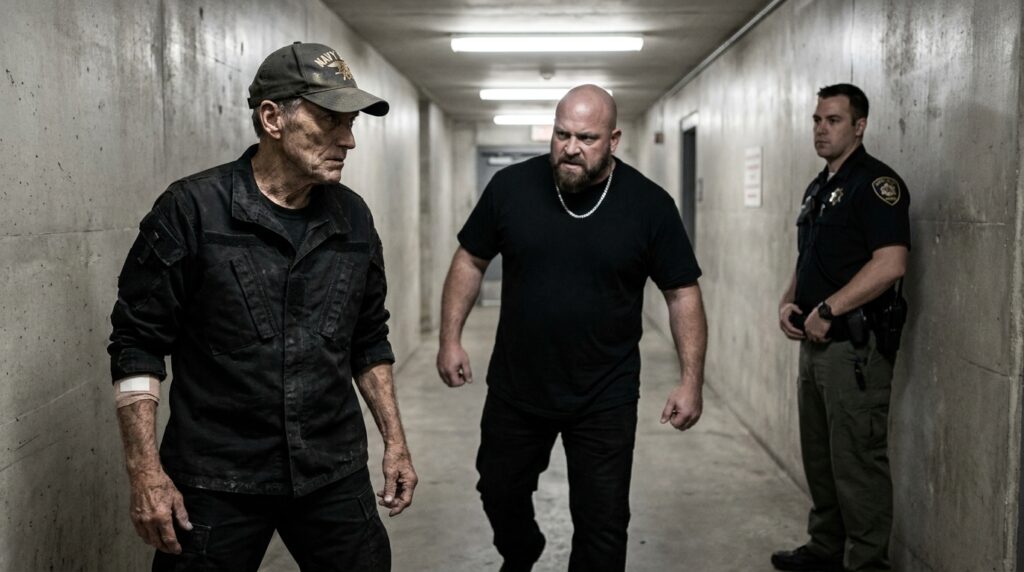
The fluorescent light overhead vibrated with a low, hydraulic hum, casting a dead, sickly hue across the concrete corridor. The air tasted of chemical bleach and old skin, heavy and completely still. John Vance did not look at the walls. He didn’t need to. His heels were locked precisely two inches from the baseboard, his spine holding a straight, rigid axis that his lower vertebrae disputed with a dull, throbbing ache. Beneath the rolled sleeves of his faded tactical shirt, his forearms looked like cured leather pulled tight over old iron pipes.

Two inches away, the air grew warm and smelled of stale grease.

“You’re in the wrong lane, old man,” Miller said. His voice was thick, wet with the unearned confidence of a man who had only ever fought people who were already afraid of him. He loomed, a four-inch advantage in height and sixty pounds of soft, heavy mass crowding into Vance’s peripheral vision. A thick steel chain rattled against Miller’s collarbone as he leaned in, his chest rising like a wall to choke out the corridor’s remaining light.

Vance kept his gaze fixed on the third button of Miller’s black shirt. He didn’t look up into the eyes. In a real engagement, eyes were a distraction—they showed intent too late. The shoulders, the set of the hips, the slight weight shift toward the left heel—those were the true indicators.

“Move,” Miller barked, his jaw tightening until his beard bunched up against his throat.

Along the opposite wall, the junior guard, a kid named Harris with a clean uniform and a baton that had never hit anything harder than an old mattress, leaned back. He didn’t move his hand toward his belt. He just smiled, a thin, cynical twitch of his lips that said he was perfectly content to watch fifty years of service get scrubbed off the floor by a career felon.

Vance let his breath out slowly, a quiet hiss through his nose. His left hand remained dead at his side, but his index finger twitched twice against his thigh, verifying his distance from the concrete floor.

“I’ve survived battles that would break most other people,” Vance said. The words didn’t come from his throat; they came from deep in his chest, gravelly and completely flat. There was no anger in them, no bravado. It was a statement of structural fact, like a weight-bearing rating stamped onto a steel beam.

Miller laughed, a short, sharp snort that sprayed a microscopic mist into the gap between them. “We’ll see about that.”

The big man’s right shoulder dropped three inches—the universal tell of a forward grab.

Before Miller’s thick, blunt fingers could touch the fabric of Vance’s shirt, the world moved. Vance didn’t strike; he dissolved. His left heel pivoted exactly forty-five degrees, shifting his center of gravity into the void Miller had just vacated. His right hand flared outward, his thumb hooking into the soft meat of Miller’s extended wrist, his fingers clamping down on the radial nerve like a pair of vice grips.

There was no sound of a blow. Only the heavy, wet thud of shifting mass and the dry snap of a joint being pushed past its engineered limit. Vance didn’t push; he simply let Miller’s own forward velocity finish the arc, guiding the larger man’s momentum downward until Miller’s face met the polished gray concrete with a sickening, flat slap.

Miller’s chain clattered violently against the floorboards. The big man lay there, his breath knocked completely out of him, his fingers twitching against the stone as his brain tried to process how the floor had risen to meet him.

Vance stood over him, his breath even, his Navy SEAL cap still sitting perfectly level across his lined brow. His old knee screamed with a sharp, burning white heat from the sudden pivot, but his face remained a mask of gray stone. He looked down at the guard.

Harris had frozen. His back was pinned flat against the brick wall, his hand hovering two inches above his security baton, his fingers trembling. The smirk was gone, replaced by the pale, empty stare of a man who had just watched a ghost walk through a locked door. The corridor was dead, absolute silence.

Vance reached down, his fingers catching a tiny, metallic gleam tucked deep inside the coin pocket of Miller’s dropped trousers—a standard-issue federal security bypass key, stamped with an administrative code that didn’t belong to this facility.


CHAPTER 2: THE COLD GEOMETRY OF THE ROOM

The bypass key was surprisingly heavy, its edges square and unpolished, biting into the meat of John Vance’s palm as he closed his fist. It was cold—colder than the air in the corridor, colder than the concrete floor where Miller’s chest still hitched in ragged, shallow gasps. Vance didn’t slide the metal into his pocket immediately. He let his thumb trace the laser-etched lettering across the face of the brass stub: SEC-SYS-09-ALPHA. That wasn’t bureau nomenclature. The Federal Bureau of Prisons didn’t use Greek designations for its electronic asset lockers; naval intelligence logistics did.

“Get your hands off your belt, son,” Vance said.

He didn’t turn his head to look at Harris. He kept his eyes on the heavy iron hinge of the block gate twelve feet ahead, but his voice cut through the damp air like a wire.

The guard’s boot leather scraped against the floorboards. Harris’s fingers, which had been twitching a fraction of an inch above the plastic grip of his baton, went completely still. The young man’s throat clicked as he swallowed hard, his posture flattening further against the cinderblock wall until the rivets on his utility belt groaned against the masonry.

“He… he lunged at you,” Harris stammered. His voice had lost its institutional weight, thinning out into the reedy cadence of a civilian who had suddenly realized the walls around him weren’t thick enough to keep the world out. “I have to log the use of force. I have to call the shift supervisor.”

“You won’t log anything yet,” Vance muttered. He finally turned his head, the brim of his faded Navy SEAL cap casting a sharp, triangular shadow across his nose. The lines around his mouth were deep, like channels cut into dry river stone by fifty years of high-pressure salt water. “Look at the floor. Does it look like a fight happened here?”

Harris looked down. Miller was rolling onto his side now, his large, bearded face stained purple where it had met the concrete, but there was no blood. No broken teeth. No evidence of a strike. The geometry of the takedown had been too clean, a mechanical redirection of mass that left the skin intact while the inner equilibrium remained shattered. Miller’s heavy chain lay coiled next to his ear like a dead snake.

“He fell,” Harris whispered, the lie tasting like ash but offering a path of least resistance.

“He tripped over his own weight,” Vance corrected flatly. He stepped forward, his left knee giving a distinct, dull pop that radiated a cold spike of white pain up into his hip. He didn’t let his shoulder drop. He carried the limp internally, locking the joints through sheer habit until the movement appeared seamless to the untrained eye. “Open the processing gate.”

“The desk sergeant has your intake file,” Harris said, his hand moving automatically toward the keycard reader beside the iron door, his movements jerky, uncoordinated. “They haven’t verified the detainer from the marshal’s office. You shouldn’t even be in this corridor yet.”

“Then let’s go help him verify it.”

The heavy electromagnetic lock released with a sound like a small pistol shot—a metallic clack that echoed down the narrow spine of the processing lane. Vance walked through before the steel door had even finished swinging home.

The intake room beyond was small, square, and illuminated by a single unshielded bulb that hummed at a frequency that made the back of Vance’s teeth ache. A desk sergeant with a soft belly and graying hair sat behind a three-inch slab of plexiglass, his eyes fixed on a monitor that flickered with green columns of old DOS-based data. On the counter beside him sat Vance’s personal effects: a water-damaged leather wallet, a brass pocket knife with the blade ground down from three decades of sharpening, and a small, empty patch of gray felt where his Submariner dive watch should have been.

Vance focused on the empty felt. The skin on his left wrist felt naked, abnormally light, the pale band of unexposed flesh reminding him with every pulse that his time was no longer his own.

The desk sergeant didn’t look up until Vance’s knuckles tapped against the plexiglass speaker grill.

“Vance, John,” the sergeant read off the screen, his voice nasal, bored. He reached for a plastic bin to slide the effects across the drop tray. “The system’s flagging your origin code. Says the routing manifest came through a non-standard terminal at Norfolk. I can’t assign you a permanent bunk until the logistics cell clears the transfer.”

Vance didn’t look at the sergeant’s face. He looked at the paperwork sticking out from beneath a heavy steel clipboard on the desk. The top sheet bore a circular stamp in purple ink—the same ink used on the security key currently burning a hole in his palm.

“Who signed the manifest?” Vance asked.

“Not your concern, Chief,” the sergeant said, finally looking up, his eyes narrowing as he noticed Harris standing two steps behind Vance, looking pale and holding his baton by the wrong end. “Something wrong out there, Harris?”

“Nothing,” Vance said before the boy could speak. He reached into the drop tray, his fingers wrapping around the brass pocket knife and his wallet, his hand masking the movement as he slipped the brass security key onto the metal counter, sliding it precisely beneath the edge of the purple-stamped intake sheet. “The sergeant was just about to tell me why a maritime transport detainer is being routed through an inland processing block.”

The desk sergeant stared at Vance, his eyes dropping to the sheet, then down to the small piece of brass that had just appeared beneath the paper. His boredom vanished. His jaw went rigid, the soft fat beneath his chin tightening as his fingers moved away from the computer keyboard. He didn’t look at Harris. He didn’t look at Vance. He looked at the key, recognizing the stamped code SEC-SYS-09-ALPHA with the immediate, defensive alertness of a man who had just found a live grenade in his desk drawer.

“Harris,” the sergeant said, his voice dropping an octave, losing its bureaucratic drone. “Take the other detainee back to the holding cells. Now.”

“But Sergeant, Miller’s still on the floor—”

“I said now, officer,” the sergeant snapped, his hand covering the purple-stamped sheet, concealing the key beneath his palm.

The door behind Vance began to click, the internal relays hummed, and the light on the wall shifted from green to a steady, warning amber. Someone else was accessing the floor from the administrative elevator at the far end of the room, and the sound of heavy, vibram-soled tactical boots began to echo through the ventilation shaft.

CHAPTER 3: THE STRATEGIC MISDIRECTION

The green indicator light above the administrative elevator died, replaced by a harsh, rhythmic amber pulse that bathed the room in mechanical shadows. The machinery groaned, steel cables scraping inside the concrete shaft as the platform settled behind the heavy security door. John Vance didn’t turn his back on the desk sergeant. He stood perfectly still, his weight evenly distributed over his good right leg, his fingers resting casually on the edge of the glass tray where his pocket knife lay.

“Harris,” the sergeant barked again, his face losing its flat gray color, turning a blotchy, panicked red. His hand remained pressed flat against the purple-stamped routing manifest, completely covering the brass security key. “Get that man out of the intake lane. Now.”

Harris didn’t move fast enough. The boy was staring at the elevator door, his mouth slightly open, his fingers white where they gripped the leather of his holster. Vance could hear the specific cadence of the footsteps inside the elevator before the pneumatic seal broke—three sets of boots, heavy, synchronized, the distinct sound of nylon tactical gear rubbing against ceramic chest plates. Not local marshals. The stride was too wide, the footing too aggressive. These were operators trained for aggressive entries, their movements carrying the specific, sharp precision of an active retrieval team.

“They’re early,” the sergeant muttered, his gaze shifting from the screen to Vance’s lined face.

“They’re exactly on time for what they think is an easy pickup,” Vance said, his voice dropping into a low, gravelly rasp that barely cleared the plexiglass speaker grill. He didn’t look at the elevator. He kept his eyes locked on the sergeant’s right hand. “But you’ve got a routing slip from Norfolk that doesn’t match the federal registry, and you’ve got a key under your palm that says someone’s running an unauthorized bypass on your security net. If those doors open and I’m standing here in standard processing, your name goes on the bottom of that manifest. You know how these logistics cells clean up their paper trails.”

The sergeant’s fingers twitched against the paper. The logic hit him exactly where Vance intended—not as a threat, but as a calculation of institutional survival. In the black-budget pipelines, the clerk who stamped the wrong box was always the first asset to be liquidated from the ledger.

“The medical bay,” the sergeant whispered, his index finger sliding the brass key back across the metal drop tray toward Vance’s hand. “Behind the intake desk. There’s a secure diagnostic suite with an independent magnetic lock. They don’t have the override codes for the medical block on the standard transport manifest.”

“Give me the file,” Vance said, his hand closing over the brass stub and his pocket knife in a single, fluid motion.

The sergeant hesitated for the fraction of a second it took for the elevator’s primary pneumatic seal to hiss open. Then, with a quick, desperate jerk of his wrist, he shoved the purple-stamped intake folder through the narrow slot at the bottom of the plexiglass. “Get out of the lane.”

Vance didn’t run. A tactical retreat required the same steady cadence as an advance; any sudden increase in velocity would trigger Harris’s defensive instincts or draw the attention of the arriving team through the glass window. He gripped the edge of the folder against his thigh, using his large frame to shield it from Harris’s line of sight, and stepped backward into the shadow of the rear corridor wall. His left knee screamed with every step, the joint dry and swollen from the strain of the corridor takedown, but he kept his posture rigid, his shoulders square beneath the tactical shirt.

“Harris,” Vance said, his voice carrying the calm, absolute authority of a commanding officer in an active theater. “Secure the rear door. Don’t look back at the desk.”

The boy turned instantly, his automated military background overriding his civilian training at the sound of the command tone. He stepped into the frame of the medical bay access door, his body blocking the view from the primary intake vestibule just as the heavy elevator door slid back into its steel recess.

Through the smoked glass of the partition, Vance watched three figures step onto the floor. They wore desaturated gray tactical uniforms without agency patches or nametags, their faces obscured by low-profile ballistic helmets and dark protective visors. The leader carried a short-barreled carbine held at a perfect low-ready position, his movements fluid, calculated, and entirely devoid of the standard hesitation common to municipal law enforcement.

The leader stepped directly to the desk sergeant’s window, the hard muzzle of his weapon tapping once against the plexiglass with a sharp, crystalline click.

“Detainee Vance,” the leader said, his voice muffled by the speaker system but carrying a cold, flat finality. “Where is the intake file?”

Vance didn’t wait to hear the answer. He slid through the door into the medical bay, his eyes already scanning the layout of the narrow, white-tiled room. The air here was colder, smelling of rubbing alcohol and stale ozone from an old sterilization unit. A steel examination table sat in the center of the floor, its leather padding cracked and worn down to the yellow foam beneath.

He didn’t look for medicine or supplies. He moved directly to the small electronic terminal mounted beside the secondary diagnostic door. The keyhole beneath the digital keypad was square, its interior cut with four precise, vertical grooves that matched the brass key in his hand.

Vance inserted the key. The terminal didn’t beep; instead, a low, mechanical hum vibrated behind the drywall as the magnetic deadbolts retracted, but the screen didn’t display a medical status. It flickered twice, then initialized an entirely separate data layer, displaying a series of encrypted manifest columns labeled PROJECT HORIZON – RETIRED ASSET ROUTING.

At the top of the screen, beneath a blinking terminal prompt, a single name was listed under the current transit log: MASTER CHIEF H. ROURKE – STATUS: PROCESSING.

Vance’s hand went completely rigid on the key. Rourke had been missing for two years, officially designated as a casualty during a non-attributable maritime operation in the Mediterranean. He wasn’t dead. He was three floors below this desk, trapped in the same institutional pipeline that had just tried to close around Vance.

Behind him, the heavy wooden door to the intake room splintered as a tactical boot struck the frame.

CHAPTER 4: THE PROPERTY VAULT BREACH

The second impact didn’t just rattle the wood; it sheared the cheap brass latch straight out of the frame. Splinters drifted through the cold air like snow, catching the white light of the medical bay before settling on the tile. John Vance didn’t flinch. He had already memorized the trajectory of the door’s swing. He pulled his hand cleanly from the secondary diagnostic terminal, leaving the blinking terminal screen active, a glowing green beacon designed to capture the retrieval team’s immediate focus.

“Harris,” Vance said, his voice dropping into that tight, unyielding gravel that tolerated no debate. “Floor.”

The young officer didn’t look back to check Vance’s position. The sheer mass of the tactical breach behind them was enough to make his internal survival matrix make the choice for him. Harris dropped, his knees clattering hard against the white tiles, his arms locking over the back of his neck as the door frame finally gave way entirely.

A gray-clad operator burst through the opening, the short muzzle of his carbine snapping down to cover the center of the room. The weapon swung toward the glowing terminal screen—exactly as Vance had calculated.

Vance was already moving along the blind side of the door’s arc. His old knee ground like sand inside a dry bearing, a deep, nauseating ache that radiated into his hip, but he used the momentum of his falling weight to drive his elbow backward. The hard, angular bone caught the operator directly beneath the lower edge of his ballistic visor, striking the mandibular nerve with the force of a hammer.

The man didn’t scream. His breath left him in a wet, metallic whistle as his head snapped back against the door frame. His grip on the carbine loosened just enough for Vance to clamp his forearm down on the weapon’s optical sight, forcing the muzzle toward the floor before the operator’s trigger finger could complete its automated sequence.

The weapon fired once—a muffled, compressed thwip that shattered a bottle of saline on the counter, sending a shower of glass and sterile water across the floorboards.

Vance didn’t try to take the rifle. In a closed space against multiple entry elements, committing both hands to a weapon struggle was a death sentence. Instead, he ripped the small, purple-stamped intake folder from his waistband and shoved it directly into the operator’s visor, blocking his vision for the single micro-second required to step past him. He reached down, grabbed the loop of Harris’s heavy duty belt, and dragged the dazed young guard through the open threshold of the property vault at the back of the medical bay.

The vault door was a solid slab of reinforced steel, held by an older mechanical deadbolt that didn’t rely on the central security grid. Vance slammed it shut, throwing his weight against the iron wheel until the internal rods dropped into the masonry with a heavy, final thud.

The air inside the vault was completely dead. It smelled of preserved cardboard, old copper coins, and the heavy plastic sheen of confiscated property bags. Rows of metal shelving stretched into the dark, illuminated only by a faint, amber safety strip running along the floor.

“They’re going to bypass the hinges,” Harris whispered, his voice cracking as he leaned against a shelf of canvas inmate sacks. He was bleeding from a tiny scratch on his cheek where the saline glass had flying-cut him. “They have mechanical cutters in those gear bags. I saw them.”

“They have to find the right breaker first,” Vance muttered. He didn’t look at the door. He was already moving down the central aisle of shelves, his fingers tracing the plastic labels attached to the heavy security bins. Each bin was marked with an intake date and a barcode, but three cages at the very back were wrapped in heavy steel wire, secured with a separate, non-standard padlock.

Vance reached into his pocket and pulled out the brass key he had taken from Miller. The code SEC-SYS-09-ALPHA matched the small, circular plate on the side of the center cage. He turned the key, the internal tumbler releasing with a sharp, dry click.

Inside the bin lay a single, heavy Pelican case—the kind used for transporting high-grade military encryption modules. It wasn’t inmate property. It was marked with the logistics seal of the Norfolk Maritime Command, but someone had hand-scrawled a secondary tracking number across the top in permanent marker: H. ROURKE – RET-04.

Vance popped the heavy plastic latches. The interior wasn’t filled with Rourke’s personal effects. Tucked into the custom-cut foam was a small, black tactical transponder, its power light pulsing a steady, rhythmic green. Beside it sat a stack of unredacted operational manifests detailing the systematic transfer of seven other retired specialized operators from various military hospitals directly into this federal facility over the last eighteen months.

It wasn’t an administrative error. It was a harvest.

“Chief,” Harris said, his boots crunching on the dry floor as he crept up behind Vance. “What is that? That doesn’t look like processing gear.”

“It’s a decoy,” Vance said, his face hardening as he picked up the transponder. His thumb traced the small, silver seal on the base of the device. The transponder was actively broadcasting an tracking beacon, but the destination wasn’t an external rescue node. The data loop was being routed directly through the building’s own internal communication trunk.

The realization hit Vance with the cold precision of a sniper’s bullet. The transponder had been placed here to be found. Whoever was running this facility wanted Vance to break into this vault; they wanted him to find Rourke’s supposed location parameters so they could trap him within the lower subterranean levels of the cell block under the guise of an attempted escape.

Before Vance could drop the device, the amber safety strip along the floorboards blinked out, plunging the vault into absolute, velvety darkness.

Through the thick steel of the vault door, the muffled, high-pitched whine of a hydraulic circular saw began to chew into the upper hinge.

CHAPTER 5: THE TACTICAL TRUCE

The pitch darkness inside the property vault was absolute, a heavy, suffocating weight that wiped out every visual reference. John Vance didn’t move an inch. He closed his eyes—a counterintuitive rule of night operations, ensuring that if a flash-bang or high-intensity tactical light broke the threshold, his retinas wouldn’t burn out through open lids. He tracked the environment purely by texture and vibration. The bottom of his boots registered the high-frequency vibration of the circular saw eating through the steel hinge outside.

Skrrr-chhhh.

The tone of the grinding friction changed, shifting from a hollow ring to a dense, low rattle. They were through the first plate. They had exactly ninety seconds before the second hinge sheared.

“Chief,” a voice rasped from the dark to Vance’s left. It wasn’t Harris. The cadence was deeper, heavier, the throat tight with the specific, rhythmic breathing of someone fighting back systemic physical shock. “Chief. I know you’re in here.”

Vance didn’t answer. He let his thumb slide over the cold, serrated lock of his brass pocket knife, the blade remaining folded inside the housing. He adjusted his weight by a fraction of a millimeter, shifting his center away from the aisle shelves.

“It’s Miller,” the voice whispered again. A boot leather heel dragged against the concrete floorboards, a slow, painful scrape. “The kid guard left the rear corridor gate unlatched when he dragged you in. The gray uniforms… they didn’t clear the intake cells. They don’t care about the block registry. They shot the desk sergeant, Vance.”

The information registered like a cold needle in Vance’s calculation index. The desk sergeant was dead. That meant the paper trail was already being burned behind them. This facility wasn’t processing people; it was scrubbing them off the grid.

“Harris,” Vance said, his gravelly voice low enough to barely carry across the row of property bins. “Where are you?”

“Back… back wall, Chief,” Harris’s voice cracked from twenty feet away, thin and trembling. “I can’t see my hands.”

“Stay down. Keep your mouth shut.” Vance let his hand move through the blackness until his fingers brushed the cold, textured canvas of an inmate property sack on the middle shelf. He reached inside, his knuckles hitting a heavy, iron pad-eye—the kind used for securing maritime cargo nets during transit. It weighed roughly four pounds. Sharp corners. Solid metal.

“Miller,” Vance said into the dark, projecting the sound toward the center aisle to mask his own lateral movement. “Can you hold a line?”

“My left arm’s dead from where you dropped me,” Miller rasped, his breath hitching as he moved closer. “But I can use my mass. Tell me where to stand.”

“They’re going to punch the top hinge in thirty seconds,” Vance stated flatly. His mind mapped the room as a grid of kinetic vectors. “When the door blows, they won’t use white light immediately. They’ll drop an infrared canister to clear the aisle with thermal optics. If you’re in the center line, you’re a silhouette. Move three feet right. Put your back against the steel cage.”

“Why should I trust you?” Miller muttered, though the sound of his heavy frame shifting through the dark confirmed his compliance. “You broke my wrist.”

“Because I’m the only person in this building who isn’t planning to put you in a trench,” Vance said.

The saw outside cut out with a sudden, sharp whine. The silence that followed was heavy, broken only by the distinct clink-clink of a mechanical tension tool adjusting the pressure on the vault door’s primary locking bar.

Vance gripped the iron pad-eye in his right hand. His left knee burned with a steady, liquid fire, a reminder of seventy-eight years of mileage that his mind ruthlessly pushed into the background. He didn’t have the speed for a prolonged hand-to-hand engagement against three fresh operators in body armor. He had exactly one move, and it relied entirely on using their own automated entry protocol against them.

A violent bang shattered the front of the vault. The top hinge gave way with a sound like tearing tin, the heavy steel door tilting inward until it caught on the lower deadbolt with a screaming metallic groan.

Through the two-inch gap at the top of the frame, a small, cylindrical canister clattered onto the concrete floorboards. It didn’t flash; it hissed, a faint, sweet smell of chemical aerosol filling the air as a thick cloud of specialized particulate matter began to billow through the darkness.

Vance knew that aerosol. It wasn’t tear gas. It was a thermal-density agent designed to stick to clothing, making targets glow like phosphorus torches through the gray-clad retrieval team’s digital visors.

“Don’t move,” Vance whispered toward Harris. “Don’t wipe your clothes.”

The lower hinge blew next. The door fell flat onto the vault floor with a massive, deafening thud that shook the metal shelving until property bags rained down into the dark.

Immediately, a cold, bluish lens-flare sliced through the opening—the active infrared illuminator of the lead operator’s helmet-mounted system. To the operator, the vault aisle was a corridor of pure light, and Vance was standing dead center, his clothing fully coated in the thermal particulate.

The short muzzle of the carbine rose.

Vance didn’t step back. He lunged forward, his right foot striking the flat surface of the fallen steel door, using the slick metal to slide his weight beneath the operator’s line of sight. As the carbine fired—three compressed, rhythmic thwips that tore through the canvas bags behind him—Vance swung the iron pad-eye upward with everything left in his shoulder.

The heavy iron caught the underside of the operator’s weapon frame, driving the barrel toward the ceiling. The force of the impact jarred Vance’s wrist, a sharp crack of pain echoing in his elbow, but he didn’t stop the momentum. He used his left hand to grab the operator’s nylon equipment harness, pulling himself upward until his face was two inches from the dark visor.

Through the smoked glass, he could see the tiny, green micro-displays reflecting against the operator’s eyes.

“You’re out of your depth, son,” Vance growled.

He drove his forehead straight into the visor. The heavy ballistic plastic didn’t break, but the internal mounts sheared, driving the screen directly into the man’s nose with a wet, heavy crunch. The operator staggered backward, his boots tangling in the straps of a property sack, his hands flailing as his digital vision went completely black from the broken display.

Behind him, the second operator was already stepping over the threshold, his weapon clear, his visor tracking the thermal signature of Miller’s massive form against the side cage.

CHAPTER 6: THE ADMINISTRATIVE STANDOFF

The blue glow of the second operator’s infrared illuminator swept across the wire mesh cage, locking onto the broad, glowing shape of Miller’s shoulders. The carbine’s muzzle followed the beam, the weapon rising with automated precision. Miller was too heavy, too injured from his initial floor impact to drop or roll clear.

John Vance didn’t have the leverage to throw another four-pound cargo eye. He used the body of the first operator.

With a sharp, downward wrench of his forearms, Vance twisted the nylon shoulder webbing of the blinded man he was holding, driving his foot hard into the back of the man’s knee joint. The operator collapsed backward like an unanchored pillar, his full deadweight crashing directly into the path of the second man’s advancing stride. The collision was a chaotic crunch of ceramic plate against ceramic plate, a dull, metallic clank that disrupted the second man’s shooting platform just as his finger compressed the trigger.

Three rounds erupted into the darkness, but the recoil arc was thrown wide. The bullets tore into the steel framing of the property bins, spitting yellow sparks and jagged copper fragments into the aisle.

Vance didn’t pause for the dust to settle. He used the momentum of the falling bodies to drive himself out of the vault threshold, his right boot clearing the fallen door, his bad left knee grinding with a wet, sickening pop as he forced his frame into the wider, open space of the medical bay. He needed the administrative terminal. He needed to lock the elevator shaft from the inside before the third operator, still guarding the rear exit vestibule, could establish a crossfire position.

“Harris,” Vance barked, his gravelly voice cutting through the deafening ringing left by the muzzle blasts. “The terminal. Punch the master override.”

Harris was already moving. Fear had stopped paralyzing him and shifted into raw adrenaline. The boy scrambled across the wet, tile floor, his hands slick with saline fluid and splintered wood, his fingers hitting the plastic keys of the diagnostic unit. The screen flickered violently as he slammed his palm onto the manual lock-out relay.

Behind them, the high-frequency clack-clack-clack of a tactical radio headset signaled the third operator’s movement. A cold, detached voice whistled through the static of the open channel: “Asset is breaking containment. Move to Phase Two protocol.”

The administrative elevator door at the far end of the intake desk didn’t close; instead, it began to slide open further, its internal emergency overrides clicking as a manual key was turned from the upper level. The heavy, measured thud of leather boot soles echoed from the shaft, but these weren’t tactical boots. The rhythm was slower, heavier—the deliberate pace of an individual who controlled the architecture of the building.

A single figure stepped into the blinding glare of the intake room’s unshielded fluorescent bulbs.

He didn’t wear a helmet or gray nylon armor. He wore a crisp, tailored federal marshal’s uniform, the gold star on his leather breast-badge reflecting the harsh light with a sharp, geometric edge. His hair was iron-gray, cropped close to his skull, his face flat and expressionless, like a ledger page. In his right hand, he carried a heavy-barreled Colt revolver, held loosely at his side, the muzzle pointed at the floor boards.

“Stand down, Master Chief,” the man said. His voice was completely calm, devoid of the operational urgency of the retrieval team. “You’ve verified the transponder. You’ve looked at the manifest. Let’s not make the clean-up any more expensive than it needs to be.”

Vance stopped five feet from the plexiglass partition. His chest rose and fell in slow, deliberate expansions, his right hand resting flat against his thigh, his fingers still wrapped around the folded brass pocket knife. He looked through the shattered pane where the desk sergeant’s body had been pulled clear of the desk.

“You’re out of Norfolk, Marshal,” Vance said, the words coming flat from his chest. “The routing numbers on your processing sheets belong to a deactivated maritime security cell. You aren’t executing a federal detainer. You’re running a black-site pipeline.”

The marshal didn’t deny it. He didn’t offer a villainous speech or attempt to justify the dead bodies on the floor. He simply raised the heavy revolver by two inches, his thumb drawing the hammer back with a distinct, triple-click that sounded like ice cracking under a boot.

“The country doesn’t have a budget for retired specialized foreign-theater assets who know where the old coal was buried, John,” the marshal said softly. “The system requires a clean margin. Rourke understood that before we brought him down to Layer Four. You’re just a line-item that refused to balance.”

Behind Vance, the two operators inside the property vault were already recovering, the scraping sound of their tactical gear against the splintered wood of the door signaling their imminent realignment. Harris was backed against the terminal, his eyes darting between Vance’s rigid shoulders and the marshal’s steady weapon barrel.

“You think you locked Layer Four?” Vance muttered, his voice dropping into a register so low it was almost lost beneath the hum of the light bulbs.

“I know I did,” the marshal replied. “The network is fully isolated.”

“Then you should have checked the serial number on the transponder you left in the bin,” Vance said. He didn’t look down at his naked left wrist, but his index finger moved in a tiny, circular pattern against his seam. “The tracking array wasn’t a broadcast beacon. It was a secondary validation loop. Every time your operators hit the security override keys with that alpha stamp, they unsealed the naval intelligence logistics trunk at the department level.”

The marshal’s left eyebrow twitched by a fraction of a millimeter—the first break in his professional composure. His eyes drifted to the glowing screen behind Harris, where the project manifest columns had suddenly frozen, replaced by a blinking red notification text that read: CRITICAL SYSTEM DISRUPTION – EXTERIOR INTERVENT.

From the corridor behind the administrative elevator, the distant, muffled thud of heavy, synchronized rotors began to vibrate through the concrete masonry of the ceiling, shaking the dust from the fluorescent light fixtures.

CHAPTER 7: THE REVERSED CORRIDOR

The rhythmic thud of the low-altitude rotors outside grew dense, a heavy, air-compressing throb that forced the plexiglass panels of the intake room to rattle inside their rubber gaskets. The marshal’s finger remained locked against the trigger of his heavy Colt revolver, but his center of gravity shifted. His shoulders tightened beneath the crisp wool of his uniform jacket, his sharp gray eyes darting toward the ceiling where flakes of ancient white plaster were beginning to sift downward like dead skin.

“A validation loop requires an external relay, John,” the marshal said, his voice flat, rejecting the shift in parameters through pure institutional stubbornness. “The trunk lines in this district are entirely dead-copper. Nothing leaves this floor.”

“The transponder didn’t use the district trunk,” John Vance stated. He didn’t rise from his stance, keeping his bad left knee locked out to prevent the joints from buckling under the increasing gravitational pressure of the room. He reached down slowly, his fingers pressing against the edge of the glass partition, tracing a long, jagged crack in the laminate. “It didn’t need to. Your operators brought three encrypted satellite links inside their tactical gear blocks when they breached the processing lane. The moment they turned on their visors, they gave my old unit a direct line-of-sight signal straight down the shaft.”

Behind Vance, the door of the property vault groaned. The first operator staggered out, his nose a crushed purple line behind his cracked visor, his hands blindly tracing the tile wall for support. The second man followed, his short carbine held low, his infrared illuminator casting an erratic blue circle across the ceiling as his internal software tried to recalibrate against the system-wide lockout flashing on the monitor.

“Marshal,” the second operator rasped, his voice vibrating with a sharp edge of panic. “The elevator relays are fried. Someone’s blowing the primary breakers from the substation block.”

The unshielded fluorescent lightbulbs overhead died with a final, metallic pop. For a fraction of a second, the room fell into absolute darkness, save for the blinking red text on the diagnostic screen behind Harris: CRITICAL SECURITY BREAK – EXTERIOR AUTHORIZED ENTRY.

Then, the emergency auxiliary lights kicked in—not the dim amber safety strips of the prison infrastructure, but the stabbing, high-intensity white beams of tactical searchlights cutting straight through the smoke-filled ventilation grates from the roof structure.

The heavy steel door of the primary intake block tore inward with a deafening, hydraulic crack.

A dozen figures flooded the corridor, their movements a seamless extension of the same elite geometry Vance had used to neutralize Miller. They wore the dark, desaturated navy uniforms of the Naval Criminal Investigative Service specialized response unit, their long-barreled rifles held at a flawless high-ready position, their visors clear and transparent under the glaring white beams.

At the center of the formation stood a woman in her late fifties, her dark hair pulled tight into a regulation bun beneath a black ball cap. She wore a tailored wool trench coat over a high-ranking naval intelligence uniform, her shoulder boards gleaming with the gold braid of a rear admiral. She didn’t look at the gray-clad retrieval operators or the dead desk sergeant. Her eyes locked directly on the faded Navy SEAL cap sitting level across Vance’s lined brow.

“Step back, marshal,” Admiral Torres said, her voice cutting through the hum of the auxiliary generators with the sharp, transactional chill of a command deck. “Your detainer has been unsealed by the department. You’re out of your depth.”

The marshal’s hand remained raised for three long beats, the heavy hammer of the Colt still drawn back. He looked at the gold star on his breast-badge, then at the twelve rifle muzzles pinned precisely to the center of his chest plate. Slowly, with the deliberate, heavy friction of a man who knew his name was being systematically erased from the federal ledger, he lowered the weapon and placed it flat on the counter.

“You’re protecting a ghost, Admiral,” the marshal said, his face returning to its expressionless gray baseline as two agents stepped forward to strip his leather belt. “The pipeline was authorized three levels above your desk.”

“The pipeline was an unauthorized hemorrhage,” Torres replied flatly. She didn’t look at him as he was led toward the open administrative elevator shaft. She stepped through the shattered partition, her leather shoes crunching softly on the fragments of glass and wood splinters until she stood exactly two feet from Vance.

Vance let his breath out through his nose, his shoulders relaxing by a fraction of an inch, though his spine remained a straight, rigid line. He reached into his pocket and placed the brass pocket knife and the confiscated key on the counter beside the marshal’s dropped revolver.

“Rourke is on Layer Four,” Vance said, his gravelly voice dropping into its flat, operational register. “They’ve got seven others down there. They were prepping them for non-attributable transit.”

Torres looked at the diagnostic terminal screen, her eyes tracing the hand-scrawled tracking label H. ROURKE – RET-04 before she nodded once to her tactical lead. “We’ve already secured the subterranean elevator block, Master Chief. The medical retrieval teams are moving down now.”

She looked back at Vance, her gaze softening by a minuscule margin as she noticed the deep, rhythmic hitch in his breath from his swollen left knee. She reached into her pocket and pulled out a heavy, steel-banded Rolex Submariner dive watch, its face scarred with a deep scratch across the glass from an old Mediterranean deployment. She placed it in his hand, the metal band still retaining the faint warmth of her uniform pocket.

“The processing overreach ends here, John,” Torres said softly, her voice dropping below the operational din of the room. “The uniform changes, but the training never leaves the bone. Let’s get our people home.”

Vance looked down at the watch, his thumb tracing the pale, unexposed band of skin on his left wrist before he slid the heavy metal housing back over his joint, clicking the safety latch home with a sharp, final snap. He looked back down the long, narrow iron corridor where Miller was sitting up against the wall, holding his broken wrist while a naval corpsman tended to his shoulder. The room was silent now, the unearned arrogance of the facility broken down to its raw concrete foundations.

CHAPTER 8: LAYER FOUR

The subterranean elevator didn’t drop; it shuddered downward through the concrete shaft with a rhythmic, mechanical groan that vibrated straight through the soles of John Vance’s boots. The auxiliary power grid was straining, the light inside the steel cage flickering between a dim, unshielded white and the dull, desaturated crimson of an emergency battery loop. The air here was different than the upper processing blocks—it was dense, freezing, and carried the thick, bitter stink of oxidized iron and stagnant, subterranean brine.

Clunk.

The cage stopped with a violent, metallic jolt that sent a white-hot needle of pain shooting straight from Vance’s left heel into his lower vertebrae. He didn’t drop his stance. He reached down, his fingers clamping onto the cold, rusted surface of the manual door lever, his palm catching the gritty texture of flaking rust. Beside him, Admiral Torres held a short-barreled tactical light under the receiver of her weapon, the clean white beam slicing through the wet mist rising from the floorboard slats.

“The hydraulic lines are down,” Torres said, her voice dropping into a tight, quiet rasp that was nearly swallowed by the rhythmic drip-drip of water leaking from the shaft walls. “The facility director isn’t trying to hold the gate anymore, John. He’s dumping the main storage tanks into the lower conduit to wash out the ledger.”

“He’s thirty years too late to learn how to clean a deck,” Vance muttered.

He threw his weight against the iron lever. The rust inside the housing ground together with a dry, screaming screech before the steel mesh doors popped back into their recesses.

The world beyond the gate didn’t look like a federal building. It was an old, wartime coastal artillery bunker, repurposed and reinforced with three-inch slabs of desaturated steel-blue plate that were now weeping moisture. The corridor ahead was narrow, the ceiling curved like the interior of a submarine hull, and the floor was entirely submerged under four inches of murky, gray-green water that swirled with grease rings.

Vance stepped out, his boot breaking the water with a heavy, flat splash. The cold hit his ankles instantly, a sharp, numbing chill that actually helped dull the throbbing ache in his swollen knee. He looked down the lane. A row of low, iron-riveted cell doors stretched into the darkness, each one fitted with a small, rectangular observation slit that had been welded shut from the outside.

“They aren’t cells,” Vance said, his thumb tracking the hard, square edges of his newly returned Rolex Submariner watch. The glass was cold against his skin. “They’re dry-dock storage vaults. They built this pipe out of an old maritime depot.”

“Rourke’s tracking signal is coming from the terminal room at the end of this spine,” Torres said, her light beam sweeping across a rusted brass junction box on the wall. A hand-painted number 4 had been scrubbed off the metal, replaced by a stenciled logistic code: SYS-LOG-DIST-00.

Beneath the box, half-submerged in the swirling gray water, lay a small, forgotten object. Vance reached down, his thick, corded fingers breaking the surface to retrieve it. It was an old navy-issue brass compass, its glass face cracked, its brass casing deeply pitted with green verdigris. When he wiped the silt from the backplate, his thumb hit an engraved emblem—a trident crossed with a surveyor’s transit, the unlisted seal of their original deep-cover detachment.

Rourke had been here. He’d left a breadcrumb the only way an old operator knew how—by discarding a piece of survival gear that didn’t exist on any standard military manifest.

“Chief,” Harris whispered from the rear of the team, his boots sloshing unsteadily through the current. He was carrying a backup security baton and a spare radio block, his face pale under the white tactical lights. “The water’s rising. It’s up an inch since we left the cage.”

“Maintain the interval, son,” Vance growled without looking back. “Watch the seams where the wall meets the floorboards. If you see bubbles, it means the primary drainage lines are backing up from the harbor side.”

The team advanced in a tight, three-man tactical wedge, their weapons covering the dark upper angles of the curved ceiling. The sound of their progress was an unbroken chain of wet friction—the heavy slosh of boots, the rhythmic click of gear harnesses, and the steady, automated breathing of men trained to move through high-pressure voids.

At the sixty-foot mark, the corridor widened into a square, low-ceilinged vault dominated by a massive, hydraulic pressure hatch. The steel surface was covered in bubbling, rusted scale, and a large digital readout above the wheel was dead, its housing cracked open to reveal a nest of charred, melted copper wires.

Someone had manual-locked the wheel from the far side, driving a heavy iron pry-bar through the spoke rings to freeze the mechanism.

Through the thick, laminated glass of the hatch’s viewport, a single unshielded emergency bulb flickered. Beneath it, sitting cross-legged on a wet wooden bench, was a man in a tattered gray utility uniform. His hair was a long, tangled knot of silver, his face covered in a thick, unkempt beard that hid the deep scar running from his left ear to his collarbone.

It was Master Chief Rourke. He wasn’t looking at the door. He was staring at his own bare, pale wrist, his fingers moving in a slow, phantom circle over the skin where his watch used to be, his lips moving as he repeated a silent, unvarying count against the dark.

Behind Vance, a heavy, wet thunk echoed from the elevator shaft. The cables had finally given way, and the steel cage fell through the dark, sealing their only vertical exit path with a deafening, distant crash of grinding metal.

CHAPTER 9: THE CORROSIVE ISOLATION

The shockwave of the elevator’s crash traveled up the concrete shaft as a dull, subterranean thud that rippled through the gray-green water, sending a series of dirty, oil-slicked rings sloshing against John Vance’s shins. The iron floor grates groaned beneath the sudden atmospheric displacement. Vance didn’t look back toward the shaft. His boots were already locked into a wide, defensive stance at the base of the massive hydraulic pressure hatch, his palms flattening against the cold, scaling rust of the perimeter seal.

“The elevator’s gone,” Harris whispered, his voice thin, jumping an octave as he backed up against a rows of rusted conduit pipes. He gripped the backup security baton with both hands, his fingers turning a pale, bloodless white. “Chief, we’re sealed in. We’re six floors down and the water is rising faster.”

“The water isn’t the problem, son,” Vance said, his gravelly voice dropping into a flat, level register that brooked no panic. “The volume is coming from the primary ballast trunk. Someone opened the secondary sea-chests to drown the registry. If we don’t clear this wheel before the head pressure equalizes, the iron will warp inside the track.”

He didn’t check his Rolex Submariner. The rhythmic, mechanical drip of brine from the ceiling was clock enough. Vance reached into the dark gap between the door frame and the heavy lock wheel, his fingers tracing the contours of the iron pry-bar that had been driven through the spokes. The metal was pitted, rough with layers of corrosive salt scale that tore into the skin of his knuckles as he verified the leverage angle.

“Torres, hand me the sling strap off your carbine,” Vance ordered.

The Admiral didn’t ask for a tactical rationale. She snapped the heavy nylon webbing clear of her weapon’s receiver and shoved it into Vance’s palm. Vance looped the nylon twice around the base of the pry-bar, creating a improvised high-tension wrap, then braced his good right heel against the concrete frame. His left knee screamed, the joint dry, swollen, and clicking with a deep, grinding friction that radiated directly into his hip block, but he locked the bone through sheer automated discipline.

“On my mark,” Vance growled. “Pull the top spoke.”

Torres threw her weight onto the iron wheel, her boots slipping on the wet masonry before her soles found purchase against a rusted drainage rim. Vance threw his shoulder into the nylon strap, pulling upward with the explosive, mechanical leverage of a man who had spent forty years hauling iron cargo lines out of deep water.

Skrrr-tack.

The pry-bar didn’t slide out; it sheared cleanly at the stress point, the rusted iron fragment snapping with a sound like a pistol shot before clattering into the gray current. The lock wheel spun backward three inches, its internal gears grinding together with a wet, heavy rattle that sent a shower of black iron filings into the foam.

Through the laminated glass of the viewport, Master Chief Rourke didn’t move. He sat perfectly still on the wet wooden bench, his silver beard matted against his collarbone, his eyes still fixed on the pale, naked patch of skin on his left wrist. He was still counting. His lips moved in that silent, unvarying rhythm—a phantom watch keeping time in a room where the air was running out.

“Rourke,” Vance barked, his knuckles rapping hard against the reinforced glass. The sound was flat, deadened by the density of the iron plate. “Rourke, look at the alignment. We’re unsealing the track.”

The old man inside didn’t lift his head. His fingers simply tightened their grip on his bare wrist, his thumb digging into the tendons until the skin turned a bloodless gray. He wasn’t ignoring them; his internal architecture had been broken down by eighteen months of systematic, sensory isolation until the outside world no longer possessed the specific data parameters required to register as real.

“He’s institutionalized, John,” Torres said, her voice tight as she wiped a streak of rusty condensation from her visor lens. “The logistics cell didn’t just lock him away. They ran a continuous psychological rotation on him to dissolve his operational memory. He thinks the door is a decoy.”

“He knows exactly what the door is,” Vance muttered, his face hardening into a grim mask beneath the brim of his Navy SEAL cap. He grabbed the rim of the lock wheel, his corded forearms bulging as he forced the heavy mechanism through its final three rotations. “He’s counting the pressure cycles. He knows the ballast valve is open.”

The hydraulic seals gave way with a long, deafening screech of tearing rubber. A thick sheet of brackish water erupted through the lower seam of the hatch, hitting Vance’s boots with enough force to drag his left leg six inches back into the current. The door swung inward, its massive iron hinges groaning under the weight of the water column.

Vance stepped across the threshold, his boots sinking into the thick, black silt that had settled inside Rourke’s cell. The air here tasted of old zinc and ammonia, completely dead, carrying the cold, biting chill of an underground vault that hadn’t seen an active ventilation cycle since the previous winter.

“Master Chief,” Vance said, standing directly over the old warrior. He didn’t offer a hand. He didn’t drop his stance. He stood rigid, his shoulders square, his gravelly voice projecting the unyielding, absolute authority of a deployment commander. “The unit manifest has been unsealed. Your timeline is clear. Stand up.”

Rourke’s thumb stopped its circular movement against his wrist. For the first time in two years, his head lifted, his faded blue eyes cutting through the silver tangle of his hair to lock onto the small, scratched face of the Rolex watch on Vance’s arm. The ticking wasn’t audible beneath the sloshing of the ballast tide, but the geometric reflection of the white searchlights against the steel casing was a language his brain still understood.

“The watch is late, John,” Rourke whispered. His voice was a dry, hollow rasp, like two pieces of rough canvas rubbing together in an empty room. “They changed the tides at Norfolk. They’re harvesting the deep ledger.”

Before Vance could seize the old man’s utility shirt, a sharp, metallic clack echoed from the conduit pipes overhead. The emergency white searchlights blinks out, replaced instantly by a blinding, flashing crimson flash as the facility’s primary security net initialized its final containment directive.

From the dark drainage tunnel behind the cell block, the heavy, mechanical roar of an industrial turbine pump began to spin up, but it wasn’t clearing the floorboards—it was pulling the cold harbor water directly into their survival radius.

CHAPTER 10: THE SUBTERRANEAN FLUSH

The black, stagnant pool inside the storage vault erupted upward as a foaming, gray vortex, driven by the immense kinetic force of the industrial turbine pump spinning up behind the masonry. The volume didn’t trickle; it surged, rising four inches in the span of two short respirations until the freezing brine swirled past John Vance’s thighs, dragging floating debris and chunks of unraveled insulation across the metal door frames. The crimson emergency strobes sliced through the wet, high-pressure mist, carving the room into jagged segments of deep shadow and bleeding white foam.

“Chief, it’s backing up through the conduit channels!” Harris shouted, his boots slipping violently as he scrambled to stay vertical against a banks of rusted electronic breakers. “We’re losing the floorboards! The pressure is packing the main gate shut!”

Vance didn’t answer. He lunged across the submerged threshold of the cell, his fingers sinking into the rough, salt-encrusted canvas of Master Chief Rourke’s utility shirt. His left knee joint buckled with a dry, sharp crunch of cartilage against bone, a wave of cold, nauseating agony washing up his spine, but he clamped his jaw shut until his teeth clicked. He didn’t pull Rourke toward the main corridor. The math was already closed on that vector—the fallen elevator cage had sealed the vertical shaft, and the incoming volume was transforming the primary spine into a high-pressure hydraulic trap.

“The escape isn’t up, Admiral,” Vance stated, his gravelly voice dropping into that iron register that cut straight through the deafening roar of the pump. “Look at the drainage alignment. They built the ballast trunk to clear through an old torpedo drainage tube on the harbor side. If the pump is pushing water in, the pressure release valve has to be active on the lower line.”

Rourke’s fingers remained wrapped around Vance’s wrist, his old skin feeling like dry paper over steel wires. His faded blue eyes drifted toward the stenciled markings on the rear concrete wall: DRAIN-MAN-04. His silver beard was soaked in gray brine, but the vacant look in his pupils was beginning to dissolve, replaced by the hard, instinctual lucidity of a diver who had survived three decompression failures in the seventies.

“The valve is a manual counter-weight, John,” Rourke whispered, his voice gaining structural weight, no longer a hollow rattle. “They put a steel locking pin through the piston arm when they mothballed the depot. You have to drop the arm to clear the seat.”

“Then we drop it,” Vance growled.

He dragged Rourke off the wooden bench, his right arm locking under the old man’s shoulder webbing to balance their collective weight against the mounting current. The water was waist-high now, a freezing, corrosive slurry that made every movement an exhausting tactical equation against physics and drag. Torres moved into the lead position, using the barrel of her carbine to sweep the dark water ahead for submerged obstacles as they waded toward the narrow hatchway marked at the rear of the vault spine.

The drainage shaft was a cylindrical tube of bolted iron plates, three feet in diameter, angling sharply downward at a thirty-degree tilt into the lower bedrock. The interior was a roaring cascade of white water, the volume pouring over a massive, rusted counter-weight piston that blocked eighty percent of the exit radius. A heavy steel locking pin, thick as a man’s wrist and coated in green marine scale, was driven deep into the piston’s primary pivot hinge.

“Harris,” Vance barked, shoving Rourke toward the relative shelter of the iron rim. “Hold the Master Chief’s harness line. Don’t let his weight slide into the throat of the tube.”

The boy grabbed Rourke’s canvas straps, his boots wedged against the iron rivets of the frame, his face splattered with oily foam but his eyes holding a rigid, unblinking focus.

Vance dropped into the mouth of the tube, the current hitting his chest with the weight of a moving vehicle. The pressure pinned his lower spine flat against the curved iron plate, the cold water choking out his breath until his lungs burned for oxygen. He reached up with both hands, his fingers finding the rough, pitted surface of the marine locking pin. It was frozen inside the sleeve, held by thirty years of galvanic corrosion and the immense downward force of the rising water column.

He didn’t have room for a pry-bar. He didn’t have the leverage for a sledge.

Vance reached down to his left wrist, his fingers catching the heavy steel casing of his Rolex watch. He didn’t hesitate. He jammed the solid steel link of the oyster-band directly into the tiny gap between the pin’s flange and the rusted hinge plate, using the timepiece as a mechanical wedge. He threw his full weight forward, driving his forehead and his locked forearms against the steel backing block, using his own skeletal frame to transfer the momentum of the current into the pivot line.

Crack-skrrr.

The links of the watch band sheared with a sharp, metallic snap, but the leverage was true. The marine locking pin broke its corrosion seal, sliding three inches out of the sleeve before the immense weight of the counter-weight piston took over. The iron arm dropped with a massive, wet thud that shook the entire cylinder, the manual pressure valve swinging wide to reveal the wide, dark void of the harbor drainage pipeline beyond.

The water level inside the cell block didn’t just drain; it dropped with a violent, pneumatic gasp, the sudden atmospheric equalization pulling Vance, Rourke, and the remaining team directly into the throat of the iron tube as the lower sea-valve opened to the sea.

Vance’s grip tore free from the frame. He was tumbling through a smooth corridor of wet iron, the sound of the industrial pump fading behind him as the cold, salt-laden air of the exterior world rushed into his face.

CHAPTER 11: THE HARBOR REVERSAL

The salt water didn’t cushion the fall; it struck John Vance like a concrete slab. The velocity of the pipeline flush ejected him three yards into the brackish, industrial basin of the exterior harbor, the impact driving a cold shock wave through his chest that instantly emptied his lungs. He broke the surface with a ragged, choking gasp, his right arm locked around the floating collar of Master Chief Rourke’s utility shirt. His left knee was completely numb now, a dead weight beneath the dark, oil-slicked swell, but his fingers held their grip with the automated permanence of an old mooring line.

“Torres!” Vance rasped, his voice cutting through the damp morning mist.

Twenty feet to his flank, the Admiral’s ball cap broke the water first, followed by the hard, angular muzzle of her carbine held clear of the brine. She didn’t waste oxygen on a verbal check. She cleared the cylinder with a sharp shake of her wrists and began kicking toward the low, timber-reinforced service dock that anchored the facility’s seaward perimeter. Harris was already there, his young arms hooked over a rusted iron tie-ring, his uniform dark and dripping as he hauled his frame onto the splintered wood boards.

The sunrise was breaking across the bay, a sharp, blinding orange flare that silhouetted the concrete superstructure of the processing center behind them. From this angle, the facility looked like an abandoned warehouse, its desaturated gray masonry showing the deep watermarks of a hundred coastal storms. But on the commercial dock, a twin-engine maritime logistics launch was idling, its diesel exhaust coughing a thick, gray plume of carbon into the cold morning air.

Standing at the stern of the boat, his hand resting on the throttle linkage, was the facility director—a man named Vance’s file had listed as a senior regional administrative marshal, but who now wore the heavy civilian oilskins of a commercial transport captain. At his feet sat a water-resistant lockbox, its latches popped to reveal the white, unredacted ledger sheets of the maritime command pipeline.

He wasn’t waiting for the retrieval team. He had monitored the lower ballast surge from his bridge terminal, and he knew exactly when a ledger sheet had been transformed into an active liability.

“Vance,” the director said, his voice flat, carrying across the water with the cold, thin clarity of a man who had already balanced his accounts. He didn’t raise a weapon. He didn’t need to; the launch’s heavy steel hull was already slipping its lines, the twin props churning the harbor silt into a brown, frothy wake. “You should have stayed in the corridor. A veteran with seventy-eight years of mileage doesn’t survive a clearance cycle.”

Vance didn’t answer. He used his right hand to shove Rourke onto the lower timber of the boat ramp, his boots finding purchase against the slick, green moss of the underwater pilings. He didn’t climb; he lunged. His body moved with a sudden, single-axis momentum that ignored the grinding white heat in his knee joint, his fingers catching the low gunwale of the moving launch before the stern could swing into the open channel.

The wooden hull scraped violently against the pilings, a sharp screech of tearing fiberglass echoing across the basin.

The director shifted the throttle forward, trying to use the engine’s torque to throw Vance’s weight into the propeller blades. The boat lurched, the bow rising two inches as the hull strained against the resistance of Vance’s grip. Vance didn’t try to pull himself over the rail. He used his left hand—the wrist still carrying the raw, bleeding marks where the Rolex band had sheared—to twist the boat’s primary fuel delivery line where it emerged from the deck tank.

The soft copper tubing kinked with a sharp, dry snap.

The diesel engine sputtered once, a heavy, wet cough of unburnt fuel rattling the exhaust stack before the cylinders died completely, leaving the launch drifting aimlessly in the dead center of the basin. The sudden loss of momentum threw the director forward, his boots slipping on the wet deck plates until his shoulder struck the helm station with a heavy, hollow thud.

Vance vaulted the gunwale. He landed heavily on his right side, his tactical shirt soaking up the spilled diesel oil from the deck, his face a mask of gray stone as he stood over the administrator. He didn’t use a strike. He simply placed his large, calloused palm over the director’s throat, pinning him to the deck plates until the man’s breath came in small, panicked whistles.

“The registry is open,” Vance growled, his voice a low, gravelly rasp that was lower than the wind off the bay. “The trunk lines are unsealed. Your paper trail just ran out of water.”

Behind them, the high-pitched hum of tactical sirens began to echo from the landward access road. Three separate naval intelligence security vehicles burst through the chain-link gates of the upper perimeter, their tires throwing gravel into the marsh grass as they deployed their elements along the seawall. Admiral Torres was already on the deck of the launch, her carbine covered the director’s chest plate while Harris helped Rourke slide into a dry utility blanket on the service ramp.

The old Master Chief looked across the open water, his silver beard catching the first clean yellow light of the sun. He wasn’t counting anymore. His fingers were relaxed at his side, his eyes tracking the natural, irregular rhythm of the tide hitting the timber pilings. The phantom clock inside his skull had finally stopped ticking.

Vance reached down, his fingers catching the handle of the water-resistant lockbox. He handed the unredacted ledger sheets through the rail to Torres, his movements slow, transactional, and entirely devoid of personal victory. The processing overreach had been met with a complete structural reversal, and the final line on the ledger had been permanently balanced in the bone.

Similar Posts

Leave a Reply

Your email address will not be published. Required fields are marked *






